Large Bitcoin Shorts Cluster Between Current Price And $76,300 – Here’s What To Expect

bitcoinistPublished on 2026-03-18Last updated on 2026-03-18

Abstract

A significant concentration of large Bitcoin short positions, totaling over $1 billion, is clustered between the current price and the $76,300 level. This creates a major liquidation wall that could trigger a short squeeze if Bitcoin's price continues its upward trend. Analysts note that breaching the $74,670 level, which holds $500 million in potential short liquidations alone, could initiate forced buy orders as shorts get closed. This cascade of liquidations may propel Bitcoin's price toward $82,000. Meanwhile, market data indicates early signs of buyer liquidity absorption and stabilization after a prolonged sell-side pressure, though sustained demand is crucial for the bullish momentum to continue.

A sudden rebound has shifted the market into a bullish state once again, and Bitcoin is slowly trending upward. As Bitcoin’s price momentum begins to recover, pushing it back into the $70,000 threshold, derivatives data indicate that the flagship asset is nearing a crucial point in the market structure.

Bitcoin Encounters Dense Short Liquidity Wall

Following a slightly bullish move, Bitcoin is set to undergo a crucial phase, as it could serve as a key part in determining what comes next. Bitcoin’s price may be gradually rising, but the leading cryptocurrency asset has encountered dense short liquidity around a key price zone that holds major significance.

In a post on X, Milk Road, a macro investor and analyst, disclosed that this concentration of large short positions is currently sitting between the asset’s present price and the $76,300 level. Over $1 billion is being held at this level, creating a possible pressure zone for bearish investors and traders.

According to the expert, the bulls are aware that this massive liquidity is held up at that price range, which he calls the “liquidation wall” and the number the market has been circling. If BTC’s price crosses the $76,300 level, the notable short positions will automatically get closed out along the way.

After that, those closings become buy orders from investors, and robust buy orders typically push prices higher. Once prices have been moved upward, there will be more liquidations, which will eventually trigger a cascade. A market setup like this is how a short squeeze works, and it’s among the most erratic price moves in the cryptocurrency market.
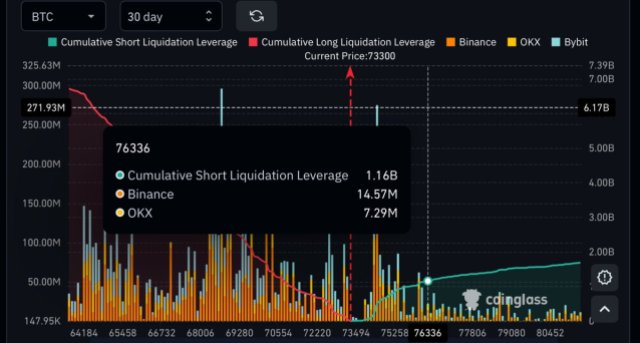
Source: Chart from Milk Road on X

This is due to the fact that the sellers are compelled to buy, not necessarily because the buyers are combative. When this finally occurs, Milk Road claims that those who bet and shorted BTC are in trouble, pointing to the $1 billion forced buys. This is not subtle; it is hitting the market at once.

Regardless of whether bulls purposefully raised prices to get closer to the squeeze zone or if there was enough organic buying to make it inevitable, the shorts remain trapped. Mlik Road highlighted that the $74,670 is the first major trip wire, holding $500 million of potential shorts liquidations alone. However, a clean break above the level and the market is expected to take action, with analysts targeting an $82,000 range as the next stop if the squeeze kicks off.

A Sign Of Liquidity Absorption

Amid current market conditions, a shift in dynamics is drawing attention around the sector. This shift is being observed in the Spot Cumulative Volume Delta (CVD) Bias. Crypto Banter Show’s host Kyle Doops reported that the metric has started to recover after a long stretch of pressure from the sell-side.

For a while, it seemed like sellers were hitting bids on every bounce. However, it is starting to look like buyers are reabsorbing liquidity, not just on one crypto exchange, but a few. Despite this, Kyle Doops suggests that investing in Bitcoin at this time is still considered early. Furthermore, demand might easily wane if it does not continue to manifest. Nonetheless, this is the first sign of stabilization that the market has seen in a while.

BTC trading at $74,385 on the 1D chart | Source: BTCUSDT on Tradingview.com

Related Questions

QWhat is the significance of the large short positions clustered between Bitcoin's current price and $76,300?

AThe cluster of large short positions, holding over $1 billion, creates a 'liquidation wall.' If Bitcoin's price breaks above $76,300, these short positions will be forced to close, triggering a cascade of buy orders that could lead to a short squeeze and rapidly push the price higher.

QAccording to the analyst Milk Road, what is the first major price level to watch for potential short liquidations?

AMilk Road highlighted that $74,670 is the first major 'trip wire,' holding $500 million in potential short liquidations on its own.

QWhat is a short squeeze and why is it considered an erratic price move in the crypto market?

AA short squeeze occurs when the price of an asset rises, forcing traders who had bet against it (shorted it) to buy back the asset to close their positions and limit losses. This forced buying creates more upward pressure on the price, leading to a cascade of liquidations. It is erratic because the price move is driven by sellers being forced to buy, not necessarily by aggressive buying from bullish investors.

QWhat market dynamic shift is being observed in the Spot Cumulative Volume Delta (CVD) Bias?

AThe Spot CVD Bias has started to recover after a prolonged period of sell-side pressure. This indicates that buyers are beginning to reabsorb liquidity across several exchanges, which is seen as an early sign of market stabilization.

QWhat is the next price target for analysts if a short squeeze is triggered?

AAnalysts are targeting the $82,000 range as the next stop if the short squeeze is successfully triggered and the price breaks above the key resistance level.

Related Reads

Stuck Polymarket: The Real Test After Riding the Traffic Boom Has Arrived

Polymarket, a leading prediction market platform, is facing significant technical challenges as its growth outpaces its current infrastructure on Polygon. Users are experiencing laggy transactions, unresponsive orders, and delayed confirmations, severely impacting the trading experience. In response, DeFi Engineering VP Josh Stevens outlined a comprehensive engineering overhaul. The plan includes reducing on-chain data delays, fixing order cancellation issues, rebuilding the central limit order book (CLOB), improving website performance, and developing a unified SDK and API. A major revelation was the ongoing "chain migration," indicating a potential move away from Polygon. The core issue is that Polymarket has evolved from a simple prediction market into a high-frequency trading platform, making Polygon's limitations—such as block space, gas fees, and block time—a ceiling for further growth. The migration is not just a simple chain switch but a fundamental rebuild of its trading system to support more complex products like perpetual contracts (Perps). This announcement has sparked competition among chains like Solana, Sui, and Algorand, all vying to host Polymarket. For Polygon, losing this key application, which contributes significantly to its gas fee revenue, would be a major setback. The real test for Polymarket is no longer attracting users but proving it can provide a stable, reliable trading environment that retains them.

Odaily星球日报56m ago

Stuck Polymarket: The Real Test After Riding the Traffic Boom Has Arrived

Odaily星球日报56m ago

Lowering Expectations for BTC's Next Bull Market

The author, Alex Xu, explains his decision to significantly reduce his Bitcoin holdings (from full to ~30% of his portfolio) during the current bull cycle, citing a lowered long-term outlook for BTC's price appreciation in the next cycle. He outlines six key reasons for this reduced expectation: 1. **Diminished Growth Drivers:** The narrative of exponential user adoption has largely played out with institutional ETF adoption. The next major growth phase—adoption by sovereign national reserves or central banks—seems unlikely in the near future. 2. **Personal Opportunity Cost:** More attractive investment opportunities have emerged in other assets, such as undervalued companies. 3. **Industry-Wide Contraction:** The broader crypto industry is struggling, with most Web3 business models (SocialFi, GameFi, DePIN) failing. This overall萧条 (depression) reduces the fundamental demand and consensus for Bitcoin. 4. **Strain on Major Buyer:** MicroStrategy, a major corporate buyer of BTC, faces rising financing expenses for its debt, which could slow its purchasing rate and create significant marginal pressure on the market. 5. **Increased Competition from Gold:** The emergence of "tokenized gold" has closed the functional gap (portability, divisibility) between physical gold and Bitcoin, offering a strong competitor in the non-sovereign store-of-value space. 6. **Security Budget Concerns:** The block reward halving continues to exacerbate the long-standing issue of funding Bitcoin's network security, with new fee source explorations like Ordinals and L2s largely failing. The author's decision to hold a significant (though reduced) position reflects a cautious, not bearish, outlook. He remains open to increasing his exposure if the fundamental reasons for his skepticism change or if new positive catalysts emerge.

marsbit1h ago

Lowering Expectations for BTC's Next Bull Market

marsbit1h ago

Can Iran 'Control' the Strait of Hormuz?

Iran has announced a comprehensive plan to assert control over the strategic Strait of Hormuz, a critical global oil shipping chokepoint. The proposed measures include requiring all vessels to obtain Iranian permission for passage, imposing fees for security, environmental protection, and navigation management—preferably paid in Iranian rials—and absolutely banning Israeli ships. Vessels from countries deemed hostile by Iran’s top security bodies may also be barred. Analysts suggest Iran’s motives are multifaceted: increasing pressure on the U.S. and Israel by leveraging control over oil transit to influence global prices and inflation; creating a new revenue stream, potentially exceeding $7.7 billion annually, to counter Western sanctions and support postwar reconstruction; and using transit permissions as bargaining chips in future negotiations, notably with the U.S. However, the plan faces significant practical and diplomatic challenges. Enforcing comprehensive interception and fee collection in the busy waterway, patrolled by international military forces, would be difficult. The U.S. has already countering with a blockade of Iranian ports and threats to intercept any ship paying fees, potentially strangling Iran’s oil exports and fee revenue. Broad international opposition, led by European and Gulf states, and legal controversies further complicate implementation. The proposal may ultimately serve more as a negotiating tactic than a feasible policy, with its execution remaining highly uncertain.

marsbit2h ago

Can Iran 'Control' the Strait of Hormuz?

marsbit2h ago

Trading

Spot
Futures

Hot Articles

What is $BITCOIN

DIGITAL GOLD ($BITCOIN): A Comprehensive Analysis Introduction to DIGITAL GOLD ($BITCOIN) DIGITAL GOLD ($BITCOIN) is a blockchain-based project operating on the Solana network, which aims to combine the characteristics of traditional precious metals with the innovation of decentralized technologies. While it shares a name with Bitcoin, often referred to as “digital gold” due to its perception as a store of value, DIGITAL GOLD is a separate token designed to create a unique ecosystem within the Web3 landscape. Its goal is to position itself as a viable alternative digital asset, although specifics regarding its applications and functionalities are still developing. What is DIGITAL GOLD ($BITCOIN)? DIGITAL GOLD ($BITCOIN) is a cryptocurrency token explicitly designed for use on the Solana blockchain. In contrast to Bitcoin, which provides a widely recognized value storage role, this token appears to focus on broader applications and characteristics. Notable aspects include: Blockchain Infrastructure: The token is built on the Solana blockchain, known for its capacity to handle high-speed and low-cost transactions. Supply Dynamics: DIGITAL GOLD has a maximum supply capped at 100 quadrillion tokens (100P $BITCOIN), although details regarding its circulating supply are currently undisclosed. Utility: While precise functionalities are not explicitly outlined, there are indications that the token could be utilized for various applications, potentially involving decentralized applications (dApps) or asset tokenization strategies. Who is the Creator of DIGITAL GOLD ($BITCOIN)? At present, the identity of the creators and development team behind DIGITAL GOLD ($BITCOIN) remains unknown. This situation is typical among many innovative projects within the blockchain space, particularly those aligning with decentralized finance and meme coin phenomena. While such anonymity may foster a community-driven culture, it intensifies concerns about governance and accountability. Who are the Investors of DIGITAL GOLD ($BITCOIN)? The available information indicates that DIGITAL GOLD ($BITCOIN) does not have any known institutional backers or prominent venture capital investments. The project seems to operate on a peer-to-peer model focused on community support and adoption rather than traditional funding routes. Its activity and liquidity are primarily situated on decentralized exchanges (DEXs), such as PumpSwap, rather than established centralized trading platforms, further highlighting its grassroots approach. How DIGITAL GOLD ($BITCOIN) Works The operational mechanics of DIGITAL GOLD ($BITCOIN) can be elaborated on based on its blockchain design and network attributes: Consensus Mechanism: By leveraging Solana’s unique proof-of-history (PoH) combined with a proof-of-stake (PoS) model, the project ensures efficient transaction validation contributing to the network's high performance. Tokenomics: While specific deflationary mechanisms have not been extensively detailed, the vast maximum token supply implies that it may cater to microtransactions or niche use cases that are still to be defined. Interoperability: There exists the potential for integration with Solana’s broader ecosystem, including various decentralized finance (DeFi) platforms. However, the details regarding specific integrations remain unspecified. Timeline of Key Events Here is a timeline that highlights significant milestones concerning DIGITAL GOLD ($BITCOIN): 2023: The initial deployment of the token occurs on the Solana blockchain, marked by its contract address. 2024: DIGITAL GOLD gains visibility as it becomes available for trading on decentralized exchanges like PumpSwap, allowing users to trade it against SOL. 2025: The project witnesses sporadic trading activity and potential interest in community-led engagements, although no noteworthy partnerships or technical advancements have been documented as of yet. Critical Analysis Strengths Scalability: The underlying Solana infrastructure supports high transaction volumes, which could enhance the utility of $BITCOIN in various transaction scenarios. Accessibility: The potential low trading price per token could attract retail investors, facilitating wider participation due to fractional ownership opportunities. Risks Lack of Transparency: The absence of publicly known backers, developers, or an audit process may yield skepticism regarding the project's sustainability and trustworthiness. Market Volatility: The trading activity is heavily reliant on speculative behavior, which can result in significant price volatility and uncertainty for investors. Conclusion DIGITAL GOLD ($BITCOIN) emerges as an intriguing yet ambiguous project within the rapidly evolving Solana ecosystem. While it attempts to leverage the “digital gold” narrative, its departure from Bitcoin's established role as a store of value underscores the need for a clearer differentiation of its intended utility and governance structure. Future acceptance and adoption will likely depend on addressing the current opacity and defining its operational and economic strategies more explicitly. Note: This report encompasses synthesised information available as of October 2023, and developments may have transpired beyond the research period.

363 Total ViewsPublished 2025.05.13Updated 2025.05.13

What is $BITCOIN

Discussions

Welcome to the HTX Community. Here, you can stay informed about the latest platform developments and gain access to professional market insights. Users' opinions on the price of BTC (BTC) are presented below.

活动图片















