LAB’s 23% price crash meets bearish bets – Can bulls defend $13?

ambcryptoPublished on 2026-06-29Last updated on 2026-06-29

Abstract

LAB's price plummeted over 23% in 24 hours, trading near $13.53 as bearish sentiment dominated. Despite the sharp decline, on-chain data shows ongoing token accumulation, with negative spot exchange netflows indicating holders are moving LAB to private wallets rather than selling. However, this has not offset broader selling pressure. Technically, LAB is testing the lower support of its ascending channel near $13. A break below could target the $12 demand zone. Indicators like the MACD and Parabolic SAR remain bearish. In derivatives markets, a negative funding rate shows sustained short interest, though this creates potential for a short squeeze if buyers return. In summary, LAB faces heavy selling pressure with key channel support at risk. A successful defense of $13 could stabilize the price, while a breakdown would likely target $12 next.

LAB extended its decline after losing more than 23% of its value over the past 24 hours, reflecting persistent selling pressure across the market. Trading volume also declined by 35.01% to $32.2 million, showing that participation cooled even as the token registered another sharp decline.

The asset traded around $13.53 at the time of writing, leaving its market capitalization at $4.22 billion after another wave of losses. However, the decline arrived after LAB failed to sustain its earlier recovery within an ascending channel.

Why are traders still accumulating LAB?

Spot exchange activity continued reflecting accumulation rather than aggressive distribution despite the ongoing price decline.

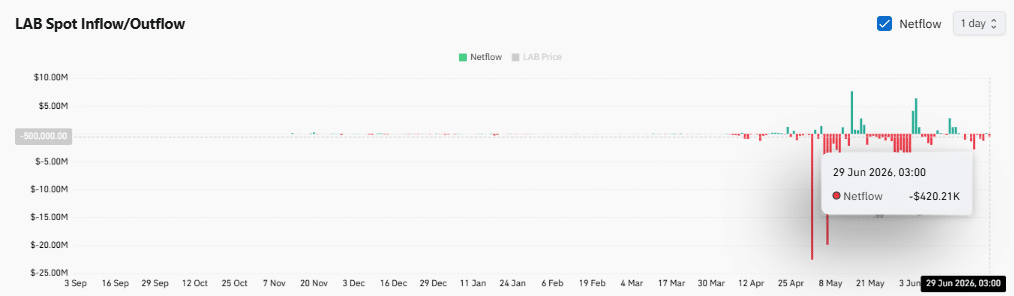
CoinGlass data showed another $420.21K in negative spot netflows on the 29th of June, meaning more LAB left exchanges than entered them. That trend suggested holders still preferred moving tokens into private wallets instead of preparing them for immediate sale.

However, the relatively modest outflow failed to offset the broader bearish sentiment dominating the market. Buyers showed limited urgency despite declining exchange balances, leaving sellers with enough control to push prices lower.

As a result, exchange flows continued supporting reduced sell-side supply, yet price action remained largely dictated by weak demand across the broader market.
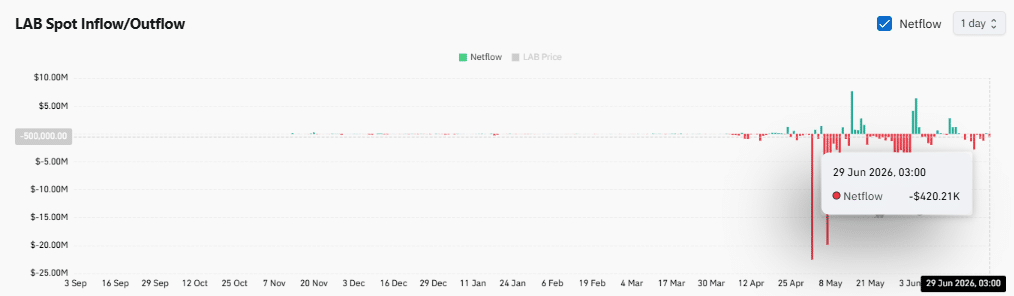
Source: CoinGlass

LAB edges closer to losing channel support

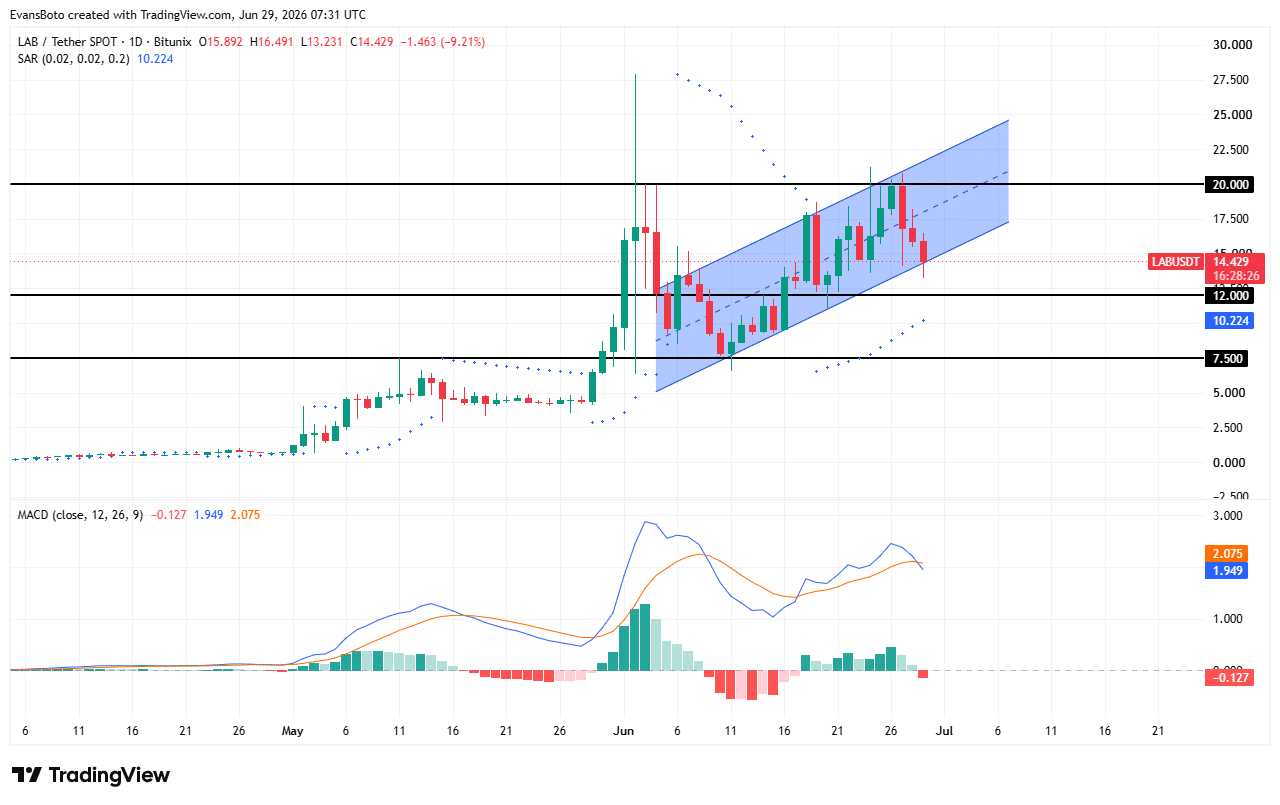
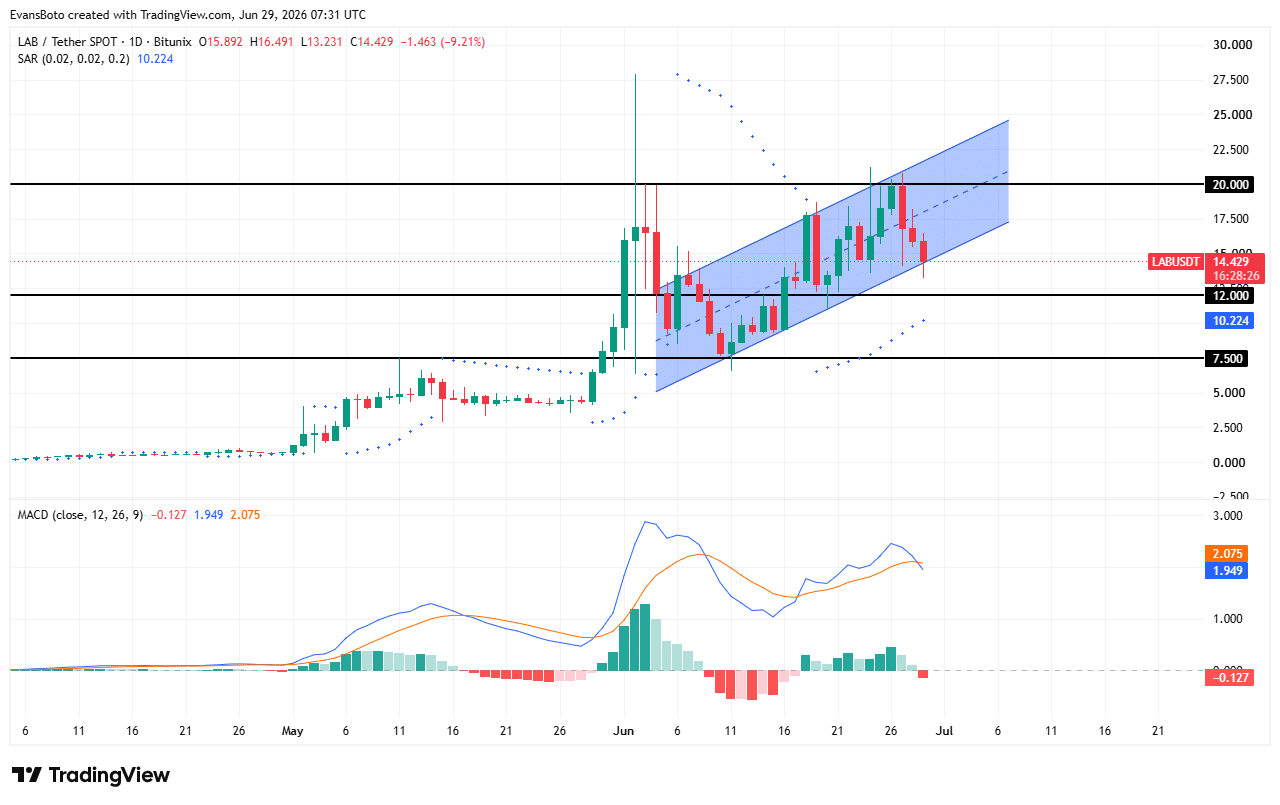
LAB approached the lower boundary of its ascending channel after several consecutive bearish candles erased much of the previous recovery. Price slipped toward the channel’s baseline near the $13 level, placing the entire structure under pressure.

A confirmed move below that trendline would expose the next major demand zone around $12, where buyers previously stepped in. Technical indicators continued favoring sellers as LAB weakened near channel support.

At press time, the MACD line crossed below the signal line while the histogram turned negative, showing that bullish strength had faded during the latest pullback. In addition, the Parabolic SAR remained above price, reinforcing the prevailing bearish trend after flipping earlier in the decline.

However, the channel remained technically intact during the latest session, leaving bulls with one final opportunity to defend the structure. The rejection from the upper half of the channel also showed that buyers struggled to sustain higher prices. Unless demand returns quickly, sellers could force a decisive break below the pattern.
Source: TradingView

Why are short traders paying to stay?

Derivatives positioning continued to reflect bearish conviction across the futures market.

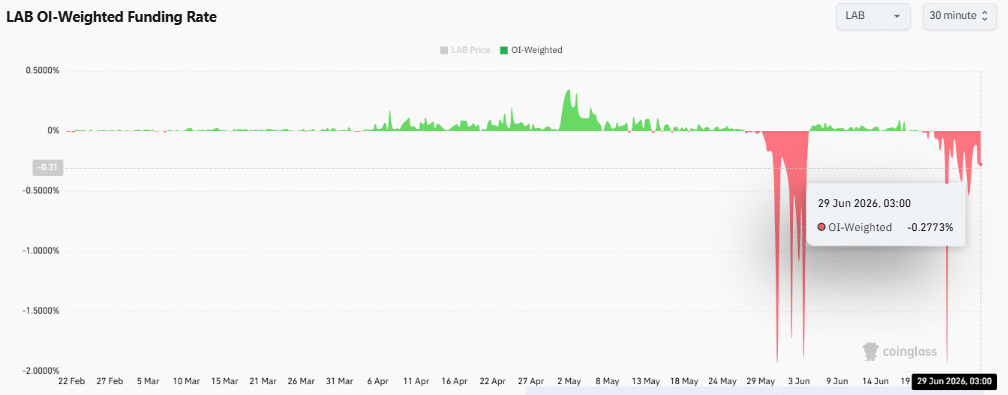
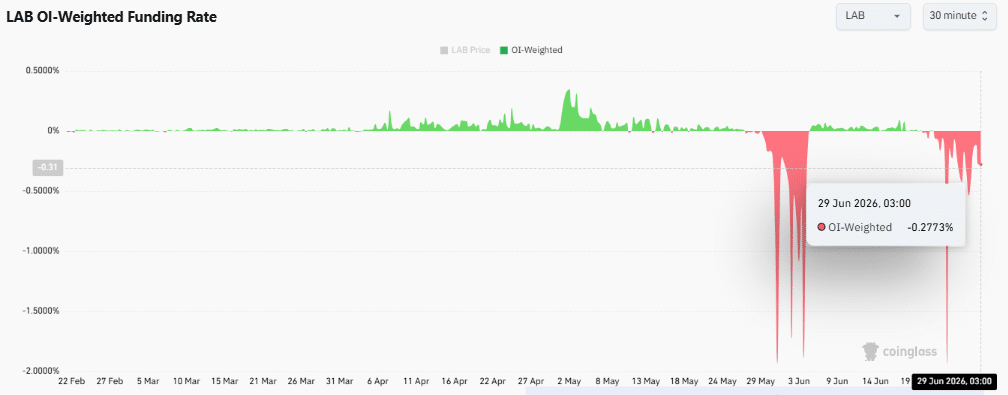
At the time of writing, LAB’s OI-Weighted Funding Rate stayed negative at -0.2773%, showing that short traders continued paying premiums to maintain their positions. That reading highlighted sustained confidence among bearish participants despite the extended decline.

However, deeply negative funding also suggested the market had become increasingly one-sided. If buyers reclaim channel support and force a rebound, overly crowded short positions could face pressure from a rapid squeeze.

For now, though, derivatives data continue supporting the prevailing bearish outlook as traders maintain defensive positioning against further downside.
Source: CoinGlass

Can LAB avoid a breakdown?

LAB remained under considerable pressure after losing more than 23% while technical indicators and derivatives positioning favored sellers.

However, the ascending channel had not broken down yet, and negative exchange netflows continued showing that holders still removed tokens from exchanges.

If buyers defend the lower channel boundary, LAB could stabilize before attempting another recovery. Otherwise, a confirmed break below support would likely expose the $12 demand zone as the next major downside target.


Final Summary

  • LAB remained under heavy selling pressure as bearish technical signals continued dominating market sentiment.
  • Negative exchange netflows contrasted with falling prices, while the $12 zone emerged as the next key test.


Related Questions

QWhat is the current market price and 24-hour performance of LAB mentioned in the article?

AAt the time of writing, LAB was trading around $13.53, having lost more than 23% of its value over the past 24 hours.

QWhat does the negative spot netflow data from CoinGlass indicate about LAB holders' behavior?

AThe negative spot netflows indicate that more LAB tokens were withdrawn from exchanges than deposited, suggesting holders are moving tokens into private wallets rather than preparing them for immediate sale.

QWhat is the key technical support level for LAB within its ascending channel, according to the analysis?

AThe key technical support level is the lower boundary of the ascending channel, located near the $13 level. A break below this could expose the next major demand zone around $12.

QWhat does LAB's negative OI-Weighted Funding Rate suggest about market positioning?

AThe negative OI-Weighted Funding Rate of -0.2773% indicates that short traders are paying a premium to maintain their positions, reflecting sustained bearish conviction but also creating the risk of a short squeeze if prices rebound.

QWhat are the two main conflicting signals the article presents regarding LAB's future price direction?

AThe conflicting signals are: 1) Bearish technical indicators and derivatives positioning favoring sellers, and 2) Negative exchange netflows and an intact ascending channel suggesting some holders are accumulating and a potential defense of support by buyers.

Related Reads

$2 Trillion: Countdown to AI's Largest IPO in History

The countdown for the largest IPO in AI history, a potential $2 trillion listing for Anthropic, is underway for October. The staggering valuation, reportedly projected by several investors, contrasts with the company's own internal restraint on setting a public target. Founded five years ago by former OpenAI core members, Anthropic's growth has been meteoric. Annual recurring revenue (ARR) surged from ~$9B in late 2025 to $47B by May 2026, with Q2 2026 revenue of $11.5B marking a 14x year-over-year increase. Bank valuations are even based on internal 2028 revenue forecasts of $190-200B. A key growth driver is Claude Code, its AI coding assistant. Its ARR quintupled in five months to $2.5B by February 2026, now constituting nearly 20% of total revenue. Surveys indicate Anthropic commands roughly 40% of enterprise LLM spending, doubling OpenAI's share in programming-specific use. However, alongside this explosive growth, reports detail significant internal cultural strife. Critics describe a divisive "priesthood" of PhD executives, led by CEO Dario Amodei, who promote a "save humanity" narrative that some employees find cult-like and alienating. This has reportedly created a demoralized workforce and a covert "underground network" of dissent among engineers torn between lucrative pre-IPO equity and a toxic work environment. Anthropic now faces a pivotal paradox: pursuing its mission of "safe" AI requires immense capital for compute, yet that capital demands relentless commercial growth. As it approaches its historic IPO, the company must navigate intense regulatory scrutiny, soaring operational costs, and internal tensions—any of which could destabilize its post-listing trajectory, much like SpaceX's significant post-IPO stock drop. The stage is set for a defining moment in tech history.

marsbit2h ago

$2 Trillion: Countdown to AI's Largest IPO in History

marsbit2h ago

AI Boosting Efficiency and Cutting Costs Makes VC Increasingly Expensive

"AI for Cost Reduction Makes VC Funding More Expensive" Despite the "cost-reduction and efficiency" narrative of AI, venture capital (VC) investment in the AI sector is becoming increasingly costly. While AI tools lower the initial costs for many startups—with team sizes shrinking across funding stages—the market is polarizing. For top-tier AI teams, especially those from leading companies like Google and OpenAI, funding rounds are now larger and valuations are higher than ever at the seed and early stages. For example, new ventures by prominent researchers are securing billions in funding with valuations reaching tens of billions before having a mature product. This creates a "barbell" market: lightweight startups need less capital, while elite AI firms attract massive investments early on. This dynamic raises the cost for VCs to acquire and maintain meaningful ownership stakes. As valuations soar early, securing the same equity percentage requires significantly larger capital commitments. VCs must now invest more upfront and reserve substantial funds for follow-on rounds to avoid dilution, prompting large firms like Accel and a16z to raise massive new funds. Consequently, capital is concentrating intensely in a few perceived winners like OpenAI and Anthropic, widening the gap between large and small VC funds. While high valuations bake in future growth expectations, they also compress potential returns, demanding that portfolio companies achieve unprecedented scale. For major VCs, the core strategy is clear: secure early positions in potential winners and maintain the capital to keep investing as valuations rapidly escalate.

marsbit3h ago

AI Boosting Efficiency and Cutting Costs Makes VC Increasingly Expensive

marsbit3h ago

Trading

Spot
活动图片