Kraken Partners With Nasdaq In New Tokenized Stocks Move

bitcoinistPublished on 2026-03-10Last updated on 2026-03-10

Abstract

Kraken's parent company Payward has partnered with Nasdaq to develop an "equities transformation gateway," a new infrastructure layer connecting regulated tokenized equity markets with permissionless blockchain networks. The collaboration centers on Kraken's xStocks product, which has surpassed $25 billion in transaction volume with over $4 billion settled on-chain. Scheduled to become operational in H1 2027, Nasdaq's equity token design will use xStocks as its permissionless infrastructure layer, maintaining issuer control and regulatory compliance while enabling interoperability with DeFi environments. The gateway will allow seamless movement of tokenized equities between traditional markets and blockchain networks, with Kraken handling KYC/AML requirements. Payward's co-CEO Arjun Sethi emphasized that tokenization transforms equities into programmable instruments capable of serving as cross-platform collateral for trading, margin, derivatives, and lending—significantly enhancing capital efficiency beyond traditional brokerage limitations.

Kraken parent Payward has partnered with Nasdaq to build what the companies describe as an “equities transformation gateway,” a new infrastructure layer designed to connect regulated tokenized equity markets with permissionless blockchain networks. For crypto markets, the significance is clear: one of the largest traditional market operators is now working directly with a crypto-native tokenization framework to move equities between institutional rails and DeFi environments.

The partnership centers on xStocks, Kraken’s tokenized equities product, which Payward said has surpassed $25 billion in total transaction volume less than a year after launch. More than $4 billion of that volume has been settled on-chain, and the framework now counts over 85,000 unique holders across supported networks, giving Kraken a sizable footprint as tokenized stocks move from concept toward market structure.

Nasdaq And Kraken Join Forces

Under the proposed setup, xStocks will power the permissionless infrastructure layer for Nasdaq’s upcoming issuer-sponsored equity token design. That design, which Nasdaq expects to become operational starting in the first half of 2027, is meant to preserve issuer control, existing regulatory frameworks, and the rights attached to the underlying shares while still allowing those assets to interact with blockchain-based financial systems.

In practical terms, the gateway is supposed to let eligible users swap tokenized equities between a regulated, permissioned market environment and open on-chain ecosystems. Payward said this would allow assets to move “fluidly” between institutional trading infrastructure and decentralized financial networks, while Payward Services handles KYC and AML onboarding for participants accessing the bridge through Kraken.

Arjun Sethi, co-CEO of Payward and Kraken, framed the effort as a structural change to how equities can be used once they are placed on programmable rails. “Tokenization upgrades market infrastructure at the asset layer by allowing equities to exist as programmable financial instruments that can operate across both regulated capital markets and open blockchain networks,” he said. “Today most equities sit inside brokerage systems where their utility is largely limited to directional exposure and, in some cases, broker-specific margin arrangements.”

He argued that the current model leaves capital trapped inside siloed venues. “That structure fragments liquidity across venues and leaves a meaningful amount of capital static relative to its potential utility,” Sethi said. “With xStocks, our goal is to make equities natively interoperable across trading venues, financial applications and blockchain networks while preserving issuer rights, regulatory protections and price integrity.”

Sethi went further, tying tokenized equities to a broader capital-efficiency thesis that will be familiar to crypto derivatives traders. “Bringing equities onto programmable infrastructure expands how they can function within a portfolio,” he said. “Instead of simply representing exposure to a company, tokenized equities can operate as collateral within unified trading systems that support spot markets, cross-margin trading, derivatives, perpetual futures, and financing environments.”

That point sits at the heart of the announcement. Payward is not pitching tokenized stocks merely as wrappers for traditional shares, but as collateral that can move across trading, lending and hedging systems under a unified margin framework. In jurisdictions where xStocks are already available, Payward will also serve for an initial period as the primary settlement layer for transactions tied to Nasdaq’s equity token design.

At press time, the total crypto market cap stood at $2.32 trillion.
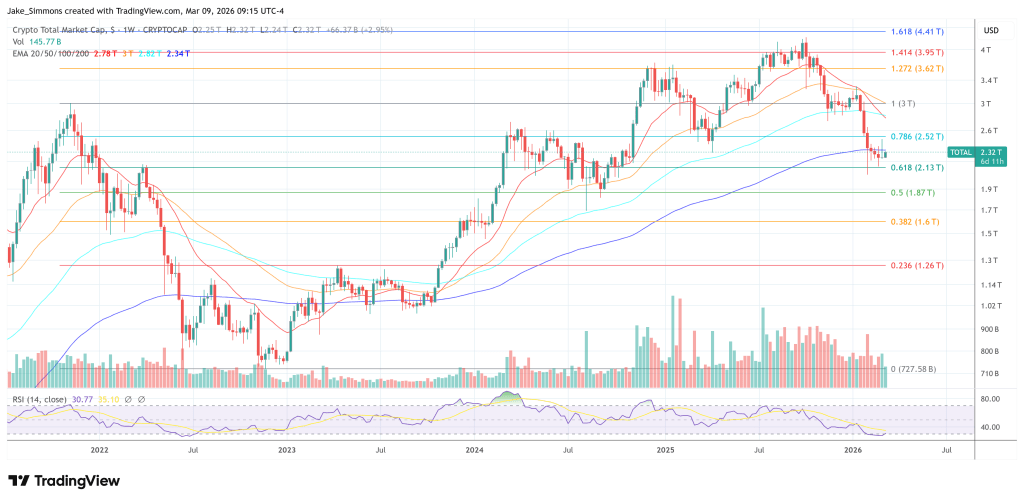
Total crypto market cap, 1-week chart | Source: TOTAL on TradingView.com

Related Questions

QWhat is the main purpose of the partnership between Kraken's parent company Payward and Nasdaq?

AThe partnership aims to build an 'equities transformation gateway,' a new infrastructure layer designed to connect regulated tokenized equity markets with permissionless blockchain networks, allowing equities to move between institutional rails and DeFi environments.

QWhat is xStocks and what milestone has it achieved according to the article?

AxStocks is Kraken's tokenized equities product, which has surpassed $25 billion in total transaction volume less than a year after launch, with over $4 billion settled on-chain and more than 85,000 unique holders.

QWhen does Nasdaq expect its issuer-sponsored equity token design to become operational?

ANasdaq expects its issuer-sponsored equity token design to become operational starting in the first half of 2027.

QHow does Arjun Sethi describe the current limitation of traditional equities in brokerage systems?

AArjun Sethi states that in traditional brokerage systems, equities' utility is largely limited to directional exposure and some broker-specific margin arrangements, which fragments liquidity and leaves capital trapped in siloed venues.

QWhat broader function does Payward envision for tokenized equities beyond being wrappers for traditional shares?

APayward envisions tokenized equities functioning as collateral within unified trading systems that support spot markets, cross-margin trading, derivatives, perpetual futures, and financing environments, enhancing capital efficiency and interoperability.

Related Reads

Has Hook Summer Really Arrived? sato, Lo0p, FLOOD Ignite the New Narrative of Uniswap v4

"Hook Summer" Arrives? Sato, Lo0p, FLOOD Ignite Uniswap v4 Narrative Amidst a slight market recovery, attention within the Ethereum ecosystem has shifted to Meme coins built on Uniswap v4's Hook protocol. Following ASTEROID, tokens like sato, sat1, Lo0p, and FLOOD have become market focal points, with market caps ranging from millions to tens of millions, bringing concentrated liquidity to a narrative-dry market. Uniswap v4 Hooks are "plugin smart contracts" that allow developers to inject custom logic at key points in a liquidity pool's lifecycle (initialization, adding/removing liquidity, swaps, etc.), making the AMM programmable. Recent representative projects include: * **sato**: Market cap peaked over $38M; uses a v4 curve mechanism for minting/burning, locking ETH as reserve. * **sat1**: Market cap briefly exceeded $10M, positioning as an "optimized sato," but later declined significantly. * **Lo0p**: Market cap neared $6.6M; a "lending AMM protocol" allowing users to borrow ETH against deposited LO0P tokens without immediate selling pressure. * **FLOOD**: Market cap approached $6M; channels trading reserves into Aave v3 to generate yield, which is retained in the pool. The emergence of these Hook-based tokens could drive long-term growth for the Uniswap ecosystem by attracting users and liquidity to v4 pools. Combined with Uniswap's activated fee switch (partially used to burn UNI), the long-term outlook for UNI appears positive. However, short-term UNI price appreciation is not directly guaranteed. Factors include the sustainability and lifecycle of these new tokens, their price volatility, overall market conditions, and regulatory pressures. Currently, Uniswap v4's TVL ($595M) lags behind v3 and v2, indicating Hook adoption still requires time to mature. In summary, the Hook ecosystem serves as "long-term nourishment" for UNI, but acts more as a "catalyst" than a direct "booster" in the short term. Note: These are early-stage experimental tokens and may carry unknown risks.

marsbit27m ago

Has Hook Summer Really Arrived? sato, Lo0p, FLOOD Ignite the New Narrative of Uniswap v4

marsbit27m ago

Has Hook Summer Truly Arrived? sato, Lo0p, FLOOD Ignite the New Uniswap v4 Narrative

With the broader market showing signs of recovery, a new wave of interest has emerged around Ethereum-based meme coins. Following ASTEROID, tokens like sato, sat1, Lo0p, and FLOOD, built upon the Uniswap v4 Hook protocol, are capturing market attention. Their market capitalizations range from millions to tens of millions of dollars, injecting much-needed focused liquidity into a market lacking narratives. This article explores whether this trend signifies an incoming "Hook Summer" and its potential impact on UNI's price. Hooks are essentially plug-in smart contracts for Uniswap v4 liquidity pools, allowing developers to inject custom logic at key points in a pool's lifecycle (like initialization, adding/removing liquidity, swaps). This transforms the AMM into programmable building blocks. Key highlighted projects include: * **sato**: Peaked over $38M market cap. It utilizes a v4 curve for minting/burning; buying locks ETH as reserve to mint new tokens, while selling redeems ETH from the reserve and burns tokens. * **sat1**: Market cap briefly exceeded $10M, promoted as an "optimized sato," but later declined significantly. * **Lo0p**: Reached nearly $6.6M. It's a lending AMM protocol where buying LO0P tokens locks them as collateral, allowing users to borrow ETH from the pool reserve at 40% LTV, aiming to improve capital efficiency for idle ETH in LPs. * **FLOOD**: Peaked near $6M. Its mechanism directs asset reserves from buys into Aave v3 to generate yield, with fees and interest retained in the pool to potentially influence the token's price long-term. In the long term, the development of the Hook ecosystem can attract users and liquidity to Uniswap v4, benefiting UNI's fundamentals—especially combined with the recent activation of the protocol fee switch, where a portion of fees is used to burn UNI. However, in the short term, these Hook-based tokens are unlikely to directly drive significant UNI price appreciation. Their impact is moderated by factors like token sustainability, price volatility, and broader market and regulatory conditions. Currently, Uniswap v4's TVL ($595M) still trails behind v2 and v3, indicating adoption and growth will take time. The article concludes that while the Hook ecosystem provides long-term "nourishment" for UNI, its short-term role is more of a "catalyst" than a "booster." Readers are cautioned that these are early-stage experimental tokens and may carry unknown risks.

Odaily星球日报40m ago

Has Hook Summer Truly Arrived? sato, Lo0p, FLOOD Ignite the New Uniswap v4 Narrative

Odaily星球日报40m ago

Interview with Michael Saylor: I Did Say I Would Sell Bitcoin, But Never a Net Sale

Interview with Michael Saylor: I Said We'd Sell Bitcoin, But Never Be a Net Seller In a recent podcast, MicroStrategy Executive Chairman Michael Saylor clarified the company's stance on potentially selling Bitcoin. Following MicroStrategy's earnings call statement about being prepared to sell BTC to fund dividends for its STRC (Strategic) credit product, Saylor emphasized the distinction between selling and being a "net seller." Saylor explained the core business model: MicroStrategy sells credit instruments like STRC and uses the proceeds to buy Bitcoin, which is viewed as "digital capital" expected to appreciate around 30-40% annually. A portion of these capital gains can then be used to pay the dividends on the credit products. He stressed that even if the company sells some Bitcoin for dividends, it simultaneously buys much more with new credit issuance. For example, after raising $3.2 billion from STRC sales in April, the dividend obligation was only $80-90 million, making the company a net buyer. The clarification aims to counter market narratives questioning the value of Bitcoin on MicroStrategy's balance sheet if it were never sold, and to dismiss claims of a "Ponzi scheme." Saylor reiterated his personal philosophy for investors: "Don't be a net seller of bitcoin" and ensure your Bitcoin holdings increase each year. Saylor also discussed Bitcoin's role as the foundation for "digital credit," noting that STRC has become the largest and most liquid preferred stock issue in the U.S., offering high risk-adjusted returns (Sharpe ratio). He highlighted Bitcoin's deep liquidity, stating that even large purchases by MicroStrategy do not move the market significantly, which is driven by macro factors, geopolitical tensions, and capital flows from ETFs and credit products. Finally, Saylor reflected on his early inspiration from sci-fi books, which motivated his path to MIT, and maintained his fundamental thesis on Bitcoin remains unchanged: it is superior digital capital enabling superior digital credit.

链捕手44m ago

Interview with Michael Saylor: I Did Say I Would Sell Bitcoin, But Never a Net Sale

链捕手44m ago

Trading

Spot
Futures
活动图片





