Kelp DAO Hack: Aave DAO Proposes To Contribute 25,000 ETH To Recovery Efforts

bitcoinistPublished on 2026-04-25Last updated on 2026-04-25

Abstract

Aave DAO has proposed contributing 25,000 ETH from its treasury to a coordinated recovery effort following a major exploit on Kelp DAO. The attack, which occurred on April 18, targeted Kelp's rsETH Ethereum LayerZero adapter, resulting in a loss of approximately 163,183 ETH. Through frozen assets, recovered funds, and expected liquidations, over half the deficit has been covered, but a gap of roughly 75,081 ETH remains. A coalition named "DeFi United," including pledges from EtherFi, Lido, Ethena, and a credit line from Mantle, is mobilizing to restore the system. Aave's anchored contribution is a key part of this effort to reintroduce liquidity and fully back the affected tokens.

Aave DAO has unveiled a proposal to deploy 25,000 ETH from its treasury to support a coordinated recovery effort following the recent Kelp DAO exploit. The move forms part of a broader “DeFi United” initiative aimed at restoring user funds and stabilizing affected lending markets.

On April 18, KelpDAO suffered a major attack targeted at its rsETH Ethereum LayerZero adapter, allowing a hacker to drain assets and break the backing relationship between locked ETH collateral and minted tokens across chains. The breach triggered a cascading liquidity and solvency challenge across DeFi platforms that integrated rsETH and its wrapped variant.

Over $160,000 ETH Gap Remains As Exploit Recovery Efforts Gain Traction

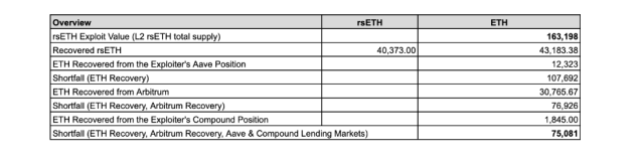
According to the Aave DAO governance proposal, the attacker stole 152,577 rsETH, which is approximately 163,183 ETH based on prevailing conversion rates. Since then, coordinated intervention by ecosystem participants has substantially reduced the gap. Kelp DAO managed to freeze 40,373 rsETH, equivalent to roughly 43,168 ETH. Additionally, the Arbitrum Security Council recovered 30,766 ETH that the attacker still held on its platform.
Source: Aave DAO

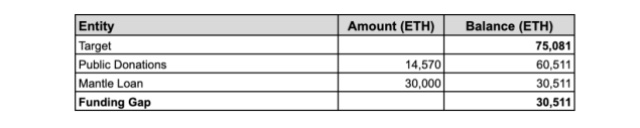
Notably, further recoveries are expected through liquidation processes on lending platforms. The attacker’s positions on Aave could yield up to 12,323 ETH, while an additional 1,845 ETH may be recovered from positions on Compound. In total, these efforts account for approximately 87,955 ETH, i.e, just over half of the original deficit. Despite this progress, a funding gap of roughly 75,081 ETH remains, resulting in a further coordinated capital injection to fully restore backing.

Aave DAO Steps In With 25,000 ETH Commitment As Coalition Mobilizes

To bridge the remaining deficit, the DeFi United coalition is combining donations, credit facilities, and treasury support. So far, ecosystem contributors including EtherFi, Lido, and Ethena have pledged 14,570 ETH, while Mantle has extended a credit facility of up to 30,000 ETH.
Source: Aave DAO

Aave DAO’s proposal to contribute 25,000 ETH represents a cornerstone of this recovery stack. Notably, the contribution is “anchored,” meaning it will not be reduced by future donations. Instead, any additional funds raised will be used to repay borrowed capital, thereby limiting Aave’s long-term exposure.

The plan requires approximately 120,015 ETH (excluding 43,168 ETH immediately frozen by Kelp DAO) to be reintroduced into the LayerZero lockbox to fully restore system integrity. However, a portion of expected recoveries remains illiquid, prompting the need for short-term loan financing from ecosystem partners.

Total crypto market cap valued at $2.57 trillion on the daily chart | Source: TOTAL chart on Tradingview.com

Related Questions

QWhat is the total amount of ETH that was stolen in the Kelp DAO exploit, and what is the remaining funding gap after recovery efforts?

AThe attacker stole 152,577 rsETH, which is approximately 163,183 ETH. After recovery efforts, including frozen funds and liquidations, a funding gap of roughly 75,081 ETH remains.

QWhat is the role of the 'DeFi United' initiative mentioned in the proposal?

AThe 'DeFi United' initiative is a coordinated effort aimed at restoring user funds and stabilizing affected lending markets by combining donations, credit facilities, and treasury support from various ecosystem participants.

QHow much ETH has Aave DAO specifically proposed to contribute, and what is the nature of this contribution?

AAave DAO has proposed to contribute 25,000 ETH from its treasury. This contribution is 'anchored,' meaning it will not be reduced by future donations and any additional funds raised will be used to repay borrowed capital to limit Aave's long-term exposure.

QWhich other major ecosystem participants have pledged support, and what are their contributions?

AEcosystem contributors including EtherFi, Lido, and Ethena have collectively pledged 14,570 ETH. Additionally, Mantle has extended a credit facility of up to 30,000 ETH.

QWhat specific mechanism of the KelpDAO protocol was targeted in the attack on April 18?

AThe attack targeted KelpDAO's rsETH Ethereum LayerZero adapter, which allowed the hacker to drain assets and break the backing relationship between locked ETH collateral and minted tokens across chains.

Related Reads

Agents Take Over Traffic Distribution Power: What Are Tencent, ByteDance, and Alibaba Competing For?

In the race to dominate the AI era's entry point, China's tech giants—Tencent, ByteDance, and Alibaba—are aggressively deploying AI Agents to control the future of traffic distribution. Alibaba is pursuing a dual-track "closed loop + openness" strategy. Its Qianwen app is evolving into a super-Agent integrated across its ecosystem (Taobao, Alipay, etc.) to handle complex tasks like travel planning. Concurrently, it is opening its platform to external brands (Luckin Coffee, KFC) and has launched a B2B Agent platform, "Wukong," targeting enterprise automation. Its other flagship, Quark, aims to be an "AI super search box" for information and tasks. ByteDance is executing an omnipresent "sprawl strategy." Its Doubao app boasts over 300 million monthly active users and is evolving into a default AI entry point for daily life, with plans for paid versions and e-commerce integration. Its core weapon is the Kouzi platform, a visual "AI assembly factory" for developers to build custom Agents. ByteDance is also pushing hardware integration, collaborating on AI phones and developing smart glasses to embed Doubao everywhere. Tencent is playing its long-held "ultimate card" by quietly embedding an AI Agent directly into WeChat. This Agent, accessible via a swipe, can understand user commands and automatically execute tasks by calling upon WeChat's millions of mini-programs (e.g., finding and ordering coffee). This leverages WeChat's unparalleled 1.4-billion-user ecosystem to position the app as an AI-powered "service operating system," a move that could dramatically reshape the competitive landscape. The core battleground is shifting from competing for "user screen time" to competing to be the "default execution layer" for user intent. The business model is evolving from an "attention economy" to an "intent economy," where the Agent that can most efficiently fulfill a user's need gains control over service access and token flow. This represents a fundamental change in how users connect with digital services, making the fight for the Agent入口 (entry point) a pivotal moment for redefining industry leadership in the AI age.

marsbit31m ago

Agents Take Over Traffic Distribution Power: What Are Tencent, ByteDance, and Alibaba Competing For?

marsbit31m ago

From Banning Doubao to Embracing Honor: Why Did WeChat Suddenly 'Change Its Face'?

The article explores the sudden shift in WeChat's strategy towards AI assistants from mobile phone manufacturers, transitioning from strict opposition to active collaboration. For over a year, WeChat fiercely resisted attempts by phone AI assistants (like ByteDance's Doubao in late 2025) to control its features via GUI automation ("simulated clicking"), citing security and data control concerns. This stance created a significant barrier for system-level AI integration. Now, Tencent has initiated A2A (Agent-to-Agent) partnerships with major phone brands like Honor, Xiaomi, OPPO, and vivo. This model allows a phone's system AI (e.g., Honor's YOYO) to parse a user's voice command and send a structured request directly to WeChat's own internal AI agent via secure APIs. WeChat then executes the action (e.g., sending a message) and returns the result. The article attributes Tencent's "change of face" to strategic pressure. While leading in social app usage, Tencent trails rivals like ByteDance and Alibaba in standalone AI app popularity. WeChat, with its vast mini-program ecosystem, is Tencent's key asset for an AI comeback. The upcoming WeChat AI agent aims to handle tasks like booking and payments within the app. However, phone system assistants remain the primary AI entry point for most users. The A2A collaboration allows Tencent to extend WeChat's AI reach to this crucial system layer while maintaining control over its core functions and data. For phone manufacturers, embracing A2A is a pragmatic move. The GUI route proved unviable due to WeChat's blocks. A2A offers a compliant path to integrate a vital service, enhancing their AI assistants' usefulness. It allows them to focus on developing their own AI ecosystems for other services while cooperating on WeChat access. The collaboration is framed as a mutual, strategic necessity: Tencent gains a distribution channel, and manufacturers gain a key functionality. The partnership relies on a "dual authorization" mechanism for security, requiring both user and app consent for each action. While questions about long-term data privacy practices remain, experts note A2A is more secure and compliant than GUI automation. Ultimately, this cooperation is seen as a tentative, calculated truce. Tencent's long-term goal is to make WeChat an AI-powered "service OS." Phone manufacturers aim to make their system AI the central user interface. Their paths may converge or clash in the future, but for now, the A2A deal represents the opening chapter in the battle for the AI-era user入口, driven by necessity and strategic calculus on both sides.

marsbit2h ago

From Banning Doubao to Embracing Honor: Why Did WeChat Suddenly 'Change Its Face'?

marsbit2h ago

Trading

Spot
Futures

Hot Articles

How to Buy DAO

Welcome to HTX.com! We've made purchasing DAO Maker (DAO) simple and convenient. Follow our step-by-step guide to embark on your crypto journey.Step 1: Create Your HTX AccountUse your email or phone number to sign up for a free account on HTX. Experience a hassle-free registration journey and unlock all features.Get My AccountStep 2: Go to Buy Crypto and Choose Your Payment MethodCredit/Debit Card: Use your Visa or Mastercard to buy DAO Maker (DAO) instantly.Balance: Use funds from your HTX account balance to trade seamlessly.Third Parties: We've added popular payment methods such as Google Pay and Apple Pay to enhance convenience.P2P: Trade directly with other users on HTX.Over-the-Counter (OTC): We offer tailor-made services and competitive exchange rates for traders.Step 3: Store Your DAO Maker (DAO)After purchasing your DAO Maker (DAO), store it in your HTX account. Alternatively, you can send it elsewhere via blockchain transfer or use it to trade other cryptocurrencies.Step 4: Trade DAO Maker (DAO)Easily trade DAO Maker (DAO) on HTX's spot market. Simply access your account, select your trading pair, execute your trades, and monitor in real-time. We offer a user-friendly experience for both beginners and seasoned traders.

2.3k Total ViewsPublished 2024.03.29Updated 2026.06.02

How to Buy DAO

Discussions

Welcome to the HTX Community. Here, you can stay informed about the latest platform developments and gain access to professional market insights. Users' opinions on the price of DAO (DAO) are presented below.

活动图片