Original|Odaily Planet Daily(@OdailyChina)
Author|Wenser(@wenser 2010)

The scale, trading volume, and other data of the prediction markets continue to grow rapidly. The pre-IPO markets of leading platforms like Kalshi and Polymarket have also attracted significant market attention and liquidity. According to data from the PreStocks platform, Kalshi's pre-market stock price has surged 21.7% in the past 30 days, far exceeding the gains of mainstream cryptocurrencies like BTC and ETH over the past month.
Before the IPO cake is served, the Pre-IPO sector might be the battleground suitable for more people to participate in early. This article by Odaily Planet Daily will analyze whether the pre-market for prediction market stocks is worth a heavy bet, from the perspectives of the industry sector, platform data, and capital valuation.
Behind the "Prediction Markets Still Have 100x Upside" Judgment: Total Trading Volume Exceeds $50 Billion in 2025
Last August, 1confirmation founder Nick Tomaino boldly claimed that "prediction market trading volume will grow 100 times".
At that time, the "twin titans of prediction markets," Polymarket and Kalshi, had not yet secured funding above the $1 billion mark, their valuations were far from the $10 billion scale, and the overall prediction market trading volume in July was less than $2 billion, nearly halved from the historical high of over $4 billion in October 2024. The judgment of 100x growth space seemed like nonsense.
But soon, in October 2025, Polymarket announced a $2 billion investment from ICE Group, the parent company of the NYSE, skyrocketing its valuation to $9 billion, and later sought a new round of funding at a valuation of $12-15 billion; Kalshi, meanwhile, completed 2 rounds of financing between October and December, with the latest round reaching $1 billion, surging its valuation to $11 billion, led by Paradigm, with participation from Sequoia, a16z, Meritech Capital, IVP, ARK Invest, Anthos Capital, CapitalG, and Y Combinator.
Behind the capital's fervent pursuit is the rapid and vigorous development of the prediction markets.
According to data from our previously published article "2025 Prediction Market Review: Total Trading Volume Exceeds $50 Billion, Dual Giants Command Over 97.5% Market Share":
- In September 2025, the combined trading volume of Kalshi and Polymarket reached $1.44 billion;
- In October 2025, prediction market trading volume reached $8.7 billion, with Kalshi leading and Polymarket following;
- In November 2025, the combined trading volume of Kalshi and Polymarket approached $10 billion, with Kalshi's trading volume reaching $5.8 billion, a 32% increase month-over-month; Polymarket's trading volume reached $3.74 billion, a 23.8% increase month-over-month.
- In December 2025, analyst Patrick Scott stated that prediction market trading volume exceeded $13 billion in November 2025, more than three times the trading volume during the peak of the 2024 election.
Thus, in just a few months, the overall monthly trading volume of prediction markets increased about 6-fold. Viewed this way, 100x growth is not out of reach.
After all, 100 times $2 billion is only $200 billion. Compared to the prediction market's total trading volume of over $50 billion in 2025, it only requires a 4x growth. Behind such a迅猛的 (rapid) growth rate is the狂飙突进 (galloping advance) of Kalshi, this US-compliant prediction market platform.
Kalshi Poised to Become the "Leading Stock in Prediction Markets": 2025 Trading Volume Nearly $24 Billion, January Volume Could Reach $9 Billion
The emphasis on Kalshi's "compliant status in the US market" is because, based on its various licenses and compliance preparations, the door to an IPO is easier for Kalshi to open. Furthermore, as a pioneer prediction market platform founded in 2018 (Odaily Planet Daily Note: The platform officially launched in July 2021, slightly later than Polymarket), Kalshi's business growth in recent years has been extremely impressive.
Kalshi's 2025 Report Card: Annual Trading Volume $23.8 Billion, Number of Trades Reached 97 Million
KalshiData previously stated that all metrics of Kalshi achieved record growth in 2025.
- In terms of notional trading volume, the annual amount reached $23.8 billion, a year-on-year increase of 1108%, approximately 12.1 times. December set a monthly historical high of $6.38 billion, the 4th week of December set a weekly historical high of $1.7 billion, and December 21st set a daily historical high of $381.7 million.
- In terms of the number of trades, the annual total reached 97 million, a year-on-year increase of 1680%, approximately 17.8 times. December saw 27.67 million trades, the 4th week of December saw 7.6 million trades, and December 21st saw 1.5 million trades, all setting historical highs.
And as time entered 2026, the growth of Kalshi's business data can be described as恐怖 (terrifying/astounding).
Kalshi's Business Surge: January 2026 Notional Trading Volume Expected to Exceed $9 Billion
On December 16, 2025, Kalshi CEO Tarek Mansour stated that with the launch of the Combo feature, the platform's single-day trading volume hit a historical high of $340 million;
On January 12, 2026, the single-day trading volume of prediction markets grew to approximately $702 million, setting a new historical high; among which, Kalshi accounted for approximately $465 million, about two-thirds of the total, while Polymarket and Opinion collectively contributed about $100 million in trading volume.
On January 26, KalshiData stated that as of January 23, Kalshi's monthly notional trading volume was approximately $6.7 billion, with a daily average trading volume of approximately $293 million. If the current pace is maintained, Kalshi's notional trading volume for January is expected to reach approximately $9.1 billion.
It is worth mentioning that last October, the overall prediction market trading volume was $8.7 billion, with Kalshi's market share around 45%-55%; now, the monthly trading volume of just the Kalshi platform exceeds the overall market size at that time. This reflects both the红利期 (dividend period) of the prediction market整体处于时代风口 (being in the trend of the times), and also shows the可怕 (astounding) business growth rate of Kalshi.
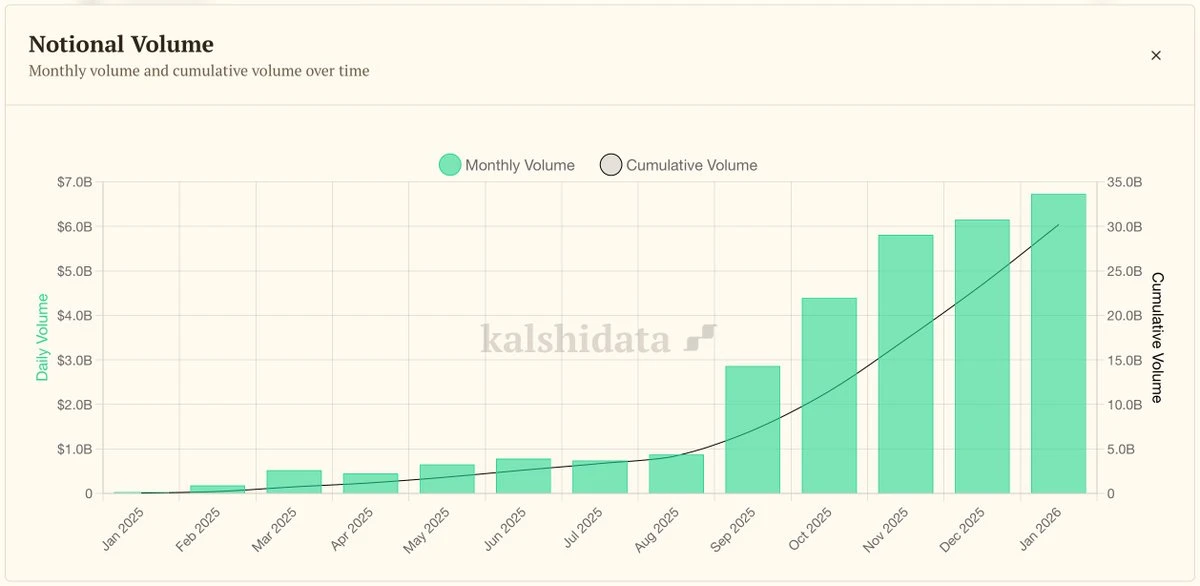
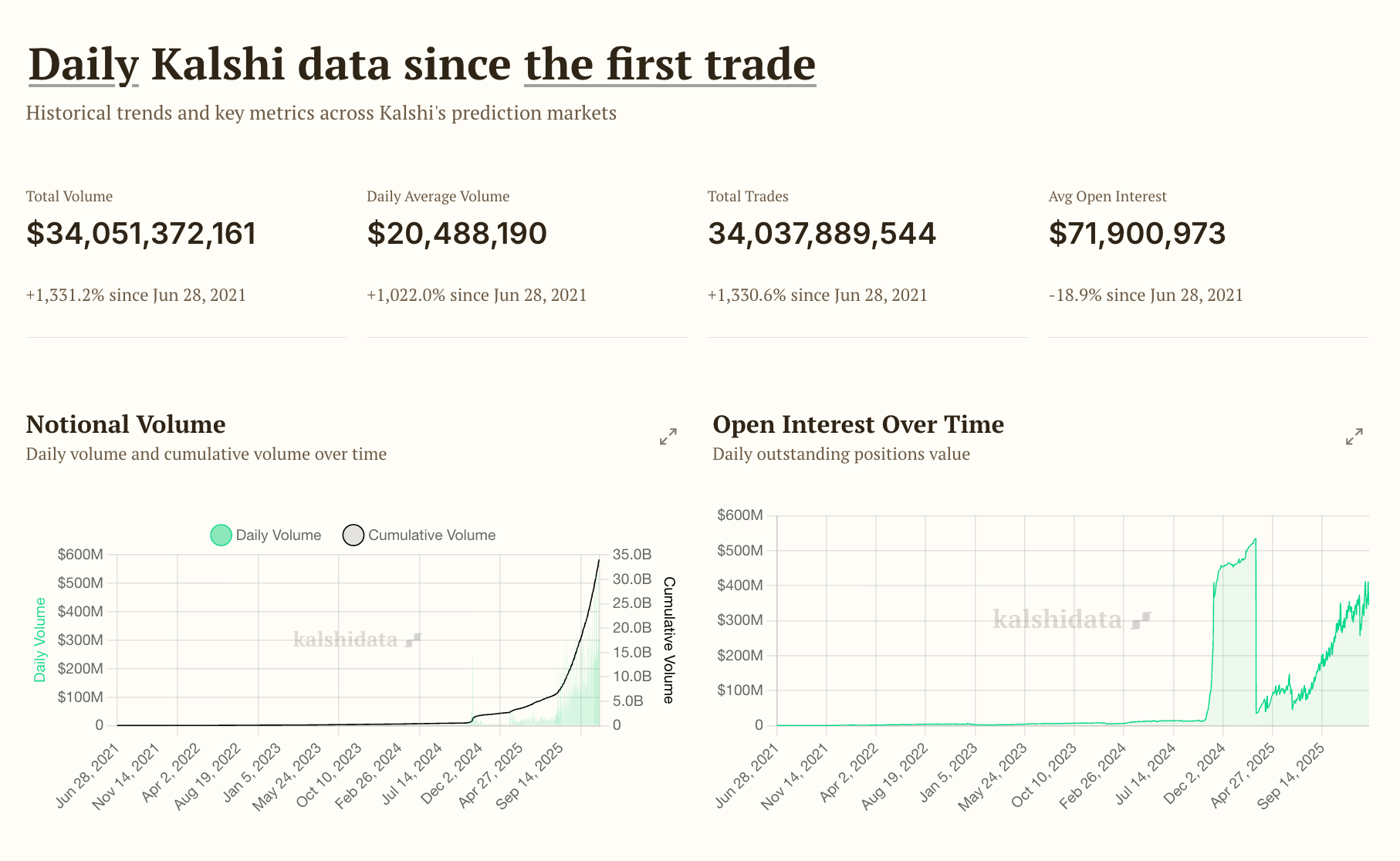
According to data from the KalshiData website, as of January 29, Kalshi's historical total trading volume exceeded $34.05 billion, with a daily average trading volume exceeding $20.48 million; looking at its notional trading volume K-line chart, it has grown almost exponentially since September 2025.
Capital Market Pricing Range: Kalshi Single Share Price is $300-$450
Finally, as the current number one prediction market platform, although Kalshi's specific IPO time and number of shares to be issued are not yet determined,结合 (combined with) its previous financing news and external statements, an IPO is a certainty. Currently, there are many divergences in the pre-market stock pricing between traditional financial markets and cryptocurrency markets:
The pre-market in traditional financial markets prices Kalshi's stock relatively lower——
- On Nasdaq Private Market, Kalshi's single share is priced around $307;
- On Hiive, Kalshi's single share is priced around $357.
The pre-market in cryptocurrency markets prices Kalshi's stock relatively higher——
- On PreStocks, Kalshi's implied market capitalization is approximately $14 billion, with a single share price of approximately $407;
- On Jarsy, Kalshi's market valuation is $11 billion, with a单独定价 (single price) of $450.
In the next article, Odaily Planet Daily will analyze in detail the price range worth buying for Kalshi's stock pre-market, dissecting the investment opportunities in prediction market stocks from the perspective of the pre-market.





