Kalshi Issues a $1 Billion Free Lottery Ticket, Remember to Scratch It

Odaily星球日报Published on 2026-03-17Last updated on 2026-03-17

Abstract

Kalshi, a prediction market platform, has announced a "Perfect Bracket Challenge" inspired by Warren Buffett, offering a $1 billion grand prize to any user who correctly predicts every game outcome in the upcoming NCAA "March Madness" basketball tournament. The tournament begins on March 18, featuring 68 college teams competing in a single-elimination format. "March Madness" is one of the most popular sporting events in the U.S., drawing widespread public engagement due to strong school allegiances. This year's tournament is especially notable as a strong NBA draft class, including top prospects like Cameron Boozer, is raising its profile. Prediction markets like Polymarket and Kalshi have launched related events. Polymarket currently lists Duke University as the favorite to win at 21%. Meanwhile, Kalshi’s free-to-enter contest also includes a $1 million consolation prize for the best bracket and an additional $1 million donation to charity if no one wins the grand prize. The odds of a perfect bracket are extremely low—often estimated at around 1 in 120 billion—since games are not purely random and upsets are common. Warren Buffett has run a similar challenge for his employees since 2014, with no one ever claiming the top prize. The announcement has sparked discussion online, with some suggesting the use of AI and automated systems to attempt mass entries. Despite the near-impossible odds, users are encouraged to submit their brackets for free.

Original | Odaily Planet Daily (@OdailyChina)

Author | Azuma (@azuma_eth)

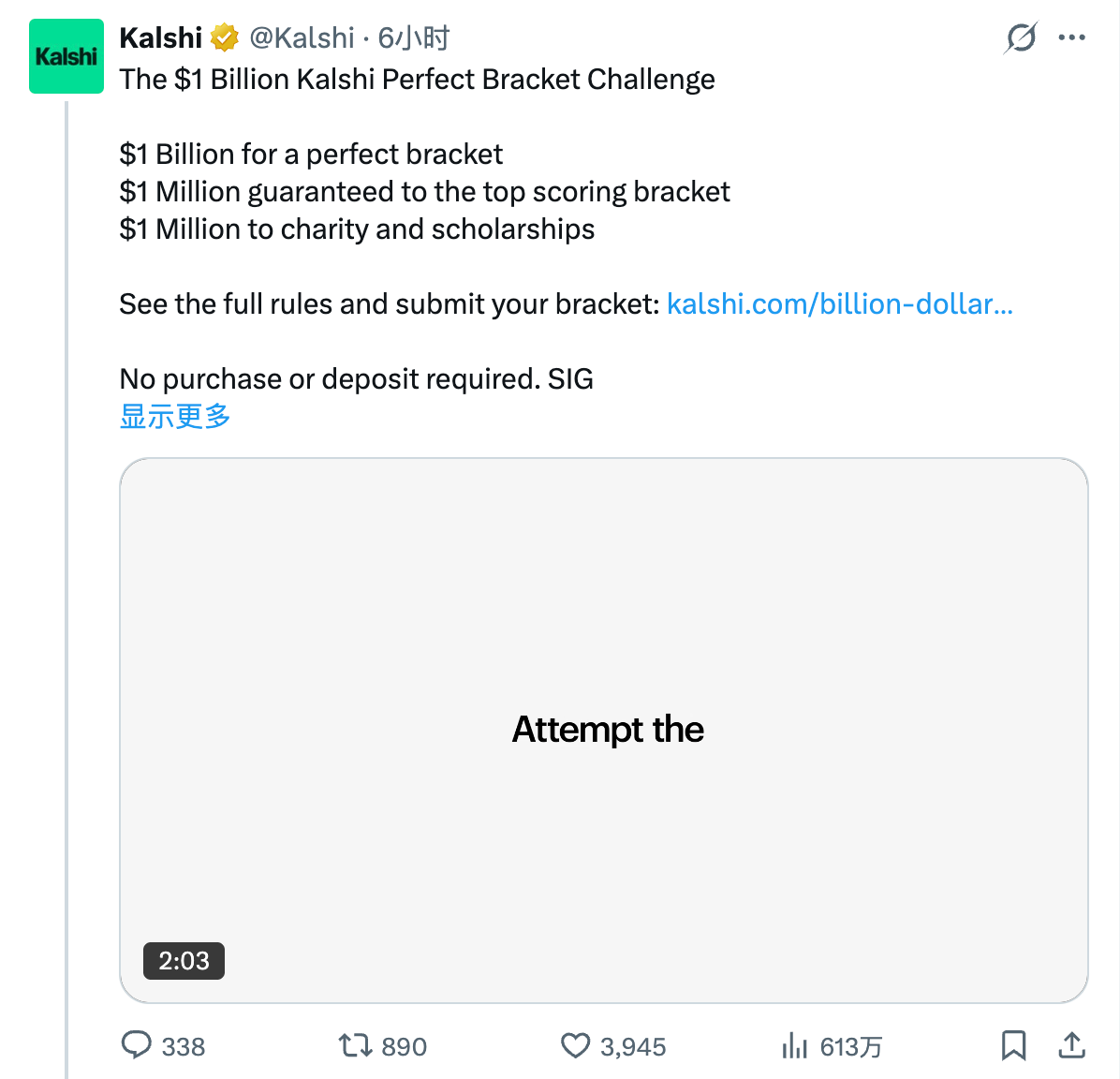
In the early hours of March 17, prediction market Kalshi announced on X that, following the example of stock god Warren Buffett, it will launch a "Perfect Bracket Challenge" for the upcoming "March Madness" NCAA tournament—users who perfectly predict all match outcomes will have a chance to win a super grand prize of $1 billion.
"March Madness": America's Hottest Basketball Spectacle

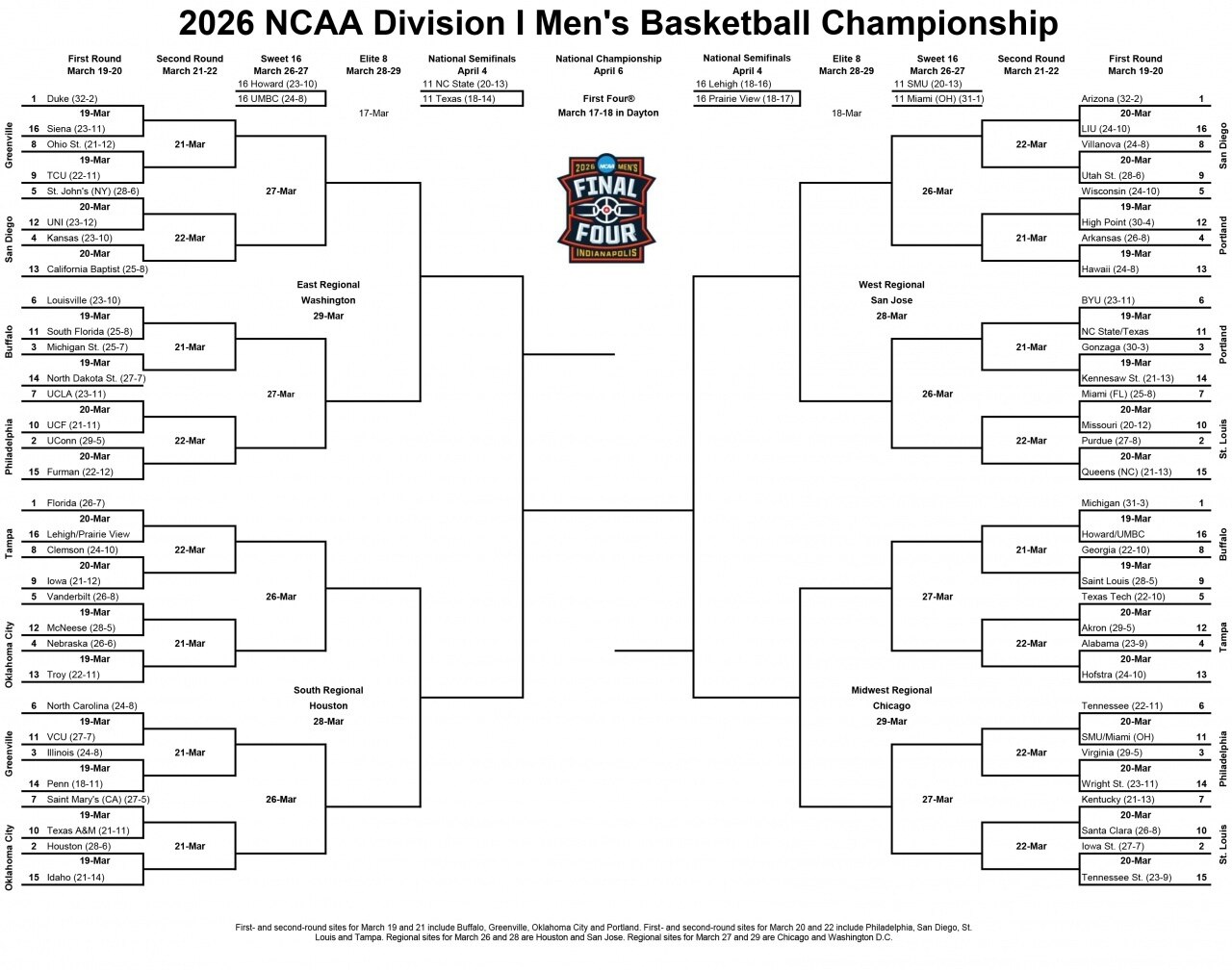
"March Madness" refers to the NCAA Men's Division I Basketball Tournament held every March by the National Collegiate Athletic Association (NCAA). The tournament, which typically begins in March, features a single-elimination format with an intense and fast-paced schedule, hence the name.

According to the schedule confirmed by yesterday's draw, the 2026 "March Madness" will officially tip off on March 18 (tomorrow) Beijing time. Sixty-eight college teams that have earned their spots in "March Madness" through months of regular-season battles will compete for the championship. The first to take place will be the First Four play-in games, where 8 play-in teams will directly eliminate 4, and the remaining 64 teams will go through five rounds of single-elimination matches (Round of 64 → Round of 32 → Sweet 16 → Elite 8 → Final Four → Championship Game → National Champion) to determine the ultimate winner.
As the most-watched college basketball event in the United States, compared to the NBA, which features professional clubs, the NCAA, centered around universities, often fosters a stronger sense of "home team identity" among the general public. During "March Madness," students, alumni, and even local communities of each school spontaneously rally to support their alma mater. Because of this, the event's atmosphere of全民参与 (quánmín cānyù -全民参与全民参与 (全民参与)全民参与 (quánmín cānyù)全民参与 (全民参与)全民参与 (quánmín cānyù)全民参与 (全民参与)全民参与 (quánmín cānyù)全民参与 (全民参与)全民参与 (quánmín cānyù)全民参与 (全民参与)全民参与 (quánmín cānyù)全民参与 (全民参与)全民参与 (quánmín cānyù)全民参与 (全民参与)全民参与 (quánmín cānyù)全民参与 (全民参与)全民参与 (quánmín cānyù)全民参与 (全民参与)全民参与 (quánmín cānyù)全民参与 (全民参与)全民参与 (quánmín cānyù)全民参与 (全民参与)全民参与 (quánmín cānyù)全民参与 (全民参与)全民参与 (quánmín cānyù)全民参与 (全民参与)全民参与 (quánmín cānyù)全民参与 (全民参与)全民参与 (quánmín cānyù)全民参与 (全民参与)全民参与 (quánmín cānyù)全民参与 (全民参与)全民参与 (quánmín cānyù)全民参与 (全民参与)全民参与 (quánmín cānyù)全民参与 (全民参与)全民参与 (quánmín cānyù)全民参与 (全民参与)全民参与 (quánmín cānyù)全民参与 (全民参与)全民参与 (quánmín cānyù)全民参与 (全民参与)全民参与 (quánmín cānyù)全民参与 (全民参与)全民参与 (quánmín cānyù)全民参与 (全民参与)全民参与 (quánmín cānyù)全民参与 (全民参与)全民参与 (quánmín cānyù)全民参与 (全民参与)全民参与 (quánmín cānyù)全民参与 (全民参与)全民参与 (quánmín cānyù)全民参与 (全民参与)全民参与 (quánmín cānyù)全民参与 (全民参与)全民参与 (quánmín cānyù)全民参与 (全民参与)全民参与 (quánmín cānyù)全民参与 (全民参与)全民参与 (quánmín cānyù)全民参与 (全民参与)全民参与 (quánmín cānyù)全民参与 (全民参与)全民参与 (quánmín cānyù)全民参与 (全民参与)全民参与 (quánmín cānyù)全民参与 (全民参与)全民参与 (quánmín cānyù)全民参与 (全民参与)全民参与 (quánmín cānyù)全民参与 (全民参与)全民参与 (quánmín cānyù)全民参与 (全民参与)全民参与 (quánmín cānyù)全民参与 (全民参与)全民参与 (quánmín cānyù)全民参与 (全民参与)全民参与 (quánmín cānyù)全民参与 (全民参与)全民参与 (quánmín cānyù)全民参与 (全民参与)全民参与 (quánmín cānyù)全民参与 (全民参与)全民参与 (quánmín cānyù)全民参与 (全民参与)全民参与 (quánmín cānyù)全民参与 (全民参与)全民参与 (quánmín cānyù)全民参与 (全民参与)全民参与 (quánmín cānyù)全民参与 (全民参与)全民参与 (quánmín cānyù)全民参与 (全民参与)全民参与 (quánmín cānyù)全民参与 (全民参与)全民参与 (quánmín cānyù)全民参与 (全民参与)全民参与 (quánmín cānyù)全民参与 (全民参与)全民参与 (quánmín cānyù)全民参与 (全民参与)全民参与 (quánmín cānyù)全民参与 (全民参与)全民参与 (quánmín cānyù)全民参与 (全民参与)全民参与 (quánmín cānyù)全民参与 (全民参与)全民参与 (quánmín cānyù)全民参与 (全民参与)全民参与 (quánmín cānyù)全民参与 (全民参与)全民参与 (quánmín cānyù)全民参与 (全民参与)全民参与 (quánmín cānyù)全民参与 (全民参与)全民参与 (quánmín cānyù)全民参与 (全民参与)全民参与 (quánmín cānyù)全民参与 (全民参与)全民参与 (quánmín cānyù)全民参与 (全民参与)全民参与 (quánmín cānyù)全民参与 (全民参与)全民参与 (quánmín cānyù)全民参与 (全民参与)全民参与 (quánmín cānyù)全民参与 (全民参与)全民参与 (quánmín cānyù)全民参与 (全民参与)全民参与 (quánmín cānyù)全民参与 (全民参与)全民参与 (quánmín cānyù)全民参与 (全民参与)全民参与 (quánmín cānyù)全民参与 (全民参与)全民参与 (quánmín cānyù)全民参与 (全民参与)全民参与 (quánmín cānyù)全民参与 (全民参与)全民参与 (quánmín cānyù)全民参与 (全民参与)全民参与 (quánmín cānyù)全民参与 (全民参与)全民参与 (quánmín cānyù)全民参与 (全民参与)全民参与 (quánmín cānyù)全民参与 (全民参与)全民参与 (quánmín cānyù)全民参与 (全民参与)全民参与 (quánmín cānyù)全民参与 (全民参与)全民参与 (quánmín cānyù)全民参与 (全民参与)全民参与 (quánmín cānyù)全民参与 (全民参与)全民参与 (quánmín cānyù)全民参与 (全民参与)全民参与 (quánmín cānyù)全民参与 (全民参与)全民参与 (quánmín cānyù)全民参与 (全民参与)全民参与 (quánmín cānyù)全民参与 (全民参与)全民参与 (quánmín cānyù)全民参与 (全民参与)全民参与 (quánmín cānyù)全民参与 (全民参与)全民参与 (quánmín cānyù)全民参与 (全民参与)全民参与 (quánmín cānyù)全民参与 (全民参与)全民参与 (quánmín cānyù)全民参与 (全民参与)全民参与 (quánmín cānyù)全民参与 (全民参与)全民参与 (quánmín cānyù)全民参与 (全民参与)全民参与 (quánmín cānyù)全民参与 (全民参与)全民参与 (quánmín cānyù)全民参与 (全民参与)全民参与 (quánmín cānyù)全民参与 (全民参与)全民参与 (quánmín cānyù)全民参与 (全民参与)全民参与 (quánmín cānyù)全民参与 (全民参与)全民参与 (quánmín cānyù)全民参与 (全民参与)全民参与 (quánmín cānyù)全民参与 (全民参与)全民参与 (quánmín cānyù)全民参与 (全民参与)全民参与 (quánmín cānyù)全民参与 (全民参与)全民参与 (quánm极参与) can, in some ways, even surpass the热度 (rèdù -热度)热度 (rèdù)热度 (热度)热度 (rèdù)热度 (热度)热度 (rèdù)热度 (热度)热度 (rèdù)热度 (热度)热度 (rèdù)热度 (热度)热度 (rèdù)热度 (热度)热度 (rèdù)热度 (热度)热度 (rè极参与) of the NBA Finals.

From a competitive standpoint, although college players' overall skill level is still难以 compared to professional players, the unique aspect of "March Madness" is that the stage window for most participants is extremely limited—usually only 1 to 4 years, and the most talented among them often enter the NBA after their freshman season. This "fleeting" opportunity makes every possession on the court feel more urgent—once they step onto the court, almost everyone competes with desperate intensity.

At the same time, 2026 is widely regarded as a strong NBA draft year, further amplifying the attention on this year's tournament. Players like Dariq Whitehead from Kansas University, AJ Dybantsa from BYU, and Cameron Boozer (son of Carlos Boozer, Yao Ming's old rival) from Duke University are seen as generational talents,有望 competing for next year's NBA No. 1 overall pick. The direct matchups between these "future stars" also add a layer of foresight into the future NBA landscape to this year's "March Madness," beyond its entertainment value.

Massive Traffic, Prediction Markets Can't Miss It

During "March Madness," filling out "brackets" to predict game outcomes through sports betting services has long been a major custom in the US. How could prediction markets, which are perfectly suited for this, miss this opportunity?

Currently, prediction markets like Polymarket and Kalshi have already launched prediction events related to the "March Madness" tournament. Polymarket has even included it in the first batch of pilot paid sports events, seemingly准备 to make a fortune from the upcoming tournament frenzy.
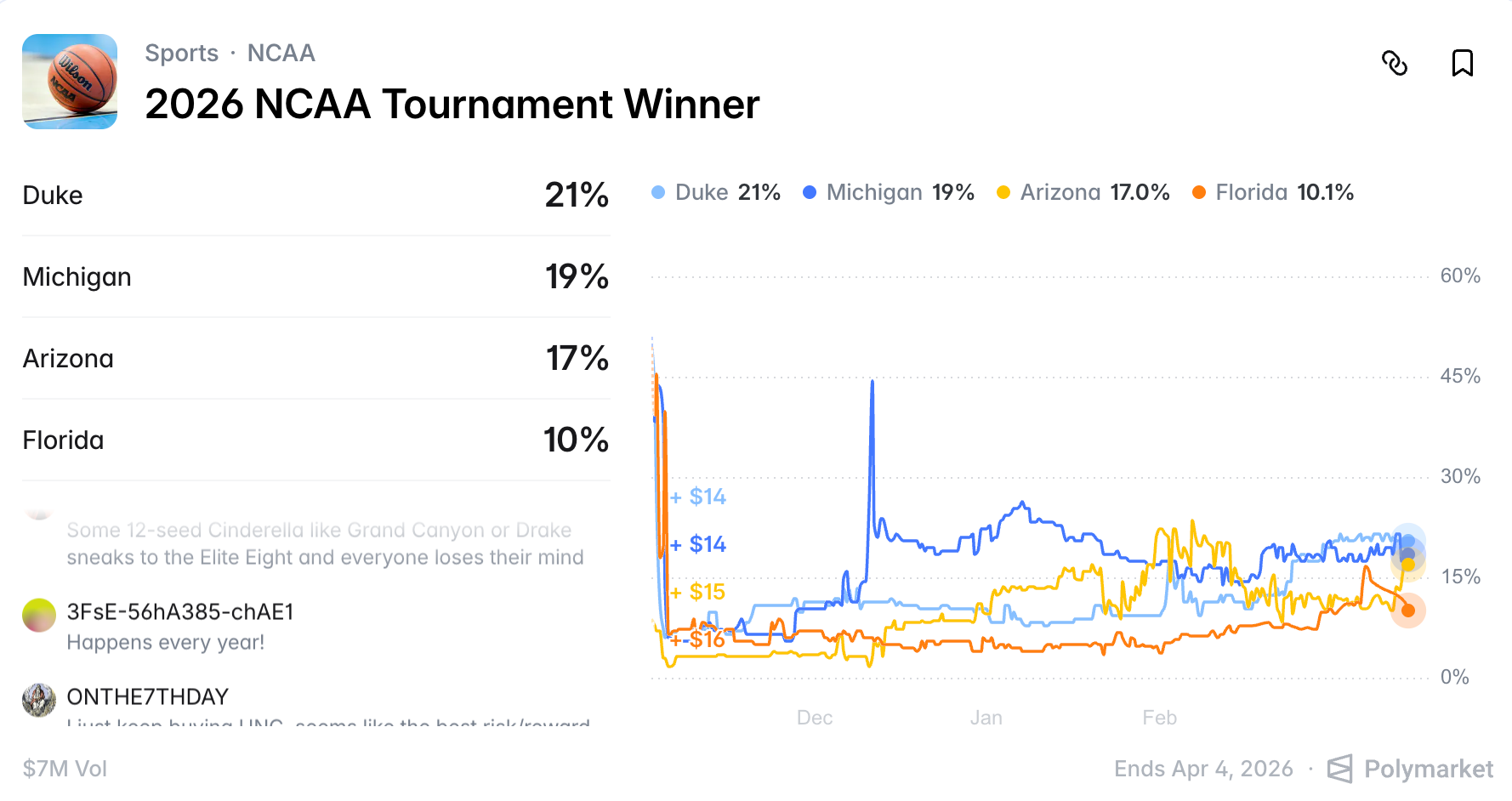
Polymarket's real-time probabilities show that the current top four universities in terms of championship odds for "March Madness" are the number one seeds from the four major regions:

  • Duke University,拥有下赛季 NBA 状元秀热门球员卡梅隆·布泽尔 (Duke University,拥有下赛季 NBA 状元秀热门球员卡梅隆·布泽尔) (Duke University,拥有下赛季 NBA 状元秀热门球员卡梅隆·布泽尔) (Duke University,拥有下赛季 NBA 状元秀热门球员卡梅隆·布泽尔) (Duke University,拥有下赛季 NBA 状元秀热门球员卡梅隆·布泽尔) (Duke University,拥有下赛季 NBA 状元秀热门球员卡梅隆·布泽尔) (Duke University,拥有下赛季 NBA 状元秀热门球员卡梅隆·布泽尔) (Duke University,拥有下赛季 NBA 状元秀热门球员卡梅隆·布泽尔) (Duke University,拥有下赛季 NBA 状元秀热门球员卡梅隆·布泽尔) (Duke University,拥有下赛季 NBA 状元秀热门球员卡梅隆·布泽尔) (Duke University,拥有下赛季 NBA 状元秀热门球员卡梅隆·布泽尔) (Duke University,拥有下赛季 NBA 状元秀热门球员卡梅隆·布泽尔) (Duke University,拥有下赛季 NBA 状元秀热门球员卡梅隆·布泽尔) (Duke University,拥有下赛季 NBA 状元秀热门球员卡梅隆·布泽尔) (Duke University,拥有下赛季 NBA 状元秀热门球员卡梅隆·布泽尔) (Duke University,拥有下赛季 NBA 状元秀热门球员卡梅隆·布泽尔) (Duke University,拥有下赛季 NBA 状元秀热门球员卡梅隆·布泽尔) (Duke University,拥有下赛季 NBA 状元秀热门球员卡梅隆·布泽尔) (Duke University,拥有下赛季 NBA 状元秀热门球员卡梅隆·布泽尔) (Duke University,拥有下赛季 NBA 状元秀热门球员卡梅隆·布泽尔) (Duke University,拥有下赛季 NBA 状元秀热门球员卡梅隆·布泽尔) (Duke University,拥有下赛季 NBA 状元秀热门球员卡梅隆·布泽尔) (Duke University,拥有下赛季 NBA 状元秀热门球员卡梅隆·布泽尔) (Duke University,拥有下赛季 NBA 状元秀热门球员卡极参与) (featuring Cameron Boozer, a hot candidate for next season's NBA top draft pick) ranks first, currently at 21%;
  • University of Michigan ranks second,暂报 19% (currently at 19%);
  • University of Arizona ranks third,暂报 17% (currently at 17%);
  • Defending champion University of Florida ranks fourth,暂报 11% (currently at 11%).

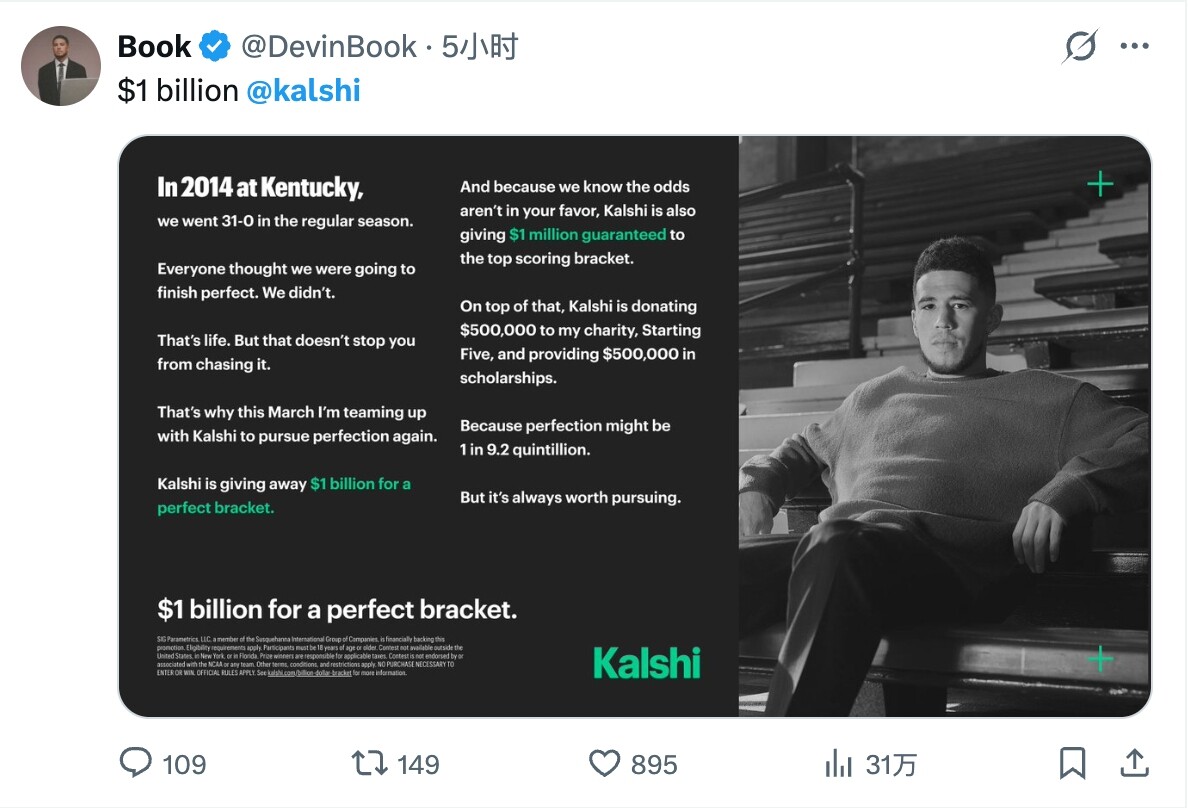
Kalshi, on the other hand, followed Buffett's lead this morning by launching a nuclear-level "$1 Billion Grand Prize" activity. All users can submit a prediction bracket for free on Kalshi, and users who perfectly predict all game outcomes can win $1 billion. If no one successfully predicts perfectly, Kalshi will also provide a $1 million reward to the user with the best prediction score and allocate another $1 million to support charitable organizations.

It is worth mentioning that Kalshi also brought in NBA star Devin Booker to help promote the event. In 2014, Booker's University of Kentucky team achieved an undefeated 31-0 record in the regular season and was once highly favored to win the national championship that year, but lost to the University of Wisconsin 64-71 in the semi-finals. Booker entered the NBA the following year, forever unable to fulfill this regret.
Buffett Has Offered the Prize for 12 Years, But No One Has Claimed the Grand Prize

The reason for mentioning that Kalshi's grand prize is following Buffett's example is that Buffett himself established a similar grand prize as early as 2014—employees of his Berkshire Hathaway company who could correctly predict the results of all games would be eligible for a huge prize of $1 billion, to be paid out by the company over 40 years (or they could choose a lump sum payment of $500 million).

However, due to the extreme difficulty of making a perfect prediction, the prize has never been claimed. Buffett later reduced the guessing difficulty several times (the reward was also adjusted downward accordingly). It wasn't until last year that an anonymous employee from FlightSafety International, a subsidiary of Berkshire Hathaway, correctly predicted 31 out of the first 32 games and claimed the downsized million-dollar prize.

How difficult is a perfect prediction? The most classic number circulating in the industry is "1 in 9.2 quintillion." This probability stems from the following mathematical calculation: assuming each game is 50% vs. 50% (completely random), without considering seed strength, odds, or historical patterns, "March Madness" has a total of 63 games (excluding the First Four). Therefore, the number of possible排列组合 (páiliè zǔhé -排列组合)排列组合 (páiliè zǔhé)排列组合 (排列组合)排列组合 (páiliè zǔhé)排列组合 (排列组合)排列组合 (páiliè zǔhé)排列组合 (排列组合)排列组合 (páiliè zǔhé)排列组合 (排列组合)排列组合 (páiliè zǔhé)排列组合 (排列组合)排列组合 (páiliè zǔhé)排列组合 (排列组合)排列组合 (páiliè zǔhé)排列组合 (排列组合)排列组合 (páiliè zǔhé)排列组合 (排列组合)排列组合 (páiliè zǔhé)排列组合 (排列组合)排列组合 (páiliè zǔhé)排列组合 (排列组合)排列组合 (páiliè zǔhé)排列组合 (排列组合)排列组合 (páiliè zǔhé)排列组合 (排列组合)排列组合 (páiliè zǔhé)排列组合 (排列组合)排列组合 (páiliè zǔhé)排列组合 (排列组合)排列组合 (páiliè zǔhé)排列组合 (排列组合)排列组合 (páiliè zǔhé)排列组合 (排列组合)排列组合 (páiliè zǔhé)排列极参与) scenarios is 2^63, which written out is 9,223,372,036,854,775,808... If these possible outcomes were written on paper, the weight of the paper would reach 180 trillion tons, equal to the weight of 500 million Empire State Buildings...

Does it seem utterly impossible? Don't worry, I'll help you significantly increase the probability!
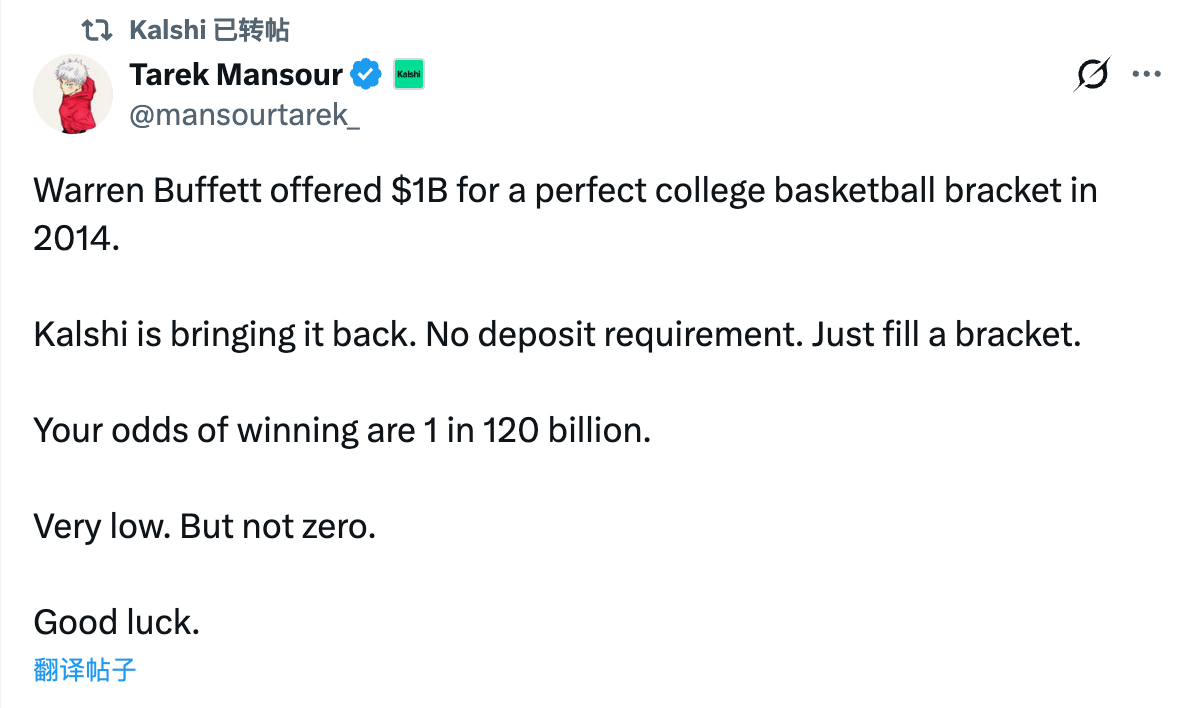
Kalshi CEO Tarek Mansour said this morning when discussing this activity that the probability of a perfect prediction is approximately "1 in 120 billion." The reason for the huge difference between these two probabilities is that this probability is based on a more realistic model calculation—sports games are not 50-50; stronger teams often win more easily. After weighting calculations based on historical win rates and related odds, the academic and statistical communities typically estimate the probability of a perfect "March Madness" prediction to be between "1 in 10^11 ~ 1 in 10^13". "1 in 120 billion" falls within this range.

But even "1 in 120 billion" means the possibility is almost zero. Clearly, Kalshi is playing the same probability game as Buffett, betting that no one will be able to take home this $1 billion.

Community is Eager, AI May Be the Key to Breaking the Deadlock

After Kalshi's grand prize activity was announced, it immediately sparked widespread discussion on social media—after all, the prediction is free, what if you win?

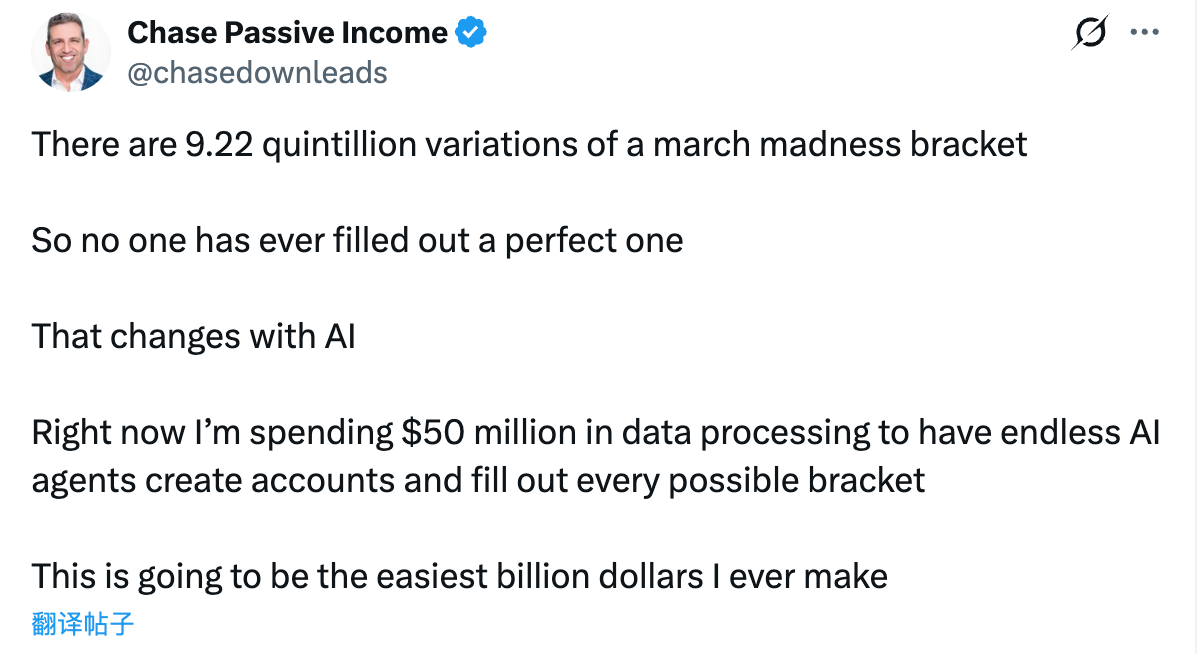
And this time, many users are pinning their hopes on the groundbreaking revolution of AI. Overseas KOL Chase Passive Income stated on X that he would spend $50 million on data processing, having countless AI agents create accounts and fill out all possible brackets, calling it the "easiest $1 billion to make."
Will the unsolvable probability puzzle persist? Can AI create a miracle? Before the national champion of "March Madness" is crowned, no one knows the answer.

As spectators, besides waiting to watch the games and enjoy the drama, don't forget to go to Kalshi and fill out your dream bracket.

Related Questions

QWhat is the 'Perfect Bracket Challenge' announced by Kalshi, and what is the prize?

AKalshi announced a 'Perfect Bracket Challenge' for the NCAA 'March Madness' tournament, offering a $1 billion grand prize to any user who correctly predicts the outcome of every game.

QWhat is the estimated probability of achieving a perfect bracket according to Kalshi's CEO, and how does it differ from the purely random calculation?

AKalshi's CEO estimated the probability of a perfect bracket at about 1 in 120 billion, which is based on a realistic model that factors in historical win rates and betting odds. This is vastly different from the purely random calculation of 1 in 9.2 quintillion, which assumes every game is a 50/50 chance.

QWhich university is the current favorite to win the championship on Polymarket, and who is their star player?

ADuke University is the current favorite to win the championship on Polymarket, with odds of 21%. Their star player is Cameron Boozer, the son of former NBA player Carlos Boozer and a top prospect for the next NBA draft.

QHow has Warren Buffett been involved in a similar 'perfect bracket' challenge, and what was the outcome?

AWarren Buffett's Berkshire Hathaway has offered a $1 billion prize for a perfect bracket since 2014, to be distributed over 40 years (or a $500 million lump sum). Due to the extreme difficulty, no one has ever won the full prize. Last year, an anonymous employee won a reduced million-dollar prize for correctly predicting 31 out of 32 first-round games.

QWhat novel strategy did a KOL suggest for potentially winning the Kalshi challenge, and what technology was central to this plan?

AKOL Chase Passive Income suggested spending $50 million on data processing to have numerous AI agents create accounts and fill out every possible bracket combination, aiming to secure the $1 billion prize. The plan centers on using artificial intelligence to brute-force the challenge.

Related Reads

It Took Me a Year to See the Hard Truth About Agent Payments

**Title: It Took Me a Year to See the Hard Truth About Agent Payments** Over the past year, I've worked on infrastructure for the Agent economy, engaging with major players like Stripe, Visa, Coinbase, and numerous startups. The findings reveal a stark reality: genuine, widespread demand for Agent-based payments does not yet exist. **Key Observations:** * **Agent-to-Merchant (Shopping):** The user experience for AI shopping often falls short, especially for visual product discovery. While AI excels at understanding needs, conversational interfaces can't yet replace browsing and comparing multiple products visually. Current merchant interest is largely defensive ("Agent Engine Optimization") for a future that hasn't arrived. High-frequency, low-friction purchases (like food delivery) are potential fits, but lack open APIs and face high AI inference costs. Simpler, more affordable, or cross-language interactions for complex UIs are a niche opportunity but require massive consumer distribution to scale. * **Agent-to-API (Developer Tools):** Developer payment needs for APIs (computing, data, models) are already met through subscriptions and prepaid credits. The core challenge is not payment friction but supplier economics: most large SaaS providers prefer enterprise contracts over micropayments for API calls. Protocols like MPP and x402 suit the long-tail of smaller services but cater to a developer market historically reluctant to pay for these tools. Major infrastructure needs at the top of the stack are already being addressed. * **Agent-to-Agent (Machine Commerce):** This is a long-term vision with almost no current transaction volume. While a future with high-speed, high-frequency, multi-party machine-to-machine transactions would require novel infrastructure, it remains theoretical. The market is not here yet. * **Agent-to-Finance:** This is the only category with clear, present demand. Financial professionals and DeFi users already pay for tools, and AI augmentation is a natural evolution. Autonomous AI agents can enable entirely new financial strategies. However, competition is fierce from established, regulated incumbents who can more easily layer AI onto their existing products. **The Core Insight:** Companies, especially giants with long time horizons, are building defensively for a potential future of mass machine commerce. For them, early investment is a low-cost hedge. For startups, the current market reality is different. The primary challenge isn't just moving money between agents (payments). The larger, unsolved problem is **orchestration** – coordinating work between agents and humans, verifying outcomes, and then settling. Payment is just a part of settlement, which is just a part of orchestration. Companies that solve the orchestration problem will subsume payments, not the other way around. After a year of building, we see the real, growing, and underserved market opportunity lies in this broader domain of orchestration.

链捕手1m ago

It Took Me a Year to See the Hard Truth About Agent Payments

链捕手1m ago

Claude Opus 4.8 Finds a $4.5 Billion Bug: The AI Era is Mass-Producing Hackers

A researcher discovered a critical "infinite mint" vulnerability in the Zcash cryptocurrency's Orchard protocol using Claude Opus 4.8, leading to a swift fix but also a 50% market drop, erasing billions in value. This incident highlights a new era where powerful, accessible AI models are dramatically lowering the barrier to finding software vulnerabilities. Previously, the security community feared specialized models like Claude Mythos Preview, capable of finding decades-old zero-day exploits. The Zcash case, however, involved a publicly available, general-purpose model. This shift makes advanced security auditing—and attack capabilities—accessible to far more people, not just experts. The mass democratization of vulnerability discovery brings a dual challenge: a flood of low-quality, AI-generated false reports that overwhelm maintainers, and the real, rapid uncovering of deep, dangerous bugs. Open-source projects, often understaffed and unfunded, are particularly vulnerable to this "attention DDoS." The article cites examples like curl shutting down its bug bounty program due to the unsustainable workload. Our perceived digital safety has often been luck, relying on the high cost and effort required to find deeply hidden flaws in complex systems, as seen with historical vulnerabilities like Heartbleed or Baron Samedit. AI changes this cost structure, effectively "mass-producing flashlights" to illuminate every corner of our codebase. While large companies operate extensive security chains involving external white-hat hackers and massive defensive operations, the global cybersecurity workforce faces a severe shortage, especially of experienced personnel capable of analyzing complex threats and coordinating fixes. The core dilemma emerges: AI makes *finding* bugs cheap and scalable, but *fixing* them remains a slow, expensive, and human-intensive process. The article concludes that AI won't destroy the internet but acts as a bright light, revealing that our digital existence is not inherently secure but is precariously maintained by ongoing human effort. The true cost in the AI era may not be discovery, but whether there will be enough people left willing and able to do the hard work of repair.

marsbit34m ago

Claude Opus 4.8 Finds a $4.5 Billion Bug: The AI Era is Mass-Producing Hackers

marsbit34m ago

Codex Goal Mode Usage Guide: How to Make AI Continuously Pursue a Specific Objective

"Codex Goal Mode: How to Make AI Work Continuously Toward a Specific Goal" OpenAI's Codex "goal mode" (/goal) transforms the AI from a reactive code assistant into a proactive execution agent capable of working autonomously for hours or even days to achieve a defined objective. To maximize its effectiveness, follow these key principles: 1. **Define Clear, Verifiable Exit Criteria:** The goal prompt should be a concise, measurable success condition, not a lengthy specification. Use quantifiable metrics like "reduce build time by 30%" or "achieve 100% test parity." 2. **Provide Initial Guidance and Tools:** Direct Codex toward likely problem areas and specify available tools (e.g., browsers, testing environments) to prevent it from exploring unproductive paths. 3. **Enable Progress Measurement:** Equip Codex with ways to track advancement, such as creating comparison tools for visual tasks or evaluation sets, ensuring it can gauge its own progress. 4. **Use a Realistic Execution Environment:** For tasks like performance optimization, provide access to environments that closely mimic production (e.g., similar configs, databases) to yield valid results. 5. **Be Cautious with Visual Goals:** Avoid vague "pixel-perfect" instructions. Instead, supplement visual references with functional checklists or design system specifications to prevent Codex from obsessing over minor details. 6. **Implement Progress Tracking:** For long-running tasks, have Codex commit code to draft PRs, update progress documents, or send Slack updates to maintain visibility into its work. 7. **Review and Consolidate Results:** Once the goal is met, instruct Codex to review its work, clean up ineffective experimental code, and reflect on what strategies succeeded or failed. Ultimately, using goal mode shifts the developer's role from writing prompts to managing a persistent engineering agent—defining objectives, establishing metrics, configuring environments, and conducting final reviews.

marsbit1h ago

Codex Goal Mode Usage Guide: How to Make AI Continuously Pursue a Specific Objective

marsbit1h ago

From Ethereum to AI's 'CROPS': What Exactly Is This 'Slow Variable' That Vitalik Has Repeatedly Emphasized?

Recently, Vitalik Buterin has frequently emphasized the concept of "CROPS," first outlined in the Ethereum Foundation's March mandate as core principles guiding its focus: Censorship Resistance, Capture Resistance, Open Source, Privacy, and Security. CROPS represents Ethereum's commitment to providing foundational capabilities for user sovereignty—enabling asset ownership, identity expression, and coordination without reliance on centralized platforms or surrendering ultimate control. This framework is gaining new urgency with the rise of AI, particularly AI agents managing digital assets and automating transactions. While AI offers convenience, it risks centralizing user data, intent, and control if dependent on opaque, centralized services. Vitalik argues for "CROPS AI"—AI that is open, privacy-preserving, secure, and capable of local execution to maintain user agency. He highlights convergence between "CROPS Ethereum access layers" and "CROPS AI," such as using zero-knowledge proofs for private remote LLM calls and Ethereum RPC reads, ensuring users can access services without exposing sensitive information. Ultimately, CROPS is not just an abstract ideal but a practical guide for Ethereum's development and AI integration. It addresses the critical long-term question: as digital systems grow more powerful, how can users retain control over their privacy, assets, and autonomy? In an AI-driven era, these principles may define Ethereum's enduring value—prioritizing verifiable, secure, and user-centric design over short-term optimizations like speed and cost alone.

marsbit1h ago

From Ethereum to AI's 'CROPS': What Exactly Is This 'Slow Variable' That Vitalik Has Repeatedly Emphasized?

marsbit1h ago

Trading

Spot
Futures
活动图片




