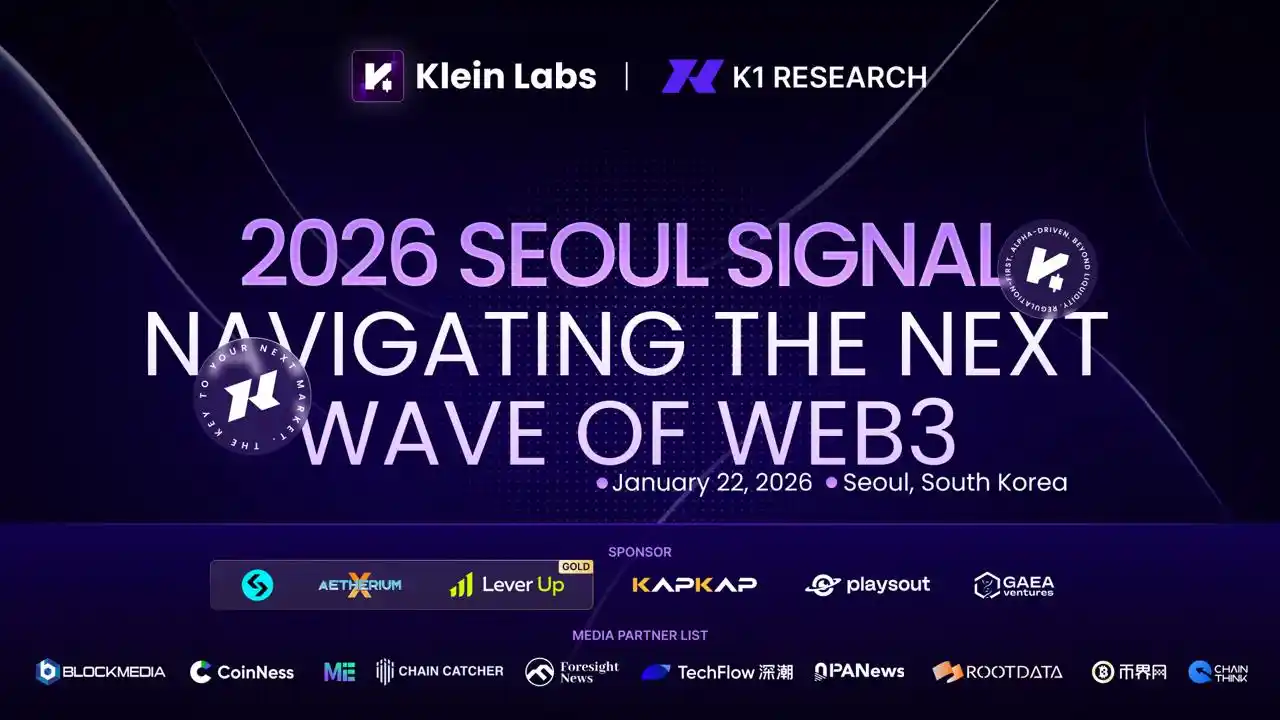
K1 Research and Klein Labs Co-host "2026 Seoul Signal", Foreseeing the Next Wave of Web3

marsbitPublished on 2026-01-12Last updated on 2026-01-12

Abstract

K1 Research, an Asia-Pacific market expansion consultancy, and Klein Labs, a strategic market maker and Web3 venture incubator, will co-host "2026 Seoul Signal: Insights into the Next Wave of Web3" on January 22 in Seoul at People the Terrace. Leveraging K1 Research's global network across Seoul, Hong Kong, Singapore, and Dubai, along with Klein Labs' expertise in liquidity design and market structure, the event aims to provide forward-looking strategic insights for the Web3 industry in 2026. It will bring together builders, creators, and traders to discuss survival strategies and long-term growth paths for the upcoming cycle. The forum is supported by three major gold sponsors: - BGB: The official platform token of Bitget Exchange, serving as a core asset within its ecosystem. - LeverUp: A perpetual contracts DEX on Monad, offering up to 1001x leverage and a fee-sharing mechanism. - AetheriumX: A Web3 ecosystem integrating staking, gaming, and a creator marketplace. Additional partners include Gaea Ventures, PlaysOut, and KapKap, all contributing to Web3 ecosystem collaboration. The organizers emphasize the event's goal to offer clear directional insights for key Web3 participants, combining practical market experience with systematic research to position Seoul as a global hub for Web3 innovation. Post-event, K1 Research and Klein Labs plan to deepen cooperation to accelerate the discovery and implementation of high-quality global projects. The event is ...

Asia-Pacific market expansion consulting firm K1 Research, in partnership with strategic market maker and Web3 startup incubator Klein Labs, will co-host "2026 Seoul Signal: Insights into the Next Wave of Web3" on January 22 at People the Terrace in Seoul.

This event leverages K1 Research's global research and industry network in Seoul, Hong Kong, Singapore, and Dubai, combined with Klein Labs' practical experience in liquidity design and market structure, aiming to provide forward-looking strategic references for the development of the Web3 industry in 2026. The forum will bring together Builders, Creators, and Traders for in-depth discussions on survival strategies and long-term growth paths for the next cycle.

The conference is supported by three heavyweight gold sponsors:

BGB — The official platform token of the Bitget exchange, serving as the core asset within the Bitget ecosystem, primarily used for trading, community, and platform benefits.

LeverUp — A perpetual contracts DEX based on Monad, offering up to 1001x leverage and a fee-sharing mechanism.

AetheriumX — A Web3 ecosystem integrating staking, gaming, and a creator marketplace.

Additionally, partners such as Gaea Ventures, PlaysOut, and KapKap will also participate, collectively promoting synergy within the Web3 ecosystem.

The organizers stated:

"'2026 Seoul Signal' aims to provide clear directional insights for core participants in Web3. By combining frontline market execution experience with systematic research, we look forward to further establishing Seoul as a key hub for global Web3 innovation." After the event, K1 Research and Klein Labs will continue to deepen their collaboration, accelerating the discovery and implementation of high-quality global projects and providing long-term support for ecosystem development.

Pre-registration for this event is now open. Interested participants are welcome to apply via the link below.

- Time: January 22, 2026 (18:30 ~ 23:00, Korea Time)

- Location: People the Terrace, 13 Dosandaero 81-gil, Gangnam-gu, Seoul, Korea (Cheongdam-dong)(Address Detail)

- Registration:Link

Related Questions

QWhat is the name of the event co-hosted by K1 Research and Klein Labs, and what is its main focus?

AThe event is called '2026 Seoul Signal: Insight into the Next Wave of Web3'. Its main focus is to provide forward-looking strategic references for the development of the Web3 industry in 2026, bringing together builders, creators, and traders to discuss survival strategies and long-term growth paths for the next cycle.

QWhich three gold sponsors are supporting the '2026 Seoul Signal' event?

AThe three gold sponsors are BGB (Bitget's official platform token), LeverUp (a perpetual contract DEX on Monad offering up to 1001x leverage), and AetheriumX (a Web3 ecosystem integrating staking, gaming, and a creator market).

QWhat are the roles of the two co-hosting organizations, K1 Research and Klein Labs?

AK1 Research is an Asia-Pacific market expansion consulting firm with a global research and industry network. Klein Labs is a strategic market maker and Web3 startup incubator with practical experience in liquidity design and market structure.

QWhen and where will the '2026 Seoul Signal' event take place?

AThe event will take place on January 22, 2026, from 18:30 to 23:00 (KST) at People the Terrace, located at 13 Dosandaero 81-gil, Gangnam-gu, Seoul, South Korea (Cheongdam-dong).

QWhat is the stated long-term goal of K1 Research and Klein Labs after the event concludes?

AAfter the event, K1 Research and Klein Labs plan to deepen their cooperation to accelerate the discovery and implementation of high-quality global projects and provide long-term support for ecosystem development.

Related Reads

US and Japan's Unprecedented Joint Action in 30 Years Marks End of Yen Carry Trade Era

Japan and the U.S. conducted a rare coordinated intervention in the foreign exchange market around August 3rd to stem the yen's sharp depreciation. U.S. Treasury Secretary Scott Bessette's notepad, photographed by Reuters, revealed plans for a $5-10 billion yen-buying operation. Following official confirmation, the USD/JPY pair plunged from near 164 to around 155-156. The intervention marks a significant shift as the U.S. moved from verbal support to practical coordination. While the core carry trade logic—exploiting the higher U.S. interest rates—remains intact, the risk structure has changed. Traders must now account for potential repeated bilateral actions, altering the risk-reward calculation for yen shorts. The intervention's immediate effect is forcing leveraged positions to unwind, amplifying the yen's rebound. However, analysts note this does not signal the end of the yen carry trade. The fundamental driver—the wide interest rate differential between the U.S. (3.50%-3.75%) and Japan (1%)—persists. The action is seen more as buying time for the Bank of Japan's gradual policy normalization while mitigating imported inflation pressures. To avoid destabilizing the U.S. Treasury market during intervention, authorities utilized the Fed's FIMA repo facility, allowing Japan to obtain dollar liquidity using its Treasury holdings as collateral instead of selling them. The move aims to contain spillover risks. While creating short-term volatility and compressing leverage for yen bears, the long-term trend for the yen will ultimately depend on the convergence of U.S. and Japanese monetary policies, not unilateral market operations. The current action is narrower in scope than historical agreements like the Plaza Accord, focused on curbing excessive yen weakness rather than engineering a broad-based dollar decline.

marsbit17m ago

US and Japan's Unprecedented Joint Action in 30 Years Marks End of Yen Carry Trade Era

marsbit17m ago

Why Hasn't Bitcoin Made the Expected Surge? There Are Both Positive and Negative Data

Analytical firm Glassnode reports Bitcoin retreated to around $62,600 after failing to sustain above $66,000. Weak spot market demand and defensive positions in derivatives are applying downward pressure. However, structural support remains from resilient long-term holders, surging on-chain activity, and renewed inflows into Bitcoin ETFs. The price action reflects weakened spot momentum, with low trading volume and persistent seller pressure keeping Bitcoin in a consolidation phase with limited breakout potential. While open interest in derivatives has fallen, funding rates have risen again, and options investors maintain a cautious stance. Demand for downside protection has increased. Positively, Bitcoin ETFs have seen renewed net inflows and trading volume, indicating institutional repositioning. On-chain metrics show a significant spike in active addresses and adjusted transaction volume, pointing to increased network usage. The historically low ratio of short-term to long-term holders suggests long-term conviction remains firm. However, overall market profitability continues to decline as the proportion of Bitcoin in profit nears cycle lows, indicating a trend of loss realization and de-risking by investors. Glassnode concludes the Bitcoin market is in a transitional phase. Structural support is present, but valuation pressure, insufficient spot demand, and defensive derivatives positioning continue to limit overall risk appetite.

cryptonews.ru47m ago

Why Hasn't Bitcoin Made the Expected Surge? There Are Both Positive and Negative Data

cryptonews.ru47m ago

Trading

Spot
活动图片