June Transaction Volume Doubles: x402 Ecosystem Continues to Expand, Content Monetization Narrative Faces Crucial Test

Foresight NewsPublished on 2026-07-10Last updated on 2026-07-10

Abstract

X402, a protocol for AI and data services, experienced significant growth in June. Its transaction volume doubled compared to May, primarily driven by the AI inference routing service BlockRun. The ecosystem expanded with new integrations: Apify enabled data scraping services, Exa extended its AI search to Solana, and Seal launched 'Hacks', a marketplace for automated AI agents. The protocol itself received crucial upgrades, including 'Builder Codes' for tracking and affiliate systems and 'Batch Settlement' to enable practical micropayments for high-frequency AI tasks. Major external validation came from tech giants. Amazon Web Services (AWS) launched a solution for AI traffic metering at its edge nodes. More significantly, Cloudflare opened its waitlist for a Content Monetization Gateway. This gateway allows websites to charge AI bots and other automated agents for accessing content, using x402 for stablecoin payments. This addresses a core internet monetization problem and represents x402's most promising path to mass adoption, though Cloudflare's CEO noted current blockchain scalability remains a critical hurdle. Current leading use cases are AI inference routing and paid data feeds. However, the large-scale real-world test with Cloudflare's gateway will be decisive in determining if x402 can transition from a useful tool to a fundamental infrastructure component for a new web economy where AI agents pay for the content they consume.


Author: David Christopher

Compiled by: Saoirse, Foresight News


x402 experienced rapid business development in June.


Protocol transaction volume surged significantly, stabilizing at roughly double the level seen in May. A clear use case has emerged: the vast majority of transaction activity is concentrated with a single service provider—the inference routing project BlockRun. Enterprise adoption continues to materialize: Amazon completed integration with the protocol, and Cloudflare officially announced the launch of its content monetization gateway. A series of technical upgrades have substantially improved the stability and transaction traceability of x402 as it enters the summer months. These very features are essential prerequisites for x402 to face the practical test that Cloudflare is poised to bring.


Next, we will review the latest developments, the directions already validated as viable, and the hypotheses yet to be proven.
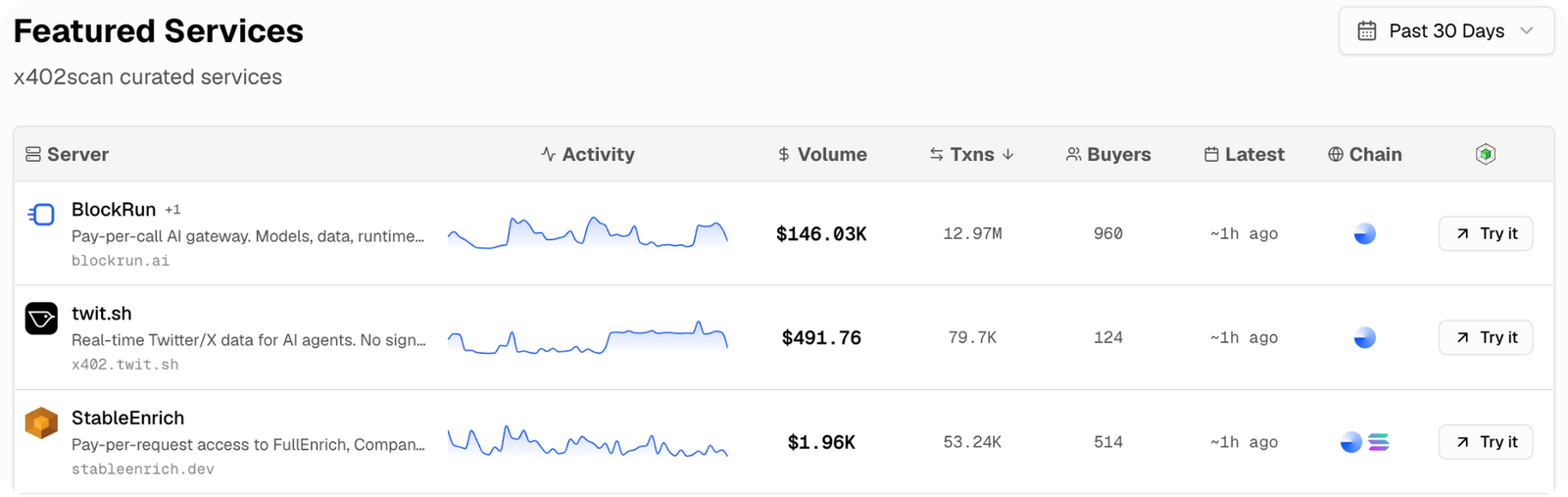

x402scan platform's featured services rankings (based on 30-day data), showcasing the activity, transaction amount, transaction count, number of buyers, and hosting blockchain for three AI data/gateway service providers charging by call: BlockRun, twit.sh, and StableEnrich.


More Service Providers Continuously Joining the Ecosystem


If you are using x402, this section is worth special attention.


In June, Apify announced its integration with x402. Developers can now use the USDC stablecoin on the Base blockchain (which remains the protocol's primary operating network) to call its web automation and data scraping toolkit. Users can now leverage stablecoins to scrape data from platforms like Twitter (X), Reddit, TikTok, and Facebook, although the quality of various automated scripts (which Apify calls Actors) within the platform is uneven.


Following closely, the AI search engine Exa expanded x402 payment support to the Solana blockchain, allowing users on this public chain to pay for web retrieval and content search services. This is particularly suitable for in-depth information research, especially for due diligence on new projects.


The personal AI assistant platform Seal launched a feature module called Hacks: a customizable agent capability that bundles multiple API requests into a single automated task. This product's underlying marketplace is built using x402, which aligns perfectly with a key application scenario I previously described in my article "My Wishlist for x402's Development." I'm delighted to see the product officially launched and plan to try it myself.


Additionally, the Merit Systems team continues to roll out new data streams, accessible for its conversational application Poncho, which is equipped with the x402 protocol.
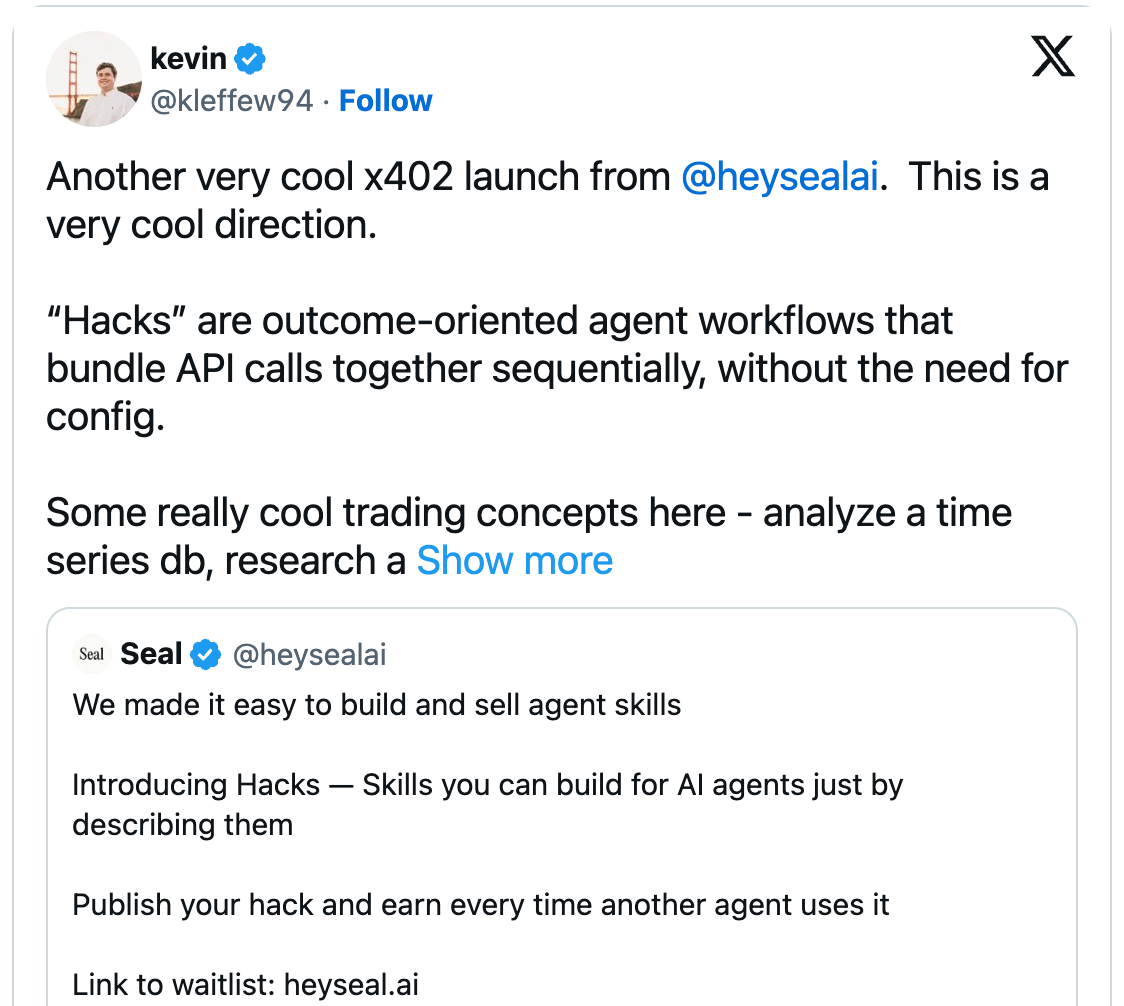

Kevin Leffew, co-author of the x402 whitepaper, commented on Seal's Hacks feature built on x402: users can create and sell AI agent automation skills described simply in text, earning revenue per call. Kevin believes this direction has broad prospects.


Significant Enhancement in Practicality of Payment Infrastructure


Two major protocol-level updates are particularly crucial:


  • Builder Codes (Developer Identifier Codes): x402 payment transactions can now be tagged with the application, client, or service intermediary that initiated the payment. This feature enables the construction of distribution affiliate and revenue-sharing systems, clearing obstacles for various marketplace ecosystems.
  • Batch Settlement: Eliminates the need for separate on-chain settlement for every small payment request. Buyers only need to pre-fund their accounts and authorize a series of consecutive purchases, with service providers later aggregating funds in batches. For high-frequency, small-amount payment scenarios like AI inference and information retrieval, where per-transaction on-chain costs and latency are infeasible, batch settlement makes the high-frequency micro-payment model a reality.


Furthermore, x402 has added support for more programming languages and compatibility with multiple blockchains, essentially lowering the integration barrier for various service providers.
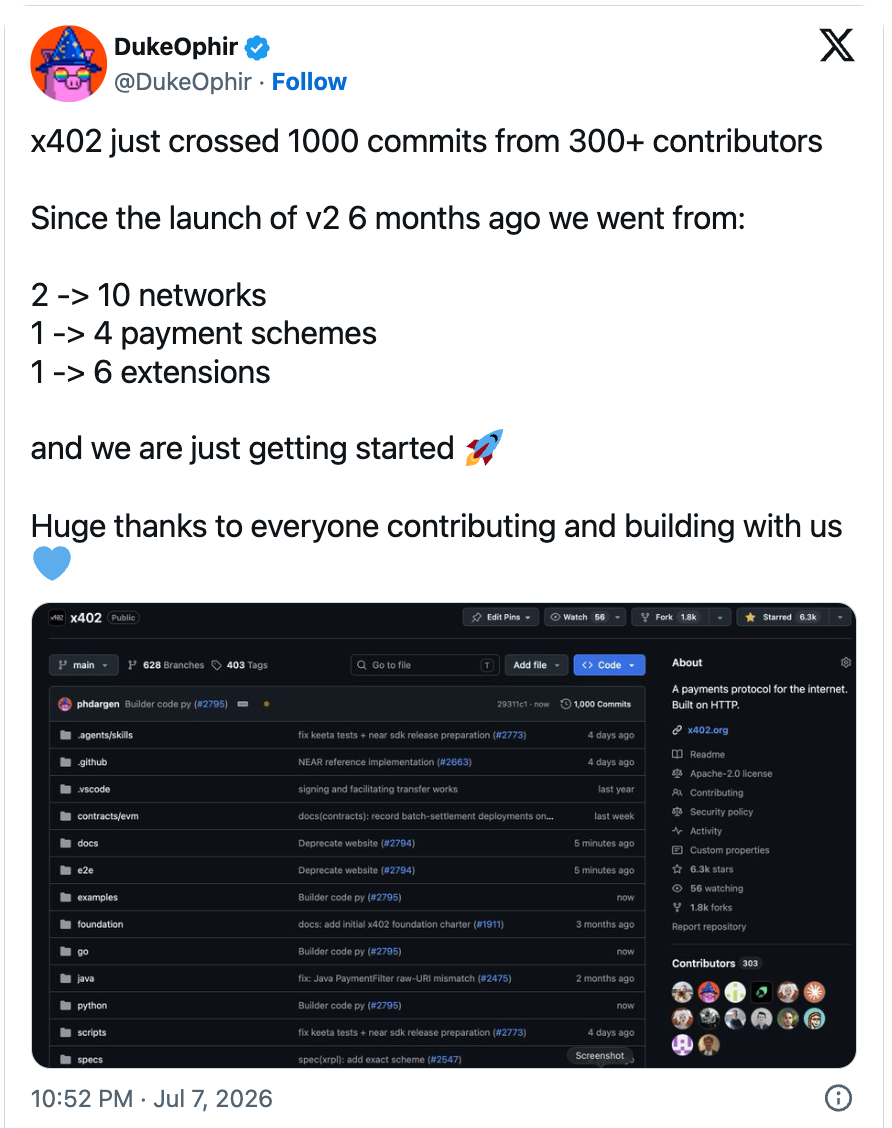

DukeOphir, a core member and de facto maintainer of the x402 ecosystem, announced project development progress: code commits exceeded 1,000, developers surpassed 300, and various technical components have expanded multiple times within half a year of v2's launch.


Channel Boost from External Mainstream Internet Giants


The most impactful developments did not originate from the crypto-native industry.


AWS launched an edge node AI traffic billing solution. When a user requests a protected resource, an AWS edge node can return pricing and payment terms, verify payment credentials, and then grant access to the resource. Any content site or API deployed on AWS can now treat AI agents as paying customers.


The main event, however, comes from Cloudflare. On July 1st, its Content Monetization Gateway officially opened for waitlist applications. Using this gateway, customers can charge for any resource hosted on Cloudflare: web content, datasets, various APIs, and tool services can all be monetized. Transactions are settled using stablecoins via x402, with payment validation occurring at the edge nodes.


Content monetization is precisely the core application scenario that initially made outsiders optimistic about x402. The current internet business model is fundamentally imbalanced: various crawler bots account for the vast majority of traffic. These bots scrape content without generating ad clicks, forcing website operators to bear bandwidth costs without revenue compensation. Cloudflare handles approximately 20% of global website traffic. Therefore, this gateway represents the first large-scale, real-world test for the model where bots pay to scrape internet content.


The biggest question at this stage is performance scaling. Cloudflare's CEO publicly endorsed x402 as the solution in a podcast but also pinpointed the core bottleneck: current blockchain throughput is temporarily insufficient to handle the required transaction volume. Even monetizing just a small fraction of Cloudflare's traffic would require millions of transactions per second, far exceeding the performance of any public chain he has tested. This performance gap must be bridged first.


Source: Bankless interview with Matthew Prince, Co-founder and CEO of Cloudflare.


Which Application Track Will Ultimately Prevail?


Several viable application tracks have already emerged within the x402 ecosystem.


AI inference routing appears to be leading in scale, with BlockRun having validated market demand: users want to access various inference services through a single interface without managing multiple individual subscriptions. The paid high-quality data track follows closely, as developers are willing to pay for superior input data, which significantly enhances large language model output quality.


Both tracks represent real and sustainable demand. However, by themselves, they are unlikely to make x402 an indispensable foundational component of the next-generation internet. In contrast, the content monetization track possesses this potential. If various AI agents need to pay for the web content they scrape, this scenario could propel x402 from being a useful tool to achieving mass adoption. The practical implementation of the Cloudflare gateway will test whether this path is viable.


Related Questions

QWhat are the two key protocol-level updates for x402 mentioned in the article, and why are they significant?

AThe two key updates are Builder Codes and Batch Settlement. Builder Codes allow payments to be tagged with the identifier of the originating application, enabling affiliate/commission systems. Batch Settlement allows for many small purchases to be authorized upfront and settled in aggregate later, making high-frequency, micro-payments for services like AI inference or data retrieval economically viable without on-chain latency and cost for every single transaction.

QWhich major non-crypto companies have recently integrated or announced support for the x402 protocol, and what are their respective contributions?

ATwo major non-crypto companies are involved: Amazon Web Services (AWS) and Cloudflare. AWS introduced an edge node AI traffic billing solution that allows resources to return pricing and validate x402 payments before granting access. Cloudflare has opened a waitlist for its Content Monetization Gateway, which will allow any resource hosted on its network (websites, APIs, data) to charge AI agents for access, settling payments via x402 at the edge.

QAccording to the article, what is currently the primary driver of transaction volume on the x402 protocol?

AThe primary driver of transaction volume is a single service provider: the inference routing project called BlockRun. The vast majority of transaction activity in June was concentrated on this platform, which provides a one-stop-shop for accessing various AI inference services.

QWhat does the article identify as the 'core bottleneck' for the success of the content monetization narrative via Cloudflare's gateway?

AThe core bottleneck is blockchain scalability/throughput. Cloudflare's CEO stated that even monetizing a small fraction of Cloudflare's traffic would require processing millions of transactions per second, a scale that far exceeds the current capacity of any blockchain he has tested. This performance gap must be bridged first.

QName at least two other application sectors or specific services (besides BlockRun) that are gaining traction within the x402 ecosystem as mentioned in the June updates.

AOther gaining sectors/services include: 1) Apify, which provides web automation and data scraping tools (e.g., for Twitter, TikTok). 2) Exa, an AI search engine that expanded x402 payment support to Solana. 3) Seal's 'Hacks' feature, which lets users create and sell custom AI agent automations. 4) Merit Systems' new data streams for its Poncho chat application.

Related Reads

Has Bitcoin Bottomed, or Is a 'Shakeout' Approaching? What's the Situation with XRP?

Cryptocurrency analytics platform Santiment shared key insights on Bitcoin and altcoin markets, highlighting significant signals from on-chain data. Analysis shows Bitcoin's 365-day MVRV ratio has fallen to -26%, indicating substantial losses for long-term holders, a level historically associated with market bottom formations and long-term buying opportunities. While short-term MVRV is near breakeven, suggesting no clear directional signal, the annual perspective points to a bottom before bullish cycles. On-chain data reveals divergent behavior: large wallets (10-10,000 BTC) have been accumulating, adding ~18,500 BTC in 10 days, while smaller retail investors continue buying dips. Analysts caution that high retail demand can sometimes create a risk of a final market shakeout or correction. The altcoin market shows a mixed picture. Ethereum's 365-day MVRV is around -33%, but recent monthly gains combined with overly optimistic social sentiment pose a short-term correction risk. XRP is in oversold territory with 30-day and 365-day MVRVs at -57.5% and -45.5% respectively, signaling potential for a strong mid-to-long term rebound. Social activity and optimism are rising for Solana, while investor sentiment remains calmer towards Cardano. Future direction for Bitcoin and altcoins depends not only on on-chain metrics but also on macroeconomic and regulatory developments. The Federal Reserve's interest rate decision and upcoming policy rulings are increasing market volatility expectations, while uncertainty around the U.S. Congressional clarity process continues to pressure pricing. *This is not investment advice.

cryptonews.ru1h ago

Has Bitcoin Bottomed, or Is a 'Shakeout' Approaching? What's the Situation with XRP?

cryptonews.ru1h ago

Bank of Korea Reveals Results of Tokenized Deposit Testing

The Bank of Korea has announced the results of its pilot test for tokenized deposits. Involving 28 central banks and international financial organizations, the project saw participation from major South Korean banks including KB Kookmin Bank, NH NongHyup Bank, Shinhan Bank, Woori Bank, and Hana Bank. Transactions, from payment orders to final settlement, were completed in real time, averaging just 80 seconds. The test involved 30 transactions across 17 different scenarios—such as corporate and interbank transfers—and was conducted in six currencies, including the Korean won, US dollar, and euro, with a total transaction value reaching approximately $995,000. The central bank reported that the platform operated stably throughout, despite being only partially connected to the existing banking infrastructure. Settlements using tokenized deposits were executed seamlessly, quickly, and transparently. An internal transfer of 20 million won (about $13,890) between NH NongHyup Bank and Shinhan Bank was also successfully processed via the Project Agora platform, which involved connecting to the Bank of Korea's CBDC test platform, Project Hangang. Additionally, KB Kookmin Bank and Japan's MUFG Bank tested cross-border payments using these deposit tokens—digital certificates issued by commercial banks within the pilot, not directly by the central bank. The Bank of Korea plans to continue testing payments with tokenized deposits. This follows last year's pledge by South Korean authorities to tighten regulations for won-based stablecoins, which will require approval from both the central bank and the Financial Services Commission.

cryptonews.ru3h ago

Bank of Korea Reveals Results of Tokenized Deposit Testing

cryptonews.ru3h ago

Trading

Spot
活动图片