It's 2026, DAOs Should Have Matured by Now

marsbitPublished on 2026-01-29Last updated on 2026-01-29

Abstract

The year 2025 marked a pivotal turning point for DAOs, shifting from idealistic experiments to a more mature hybrid model that balances decentralized oversight with operational efficiency. Key trends include a move away from pure community governance towards structures with clearer operational control, as seen with Arbitrum's OpCo and Uniswap's DUNI framework. While voter participation declined, voting power became more concentrated among active delegates. A major development was the focus on value accumulation for token holders through mechanisms like buybacks, fee switches, and burns, addressing a critical flaw in previous tokenomics. Significant conflicts, such as those at Gnosis and Aave, forced DAOs to confront issues of accountability and structural flaws. Looking ahead to 2026, key trends will include: the formalization of legal structures becoming necessary; governance evolving into risk management infrastructure; the decline of purely governance-focused tokens in favor of those with value capture; increased professional delegation; and the growing role of privacy, AI for decision fatigue, and futarchy markets. This evolution represents a maturation of the space, moving towards more effective and accountable organizations where growth benefits token holders and all participants are held responsible.

Author: Pink Brains

Compiled by: Deep Tide TechFlow

Deep Tide Intro: 2025 was a critical inflection point for decentralized governance (DAO). After years of idealistic experimentation, mainstream protocols began to seriously address core pain points such as power distribution, accountability mechanisms, and sustainability. This article, written by seasoned DAO delegate Pink Brains, draws from the practical experience of casting 725 votes within top protocols like Aave, Lido, and Gnosis, offering an in-depth analysis of the shift in DAOs from 'community autonomy' to a 'hybrid operation' model.

The author points out that governance tokens alone are no longer sustainable. The future of DAOs will evolve towards economic alignment, legal entity formation, and AI-assisted decision-making. This is not just a review of governance but also a prophecy for the evolution of Web3 organizational structures in 2026.

Full Text Below:

2025 marked a turning point for decentralized governance.

After years of experimentation, major protocols began to confront fundamental questions about power distribution, accountability, and sustainability.

The answers weren't always pleasant, but they were necessary.

What We Achieved in 2025

2025 was also the first year of our operation as an active DAO Delegate.

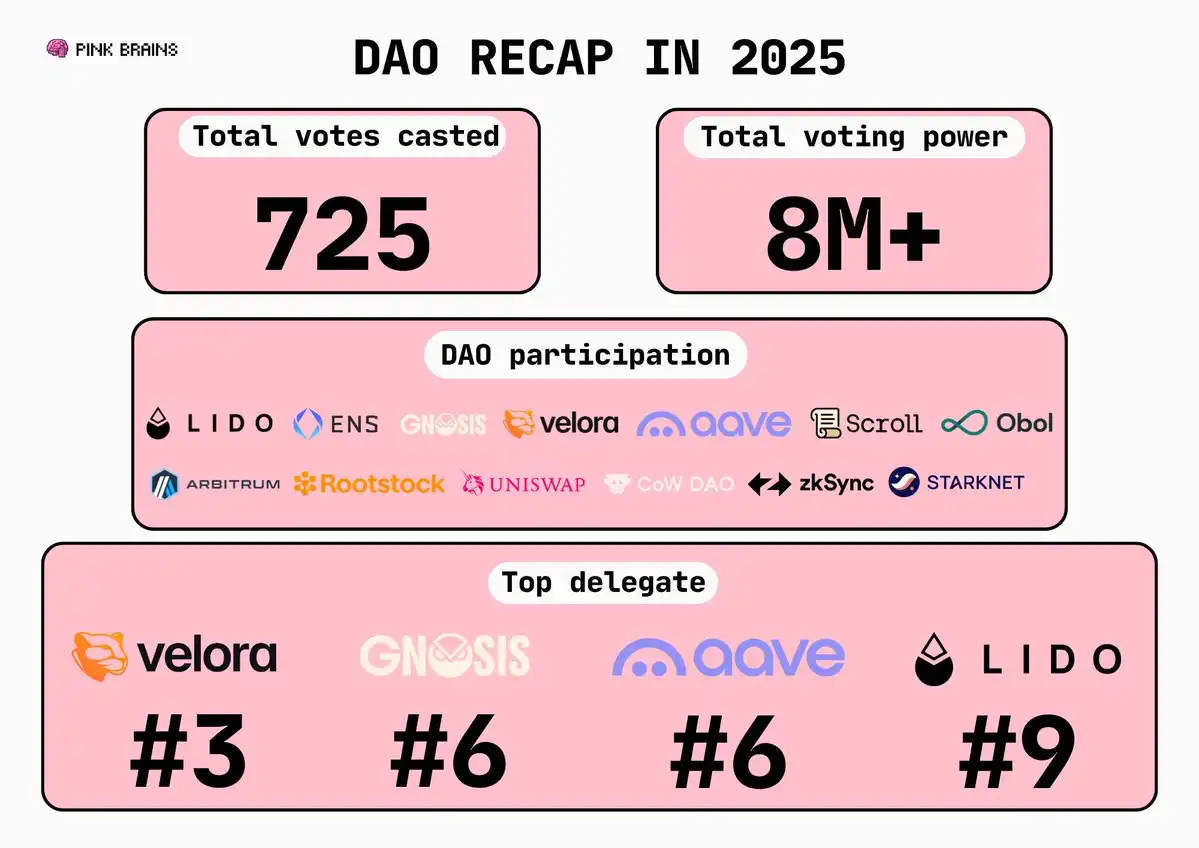
  • Cast 725 votes across 18 protocols
  • Held voting power exceeding 8 million
  • Top 10 delegate in Aave and Lido
  • Top 3 delegate in Velodrome
  • Top 6 delegate in Gnosis

This perspective, grounded in practical governance work, allowed us to clearly observe the patterns reshaping DAOs in 2025 and define their trajectory entering 2026.

Changes in DAOs in 2025

Shift in Operational Model: From Pure Community Governance to Hybrid Control

The most significant change in 2025 was the shift from purely community governance towards hybrid models with clearer operational control.

  • @arbitrum introduced an Operating Company (OpCo), channeling all DAO operations through a unified structure.
  • @JupiterExchange completely paused governance for nearly six months to reassess its approach.
  • @Uniswap launched the DUNI framework, centralizing operational authority.
  • The @Gnosis DAO executed a hard fork amidst reduced community engagement. Scroll transitioned to a CEO-led structure.
  • @Scroll_ZKP paused its DAO, shifting focus to centralized governance.
  • Recently, the Celo Foundation merged with @cLabs into a unified core contributor organization.
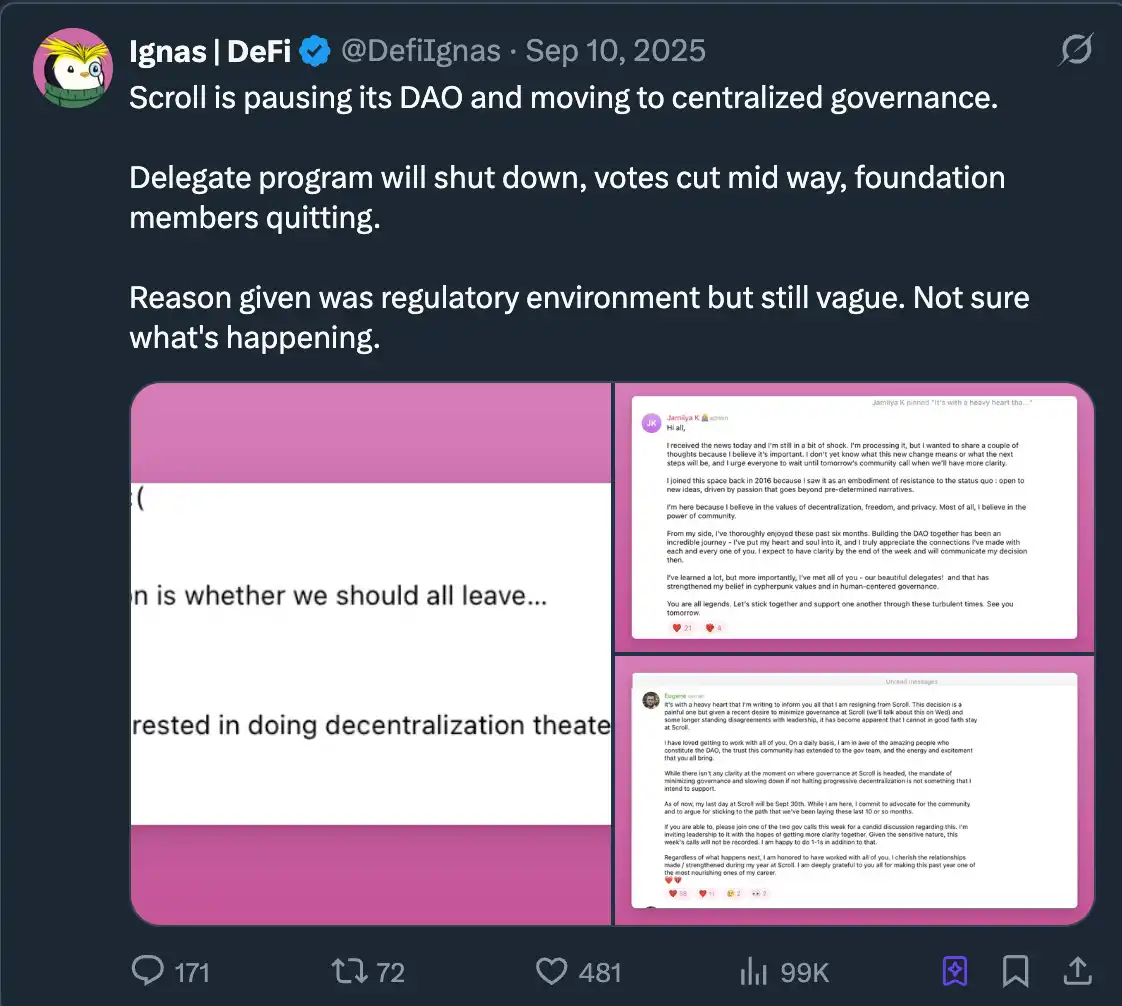
The motivation for this shift was DAOs hitting scaling limits. Execution became the bottleneck. Community-wide votes were often too slow for operations, too noisy for technical nuances, and too vulnerable for security-sensitive actions.

Consequently, governance power is concentrating towards smaller, high-context groups, while the broader community shifts towards an oversight role, as reflected in the next section.

Fewer Voters, But More Concentrated Power

In 2025, the number of proposals and voter participation dropped significantly across major DAOs. However, the voting power behind each proposal remained strong.

  • Lido saw an increase in participation after adopting a dual governance framework.
  • Arbitrum and Uniswap still had the highest overall participation, but the number of voters decreased for both.
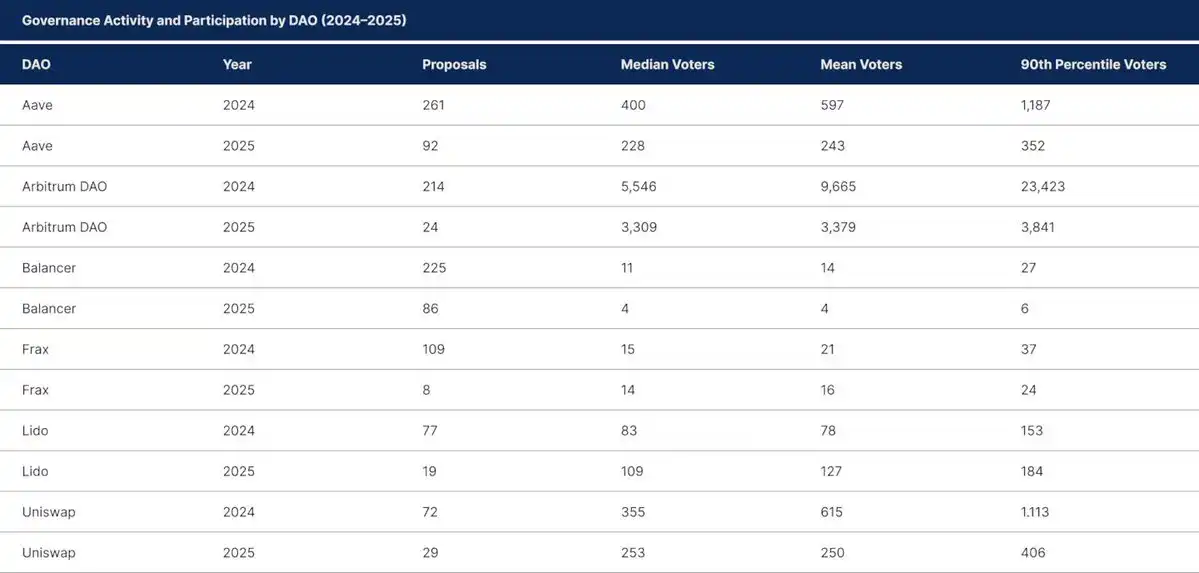
Caption: From DeFiLlama's State of DeFi 2025 Report

This does not signal the failure of governance. Instead, governance is becoming more bundled, more operationally abstract, and less frequent.

Governance influence migrated to a small number of highly active Delegates and large capital participants.

Value Accrual for Token Holders

"Token buyback", "buyback and burn", and "fee switch" became central themes in 2025.
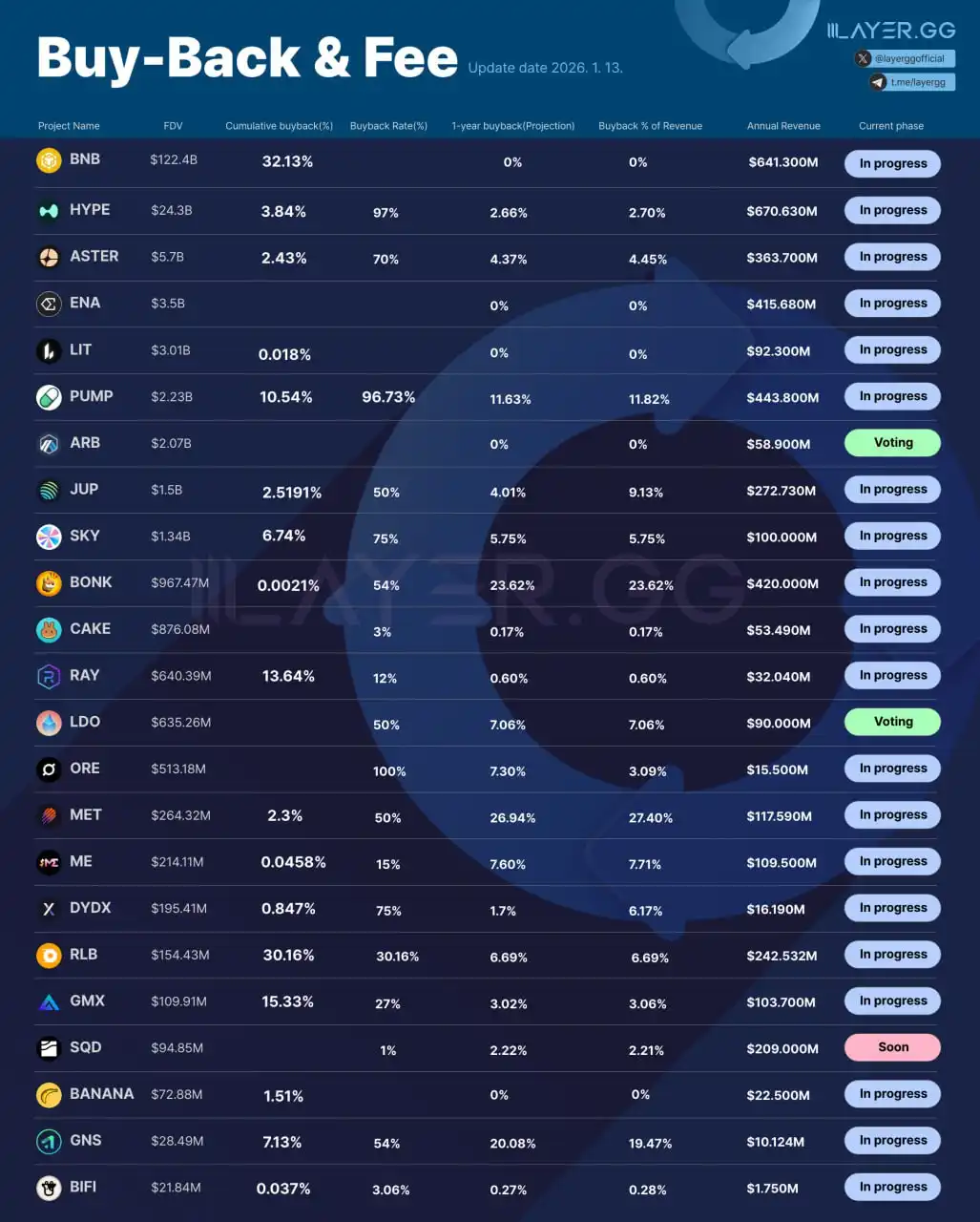
For years, token utility revolved around voting rights and incentive distribution, but offered minimal economic value to token holders. 2025 changed this equation.

  • Lido adopted a buyback framework.
  • Uniswap DAO activated the long-awaited fee switch, pledging to burn nearly $600 million worth of UNI tokens.
  • Aave implemented a token buyback mechanism. Optimism launched a buyback program.
  • CoW Protocol increased solver profitability in a way that benefits token holders.

This trend addresses a key challenge in tokenomics. Buybacks and burns reduce circulating supply, making the token more scarce. If demand remains stable, the price strengthens. When token holders can truly benefit from the protocol's success, they are more incentivized to buy, hold, and participate in governance decisions long-term.

Who Really Owns the DAO?

Two major controversies forced DAOs to confront structural flaws.

  • Gnosis voted to terminate Karpatkey's treasury mandate due to fee disputes, underperformance, and a ~$700k loss related to liquidity issues.
  • Tensions flared between Aave DAO and Aave Labs when it was discovered that approximately $10 million annually in swap fees from the CoW Swap integration were flowing to Aave Labs instead of the DAO. A vote on brand ownership failed, and the controversy left a harder question: what does "DAO-owned" really mean when the core team controls development and distribution?

These conflicts forced protocols to patch holes in accountability and governance structures.

Legal Infrastructure is Adapting to DAOs

Despite DeFi's growth, most DAOs still lack clear legal structures, creating increasing liability and regulatory risks as protocols scale.

While jurisdictions like Wyoming have introduced DAO LLC frameworks, and Switzerland offers mature legal pathways, most DAOs remain in a legal gray area.

2026 Trend Predictions

Centralized DAO as a New Practice

Protocols will develop clear frameworks to delineate "community decisions" from "operational decisions," moving beyond the false binary of "fully decentralized" or "fully centralized."

  • Operational Execution: Will be handled by Labs teams, not foundations.
  • Community Oversight: DAO delegates and the community will be responsible for treasury strategy, long-term direction, and major structural decisions.

Governance Shifts to Risk Management Infrastructure

The DAO of the future will look less like a forum full of chatter. More teams will bifurcate decisions into concave decisions and convex decisions.

Concave problems require:

  • Pre-approved guardrails and automated execution.
  • Professional oversight (risk services, auditors, security teams).
  • Rapid response frameworks for emergencies and market shocks.
  • Fewer proposals, but each decision carries higher economic impact.

Convex problems (like product direction) require decisive leadership, where the DAO acts as a "brake" or "checkpoint," not the "steering wheel."

By 2026, this will be standard for lending, stablecoins, perps, and any protocol where financial risk can compound quickly.

The End of Governance Tokens? Value Capture Must Be Built

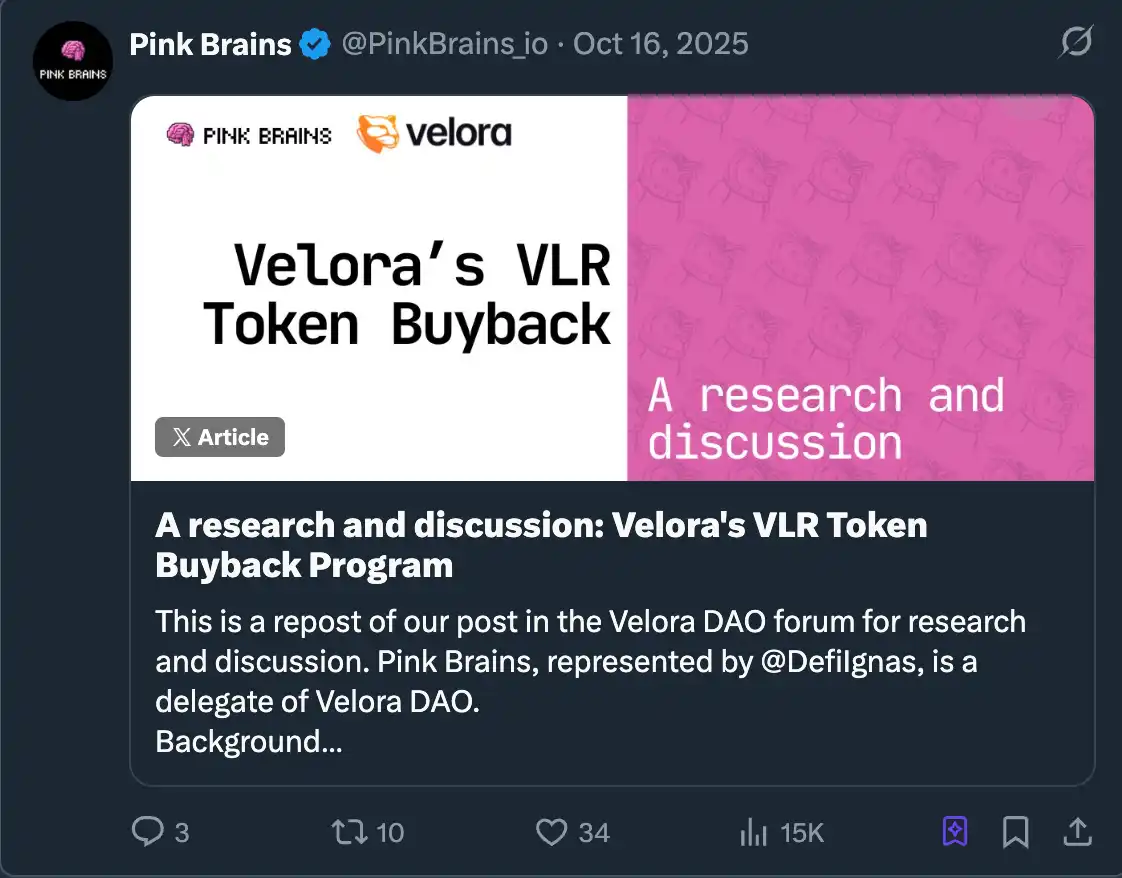
Continuing into 2026, tokens with only governance functions will struggle to maintain long-term engagement.

Delegates, whales, and strategic holders will not consistently protect the system without a visible upside. Protocols will increasingly adopt at least one value accrual path:

  • Token buyback frameworks.
  • Fee diversion or revenue sharing.
  • Staking tied to protocol cash flows.
  • Treasury strategies aimed at supporting the token's value.

When holders gain economically from the protocol's success, they are incentivized to stay attentive, participate, and protect the system.
Legal Structures Shift from Optional to Necessary

Regulatory pressure and real-world legal challenges will push DAOs towards formal entity formation, seeking a balance between decentralized governance and legal clarity.

Professional Delegation

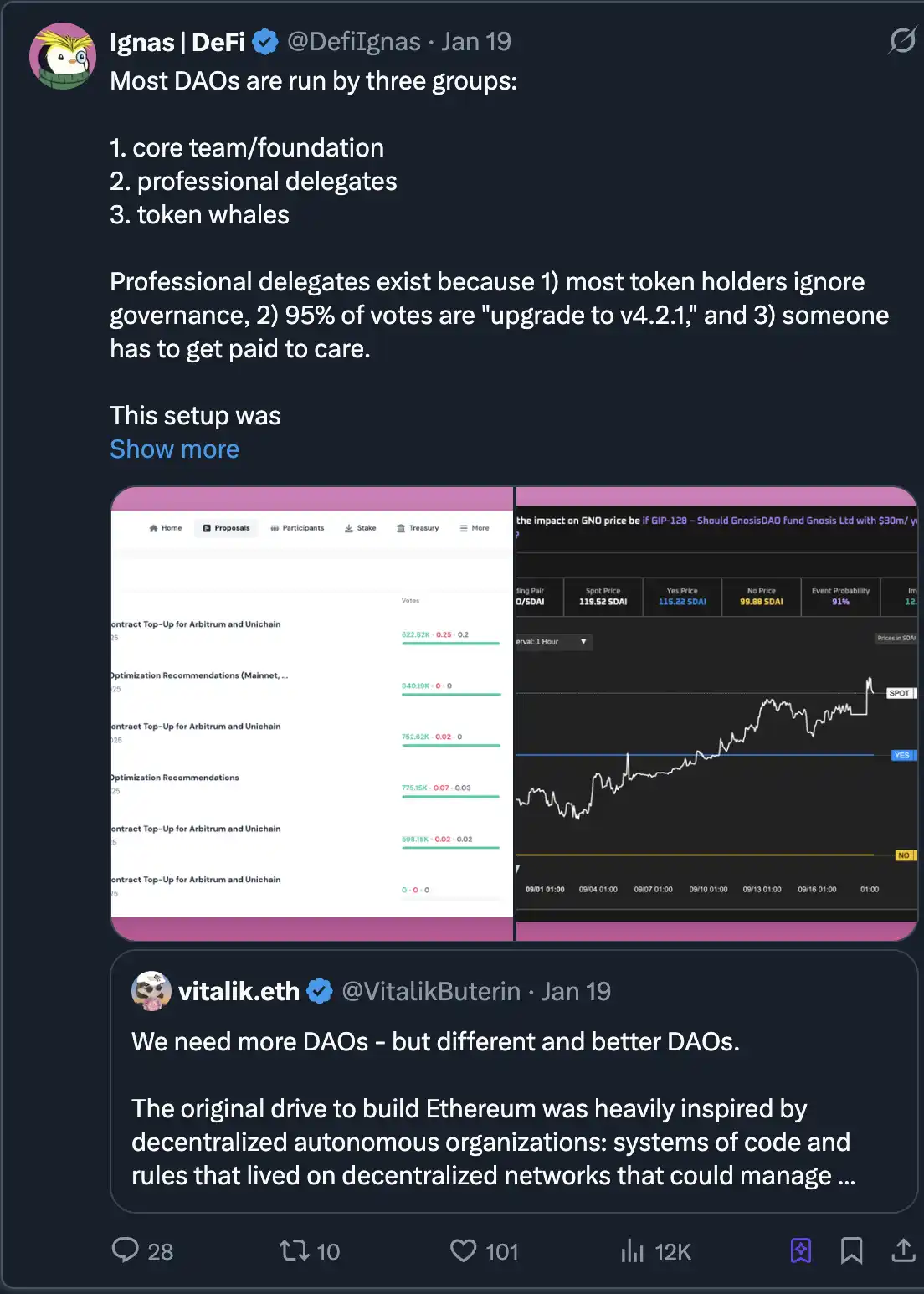
As governance complexity increases, token holders will increasingly delegate to full-time professional delegates. While this concentrates voting power, it may improve decision quality. Meanwhile, weaker delegate institutions that cannot financially sustain themselves will fold, as governance work becomes more professional, political, and costly.
Privacy, AI & Futarchy

Public governance is a social game. When every vote is public, decisions are influenced by reputation, pressure, and alliances, not purely the protocol's best interest. Therefore, governance privacy will become more important in the future.

AI will address decision fatigue. It can assist in analyzing proposals and auto-voting on routine upgrades based on user-defined preferences, requiring human intervention only for disputes or significant impact.

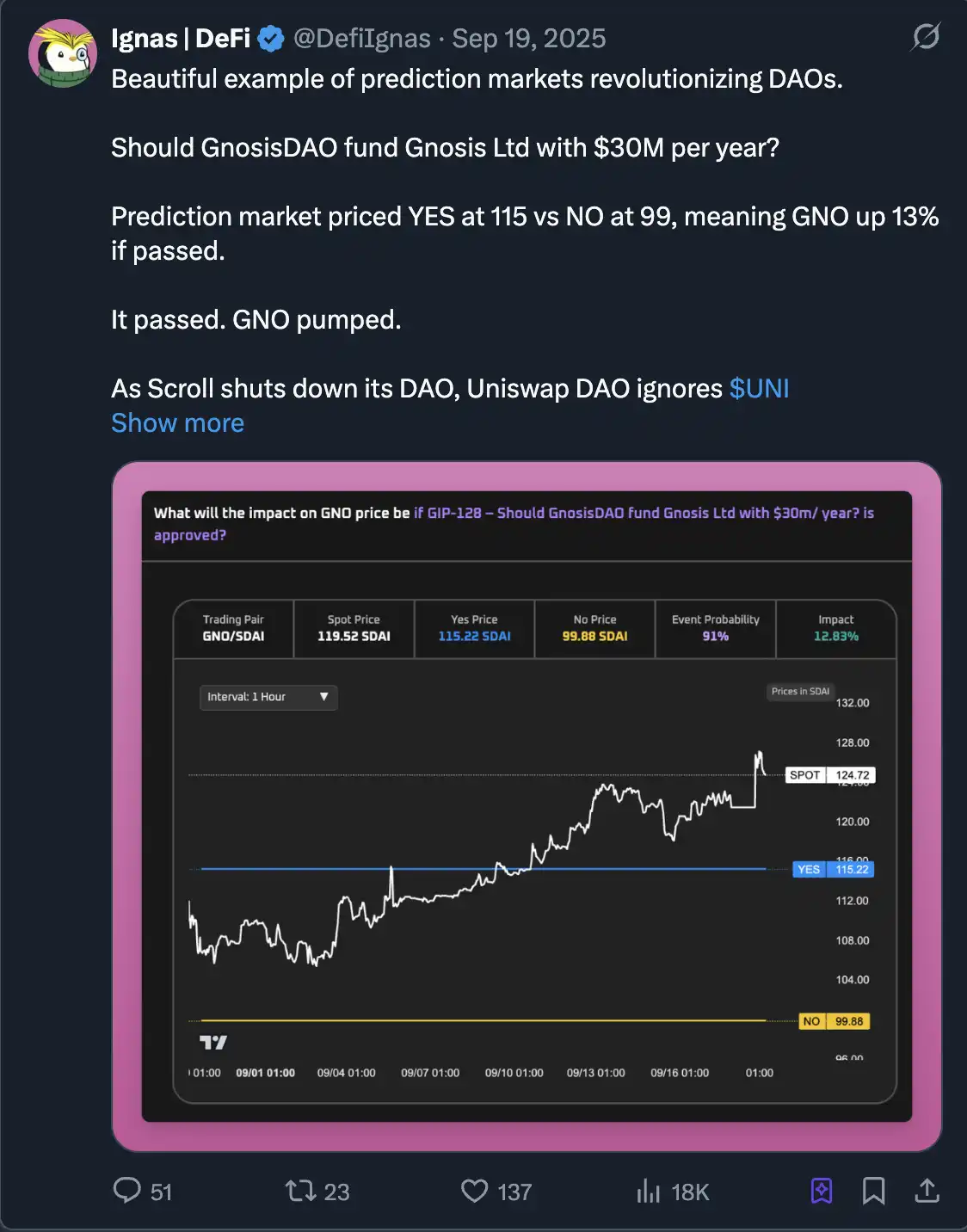
Futarchy markets will also play a larger role in DAOs. They let market signals predict which option might create value. Gnosis is testing this model, using retail prediction markets to reflect sentiment on proposals.
Crypto is Maturing, and So Are DAOs

The shifts we see in DAO operations, economic alignment, accountability conflicts, and professionalization represent maturation, not the end of DAOs.

DAOs are evolving from ideological experiments into organizational structures that balance "decentralized oversight" with "proven operational efficiency." We believe DAO governance becomes more meaningful if teams can align with community interests: moving fast when action is needed, letting growth benefit token holders, and holding all participants—core teams and delegates alike—accountable.

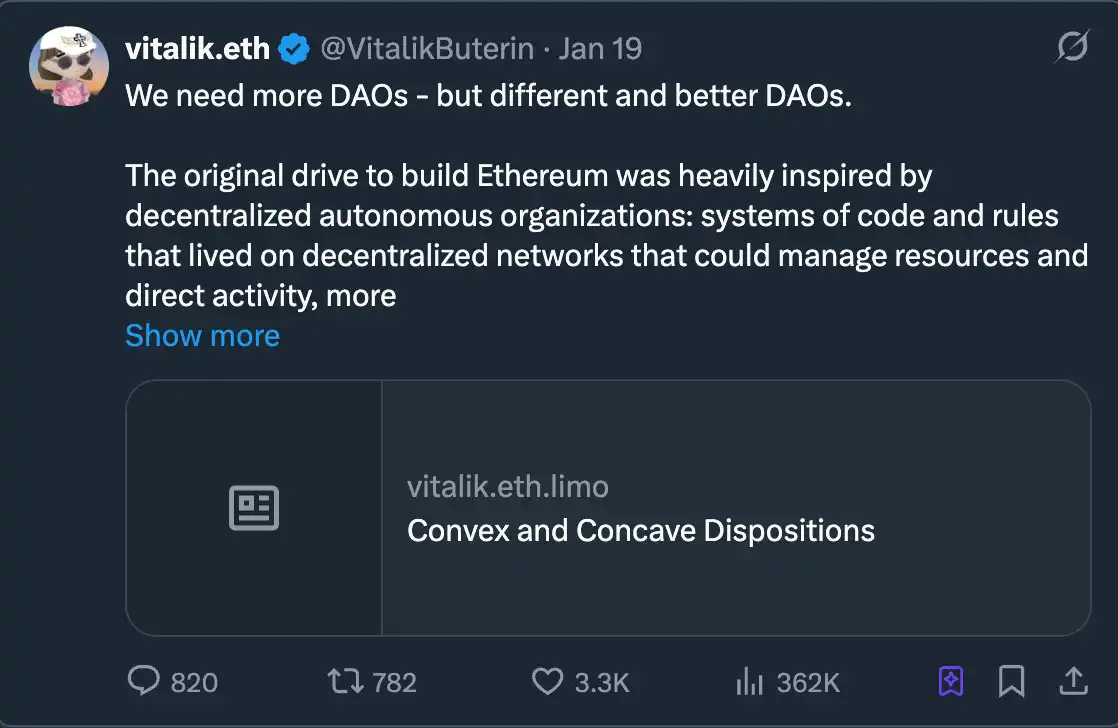
As Vitalik said: We need more DAOs, but different and better ones.
If you believe in the value of DAOs, we can be your voice.

Effective delegation is more than just casting a vote; it means doing the actual work: reading proposals, staying active on forums, understanding risks, and voting against bad decisions even when it's not popular.

This is how we operate as delegates: through clear communication and educational content, helping protocols grow while staying aligned with community incentives.


Related Questions

QWhat was the most significant shift in DAO operational models in 2025 according to the article?

AThe most significant shift was the transition from pure community governance to hybrid models with clearer operational control, where governance power was concentrated into smaller, high-context groups while the broader community shifted to a supervisory role.

QHow did the trend of 'value accumulation for token holders' manifest in major protocols in 2025?

AIt manifested through mechanisms like token buybacks, burns, and fee switches. For example, Lido adopted a buyback framework, Uniswap DAO activated its fee switch to burn nearly $600 million worth of UNI, and Aave and Optimism implemented token buyback programs.

QWhat two major controversies forced DAOs to confront their structural flaws in 2025?

AThe first was Gnosis voting to terminate Karpatkey's treasury mandate due to fee disputes, underperformance, and a $700,000 loss. The second was the conflict between Aave DAO and Aave Labs over approximately $10 million in annual swap fees from a CoW Swap integration that went to the Labs instead of the DAO.

QWhat is one key prediction for DAO governance in 2026 regarding decision-making?

AGovernance will shift towards risk management infrastructure, where decisions are split into 'concave decisions' (requiring pre-approved guardrails, professional oversight, and fast response frameworks) and 'convex decisions' (requiring decisive leadership with the DAO acting as a brake or checkpoint).

QWhy does the article suggest that 'governance privacy' will become more important in the future?

ABecause public governance is a social game where decisions can be influenced by reputation, pressure, and alliances rather than the protocol's best interest. Privacy in governance can help mitigate these influences and lead to more objective decision-making.

Related Reads

7 Months After the Collapse of Huiwang, Southeast Asia's Escrow Platforms Undergo a Major Reshuffle

Following the collapse of Huione Pay—dubbed the "Alipay of Southeast Asia"—seven months ago, the region's underground financial guarantee platform sector is undergoing a significant reshuffle. This power vacuum has been swiftly filled by emerging platforms such as XinBi, Tiger/Navigator, JinBei (renamed JinBo), Dali/Tiancheng, and FullyLight. These platforms, operating largely via Telegram and offering services like escrow for illicit transactions, have absorbed the vast user base and markets left behind by Huione. While positioning themselves as "trust intermediaries," their primary clientele consists of networks involved in online scams, money laundering, illegal gambling, and even human trafficking. For instance, the Tiger/Navigator platform explicitly provides "escrow" services for kidnapping-for-ransom operations ("强押车交易"). Data underscores the immense scale: Huione alone processed over $103 billion in cryptocurrency payments and facilitated over $31 billion through its escrow market before its downfall, linking it to Cambodia's notorious Prince Group. Since its collapse, competitors have seen explosive growth. For example, the XinBi platform has accumulated over $1.6 billion in total USDT revenue, while platforms like NewPay, OkPay (under Dali), and FullyLight Wallet collectively processed over $4.8 billion in USDT in a single year. This ecosystem thrives in regions like Cambodia and Myanmar, where regulatory gaps allow these platforms to act as critical financial infrastructure for sprawling cybercrime industries, from scam compounds to online casinos. The article concludes that the moniker "Southeast Asian Alipay" is a misnomer, obscuring the platforms' fundamental role in enabling serious criminal enterprises rather than representing legitimate financial innovation.

Odaily星球日报20m ago

7 Months After the Collapse of Huiwang, Southeast Asia's Escrow Platforms Undergo a Major Reshuffle

Odaily星球日报20m ago

The Changing Landscape: What Are Crypto VCs Experiencing?

Title: The Shifting Landscape of Crypto Venture Capital The era of dedicated crypto venture capital funds is undergoing a significant transformation. Once essential for navigating the sector's complexity and high risk, these specialized funds are now facing an identity crisis as the market matures. This shift mirrors historical patterns in other specialized investment classes like cleantech and SPACs, where initial information advantages dissipate as technologies become mainstream and integrated into existing industry frameworks. The article argues that crypto is reaching a critical inflection point, transitioning from a "building phase" to an "integration phase." Major players like Stripe, BlackRock, and Visa now engage with crypto not for its novel mechanics but as a foundational financial infrastructure. Their needs—regulatory compliance, banking partnerships, distribution channels—align with traditional fintech, a domain easily understood by large, generalist funds like Sequoia and Founders Fund. This evolution creates a "barbell effect" within the VC landscape. On one end are massive, diversified platforms that can incorporate crypto as one vertical among many. On the other are small, nimble funds focused on niche, experimental projects. The middle ground—medium-sized dedicated crypto funds—is being squeezed out. Their typical fund size makes it impossible to generate sufficient returns solely from early-stage crypto bets, yet they cannot compete with giants for later-stage deals. Consequently, leading crypto-native firms like Paradigm and Framework Ventures are expanding into AI, robotics, and other sectors, driven partly by LP pressure for better returns amid a broader VC DPI crisis. Others, like Dragonfly and a16z, have narrowed their crypto focus predominantly to financial infrastructure like stablecoins, reframing the sector's core narrative. For crypto entrepreneurs, this consolidation presents challenges. While generalist funds offer larger checks and broader resources, crypto projects now compete fiercely with AI for attention and capital within these firms. Furthermore, the long-term, non-commercial foundational work that built the ecosystem—funded by dedicated crypto VCs—is less likely to attract generalist capital focused on direct returns. The conclusion is that "crypto investor" as a standalone category is becoming obsolete, akin to "internet investor." Crypto is becoming a baseline infrastructure layer. The future will see a barbell structure: large-scale growth financing handled by generalist funds, while pioneering, speculative projects are funded by small, specialized vehicles. The dedicated crypto funds of the 2017-2021 boom, which incubated core infrastructure, are giving way to this new, bifurcated reality.

Foresight News37m ago

The Changing Landscape: What Are Crypto VCs Experiencing?

Foresight News37m ago

As Consensus Accelerates, What Are Young Investors Betting On?

Title: As Consensus Forms Faster, What Are Young Investors Betting On? In the rapid evolution of tech investment, a new generation of young investors is navigating a landscape where AI, robotics, commercial aerospace, and quantum computing are advancing simultaneously. Traditional investment logic based on financial models is giving way to a need for deep technical understanding and the ability to act before industry consensus forms. An analysis of trends from the "WAIC FUTURE TECH" list of young investment leaders reveals key shifts in focus. The first major trend is the movement of AI from the digital screen into the physical world. Investment is shifting from large language models and chatbots towards embodied AI, robotics, AI hardware, and edge computing. While demonstrations generate excitement, the real challenge lies in achieving scalable, reliable, and cost-effective delivery in complex real-world environments like factories and logistics. Success depends not just on algorithms but on the integration of sensors, actuators, and control systems. Second, the competitive focus for large models is moving beyond raw capability toward building an "intelligence flywheel." The goal is to create self-reinforcing systems where user interaction generates data, improving the model, which in turn enhances the user experience and attracts more engagement. Companies that successfully embed AI into workflows to create these closed-loop systems can build lasting value that isn't easily erased by the next model upgrade. Third, facing a potential bottleneck in high-quality human-generated data, investors are looking at new underlying technologies. Reinforcement learning and self-play, as demonstrated by AlphaGo Zero, offer paths for AI to generate its own experience. Scientific foundation models, which aim to build general AI capabilities for fields like life sciences and materials discovery, represent a non-consensus direction that could unlock new frontiers of knowledge and data. Finally, in deep-tech areas like quantum computing, commercial aerospace, and space-based infrastructure, patient capital is essential. These fields have long, uncertain development and validation cycles involving complex engineering, supply chains, and regulations. Investment here requires a long-term view, focusing on foundational team capabilities and the eventual emergence of market demand, even if commercial returns are distant. Collectively, these trends illustrate how young investors are adapting to a new era. They are learning to make earlier, technically-informed judgments, balance hype with real-world viability, and provide the patient capital needed to build the deep-tech foundations of the future.

marsbit1h ago

As Consensus Accelerates, What Are Young Investors Betting On?

marsbit1h ago

Trading

Spot
活动图片