Is XRP The Solution To Everything? Ripple President Drops Bombshell That Changes Everything

bitcoinistPublished on 2026-04-05Last updated on 2026-04-05

Abstract

Ripple President Monica Long highlighted decentralized identities (DIDs) as a key area for XRP dominance, stating they allow users to reclaim control from web2 companies. By tokenizing identities on the XRP Ledger (XRPL) using zero-knowledge proofs (ZKPs), individuals can make their identities portable and delegate access securely. This enables verification without revealing sensitive data, such as KYC or DNA. The XRPL is advancing with ZK technology, having executed its first privacy transaction on testnet via the DNA Protocol. This innovation allows institutions to confirm compliance without accessing actual data, combining privacy with regulatory needs. ZK technology is expected to enhance scalability and attract institutional use. XRP was trading around $1.31 at the time of writing.

Ripple President Monica Long has highlighted decentralized identities as another area in which XRP could dominate. This came as she explained why these decentralized identities are a game-changer.

Ripple President Reveals Another Key Area For XRP

In an X post, crypto pundit John Squire drew attention to the Ripple President’s statement in which she noted that decentralized identities will enable users to take back control of their identities from web2 companies. With decentralized identities, individuals will be able to tokenize their identities on a network such as XRP Ledger (XRPL).

Long noted that this tokenization will make these decentralized identities transportable and enable individuals to delegate access to whoever they want. John Squire described decentralized identities as a game-changer. He noted that individuals will be able to turn their identity, KYC, and even DNA into a private portable token on the XRP Ledger using zero-knowledge proofs.

The pundit added that the decentralized identities will enable everyone to prove everything without revealing anything. The XRP Ledger is already making progress with zero-knowledge proofs as the network looks to provide privacy for network users. Crypto pundit Pumpius recently highlighted how the network has made history with the first-ever zero-knowledge (ZK) privacy transaction going live on the testnet.

The pundit stated that the DNA Protocol was responsible for these ZK privacy transactions on the XRP Ledger. The protocol turned real-world data into a ZK proof, verified on-chain with zero sensitive information exposed. Pumpius added that with plans to implement ZK proof on the XRPL, banks, governments, and institutions can now confirm everything. This includes KYC, medical records, financials, and compliance, without ever seeing the actual data.

ZK Technology Will Be A Game Changer On XRPL

Ripple’s Head of Research, Aanchal Malhotra, said that it will be great for the XRP Ledger to implement zero-knowledge technology. She noted that this will enable several use cases and that there are many innovative applications they can build with this technology. ZK technology will enable several privacy features, which would further attract institutions to the network.

Crypto pundit Minus noted that ZK technology will enable privacy without sacrificing compliance. Furthermore, he said that this would lead to selective disclosure and “insane scalability.” That way, “Institutions can finally have their cake and eat it too,” he added.

It is worth noting that the XRP Ledger is already moving to implement privacy features natively on the network, including Permissioned Domains, which enable institutions to restrict access to authorized users. The network has also enabled Confidential Multi-Purpose Tokens (Confidential MPTs), which hide the balances and transaction amounts.

At the time of writing, the XRP price is trading at around $1.31, down in the last 24 hours, according to data from CoinMarketCap.

XRP trading at $1.31 on the 1D chart | Source: XRPUSDT on Tradingview.com

Related Questions

QWhat key area for XRP did Ripple President Monica Long highlight in her recent statement?

AMonica Long highlighted decentralized identities as another key area in which XRP could dominate, enabling users to take back control of their identities from web2 companies.

QHow does John Squire describe the potential of decentralized identities on the XRP Ledger?

AJohn Squire described decentralized identities as a game-changer, allowing individuals to turn their identity, KYC, and even DNA into a private portable token on the XRP Ledger using zero-knowledge proofs, enabling them to prove everything without revealing anything.

QWhat recent technological milestone was achieved on the XRP Ledger testnet related to privacy?

AThe first-ever zero-knowledge (ZK) privacy transaction went live on the XRP Ledger testnet, implemented by the DNA Protocol, which turns real-world data into a ZK proof verified on-chain without exposing sensitive information.

QAccording to Ripple's Head of Research, why is implementing zero-knowledge technology great for the XRP Ledger?

AAanchal Malhotra stated that implementing zero-knowledge technology on the XRP Ledger will enable several use cases and innovative applications, providing privacy features that would further attract institutions to the network.

QWhat are some existing privacy features already implemented or being developed on the XRP Ledger?

AThe XRP Ledger is implementing privacy features natively, including Permissioned Domains to restrict access to authorized users and Confidential Multi-Purpose Tokens (Confidential MPTs) to hide balances and transaction amounts.

Related Reads

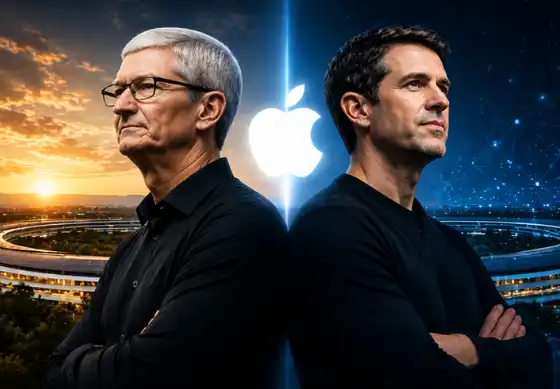
Cook's Curtain Call and Ternus Takes the Helm: The Disruption and Reboot of Apple's 4 Trillion Dollar Empire

Tim Cook has officially announced he will step down as CEO of Apple in September, transitioning to executive chairman after a 15-year tenure during which he grew the company’s market value from around $350 billion to nearly $4 trillion. He will be succeeded by John Ternus, a 50-year-old hardware engineering veteran who has been groomed for the role through increasing public visibility and internal responsibility. Ternus’s appointment signals a strategic shift toward hardware and engineering leadership, with Johny Srouji—head of Apple Silicon—taking on an expanded role as Chief Hardware Officer. This consolidation aims to strengthen Apple’s core technological capabilities. However, Cook’s departure highlights a significant unresolved issue: Apple’s delayed and fragmented approach to artificial intelligence. Despite early efforts, such as hiring John Giannandrea from Google in 2018, Apple’s AI initiatives—particularly around Siri—have struggled with internal restructuring and reliance on external partnerships, including with Google. The transition comes at a critical moment as Apple faces paradigm shifts with the rise of artificial general intelligence (ASI). The company’s closed ecosystem of hardware, software, and services—once a major advantage—now presents challenges in adapting to an AI-centric world where intelligence may matter more than the device itself. Ternus must quickly articulate a clear AI strategy, possibly starting at WWDC, to reassure markets and redefine Apple’s role in a new technological era. His task is not only to maintain Apple’s operational excellence but also to reinvigorate its capacity to innovate and lead in the age of AI.

marsbit1h ago

Cook's Curtain Call and Ternus Takes the Helm: The Disruption and Reboot of Apple's 4 Trillion Dollar Empire

marsbit1h ago

Trading

Spot
Futures
活动图片