Is Shiba Inu About to Repeat Its Bearish Playbook Again This Month?

TheNewsCryptoPublished on 2025-12-26Last updated on 2025-12-26

Abstract

Shiba Inu is on track to repeat its typical bearish December performance, declining 14.15% so far in December 2025 with only five days remaining. Historical trends show SHIB often struggles in the final month of the year, with significant losses in December 2021 (29.5%), 2022 (13.5%), and 2024 (21%). The only exception was a 24.6% gain in December 2023. To finish this month positively, SHIB would need to rally approximately 16.64% from current levels, reaching at least $0.0000084.

Shiba Inu is on track to repeat its bearish December performance as the month draws to a close. With only five days remaining in December 2025, the meme coin has declined 14.15% and shows limited signs of recovery. The pattern reinforces historical trends that have seen SHIB struggle during the year’s final month.

The fourth quarter of 2025 has proven difficult for Shiba Inu holders amid broader cryptocurrency market weakness. This downward pressure extended into December, with the token losing value consistently throughout the month. Historical data reveals December has frequently been an unfavorable period for SHIB price action.

Historical December performance shows consistent losses

December 2021 saw Shiba Inu close down 29.5% as investors took profits following the 2021 bull run. The token had achieved massive gains earlier in the year, prompting holders to exit positions during the final month.

December 2022 brought another 13.5% decline. The FTX exchange collapse in November triggered widespread panic across crypto markets, with billions wiped from total market capitalization. SHIB continued declining through December as investors reduced risk exposure.
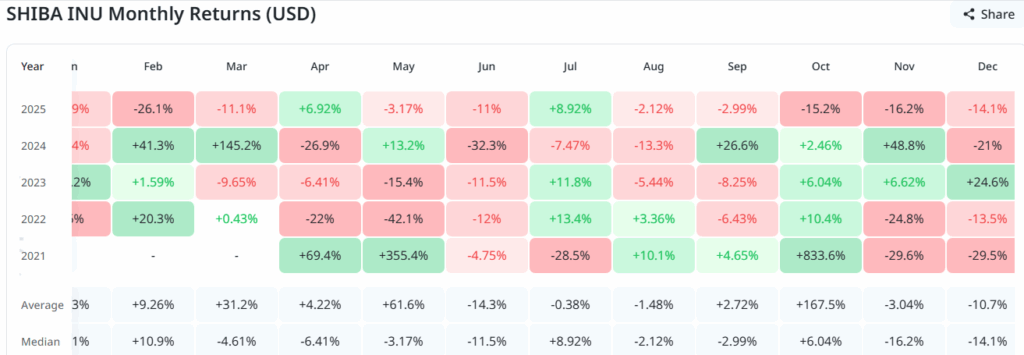
December 2023 provided the only exception to this bearish pattern. Shiba Inu closed that month with a 24.6% gain, delivering double-digit returns that defied the historical trend. Many investors anticipated this positive performance would continue into the following year.

Instead, December 2024 reversed course with a 21% decline. Investors locked in gains after SHIB rallied to $0.000033 during the post-election surge earlier that month. Profit-taking pressure overwhelmed buying demand as the year concluded.

Current month mirrors bearish December trend

December 2025 is following the established pattern of negative performance. Shiba Inu opened the month trading at $0.000008385 and has already fallen close to 14%.

For SHIB to finish December in positive territory, the price must climb to at least $0.0000084 within the remaining five days. This would require a rally of approximately 16.64% from current levels.


TagsShiba Inu

Related Questions

QWhat is the current performance trend of Shiba Inu in December 2025?

AShiba Inu is declining, having fallen 14.15% so far in December 2025, and is on track to repeat its historical bearish performance for the month.

QWhich previous December was the only exception to Shiba Inu's typical bearish trend?

ADecember 2023 was the only exception, as Shiba Inu closed that month with a 24.6% gain.

QWhat major event in November 2022 contributed to Shiba Inu's decline that continued into December?

AThe collapse of the FTX exchange in November 2022 triggered widespread panic across crypto markets, leading to a 13.5% decline for SHIB in December as investors reduced risk exposure.

QHow much does Shiba Inu need to rally in the remaining days to finish December 2025 in positive territory?

AShiba Inu needs to rally approximately 16.64% from its current level to reach at least $0.0000084 and finish December in positive territory.

QWhat was cited as the reason for Shiba Inu's 21% decline in December 2024?

AThe decline was due to investors locking in gains after SHIB rallied to $0.000033 during the post-election surge earlier that month, with profit-taking pressure overwhelming buying demand.

Related Reads

CPU, Quietly Returning to the Center of the AI Computing Power Stage

Over the past three years, AI computing power narratives have been dominated by GPUs. However, starting in 2026, this story began to shift. While training large models remains GPU-intensive, the rapid growth of inference and AI agent workloads, which require high levels of task orchestration, concurrency, and data flow management, has highlighted a renewed critical role for CPUs. These are tasks GPUs are not designed to handle. Intel's recent launch of the Xeon 6+ processor, built on its Intel 18A process and featuring up to 288 efficiency cores (E-cores), exemplifies this strategic pivot. It is positioned not as a mere companion to GPUs but as the essential "control plane" for AI infrastructure, optimized for high-density, energy-efficient, and high-throughput workloads characteristic of AI agents and inference. This "CPU resurgence" is not about CPUs outperforming GPUs in raw computation. It reflects a systemic bottleneck: as AI scales from training single models to deploying countless intelligent agents, the demand for coordination and data handling surges. Major cloud providers are also developing their own high-density ARM-based server CPUs for similar workloads. However, Intel's success with this strategy faces significant challenges. Competition includes NVIDIA's integrated CPU-GPU solutions, the expanding adoption of cloud vendors' in-house ARM CPUs, and the crucial market test of Intel's 18A manufacturing process against rivals like TSMC's N2. In conclusion, CPUs are indeed reclaiming a central, though redefined, role in AI compute—managing the complex orchestration that enables massive-scale AI deployment. While the trend is clear, which company will ultimately lead this CPU resurgence remains an open question to be decided in the data centers of 2027 and beyond.

marsbit12m ago

CPU, Quietly Returning to the Center of the AI Computing Power Stage

marsbit12m ago

After Collaborating with 35+ DeFi Projects, Pink Brains Discovers the New 2026 KOL Marketing Rules

After collaborating with over 35 leading DeFi projects on marketing over three years, Pink Brains identifies a key shift for effective marketing in 2026: prioritizing the user journey over traditional campaign tactics. The most effective marketing mirrors how users actually behave—starting with discovery on social platforms like X (formerly Twitter), followed by data-driven verification on sites like DefiLlama, and finally, participation with small test funds. Success hinges on genuine, verifiable mechanisms, not just marketing hype. Current user interest centers on several key themes: new DeFi trends (RWA, perps, crypto x AI), meaningful airdrops requiring real contributions, real yield from protocol revenue, and tokens with value capture mechanisms directly tied to product usage. Case studies like Hyperliquid's HYPE (with its aggressive buyback program) and Venice's VVV (linking demand to AI compute) exemplify how strong tokenomics foster user retention. New trading venues like prediction markets, collectibles platforms, and GambleFi are also gaining traction, driven by verifiable activity. The article outlines common mistakes in DeFi KOL marketing, such as using creators unfamiliar with the product, generic messaging, or relying on a few top-tier KOLs. Instead, effective strategies align with different KOL types—educators, content creators, airdrop hunters, and niche experts—for various stages of the user journey. Ultimately, long-term user retention depends on a combination of a genuinely useful product, responsive support, community-aligned tokenomics, and strategic community building. The core takeaway is that sustainable growth stems from products whose value is validated by data and real-world utility, not just promotional efforts.

marsbit30m ago

After Collaborating with 35+ DeFi Projects, Pink Brains Discovers the New 2026 KOL Marketing Rules

marsbit30m ago

Trading

Spot
Futures
活动图片




