Is Opinion Really Worth Paying Attention To?

marsbitPublished on 2026-03-03Last updated on 2026-03-03

Abstract

The article "Is Opinion Really Worth Paying Attention To?" examines the newly launched prediction market platform Opinion and its native token OPN, which was recently listed on Binance Launchpool. While the project has gained attention due to its rapid growth and AI-driven automation for creating prediction markets, it faces significant criticism. Key concerns include suspicious on-chain data showing disproportionately high trading volume relative to transaction count, suggesting possible wash trading. For instance, in January, Opinion generated 31% of the prediction market industry’s volume with less than 3% of total transactions, with average trades far exceeding those on established platforms like Polymarket. User activity also showed unusual volatility, spiking during holiday periods and dropping sharply afterward. Additionally, the tokenomics and airdrop allocation have drawn backlash. Only 3.5% of the total airdropped supply will be unlocked at TGE, with the rest vested over seven months, leading many early participants to feel shortchanged. The project’s A-round funding reportedly included investor protection clauses, resembling a "pricing round" aimed at exchange listing rather than organic growth. Despite its technological innovations—such as AI oracles enabling instant market creation—Opinion’s legitimacy and sustainability are in question. The platform must prove it can retain users and attract institutional participation after the incentive-driven trading phase...

Author: Chloe, ChainCatcher

Opinion officially announced the token economics and roadmap for its native token OPN yesterday. At the same time, Binance also officially announced Opinion as the 72nd Launchpool project. According to the official roadmap, Opinion will conduct its TGE in the first quarter of this year, with the second quarter focusing on ecosystem growth and decentralized governance.

However, along with the good news of the listing came not only cheers from the audience but also numerous data points that raised market doubts, an airdrop ratio criticized as "ripping off" users, and market criticism of its "speedy path to Binance."

Why Now? The Factors Behind Abandoning User Growth for Token Issuance

In the global prediction market sector, Polymarket is undoubtedly the current recognized leader. However, despite having extremely high traffic during global elections and sports events, it has never announced any token issuance. This year, the demand for prediction markets has peaked. Opinion's抢先 (first-mover) listing on Binance at this time clearly aims to capture the attention and liquidity溢出 (overflowing) from the prediction market热潮 (boom) led by Polymarket. Moreover, by leveraging users' expectations of an airdrop, it seeks to establish a significant competitive advantage.

Additionally, for the vast number of retail investors, OPN, backed by Binance, has become the preferred choice for speculating on this narrative. As the first prediction market token listed on a CEX, OPN's scarcity has ignited a spark of excitement in the crypto industry today.

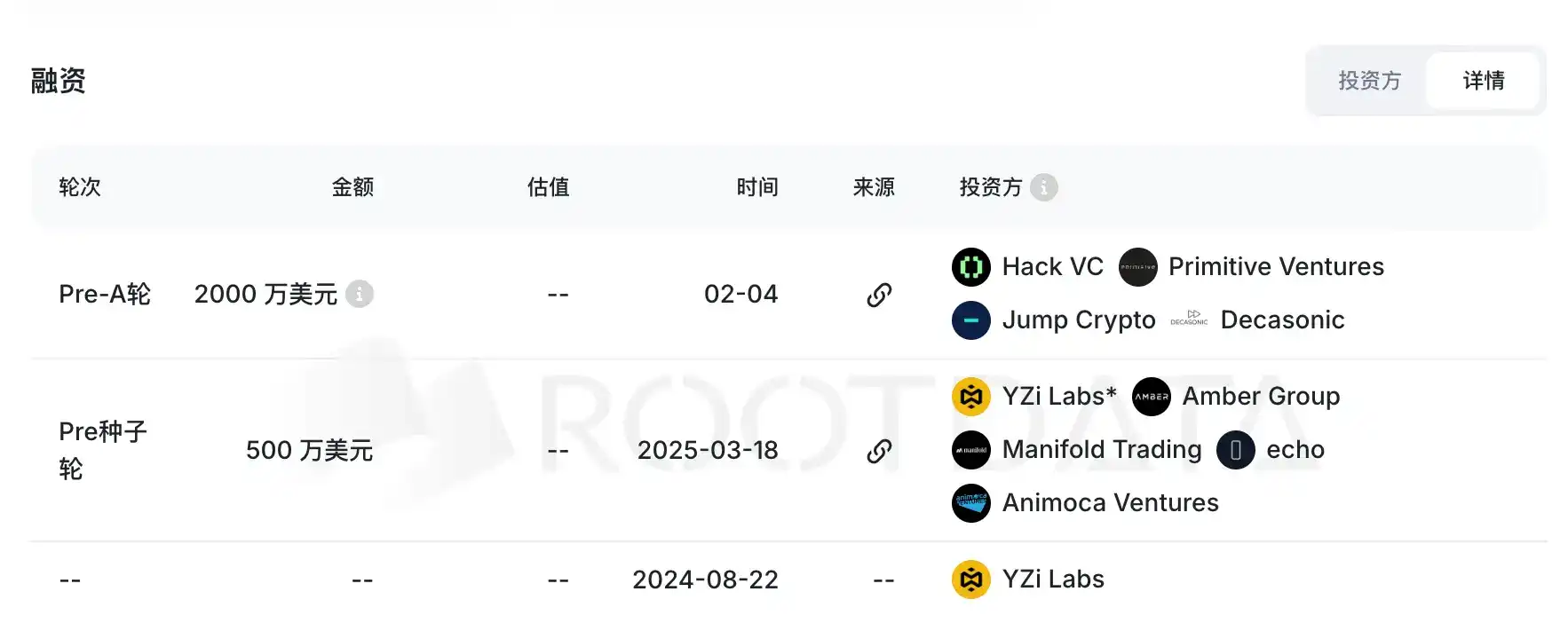
According to RootData, on February 4th, Opinion announced the completion of a $20 million Series A funding round with participation from Hack VC, Jump Crypto, Primitive Ventures, Decasonic, and others. However, @cryptobraveHQ pointed out that sources revealed that the vast majority of these participating investors have attached refund/principal protection agreements. Their nature is identical to BeraChain's principal-protected financing, essentially constituting a "pricing round" or "exchange listing round."

Furthermore, based on discussions with VC peers and exchange listing personnel, the general feedback suggests it is a typical吹水轮 (boastful round), pricing round, or花钱上所轮 (pay-to-list round). For VCs, rather than gambling on an uncertain future, it's better to capitalize on the current peak of the AI + prediction market narrative, complete the entire listing process swiftly, and achieve capital exit.
Massive Data Volume Questioned, Huge Discrepancy Between Number of Trades and Trading Volume

Perhaps in an effort to become the "first prediction market listing project," Opinion's impressive data was immediately questioned by the market.

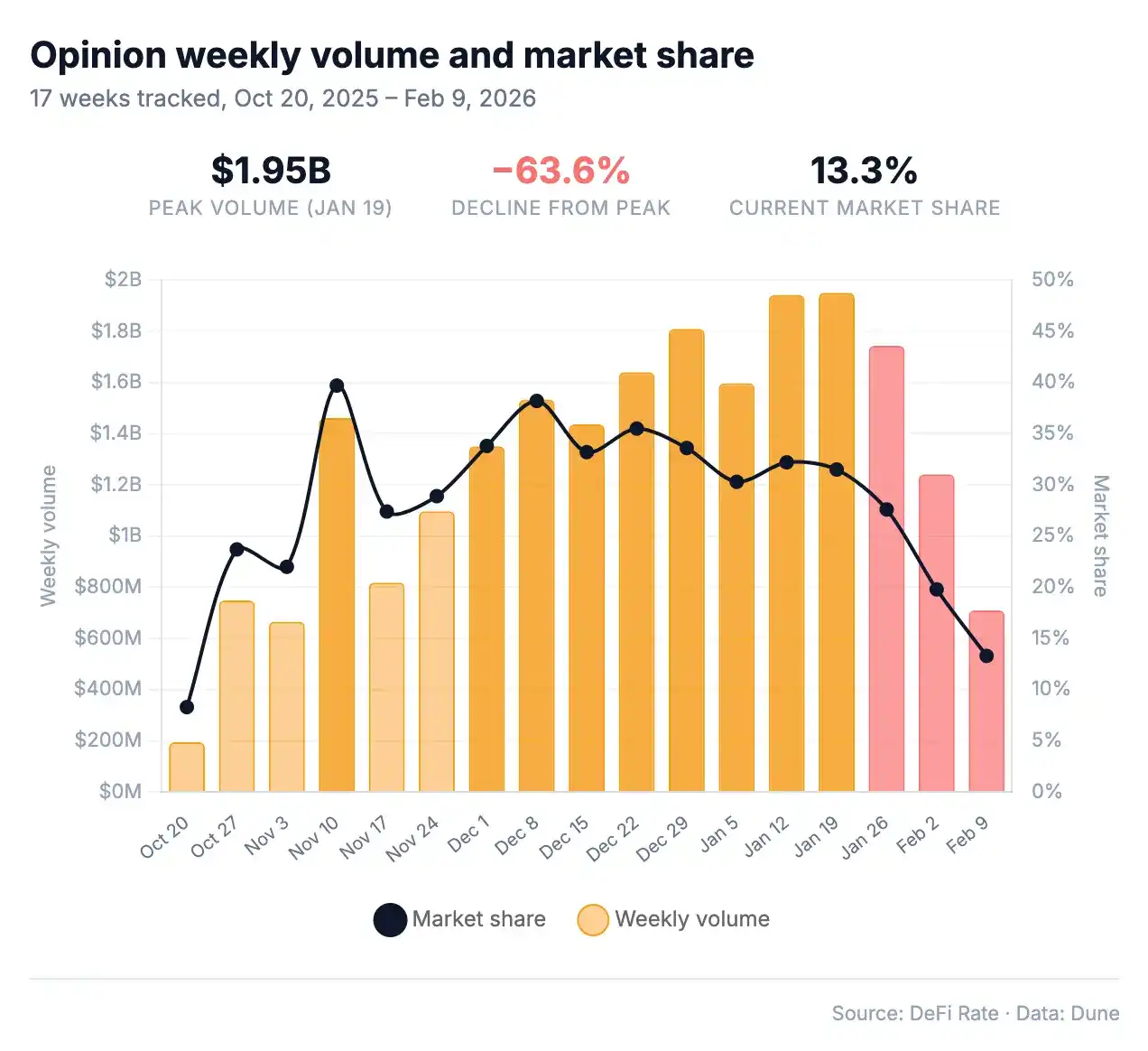
Judging from Opinion's公开 (public) data, the trading volume in January 2026 reached $8.08 billion, accounting for 31% of the entire prediction market industry. A platform that only launched in October 2025 surpassed the trading volume of long-established players like Kalshi and Polymarket within a few months, being called the "fastest-expanding platform in prediction market history." DeFiRate scrutinized 17 consecutive weeks of on-chain data from Dune Analytics (from last October to this February) and found many anomalies that cannot be explained by normal platform growth logic.

1. Huge Discrepancy Between Number of Trades and Trading Volume:

The core issue is not the size of the trading volume, but the ratio between trading volume and the number of trades. In January 2026, Opinion's $8.08 billion trading volume came from 3.2 million trades, averaging about $2,525 per trade. During the same period, Kalshi generated $9.55 billion from 54.5 million trades, averaging $175 per trade; Polymarket generated $7.66 billion from 52 million trades, averaging $147 per trade. Simply put, Opinion produced 31% of the industry's trading volume with less than 3% of the industry's total number of trades.

This ratio has never been normal across more than ten consecutive weeks of data. The most extreme week was November 10th: Opinion produced $1.46 billion in trading volume from 218,582 trades, averaging a whopping $6,688 per trade; in the same week, Polymarket produced $952 million from 4.19 million trades, averaging $228 per trade. Opinion's number of trades was one-nineteenth of Polymarket's, yet its trading volume was 53% higher.

By February 9th, Opinion produced 13.2% of the industry's trading volume but contributed only about 0.7% of the number of trades. This 19:1 ratio has never been接近 (approached) by any prediction platform.

2. Abnormal Per Capita Trading Volume: Do New Users Actually Increase the Platform's Average Trading Volume?

The normal growth logic for a platform is: as the user base expands, incoming retail investors (new散户) lower the average trading volume per capita. Opinion's trajectory is恰恰相反 (precisely the opposite). According to DeFiRate data, at launch in October, 20,534 users generated a monthly trading volume of $38,537 per user; by January, the user base expanded to 101,954 people, but the per capita trading volume反而翻倍 (instead doubled) to $79,241. The platform size grew 5 times.

Typically, new users would lower the platform's average trading volume. But on the Opinion platform, each batch of new users actually increased the trading volume? This is截然不同 (completely different) from the natural growth seen on platforms like Polymarket, where the average trading volume per user grew steadily but slowly (August: $4,852/user, January: $11,817/user, user count grew 2.9x, trading volume grew 2.4x).

3. Dramatic Fluctuations in User Numbers, Only Looking Normal During Holidays?

Opinion's user base itself is another red flag. Within 17 weeks, weekly active users surged from 11,124 to 67,913, then fell back to 18,098, a fluctuation amplitude of 6 times. The most significant fluctuation occurred between February 2nd and February 9th: within one week, the number of users dropped from 67,804 to 18,098, a single-week萎缩 (contraction) of 73%. During the same period, Polymarket's user base fluctuated within a range of only 1.5 times over 17 weeks and showed a stable upward trend.

Particularly notable is a period where the data异常回归正常 (abnormally returned to normal): the holiday interval from December 22nd to January 4th. During these two weeks, Opinion's number of trades suddenly surged from the usual 300,000 to 600,000 trades to 1.4 million to 1.8 million trades, while the average trade size simultaneously dropped to $1,000 to $1,163. This was the only time Opinion's data profile looked like a normal prediction market. However, once the holidays were over, the data immediately反弹 (bounced back) to its previous abnormal state.
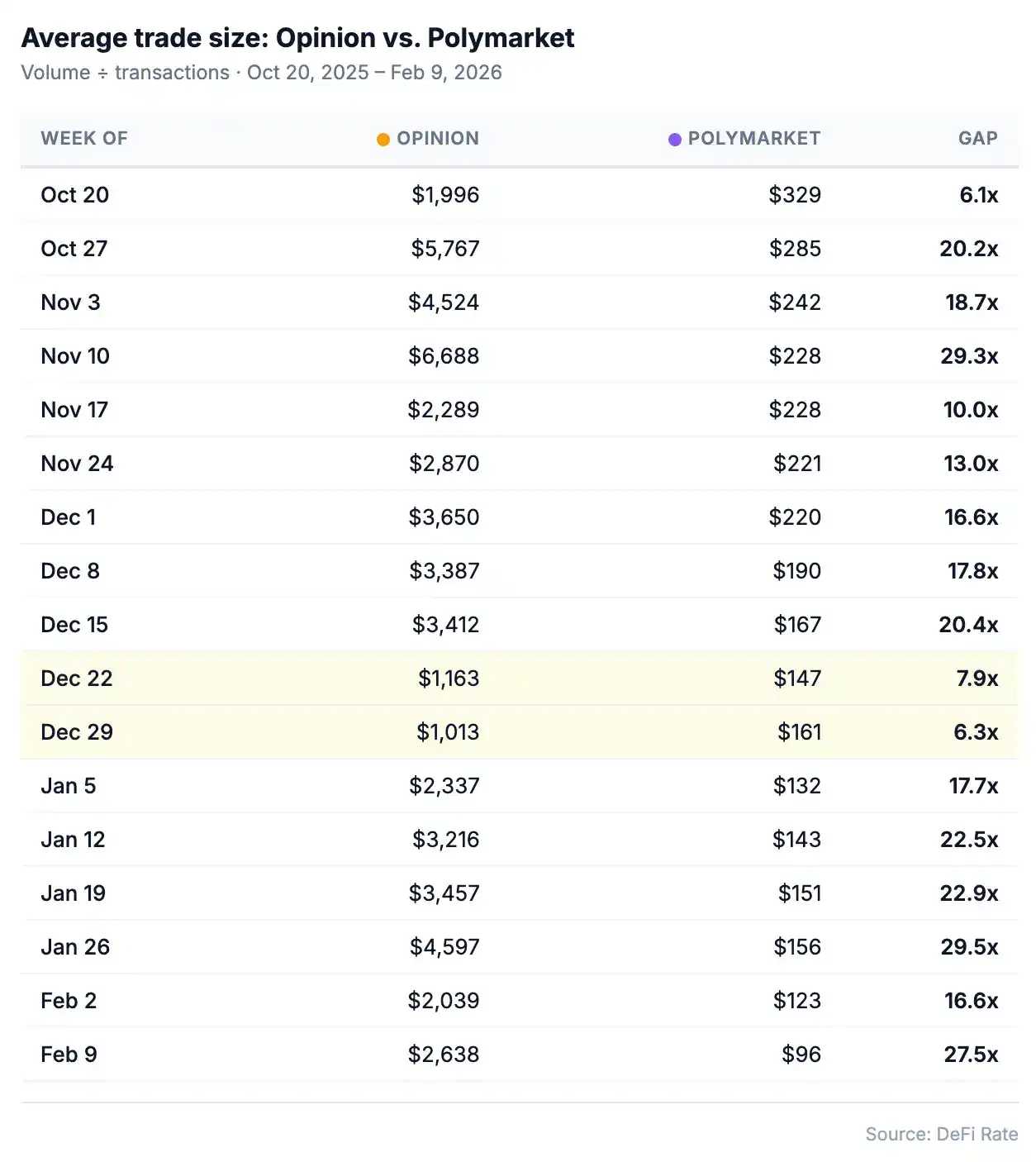
These anomalies are not without trace. Opinion's points system明确规定 (explicitly states) that trade size is one of the weighting factors for points, a design that directly encourages users to place larger bets. Coupled with the airdrop expectation before TGE and a KYC-free environment, this created a strong incentive for wash trading.

It is worth referencing that Columbia University researchers estimated in November 2025 that approximately 25% of Polymarket's total trading volume over three years came from wash trading, with sports markets as high as 45%, and Polymarket doesn't even have a points system or explicitly rewards based on trade size. Opinion, building on these existing conditions with a points mechanism that rewards large trades, has a significant wash trading incentive.

Extremely Low Airdrop Ratio, Criticized by Users as Being "Ripped Off"

Furthermore, the airdrop allocation announced yesterday sparked strong backlash from the community. Although the official claimed the total airdrop would be 23.5%, and the initial circulating supply at TGE is expected to be 19.85%, only 3.5% (approximately 8.2 million tokens) will be unlocked at launch, with the remaining portion being linearly released over 7 months. The rest is either老鼠仓 (rat trading warehousing) or上供 (offered up) to Binance.

Compared to Opinion's high fees and the门槛 (threshold) of its complex points system, many users who engaged in months of real trading and incurred high costs received extremely meager allocations, leading many深度参与者 (deep participants) to exclaim that they were essentially ripped off by the official team.

The impact of this ratio goes far beyond community sentiment backlash. It has also接连影响 (successively affected) prediction market projects within the Binance ecosystem. Users who are still观望 (observing) PredictFun and Probable can't help but question whether there is any real return expectation left for Binance's生态 (ecosystem) prediction markets?

Opinion's抢先 (first-mover) listing was supposed to背书 (endorse) later players in this sector. But the 3% airdrop ratio and data doubts are highly likely to make potential users of PredictFun and Probable望而却步 (hesitate to proceed).

Finally, it is undeniable that Opinion has genuine innovation at the technical level. Traditional prediction markets require manual review to open a market and manually set settlement conditions. Opinion uses an AI oracle to make this process almost instantaneous. This means it can cover far more scenarios than its competitors, not just elections and sports events. Changes in a DeFi protocol's TVL, the listing time of a token—all can become a liquid prediction market within minutes.

Additionally, independent researcher Haotian also mentioned that even if a significant portion of Opinion's trading volume必然 (inevitably) comes from wash trading for OPN points, "but撇开 (setting aside) wash trading, if institutions and arbitrageurs account for a relatively large proportion in a platform's user profile, it actually验证 (validates) the承载能力 (load-bearing capacity) of its underlying infrastructure from the side."

"Enabling large funds to conduct precise hedging in prediction markets like derivatives, not just gambling at the retail level, is the goal that prediction market 2.0 should strive for in the future."

It can be said that after TGE, Opinion will face a残酷的 (brutal) retention test: after the points rewards are removed, how many people will be willing to stay and truly use the platform? Can macro prediction markets attract a sufficient scale of institutional users to support organic trading volume?


Related Questions

QWhat are the main data anomalies that raise doubts about Opinion's trading volume?

AThe main anomalies include a massive discrepancy between the number of transactions and the total trading volume, with Opinion generating 31% of the industry's volume with less than 3% of its transactions. The average transaction size was an abnormally high $2,525 compared to competitors. Additionally, the platform's user base showed extreme volatility, and the average trade size per user increased as the user base grew, which is contrary to normal platform growth patterns.

QWhy did Opinion's launch on Binance generate criticism regarding its funding round?

AIt was revealed that the project's $20 million Series A funding round, which included investors like Hack VC and Jump Crypto, largely came with refund rights/principal protection agreements. This structure is similar to a 'pricing round' or 'exchange listing round,' leading critics to label it as a typical 'blow water round' designed to facilitate a quick capital exit through a centralized exchange listing rather than genuine venture investment.

QHow did the airdrop allocation for OPN tokens cause backlash among users?

AThe airdrop allocation was criticized for being extremely low. Although the official airdrop was announced as 23.5% of the total supply, only 3.5% (approximately 8.2 million tokens) were unlocked at the Token Generation Event (TGE), with the remainder being linearly released over 7 months. Users who had incurred high transaction fees and spent months on the platform felt that the minimal reward was essentially a 'reverse rug pull' by the project.

QWhat technological advantage does Opinion claim to have over competitors like Polymarket?

AOpinion utilizes an AI oracle to automate the process of creating and settling prediction markets. This allows new markets to be created almost instantly for a wider range of events, such as changes in a DeFi protocol's TVL or a token's listing time, moving beyond the traditional focus on elections and sports events that require manual review and settlement.

QWhat is the central concern for Opinion's future after its Token Generation Event (TGE)?

AThe primary concern is user retention and organic growth after the removal of the points-based incentive system that encouraged large trading volumes. The platform must prove it can attract and retain a sufficient base of institutional users and genuine traders to support sustainable, organic trading activity, moving beyond the 'wash trading' that was incentivized by the airdrop campaign.

Related Reads

STAR 50 Soars 10.73%, Why Did A-Shares Stage a "V-Shaped Reversal"?

After a prolonged decline, the Chinese A-share market staged a strong rally on July 21. The STAR 50 index surged 10.73%, its largest single-day gain in nearly a year, leading a broad-based "V-shaped" reversal. The Shanghai Composite Index rose 1.79%, the Shenzhen Component Index gained 4.81%, and the ChiNext Index jumped 7.05%. Total market turnover reached 2.97 trillion yuan, an increase of 256.1 billion yuan from the previous session, with over 3,100 stocks advancing. The semiconductor sector spearheaded the rebound, with related ETFs posting significant gains. Analysts attribute the surge to three converging factors. First, coordinated capital inflows from "national team" institutions, insurance funds, listed company buybacks, and fund house self-purchases have bolstered market liquidity and confidence. Second, supportive policy signals, including commitments from regulators to ensure stable market operations, provided a favorable backdrop. Third, a stabilization and recovery in overseas markets, notably South Korea, created a positive external environment. Institutions suggest the most severe panic selling phase for the tech sector has likely passed, following a significant digestion of crowded positions and leveraged funds. While short-term volatility may persist, the medium to long-term outlook remains underpinned by enduring trends like AI computing demand expansion and semiconductor localization. The market's focus now shifts to the sustainability of supportive fund flows, earnings reports, and upcoming catalysts from the global AI industry chain.

marsbit15m ago

STAR 50 Soars 10.73%, Why Did A-Shares Stage a "V-Shaped Reversal"?

marsbit15m ago

U.S. Tech Momentum Stocks Post Largest Single-Day Gain Ever, But Is the Plunge Over?

US tech momentum stocks staged a sharp rebound on Tuesday (July 21st). Morgan Stanley's TMT Momentum Factor surged over 12%, marking its largest single-day gain on record, exceeding even peaks from the 2000 dot-com bubble. Key momentum indices from Goldman Sachs also posted their strongest daily performances in years. The rally was led by semiconductors, with the Philadelphia Semiconductor Index jumping 4.6%. This rebound followed three consecutive down days and a cumulative 33% plunge in momentum stocks, one of the steepest drawdowns since the dot-com era. Analysts attribute the surge largely to a short squeeze. Heavy selling had pushed high-beta momentum stocks into deeply oversold territory, forcing many short sellers, particularly in Asia, to cover their positions, creating a self-reinforcing buying spiral. However, the rebound's internals appear weak. Trading volume was notably low, and advancing stocks still lagged decliners on the S&P 500, indicating a narrow, concentrated rally rather than broad market participation. Diverging views emerge on the outlook. BTIG warns the bounce has hit key resistance and recommends selling into strength, citing extreme volatility and historical parallels to past market tops. Conversely, Goldman Sachs and UBS believe the momentum unwind is nearing its end, suggesting it may be time to gradually add exposure, as positioning has been significantly reduced. They caution, however, that high volatility warrants a measured approach, potentially using defined-risk strategies. The upcoming earnings season, particularly reports from major tech firms like Alphabet, is seen as a critical test for the rally's sustainability. Simultaneously, bond markets flashed a warning, with yields rising partly due to spiking oil prices. Analysts note that if long-term Treasury yields break decisively higher, it could pose a significant headwind for equities, especially growth stocks.

marsbit23m ago

U.S. Tech Momentum Stocks Post Largest Single-Day Gain Ever, But Is the Plunge Over?

marsbit23m ago

U.S. Tech Momentum Stocks Record Largest Single-Day Gain Ever, but Has the Rout Ended?

U.S. tech momentum stocks staged a dramatic rebound on Tuesday, July 21st. Key momentum indices like the Morgan Stanley TMT Momentum Factor and Goldman Sachs' High Beta Momentum Long Index posted historic or near-historic single-day gains, fueled largely by semiconductor stocks. This sharp rally followed a severe three-day sell-off that saw momentum stocks plunge 33%, marking one of the steepest pullbacks since the dot-com bubble. Analysts attribute the bounce primarily to a short squeeze, as forced covering from over-leveraged traders, particularly in Asia, created a buying spiral. However, the rally's health is questioned due to weak market breadth—overall trading volume was low, and decliners outnumbered advancers in the S&P 500 despite the index's gain—suggesting a narrow, concentrated surge rather than broad recovery. Opinions on the sustainability diverge. BTIG strategists warn the rebound has hit key resistance levels, citing extreme volatility and historic stock dispersion as signs of an ongoing broader correction, and recommend selling into strength. Conversely, Goldman Sachs and UBS view the aggressive momentum unwinding as nearing its end, noting reduced positioning and a lack of new fundamental catalysts. They suggest the sell-off presents a selective opportunity to add exposure, albeit cautiously and gradually using defined-risk strategies. The immediate trajectory hinges on the ongoing earnings season, with market focus on Alphabet's capital expenditure guidance for AI investment clarity. Meanwhile, bond markets present a risk, with rising Treasury yields—potentially heading toward 5.5%—and widening credit spreads for mega-cap tech companies posing a threat to equity valuations. The combination of technical factors, earnings results, and macro conditions leaves the durability of the rebound in doubt.

链捕手25m ago

U.S. Tech Momentum Stocks Record Largest Single-Day Gain Ever, but Has the Rout Ended?

链捕手25m ago

Long-Divided Must Unite, Long-United Must Divide: When L1 Becomes Its Own Rollup, What Is Ethereum's Endgame?

"The Inevitable Cycle: When L1 Becomes Its Own Rollup – What is Ethereum's Endgame?" For years, the Ethereum community grappled with concerns that L2s were fragmenting the ecosystem and eroding L1's value. While L2s provided cheaper execution, they also splintered liquidity and the unified user experience of a single chain. This has prompted a fundamental reassessment of the relationship between L1 and L2. Ethereum's roadmap is evolving. The "Scale" initiative merges L1 and L2 expansion into a holistic framework. L1 itself is advancing with higher gas limits, statelessness, and zkEVM verification, no longer content to be just a low-throughput settlement layer. Consequently, the primary value proposition of L2s is shifting from merely providing cheap blockspace to offering L1 cannot easily provide: application-specific optimizations, privacy features, and flexible governance models. L2s are becoming a spectrum of execution environments with varying degrees of security inheritance from Ethereum. A critical challenge in this multi-chain future is interoperability. The vision is to make Ethereum "feel like one chain again." This relies on advancements in native account abstraction (like EIP-7702) and intent-based architectures (Open Intents Framework), where users declare desired outcomes, and solvers handle the complex cross-chain execution. Furthermore, shortening Ethereum's finality time from minutes to seconds is crucial, as it underpins trust between chains for bridges, stablecoins, and cross-chain applications. Perhaps the most provocative idea is that Ethereum L1 itself could become a form of "its own Rollup." As zkEVM and proof systems mature, high-performance nodes could execute transactions and generate validity proofs. Regular validators would then verify these proofs instead of re-executing all transactions. This blurs the traditional L1/L2 hierarchy, making "Rollup" more of a general execution-verification architecture. Native Rollup aims to integrate L2 validation more directly into the Ethereum protocol, allowing L2s to inherit L1's security more fully and move away from reliance on security councils. In the end, L2s are not destined to replace L1 or be made obsolete by it. The likely future is a unified system where diverse execution environments—each optimized for specific use cases like DeFi, gaming, or privacy—coexist. They will share a common foundation of security, liquidity, and verifiable state, seamlessly connected to restore a cohesive user experience. The next phase for Ethereum is not just about scaling through separation, but about intelligently reintegrating what was separated back into a coherent whole.

链捕手41m ago

Long-Divided Must Unite, Long-United Must Divide: When L1 Becomes Its Own Rollup, What Is Ethereum's Endgame?

链捕手41m ago

Trading

Spot
活动图片




