Original | Odaily Planet Daily (@OdailyChina)
Author | Azuma (@azuma_eth)
On the morning of August 17th, Beijing time, Bloomberg reported that payment giant Stripe has finalized the acquisition of AI infrastructure startup OpenRouter (A fun fact: Alex Atallah, the co-founder of OpenRouter, previously founded a company called OpenSea). While the acquisition amount did not reach the previously rumored $10 billion, it still exceeded $7 billion.
Although the advancement of this acquisition has long been no secret, and the market is not unfamiliar with the strategic fit needs of both parties, when the deal was finally confirmed, a large number of skeptical voices emerged in the market. The core question of the skepticism is — Is OpenRouter really worth this much money?

Odaily Note: Jason, a popular investor and million-follower influencer, has also expressed his confusion about this deal.
After all, at the end of May this year, OpenRouter completed a $113 million Series B funding round with a valuation of "only" about $1.3 billion. Just over two months later, Stripe has to shell out over five times that amount in real money. Meanwhile, OpenRouter's current revenue scale also seems insufficient to support such a high price. The market estimates the platform's current annualized revenue to be around $50 million. At the $7 billion acquisition price, this corresponds to a staggering price-to-sales ratio of 140x.
What's more crucial is that OpenRouter's core business does not seem to possess strong technical barriers. OpenRouter essentially provides a unified entry point for AI models. Developers can access models from OpenAI, Anthropic, Google, and numerous open-source models through a single set of APIs, with OpenRouter responsible for routing, failover, and price optimization among different models and inference providers. Theoretically, model vendors, cloud service providers, or other AI infrastructure companies could replicate similar functionalities.
Thus, two completely different judgments naturally emerged in the market. One view holds that Stripe may have spent over $7 billion to acquire what is merely a seemingly sexy but not-so-substantial middle layer. However, another view argues that precisely this "middle layer" is most worth buying, because what OpenRouter is truly valuable for may never have been those few lines of code forwarding API requests, but rather the AI inference traffic, users, payment relationships, and the resulting data and distribution capabilities it has already aggregated.
Opposing View: Limited Moat, Merely a Transitional Product of the Era
After the deal news broke, market skepticism focused on one question: Is model routing itself a business worth betting on long-term?
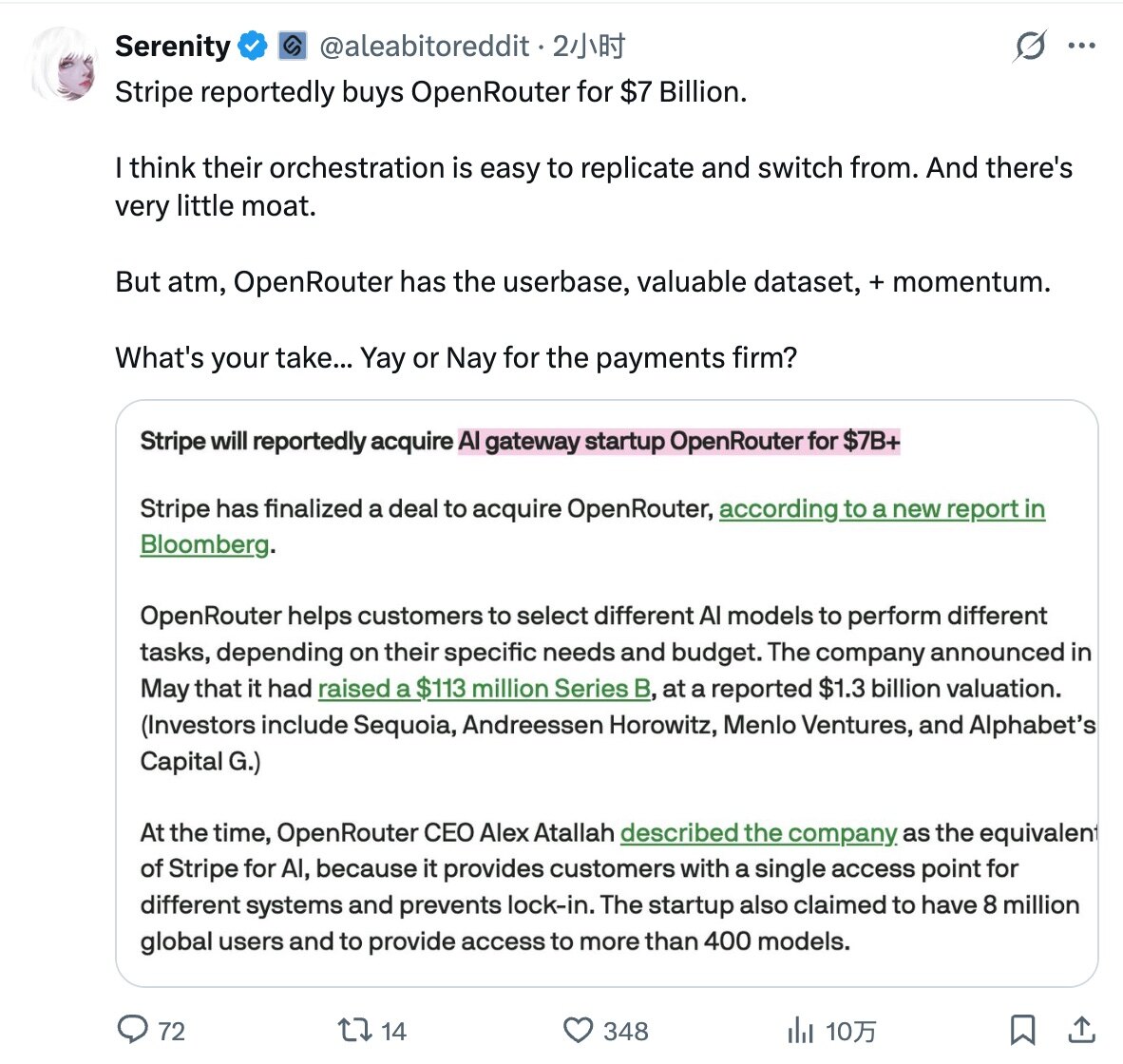
"White-haired stock god" Serenity posted on X regarding this, stating that OpenRouter's model orchestration and scheduling capabilities are easy to copy and replace, "with almost no moat," but he also admitted that, at least for now, OpenRouter already possesses a large user base, a highly valuable dataset, and strong growth momentum.
This is actually the core contradiction for the opposition: they do not deny OpenRouter's current value, but doubt whether this value can last for a decade.
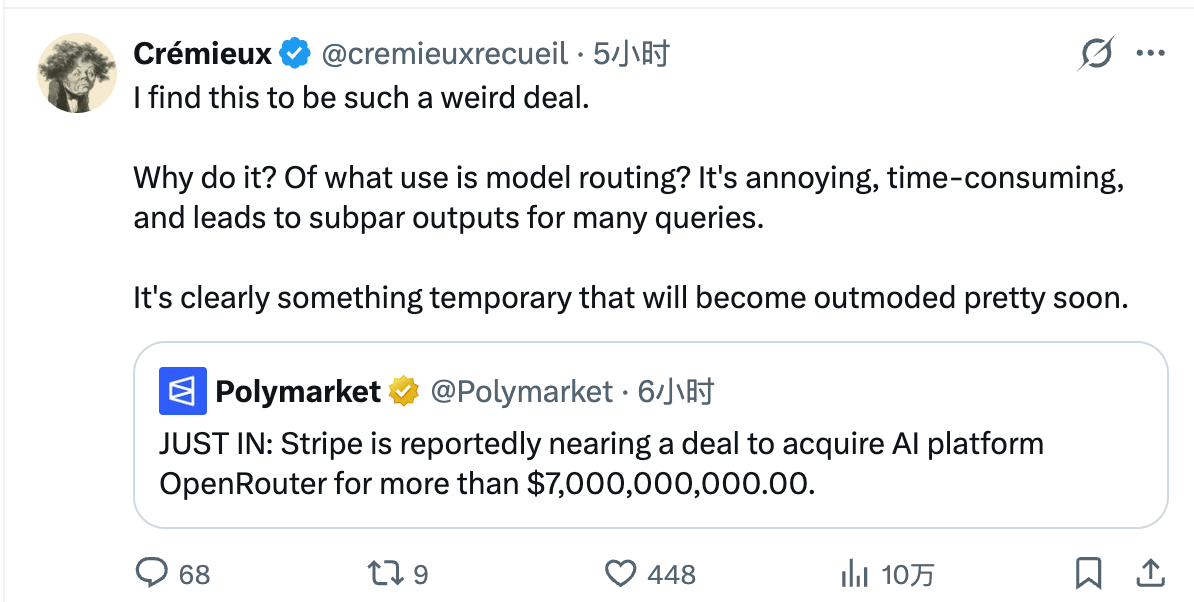
Another tech KOL with over 300,000 followers, Crémieux, posed a more direct question: Since model routing itself adds complexity to calls and may lead to suboptimal results for many requests, why is an independent routing layer still needed? If the number of models, pricing, and calling methods stabilize in the future, could this layer of intermediary become increasingly redundant?
From this perspective, the biggest risk OpenRouter faces might not even be "competition from other relay stations," but whether this business is merely a transitional product as AI infrastructure develops to a certain stage. After all, OpenAI, Anthropic, Google, cloud vendors, and even Stripe itself have the capability to gradually integrate multi-model calling, fallback, price optimization, and usage management directly into their own products. If ultimately every model platform comes with its own router, on what grounds can OpenRouter continue to charge as an intermediary?
OpenRouter's current business model is actually quite simple — the platform does not mark up underlying model prices but charges a 5.5% platform fee when users purchase Credits. Therefore, OpenRouter, in the eyes of the opposition, is more like an AI traffic intermediary with extremely fast growth but questionable commercial moat.
And $7 billion seems a bit too expensive for an "intermediary."
Supporting View: Don't Limit It to a Relay Station, Imagine It as the Toll Booth of the AI Era
Of course, many professionals hold the completely opposite view. If we only understand OpenRouter through the logic of a "model relay station," we might have underestimated this deal from the start.
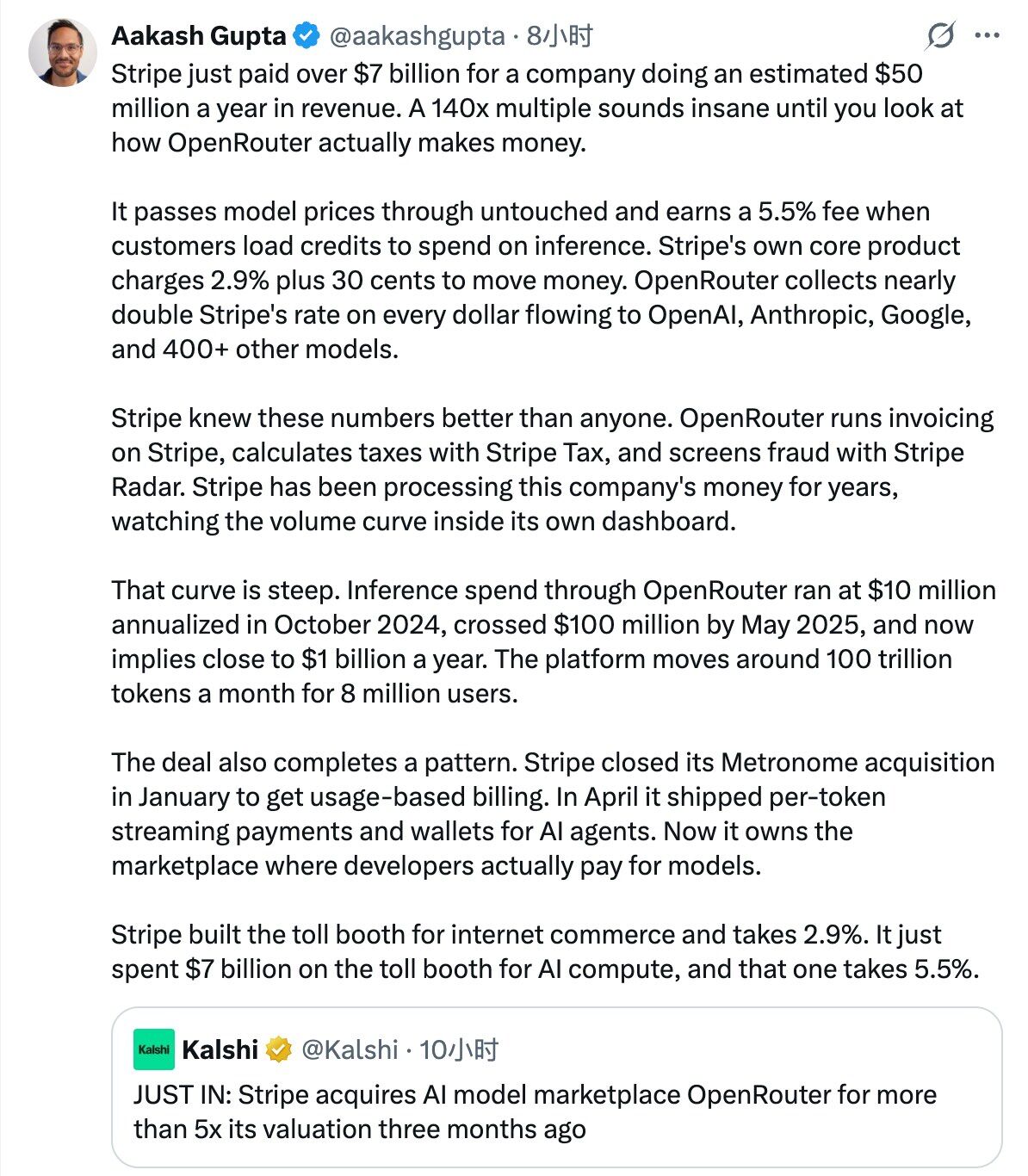
The viewpoint of Silicon Valley product growth expert Aakash Gupta is quite representative. In Gupta's view, a 140x price-to-sales ratio does sound crazy, but the issue is that OpenRouter itself does not make money according to the logic of traditional software companies — The 5.5% platform fee means that for every $1 flowing to OpenAI, Anthropic, Google, and over 400 other models, OpenRouter takes a cut of 5.5%. In comparison, Stripe's own core business (fund flow) charges only 2.9%, with the former being almost twice the latter.
More importantly, Stripe is precisely in the best position to understand this business — because OpenRouter's payment infrastructure runs on Stripe, tax calculations use Stripe Tax, and anti-fraud uses Stripe Radar. Stripe, from its own backend, has witnessed firsthand OpenRouter's transaction volume curve growing at a steep slope.
Therefore, in this view, Stripe did not buy a simple API proxy, but a rapidly expanding AI inference transaction channel. The routing capability might be easy to replicate, but what is truly hard to replicate are the users, requests, and data already aggregated on that route.
Gupta finally offered a brilliant analogy — Stripe once built toll booths for internet commerce, and now, it is using $7 billion to buy the toll booth for the AI inference era. If this analogy holds, then what appears to be a high valuation today is no longer buying OpenRouter's current revenue, but rather the future scale of the AI inference market and the "toll" OpenRouter can collect as a traffic entry point.
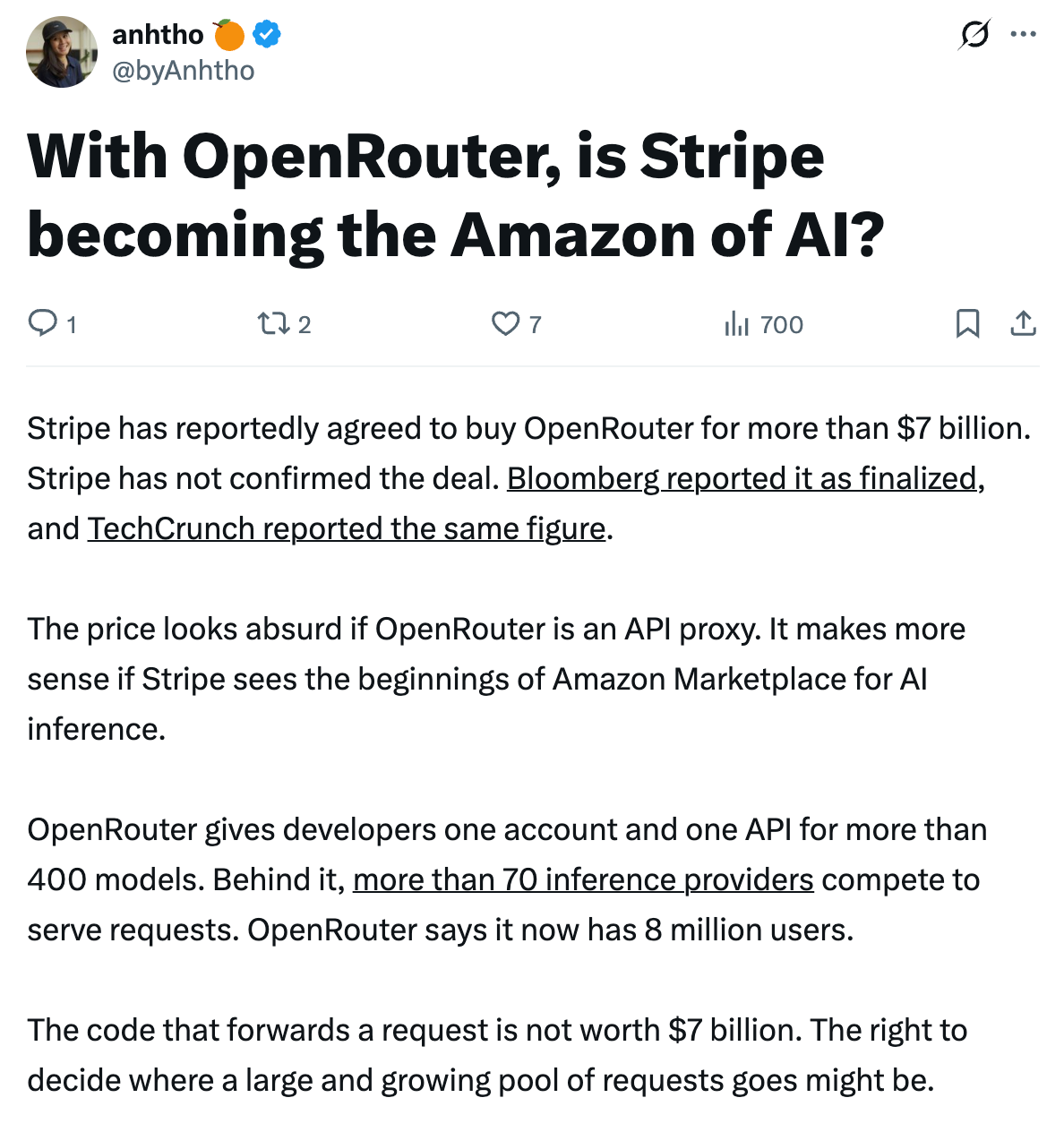
Lago co-founder byAnhtho gave a similar judgment from another angle: if OpenRouter is merely viewed as an API proxy tool, this price is certainly outrageous; but if Stripe sees the nascent form of an "Amazon" in the field of AI inference, the logic becomes completely different — The code that simply forwards requests might not be worth $7 billion, but the scheduling power that decides the final destination of a vast and growing number of AI requests might truly be worth this price.
Unfinished Debate
Placing both sides' views side by side, the essence of this debate is a divergence regarding the value anchor points of AI infrastructure.
If OpenRouter is seen as an AI intermediary with annualized revenue of only $50 million and limited technical barriers, a 140x price-to-sales ratio is clearly hard to justify. But if it is seen as a key traffic entry point forming between AI applications and model/inference suppliers, then today's revenue scale might not be the most important metric.
In the end, the market is not truly debating how much OpenRouter is worth today, but rather how large the future AI inference market will grow, and whether OpenRouter can occupy that "toll booth" position within it in the long term.
In the internet era, Stripe became the "toll booth" of the commercial world through payment infrastructure. Now, it is trying to use over $7 billion to preemptively buy another "toll booth" for the AI inference era. Whether this deal is an overpay or Stripe seeing the next ticket for AI infrastructure ahead of time, the answer can only be given by time.