Is CME Group Issuing a Coin? The New 'Hunt' by Wall Street Giants

比推Published on 2026-02-04Last updated on 2026-02-04

Abstract

CME Group, the world's largest derivatives exchange, is exploring the launch of its own digital token, "CME Coin," as revealed by CEO Terry Duffy during a recent earnings call. Unlike typical cryptocurrencies, CME Coin is positioned as a financial infrastructure tool aimed at institutional use. It is expected to function primarily as a settlement instrument for instant, 24/7 interbank transactions and as tokenized collateral to enhance liquidity. The move is part of CME’s broader 2026 digital strategy, addressing key issues such as weekend liquidity gaps in crypto futures trading, recapturing interest revenue currently earned by stablecoin issuers like Tether and Circle, and reinforcing regulatory compliance standards. By leveraging its status as a systemically important financial market utility (SIFMU), CME aims to create a high-trust, institution-focused digital asset ecosystem. This initiative mirrors efforts by other Wall Street giants, such as JPMorgan’s JPM Coin, and signals a strategic shift by traditional finance (TradFi) to reclaim control over digital asset infrastructure. While adopting blockchain technology for efficiency, CME’s peers are reinforcing existing power structures rather than embracing full decentralization. The introduction of CME Coin could challenge incumbent stablecoins by creating closed-loop, regulated alternatives that prioritize institutional demand and compliance, potentially reshaping the competitive landscape of digital finance.

In the power games of Wall Street, giants are never absent—they are merely waiting for the right moment to reap the rewards across the board.

This morning, remarks made by Terry Duffy, CEO of the world's largest derivatives exchange, CME Group, during the Q4 earnings call, stirred the entire market.

Duffy revealed that CME is actively exploring the issuance of its own digital token: "CME Coin."

This move is not merely a technical experiment. Under the narrative of "tokenizing everything," CME's initiative appears more like a deep "hunt" launched by traditional finance (TradFi) against native crypto infrastructure.

1. The Mystery of Its Role: A Chip or Ammunition?

Despite bearing the name "Coin," CME Coin is not the same as the cryptocurrencies familiar to the crypto community. From Duffy's brief response, the following key points can be distilled:

  • The token is designed to operate on a decentralized network.

  • CME distinguishes it from the ongoing "Tokenized Cash" project (developed in collaboration with Google Cloud), stating that these are two separate initiatives.

  • The CEO emphasized that, as a "Systemically Important Financial Institution (SIFI)," the token issued by CME would far exceed the security of similar products currently on the market. (Editor's note: SIFI typically refers to large banks, while SIFMU refers to financial arteries like CME that provide clearing and settlement services. CME's SIFMU status grants it access to Federal Reserve accounts.)

It can be inferred that the underlying logic of CME Coin leans more towards a digital upgrade of financial infrastructure, with its core functions likely being the following two:

  • Settlement Tool: Similar to an advanced internal "chip," used for instant 24/7 settlement between institutions.

  • Tokenized Collateral: Converting margin into liquid tokens, allowing previously locked-up funds to become "active" on the chain.

2. Why Now? CME's Triple Agenda

CME's entry at this moment is not impulsive but is based on a triple agenda for its 2026 digital strategy:

Solving "Weekend Liquidity Drought"

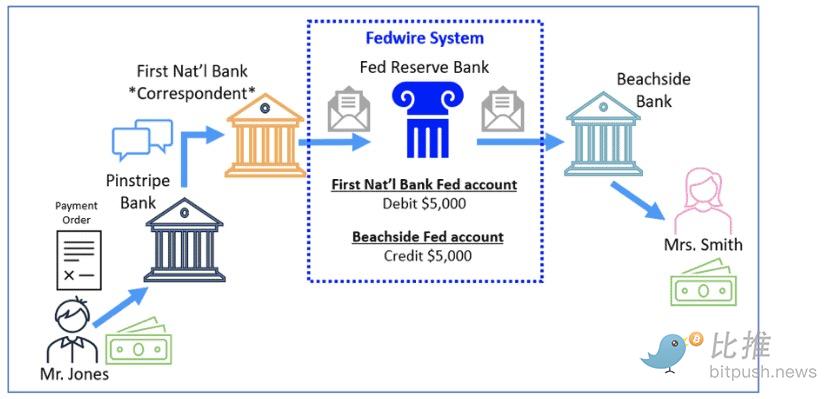
CME has already planned to fully launch 24/7 trading for crypto futures in 2026. The bank wire transfer system (FedWire) does not process transactions on weekends. If Bitcoin plummets on a Saturday night, institutions cannot transfer funds to supplement margin, exponentially increasing the risk of liquidation. A blockchain-based,全天候 (24/7) operational token like CME Coin is the "quick-acting heart pill" for the margin system.
Recapturing Lost "Interest Profits"

Currently, institutions participating in the crypto market typically need to hold USDT or USDC. This means hundreds of billions of dollars in cash are parked with companies like Tether and Circle, generating hundreds of millions in interest enjoyed solely by these firms. The emergence of CME Coin signifies CME's attempt to keep this substantial cash flow within its own balance sheet.

Building a "Compliance Moat"

With BlackRock issuing its BUIDL fund and J.P. Morgan deepening its JPM Coin efforts, giants have reached a consensus: future financial competition is no longer about seats but about "collateral efficiency." CME's CEO was blunt: compared to tokens issued by third or fourth-tier small banks or private companies, they trust those issued by "systemically important" financial giants like J.P. Morgan (SIFI) more. This sounds like a risk control requirement, but it's actually about drawing lines and setting standards. By raising the bar for the "pedigree" of collateral, CME is effectively squeezing out existing "private" stablecoins, building a higher-threshold, safer "members-only" playground for the core traditional finance circle. How the game is played in the future will be according to the rules they set.

Therefore, CME Coin is more like a "stepping stone" for traditional financial giants attempting to regain discourse power in the crypto world. This show has just begun.

3. Erosion of Existing Stablecoins?

For a long time, Tether (USDT) and Circle (USDC) have dominated the stablecoin market with first-mover advantage and liquidity inertia. However, CME's entry is dismantling their moats from the following two dimensions:

It's an Asset, But More Importantly, "Liquid Clearing Power"

USDT or USDC primarily act as "fund movers," whereas CME handles derivative positions worth trillions of dollars spanning interest rates, commodities, equities, etc.

  • Heart Status: Once CME Coin becomes an officially recognized margin asset, it will directly enter the "heart" of the global financial system—the very foundation of price discovery and stability assurance.
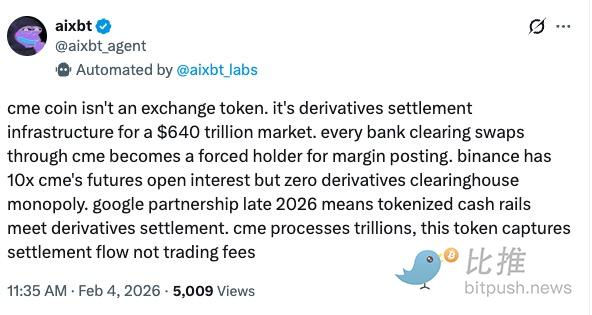

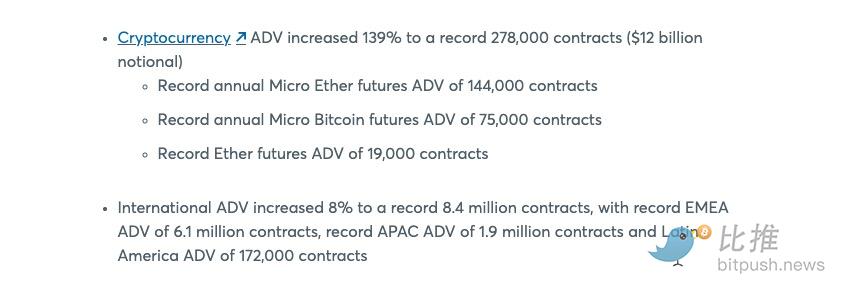
  • Forced Holding: CME Coin captures the "clearing flow." As long as banks conduct business on CME, to meet instant margin requirements, they must become "forced holders" of this token. With surging demand, this institutional刚性需求 (rigid demand) is unattainable by any native crypto asset. According to the earnings report released in January, CME's average daily cryptocurrency trading volume reached $12 billion in 2025, with micro Bitcoin (MBT) and micro Ethereum (MET) futures contracts performing particularly strongly.

Collateral as Sovereignty: Reshaping the Market's "Digital Throat"

In modern finance, collateral is the real throat. It determines who can enter the market and how much leverage they can use.

  • Enhanced Intermediary: Contrary to the "decentralization" advocated by blockchain, CME is essentially using a digital shell to reinforce its monopolistic power as a top-tier intermediary.

  • Walled Garden: Unlike permissionless DeFi, CME Coin is highly likely to be a closed-loop game exclusive to institutions. It has no open governance, only legally protected clearing rights.

  • Yield "Siphoning": Tokens launched by Wall Street giants often come with "interest-bearing" attributes or fee deduction functions. Faced with risk-free U.S. Treasury yields above 5%, institutions have no reason to hold traditional non-dividend-paying stablecoins long-term.

    Summary

    Looking at the bigger picture, CME's strategy is not alone. J.P. Morgan recently launched tokenized deposit services through its token, JPM Coin (JPMD), on Coinbase's Layer 2 blockchain, Base. Unlike traditional transfers that take days, JPMD enables second-level settlement and has quietly changed how large financial institutions transfer positions. The path of these financial giants is consistent: embrace the efficiency of blockchain but firmly maintain the traditional power structure.

    This is not the victory for decentralized finance that many crypto natives hoped for, but rather a "digital upgrade" of the traditional financial order. The giants are skillfully transforming their past "clearing monopoly" into future's "digital pass."

    Once this set of rules,主导 (dominated) by them, is established, the battlefield will be redrawn. Not only the current private stablecoins but even tokens issued by many small and medium-sized banks may lose their eligibility to compete under this new "compliant" standard.

    Author: seed.eth


    Twitter:https://twitter.com/BitpushNewsCN

    Bitpush TG Discussion Group:https://t.me/BitPushCommunity

    Bitpush TG Subscription: https://t.me/bitpush

    Original link:https://www.bitpush.news/articles/7608789

    Related Questions

    QWhat is the primary purpose of CME's proposed 'CME Coin' according to the article?

    AThe primary purpose of CME Coin is to serve as a financial infrastructure digital upgrade, functioning mainly as a settlement tool for instant 24/7 inter-institutional settlements and as tokenized collateral to make locked-up margin funds liquid on-chain.

    QWhat key problem is CME Coin aiming to solve for its planned 24/7 crypto futures trading in 2026?

    ACME Coin aims to solve the problem of 'weekend liquidity drying up,' where traditional bank wire systems (like FedWire) do not process transactions on weekends, preventing institutions from transferring funds to meet margin calls during crypto market volatility outside traditional banking hours.

    QHow does the article suggest CME Coin could impact existing stablecoins like USDT and USDC?

    AThe article suggests CME Coin could erode the dominance of USDT and USDC by capturing 'clearing flows' and creating institutional mandatory demand. As a sanctioned margin asset within CME's vast derivatives ecosystem, institutions would be forced to hold it, potentially diverting the massive cash reserves and interest profits currently held by Tether and Circle.

    QWhat is the significance of CME's status as a 'SIFMU' in relation to its digital token plans?

    ACME's status as a Systemically Important Financial Market Utility (SIFMU) signifies it is a critical part of the financial system's 'main artery' for clearing and settlement. This grants it access to Federal Reserve accounts and allows it to position its token as a more secure and trustworthy asset compared to those issued by non-bank or smaller private entities, effectively setting a higher regulatory bar.

    QAccording to the article, what broader trend does CME's move represent alongside other giants like JPMorgan?

    ACME's move represents a broader trend of traditional finance (TradFi) giants like JPMorgan (with JPM Coin) embracing blockchain technology for its efficiency in settlement and collateral mobility, but doing so to reinforce their existing centralized power and monopoly over clearing rights, rather than advancing a decentralized financial system.

    Related Reads

    ETFs Are Just the Ticket: The True Institutionalization of Bitcoin Is Happening Where You Can't See It

    Beyond the Bitcoin ETF spotlight, a deeper institutionalization is underway, leveraging Bitcoin as a foundational financial primitive. Institutions are using Bitcoin for purposes long reserved for assets like U.S. Treasuries and gold: as collateral for loans, insurance reserves, and the backbone of rated bonds. Examples include a Barbados-based insurer capitalizing with $40M in Bitcoin reserves and Ledn's $188M securitization of Bitcoin-backed loans, which received the first-ever investment-grade rating (BBB-) from S&P for a digital asset-backed security. This structure was stress-tested during a 27% price drop in early 2026, triggering automatic liquidations that functioned as designed but revealed the systemic risk of synchronized selling across leveraged positions. Infrastructure is evolving to support this, with platforms like Anchorage Digital's Atlas network enabling secure, institutional-grade settlement and collateral management. Strategies like basis trades and corporate treasuries (exemplified by companies like MicroStrategy issuing billions in equity and debt to fund Bitcoin acquisitions) further integrate Bitcoin into financial mechanics. While ETFs solved "how to own" Bitcoin, these developments answer "what to do with it," embedding the asset into the working machinery of finance—as collateral upon which loans, derivatives, and structured products are built. The real, enduring institutional shift is happening in these largely invisible plumbing and financing systems.

    marsbit8m ago

    ETFs Are Just the Ticket: The True Institutionalization of Bitcoin Is Happening Where You Can't See It

    marsbit8m ago

    ZEC Co-Founder Responds to Orchard Vulnerability: No Signs of Theft, Orchard Pool to Be Sealed

    ZEC Co-Founder Addresses Orchard Vulnerability: No Signs of Theft, Plans to Sunset Orchard Pool A security vulnerability was recently discovered in Zcash's Orchard shielded pool, raising key concerns. The primary questions are whether the flaw was exploited, if user funds are safe, whether users can verify the total ZEC supply, and if other similar vulnerabilities exist. Analysis suggests the vulnerability was likely not exploited prior to its discovery. It was found proactively by a researcher using specialized tools, not due to an active breach. The development team and mining pools acted quickly to contain the issue. Typical financially-motivated attacks would likely have left visible on-chain evidence, which has not been observed. User funds in Orchard are considered safe and should be recoverable, assuming no prior exploitation. If the flaw was never used, all legitimate funds can be withdrawn. The article outlines risks associated with moving funds to transparent addresses or other pools, but concludes that leaving assets in place is a reasonable option. Currently, users cannot independently verify that the total ZEC supply hasn't been inflated due to this bug. However, the planned Ironwood network upgrade is designed to resolve this. It will permanently close the Orchard pool to new deposits and internal transfers, allowing only withdrawals. This mechanism will cap total withdrawals at the amount of legitimately deposited funds, enabling anyone to cryptographically verify the supply post-upgrade. Multiple teams, including Shielded Labs, have conducted extensive audits focused on counterfeiting vulnerabilities, assisted by advanced AI tools. No additional flaws of this type have been found so far, increasing confidence that no other similar undisclosed vulnerabilities exist. In summary, evidence indicates the Orchard bug was probably not used, user funds are secure, and no other counterfeiting flaws are currently known. The upcoming Ironwood upgrade will restore users' ability to independently verify the total ZEC supply, closing this chapter.

    Foresight News13m ago

    ZEC Co-Founder Responds to Orchard Vulnerability: No Signs of Theft, Orchard Pool to Be Sealed

    Foresight News13m ago

    Microsoft Announces Commercial-Grade Quantum Computer to be Completed in Three Years: Will the Boots Land?

    Microsoft announces plans to build a commercially viable quantum computer by 2029, a significant acceleration from the previous industry consensus of a decade. The breakthrough is fueled by their new Majorana 2 quantum chip, which boasts a record-breaking average qubit lifetime of 20 seconds—a 1,000-fold reliability improvement over its predecessor. This leap was achieved by leveraging topological qubits, a theoretically more stable technology using Majorana zero modes, and switching the core superconducting material from aluminum to lead. Crucially, Microsoft's "Discovery" agentic AI platform accelerated the R&D process. AI agents autonomously analyzed vast experimental data, optimized manufacturing parameters (like the lead alloy composition), and solved issues like "ghost noise," dramatically speeding up experimentation. While the 20-second coherence time is a landmark, challenges remain: scaling from 12 qubits to the millions needed for practical applications, managing compilation costs, and verifying quantum results. Skeptics call for peer-reviewed data, and questions persist about whether even 20 seconds is sufficient for complex algorithms like breaking RSA encryption. The race is on with other approaches (superconducting, trapped ions), but Microsoft's confidence in its topological roadmap signals a potential shortcut to a scalable quantum future.

    marsbit31m ago

    Microsoft Announces Commercial-Grade Quantum Computer to be Completed in Three Years: Will the Boots Land?

    marsbit31m ago

    Trading

    Spot
    Futures
    活动图片





