Author: Zhao Ying
Source: Wall Street Insights
U.S. equity capital raising has been recovering from its 2023 low, and may accelerate significantly in the coming months: a batch of mega IPOs are lining up, with individual fundraising sizes potentially reaching tens of billions of dollars. The most direct market concern is that these new listings will 'drain' capital from existing U.S. stocks, especially when index holdings and large-cap positions are already high.
Super IPOs from SpaceX, OpenAI, and Anthropic are queuing up to list in the U.S. SpaceX's registration statement (S-1) was formally disclosed last week, with its IPO expected to be scheduled for the second week of June, making it the first of the three companies to complete a public offering. OpenAI plans to go public as soon as September this year, significantly earlier than previous market expectations, and Anthropic may seek an IPO as early as October this year.
According to Wind Trading Desk, Deutsche Bank Securities strategist Parag Thatte wrote in a report on May 22: 'Under our demand-supply framework, an increase in issuance itself could indeed have a negative impact on stocks, but the effect is only moderate; both past academic literature and empirical evidence from issuance waves clearly show that issuance waves are usually accompanied by strong stock market returns, as they occur during periods of strong stock demand.'
The core judgment of this research is not that 'issuance is harmless', but that 'issuance is not the main cause'. Increased supply can cause short-term disturbances; the largest IPO alone, when put into the model, might drag the market down by about 1%. If the listing schedule is concentrated and these new listings squeeze out other stocks from index benchmarks, the impact could be greater. However, this still looks more like a trigger for a common pullback rather than a sufficient condition for the end of a bull market. The U.S. stock market experiences a pullback of over 3% on average every 1 to 2 months, with many potential triggers, IPOs being just one of them.
What truly supports this judgment is that the demand side hasn't collapsed yet. The household sector still holds high cash balances, corporate profit growth is strong, equity funds are still seeing inflows, and buyback announcements remain at high levels. The issue isn't 'whether there is enough money to buy new shares', but whether demand can continue to outpace supply. Another boundary condition is that large-cap stocks, especially large-cap tech stocks, already have elevated positioning; that is where sensitivity is higher.
This issuance wave seems large, but it's not excessive within the context of the entire U.S. stock market.
The quarterly pace of U.S. equity issuance has risen from a low of about $30 billion in early 2023 to the current level of about $120 billion. In the coming months, a batch of mega IPOs could push the pace up another notch.
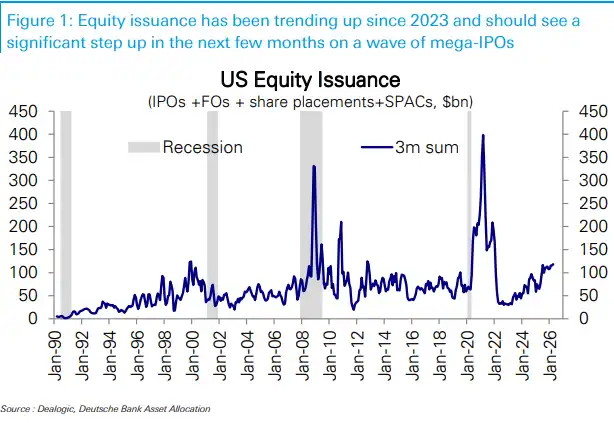
Looking at IPOs alone, some of the upcoming large projects could have fundraising sizes equivalent to the total amount raised by all U.S. listings in the past nine months. Expanding the scope to all U.S. equity issuance, including secondary offerings, this would be equivalent to about two months of issuance volume.
But from a different perspective, the pressure is much smaller. Even the largest anticipated IPO's fundraising amount is just slightly above 0.1% of the current total market capitalization of the S&P 500. This is also why 'increased supply' alone is insufficient to conclude 'the U.S. stock market will inevitably fall': the absolute amount is eye-catching, but relative to the market size, it's not extreme.
Historically, issuance waves have been more like companions to bull markets.
Over the past 30+ years, the U.S. stock market has experienced several cycles of rising equity issuance. In historical samples, the stock market typically performed strongly during these phases: the median return for the S&P 500 in the first 3 months after an issuance wave began was about 8%; extending to 12 months, returns exceeded 20%.
Exceptions are clear: during the 2008–2009 global financial crisis, entities like financial institutions were forced to raise capital, and rising issuance occurred amid heavy selling. This type of 'forced capital replenishment' issuance is not the same as companies raising capital during normal market conditions when valuations and demand are favorable.
Academic literature also leans towards this direction of causality: stronger stock markets and higher expected profitability tend to appear first, followed by issuance waves; the issuance itself has limited negative impact on the concurrent market. The more troublesome part comes later – following an issuance wave, stock market returns eventually weaken, but this 'eventually' can be delayed for a long time and cannot be simply used as a short-term sell signal.
Models suggest an impact of about 1%, but concentrated listings could amplify the perceived effect.
The demand-supply framework considers several forces together: investor positioning changes, equity fund flows, buybacks, and issuance. Issuance, being an increase in supply, is naturally a negative factor, all else being equal.
Calculations show that the largest IPO alone might cause a market decline of about 1%. If listing times are highly concentrated, or if new listings squeeze out allocations to other constituent stocks after entering index benchmarks, the actual pressure could be somewhat greater.
But it's important to distinguish between 'downside risk' and 'systematic selling pressure'. Pullbacks of over 3% occur in the U.S. stock market on average every 1 to 2 months. An IPO wave could become the catalyst for one such pullback, but it doesn't necessarily change the market's direction. Unless the demand side weakens simultaneously, supply shocks alone are unlikely to bring down the index.
The demand side is still holding up for now: cash, profits, and buybacks are all providing support.
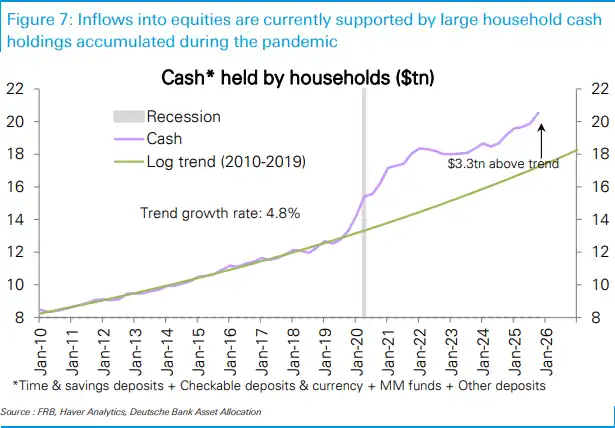
The household sector remains a key buffer. Cash balances accumulated during the pandemic are still very high; household cash holdings are about $3.3 trillion above the 2010–2019 trend level. Relative to personal income, cash holdings are also at elevated levels, giving households the capacity to direct a larger portion of new savings into financial assets, including stocks.
Profits are another pillar of support. The correlation between equity fund inflows and S&P 500 profit growth since 2003 is about 54%. First-quarter profit growth has been described as one of the strongest in over two decades, explaining why capital is still willing to chase equity assets.
Buybacks are also a significant component of demand. S&P 500 buyback announcements remain strong, meaning companies themselves are still providing buying power. Increased issuance brings supply, while buybacks and fund inflows provide absorption capacity; the current balance hasn't clearly tilted towards the supply side yet.
Positioning is not uniformly overheated; crowding is mainly in large-cap tech.
Overall equity positioning is only slightly overweight, at the 53rd percentile since 2010. Active investor positioning is lower, around the 47th percentile, close to neutral; systematic strategy positioning is somewhat higher, around the 64th percentile.
The real crowding is in large-cap stocks, especially large-cap tech. Large-cap positioning is at the 85th percentile, and large-cap tech is at the 93rd percentile. This means that if an IPO wave triggers capital rebalancing, the most likely targets for market focus would not be 'all stocks', but the already heavily held sectors.
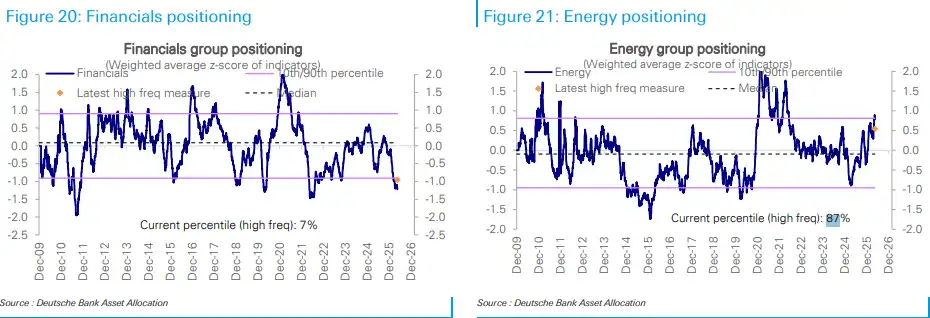
The sector distribution is also uneven. Energy positioning is high, at the 87th percentile; large-cap growth and tech overall are slightly overweight. Financials are significantly underweight, at the 7th percentile; Materials is even more extreme, at the 0th percentile. The U.S. stock market is not uniformly positioned, and supply shocks won't land evenly in every corner.
Fund flows are not uniformly optimistic; strength is concentrated in the U.S. and tech.
In the most recent week, equity fund inflows slowed significantly to $2.4 billion. U.S. equity funds still saw inflows of $9.5 billion, and broad global funds had inflows of $10.3 billion, but regions outside the U.S. experienced significant outflows.
Japanese equity funds saw outflows of $4.4 billion, the largest in five weeks; European funds saw outflows of $2.3 billion, marking the sixth consecutive week of outflows; Emerging markets had outflows of $7.9 billion, also for the sixth straight week. Among these, China-related funds saw outflows of $9.7 billion, while South Korea and Taiwan saw inflows of $3 billion and $1.7 billion respectively.
Sectoral flows were even more concentrated. Tech funds saw inflows of $9 billion, the largest in seven months. Meanwhile, bond fund inflows reached $30.5 billion, rising to a five-month high. Capital is not unidirectionally pouring into risk assets but is flowing divergently among U.S. equities, tech, and bonds.
This is also the most crucial area to watch under the IPO wave: not the number of new listings itself, but whether demand continues to concentrate in a few strong assets. If profits, buybacks, and U.S. equity inflows continue to provide support, the issuance wave will likely be just short-term noise; if crowded tech positioning loosens and equity inflows cool, then supply pressure could transform from a 'modeled disturbance of about 1%' into a harder-to-digest problem.






