Interviewing 10 Dubai Workers: Some Were Asked to Sign 'Life-or-Death Waivers'

marsbitPublished on 2026-04-02Last updated on 2026-04-02

Abstract

The article "Interviews with 10 Dubai Workers: Some Forced to Sign 'Life-or-Death Waivers'" explores the impact of the 2026 Iran-Israel conflict on Dubai's crypto industry and expatriate community. Following missile and drone attacks, Dubai International Airport and Burj Al Arab hotel were hit, causing evacuations and disruptions. While the Dubai Financial Market Real Estate Index fell ~30%, actual property prices dropped only 4-5%. Crypto workers responded diversely: some fled due to safety concerns or family pressure (e.g., Stella, Rebecca), others remained, citing leadership confidence and established lives (e.g., Tiffany), and a few returned under company-mandated "life-or-death waivers" to seize business opportunities. Despite short-term chaos, long-term optimism persists. Experts like Ethan argue Dubai remains irreplaceable as MENA's crypto hub due to its strategic location, English proficiency, crypto-friendly policies, and infrastructure—alternatives like Qatar, Istanbul, or North Africa lack comparable stability or scale. Events like Token2049 were postponed, but the city's role in crypto networking and business development (as Oliver notes) remains vital. Ultimately, many express faith in the UAE's resilience and China’s evacuation assurances, viewing the crisis as a setback rather than a terminal decline for Dubai's crypto ecosystem.

Author|jk

On February 28, 2026, the US and Israel jointly launched a military strike against Iran, and Iran immediately launched a large-scale counterattack. The skies of the Middle East were instantly torn apart by missiles. Shattered were not only military facilities on the battlefield but also the lives of crypto practitioners who had just settled in this land. Dubai, a city hailed in recent years as the "Promised Land of Web3," is now facing a more severe, real-world test.

To this end, Odaily Planet Daily sought out multiple crypto industry professionals based in Dubai to inquire about their experiences, current situations, and plans for their next safe haven.

Dubai's Current Situation: Airport Attacked, Hotel on Fire, Financial and Real Estate Markets Show Lagging Reaction Signals

For those living in the UAE, Dubai is already a battlefield in a certain way.

Since Iran began its "True Promise" retaliatory operation, Iran has launched over two thousand missiles and drones towards Dubai. Missiles and anti-missile systems have engaged in a tug-of-war in Dubai's skies.

On the ground, Dubai International Airport and the Burj Al Arab hotel have been affected. Xiaohongshu is filled with scenes of Dubai International Airport terminals being pierced by drone debris, smoke billowing, and passengers fleeing in all directions.
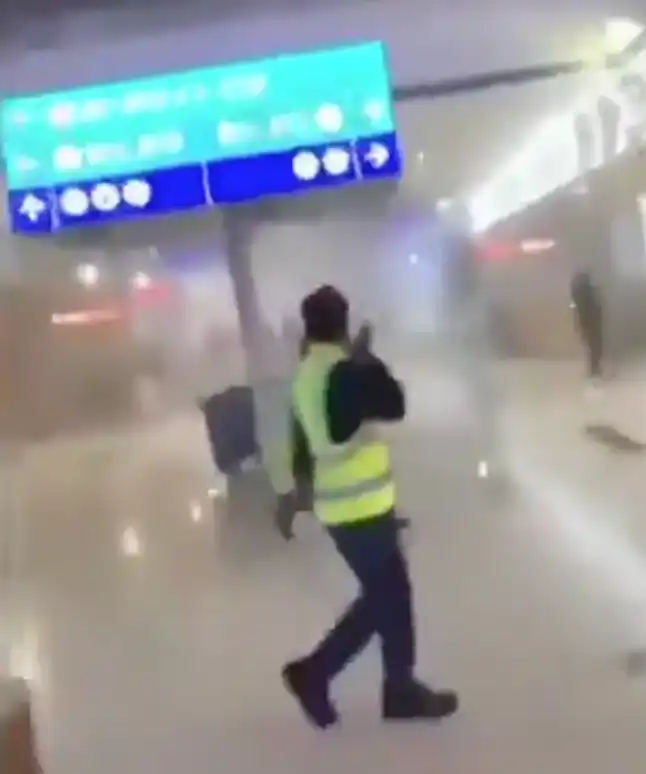
Emergency evacuation when Dubai International Airport was hit. Source: X
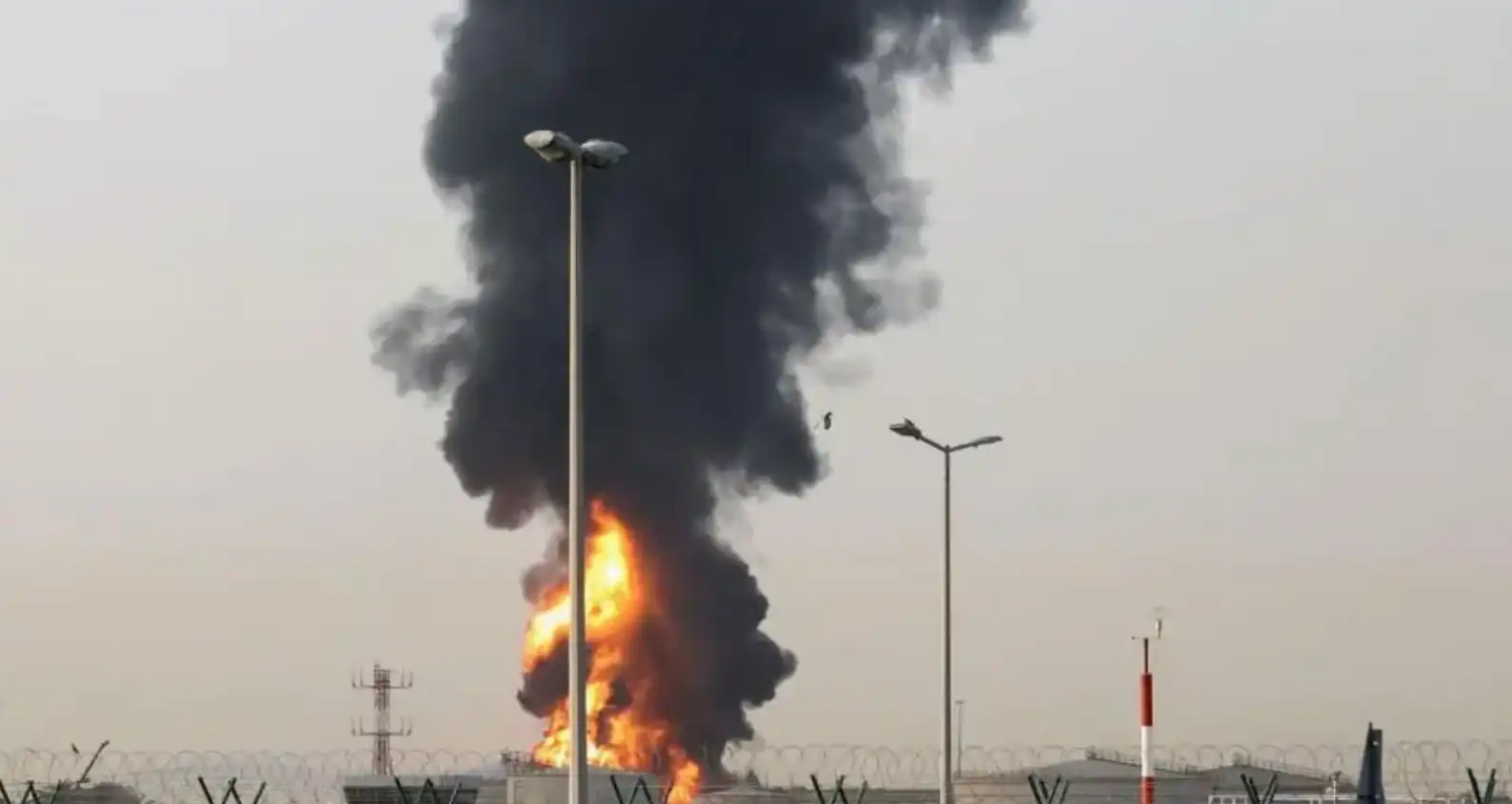
Area near Dubai International Airport fuel depot hit. Source: BBC

In local Chinese community groups in Dubai, people share daily: "I heard explosions again here."

Previously, Odaily Planet Daily reported that the Fairmont Palm Hotel on the luxurious Palm Jumeirah was set on fire by falling drone debris, injuring 4 people. (I checked this hotel; the cheapest rooms cost around 1500 RMB per night during the low season, and can reach three to four thousand during the peak season.)

If you only read the news, you might think nowhere in Dubai is safe.

The first reaction of outsiders is: if the situation is already this severe, must Dubai's booming real estate market be plummeting through the floor? Should we all be evacuating?

What about the Real Estate and Financial Markets?

When the retaliation began, the Dubai Financial Market Real Estate Index (DFMREI) plummeted from around 16,000 points to the range of 11,500-11,700 points, a drop of about 30% in just a few weeks. Residential transaction volume also fell by 25%-30%. The DFMREI fell from about 16,140 points on February 28 to about 11,500 points in mid-March, a drop of about 30%, hitting its lowest point since April 2025 and erasing all gains accumulated throughout 2026. As of March 31, the DFMREI closed at 11,721.04 points, basically consolidating at low levels with no significant rebound yet.
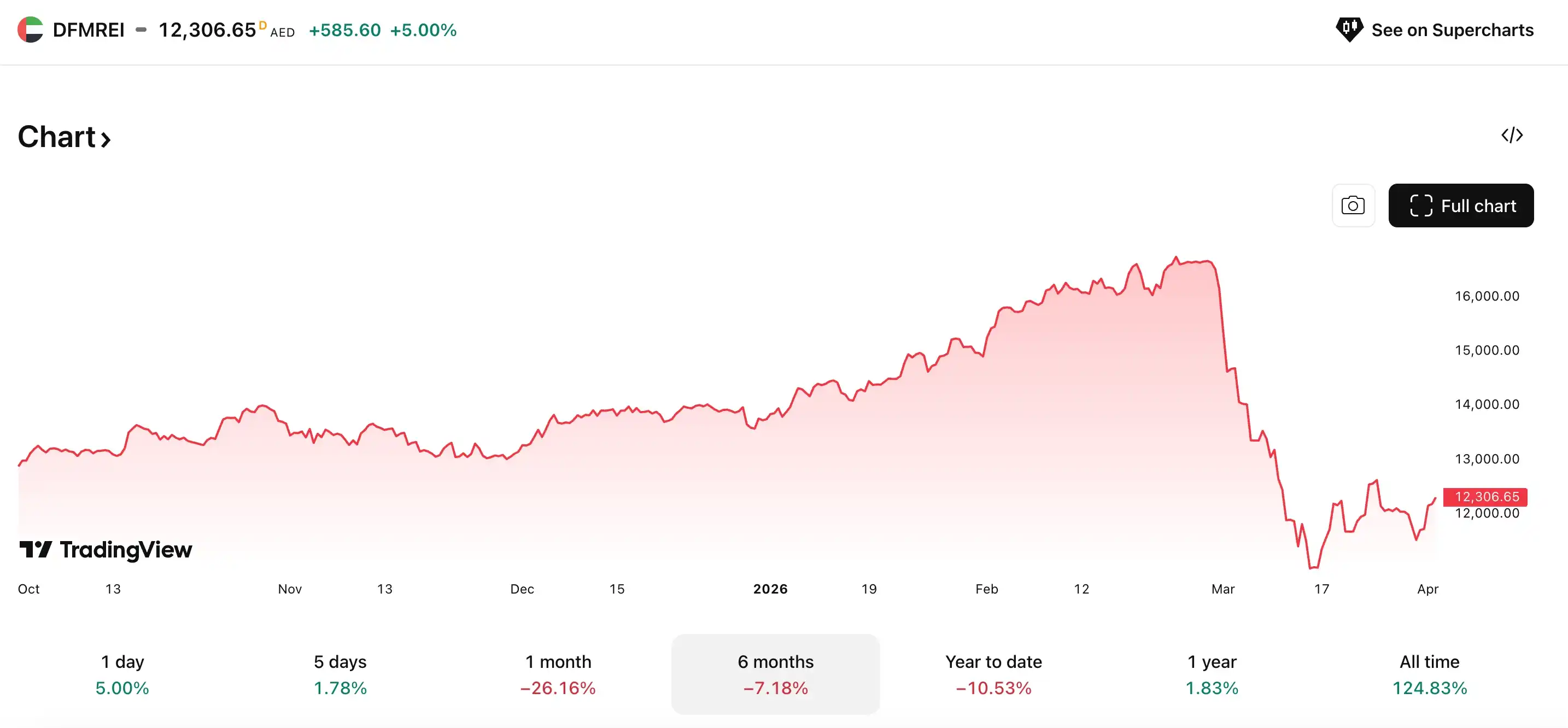
Dubai Financial Market Real Estate Index. Source: TradingView

However, it's important to note that the DFMREI is a stock index tracking the share prices of real estate companies listed on the Dubai Exchange (such as Emaar, DAMAC, etc.), not the actual real estate transaction prices. A 30% drop in the index does not mean Dubai apartment prices fell 30%; in terms of actual transactions, according to local news reports, from February 28 to March 22, actual number of property transactions decreased significantly compared to the same period in previous years, with the average transaction price falling by about 4%-5%.

Regarding financial markets, as of March 31, the Dubai and Abu Dhabi stock markets have lost a total of about $120 billion in market capitalization since the war began on February 28. Among them, the Dubai Financial Market (DFM) General Index fell about 16%, losing about $45 billion; the Abu Dhabi ADX General Index fell about 9%, losing about $75 billion.

Judging from the market reaction, it doesn't seem that severe.

Meanwhile, Dubai International Airport is still operating, albeit on a reduced schedule. A drone-induced fuel depot fire on March 30 again briefly halted flights, which were only partially restored by 10 a.m. that day. Flight suspensions to Dubai by major European airlines like Lufthansa, Air France, and British Airways have been extended until the end of March or even later, with some cancellations lasting until May 31.

The Token2049 Dubai summit, well-known in the crypto industry and originally scheduled for April 29-30, 2026, announced a postponement to April 2027, citing "the impact of ongoing regional uncertainties on safety, international travel, and operational logistics."

With all these conflicting pieces of information coming in, what is the real situation in Dubai like?

What is the future of Dubai? Is Dubai's crypto industry suffering irreversible damage?

Portrait of Crypto Practitioners in Dubai: Some Resign and Return Home, Others Rush to the 'Battlefield' by Starlight

"Some resign from office and return home; others rush to the examination hall by starlight." This phrase from "The Scholars" perfectly describes the scene in Dubai in 2026. Based on reactions collected by Odaily Planet Daily from crypto industry practitioners, they can be roughly divided into three categories.

The Escapers: Ten thousand reasons can't outweigh parents' worry

Stella is a data analyst at a cryptocurrency exchange. The company headquarters is in Dubai, and she has been working there for a year. In February this year, she took annual leave during the Spring Festival and rushed back to her hometown in Hunan to celebrate a lively New Year with her parents.

But right after the New Year, the geopolitical conflict broke out.

On the day of her return flight, Stella waited at the airport for 5 hours. The scheduled flight was delayed repeatedly and eventually canceled.

"Ticket prices changed every day during that time," she told an Odaily Planet Daily reporter. "Fortunately, the company eventually allowed all of us to work remotely, including colleagues in Dubai. No one goes to the office anymore."

She told the reporter that she originally wanted to keep trying to get a ticket back to Dubai, but it was really hard to explain to her parents at home. Stella said, her parents are in their fifties and often see WeChat official accounts talking about explosions and airstrikes here and there. She really couldn't let them worry so much.

"When I was studying for my master's degree abroad, I encountered the COVID-19 pandemic. My parents couldn't sleep all night looking at the local infection data." After realizing the conflict in Iran showed signs of becoming prolonged, Stella felt that even if she had to work across time zones, she didn't want to go through something like that again.

Stella is lucky. Rebecca, who works for a crypto infrastructure service provider, rushed back to China after the conflict started.

On March 6, the Ministry of Foreign Affairs advised Chinese citizens stranded in the Middle East to seize the window of resumed flights to evacuate.

After the conflict broke out, according to Rebecca, ticket prices didn't skyrocket particularly outrageously, but tickets still needed to be snatched up in the initial period of the conflict. Especially right at the start, there were news reports claiming that "the US military bombed Iran by hiding under the radar of civilian aircraft, thus avoiding detection," so some people, worried that civilian flights could become potential targets, drove for hours from Dubai to Oman—the only country in the Middle East without a US military base—and then made their way back to China.

Rebecca said that everyone she knew during that time returned to China.

"This time it's really... the vast majority of Chinese people are hearing explosions with their own ears for the first time. Who can handle that?"

The Stayers: If the Sheikhs haven't left, why should I?

A significant number of those who stayed expressed a very optimistic attitude in interviews. Within days of the Iranian attack, the leaders of the UAE, the Sheikhs, appeared publicly in downtown Dubai to reassure the public and express confidence.

Sheikhs appearing in public after the conflict. Source: Gulf News

Also, according to a report by The National, as of the 29th, data showed 11 deaths and 178 injuries in the UAE. Fortunately, not a single one was Chinese. Most of the injured were South Asian expatriate workers, with a small number being military personnel.

Tiffany, who works for a crypto wallet project, told the reporter, "People in Dubai, those whose companies aren't remote, basically carry on as usual, going to work normally if that's the routine."

According to an interview by crypto.news, an exchange employee using the pseudonym Jarseed stated that he had left Dubai for Hong Kong, but "many exchange employees have bought houses, settled down, and sent their children to school in Dubai. This group's attachment is far stronger than that of the digital nomads who can relocate at any time." Even if companies allow temporary work-from-home or longer-term remote work, these people have put down roots in Dubai. Where else can they go?

The Returners: You, Dare to Sign a Life-or-Death Waiver?

"Not my company, but I know some companies require people returning to Dubai to sign a life-or-death waiver," revealed an anonymous employee stationed in Dubai.

Shocking at first hearing, but this is indeed the reality for some workers in Dubai. As commercial entities, companies naturally cannot guarantee personal safety under these circumstances, so some companies require employees to sign liability waivers, what they call "life-or-death waivers."

Part of the reason is that some people truly cannot return to China for various reasons; on the other hand, because so many people have returned home, a certain vacuum has appeared in local operations in some niche areas. At this time, whoever has the courage to step up and take these orders gains the opportunity to overtake competitors in various industries.

This is both a risk and an opportunity. Thus, the Middle East is witnessing some brave returners.

Stella laughed and cried as she opened her phone to show a local group chat to Odaily Planet Daily: "Look in this group chat, this person just came back, and everyone刷屏 (floods the screen with) 'Welcome xx back to the war zone to overcome difficulties together with everyone'".

Dubai's Position Has No Substitute

"In the long run, will Dubai still be the crypto hub of the Middle East?" I asked everyone for their opinion on this question.

Ethan, the founder of a Web3 x AI project, directly opened a map to discuss this issue with us.

Ethan believes that Dubai's position is irreplaceable in the long run. His logic is simple: besides Dubai, where else can you go?
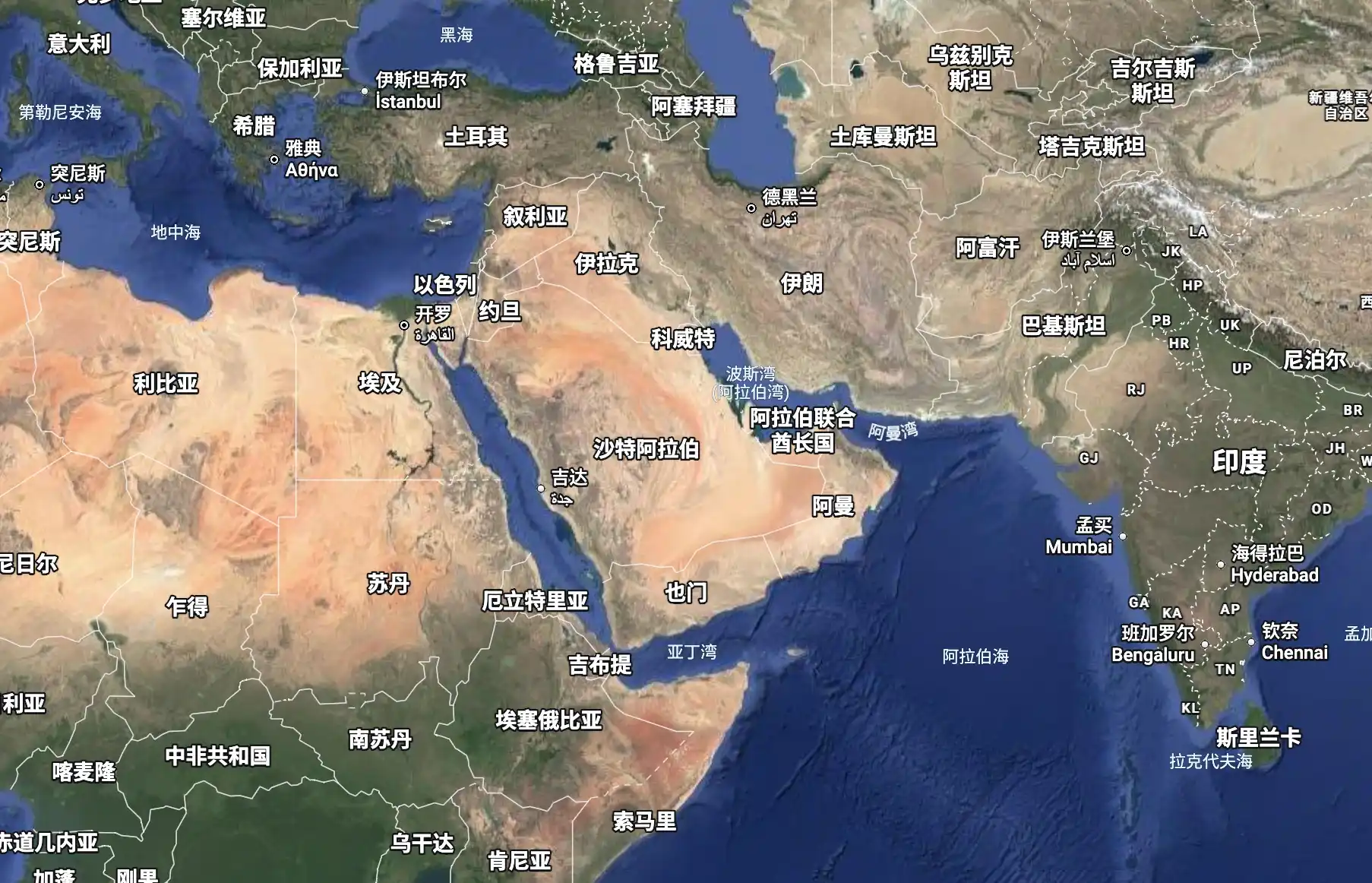
If you draw a circle centered on the UAE, you'll find almost no city comparable to Dubai within range

The nearest city of similar scale, Qatar, although developed and the country is not short of money, is also within the strike range. Israel is developed, but how do you do business with Arabs if you move there? Other cities in the Middle East are not as large as Dubai, and they might also be affected by the escalating situation.

Slightly farther away, Istanbul has an insufficient market size and not a high enough English proficiency rate. A bit further, North Africa is far less stable financially and politically than Dubai.

Even farther away, if you want to do business with the EU, why not just move to London, Paris, or Frankfurt?

So, after considering all options, Ethan believes that if you need to simultaneously satisfy the conditions of a city of similar scale,无障碍的语言沟通 (barrier-free language communication), crypto-friendly, and stable policy and financial environment, Dubai is the only choice.

"We can't just go to India, right."

Ethan told me that Dubai has always been the center of business dealings in the Middle East. Agricultural products from North Africa are unloaded here, small appliances from China are distributed here. Around the Deira area where Ethan lives, hundreds of thousands of Indians, Arabs, and Africans support the largest trade market in the Middle East.

Rebecca holds a similar view. Her company is a large international company, and Dubai is the center of its MENA (Middle East North Africa) regional business. Although she is temporarily working remotely from China, she told us that the company's operations are running normally, and she herself "will eventually return to Dubai."

The Agglomeration Effect of a Big City is Important, Especially for the Crypto Industry

Oliver, the Business Development (BD) lead for an audit project, told Odaily Planet Daily that living in a big city like Dubai is very important for the team.

He told us that although Web3 is mostly remote work, relying solely on online connections and conferences is far from enough for BD. His colleagues are mostly based in hotspot cities like Singapore and New York, and they usually cultivate very good crypto circles within their own cities, which is very important for "getting familiar" and building early trust.

Oliver himself comes from traditional finance. He believes the BD and sales process is "best done face-to-face."

From this perspective, living in a big city with a crypto atmosphere is important. Digital nomads working remotely can indeed live in places with low living costs like Nepal, but how many potential clients in the crypto industry would be there?

Believe in the UAE, and More Importantly, Believe in the Motherland

According to a Crypto.news report, Shuyao, co-founder of MegaETH, stated, "I am still very bullish on Dubai in the medium to long term. This is just its own bear market phase."

Tiffany, who works in operations, mentioned there is another layer of risk.

Since factors like war fall under force majeure, in some employment contracts, the company can lay off employees without liability. At this time, if the employee also doesn't want to return to Dubai, they might have to part ways with the company.

So, some of the returners might also be forced by circumstances.

However, she told us,

"I believe in the UAE; they won't let the situation really become irreparable. China will definitely evacuate its citizens if needed. I also believe in our country."

(Stella, Rebecca, Tiffany, Ethan, and Oliver in the article are pseudonyms.)

Related Questions

QWhat is the main reason some Chinese workers in Dubai are returning to China despite the conflict?

AThe primary reason is concern for their families, particularly parents who are extremely worried about their safety due to the ongoing missile and drone attacks, as they do not want to put their families through the stress they experienced during events like the COVID-19 pandemic.

QHow has the Dubai real estate market been affected since the military conflict began?

AThe Dubai Financial Market Real Estate Index (DFMREI), which tracks listed real estate company stocks, plummeted by approximately 30%. However, actual residential transaction prices saw a more modest decline of about 4-5%, and transaction volume decreased by 25-30%.

QWhat is the 'life and death agreement' mentioned in the context of some workers returning to Dubai?

AThe 'life and death agreement' refers to a liability waiver or disclaimer that some companies require employees to sign before returning to Dubai. This is because companies, as commercial entities, cannot guarantee personal safety amidst the conflict, and the agreement shifts responsibility away from them.

QAccording to the interviewees, why is Dubai considered a difficult location to replace as a crypto hub in the Middle East?

AInterviewees argue that Dubai is irreplaceable due to its unique combination of factors: it is a large, English-friendly, crypto-friendly city with stable policies and a financial environment. No other city in the region (like Doha or Istanbul) or nearby offers a comparable scale and set of advantages for conducting business, especially with the Arab world.

QWhat was the official reason given for the postponement of the Token2049 Dubai crypto conference?

AThe Token2049 Dubai conference was postponed to 2027 due to 'the ongoing regional uncertainties impacting safety, international travel, and operational logistics' caused by the military conflict.

Related Reads

Yao Shunyu's 88 Days

Yao Shunyu, a 27-year-old AI expert with a background from Princeton and OpenAI, joined Tencent in September 2025. Within 88 days, he led a major overhaul of Tencent’s AI strategy and organization, resulting in the release of Hunyuan Hy3 preview—a MoE model with 295B total parameters and 21B active parameters, supporting up to 256K context length. The launch came after Tencent leadership, including CEO Ma Huateng and President Martin Lau, openly criticized Hunyuan's earlier underperformance—citing slow development, over-reliance on superficial benchmark optimization, and poor generalization in real-world applications. Internal adoption was low, with key business units like WeChat and gaming seeking external AI solutions. Yao reshaped Tencent’s AI approach by integrating previously siloed teams, dissolving the ten-year-old Tencent AI Lab, and establishing new units focused on AI infrastructure and data. Hy3 preview was developed using co-design principles, closely aligned with product teams to ensure practical usability from the start. It has already been integrated into core products like Yuanbao, QQ, and enterprise tools. The release signals a shift from chasing rankings to building usable, scalable AI grounded in Tencent’s ecosystem. While external partnerships (like with DeepSeek and OpenClaw) helped retain users temporarily, the focus is now on making Hunyuan a reliable internal foundation. The real test lies in sustaining this new organizational momentum amid fierce competition from Alibaba, DeepSeek, and others.

marsbit2h ago

Yao Shunyu's 88 Days

marsbit2h ago

Trading

Spot
Futures

Hot Articles

What is SONIC

Sonic: Pioneering the Future of Gaming in Web3 Introduction to Sonic In the ever-evolving landscape of Web3, the gaming industry stands out as one of the most dynamic and promising sectors. At the forefront of this revolution is Sonic, a project designed to amplify the gaming ecosystem on the Solana blockchain. Leveraging cutting-edge technology, Sonic aims to deliver an unparalleled gaming experience by efficiently processing millions of requests per second, ensuring that players enjoy seamless gameplay while maintaining low transaction costs. This article delves into the intricate details of Sonic, exploring its creators, funding sources, operational mechanics, and the timeline of significant events that have shaped its journey. What is Sonic? Sonic is an innovative layer-2 network that operates atop the Solana blockchain, specifically tailored to enhance the existing Solana gaming ecosystem. It accomplishes this through a customised, VM-agnostic game engine paired with a HyperGrid interpreter, facilitating sovereign game economies that roll up back to the Solana platform. The primary goals of Sonic include: Enhanced Gaming Experiences: Sonic is committed to offering lightning-fast on-chain gameplay, allowing players and developers to engage with games at previously unattainable speeds. Atomic Interoperability: This feature enables transactions to be executed within Sonic without the need to redeploy Solana programmes and accounts. This makes the process more efficient and directly benefits from Solana Layer1 services and liquidity. Seamless Deployment: Sonic allows developers to write for Ethereum Virtual Machine (EVM) based systems and execute them on Solana’s SVM infrastructure. This interoperability is crucial for attracting a broader range of dApps and decentralised applications to the platform. Support for Developers: By offering native composable gaming primitives and extensible data types - dining within the Entity-Component-System (ECS) framework - game creators can craft intricate business logic with ease. Overall, Sonic's unique approach not only caters to players but also provides an accessible and low-cost environment for developers to innovate and thrive. Creator of Sonic The information regarding the creator of Sonic is somewhat ambiguous. However, it is known that Sonic's SVM is owned by the company Mirror World. The absence of detailed information about the individuals behind Sonic reflects a common trend in several Web3 projects, where collective efforts and partnerships often overshadow individual contributions. Investors of Sonic Sonic has garnered considerable attention and support from various investors within the crypto and gaming sectors. Notably, the project raised an impressive $12 million during its Series A funding round. The round was led by BITKRAFT Ventures, with other notable investors including Galaxy, Okx Ventures, Interactive, Big Brain Holdings, and Mirana. This financial backing signifies the confidence that investment foundations have in Sonic’s potential to revolutionise the Web3 gaming landscape, further validating its innovative approaches and technologies. How Does Sonic Work? Sonic utilises the HyperGrid framework, a sophisticated parallel processing mechanism that enhances its scalability and customisability. Here are the core features that set Sonic apart: Lightning Speed at Low Costs: Sonic offers one of the fastest on-chain gaming experiences compared to other Layer-1 solutions, powered by the scalability of Solana’s virtual machine (SVM). Atomic Interoperability: Sonic enables transaction execution without redeployment of Solana programmes and accounts, effectively streamlining the interaction between users and the blockchain. EVM Compatibility: Developers can effortlessly migrate decentralised applications from EVM chains to the Solana environment using Sonic’s HyperGrid interpreter, increasing the accessibility and integration of various dApps. Ecosystem Support for Developers: By exposing native composable gaming primitives, Sonic facilitates a sandbox-like environment where developers can experiment and implement business logic, greatly enhancing the overall development experience. Monetisation Infrastructure: Sonic natively supports growth and monetisation efforts, providing frameworks for traffic generation, payments, and settlements, thereby ensuring that gaming projects are not only viable but also sustainable financially. Timeline of Sonic The evolution of Sonic has been marked by several key milestones. Below is a brief timeline highlighting critical events in the project's history: 2022: The Sonic cryptocurrency was officially launched, marking the beginning of its journey in the Web3 gaming arena. 2024: June: Sonic SVM successfully raised $12 million in a Series A funding round. This investment allowed Sonic to further develop its platform and expand its offerings. August: The launch of the Sonic Odyssey testnet provided users with the first opportunity to engage with the platform, offering interactive activities such as collecting rings—a nod to gaming nostalgia. October: SonicX, an innovative crypto game integrated with Solana, made its debut on TikTok, capturing the attention of over 120,000 users within a short span. This integration illustrated Sonic’s commitment to reaching a broader, global audience and showcased the potential of blockchain gaming. Key Points Sonic SVM is a revolutionary layer-2 network on Solana explicitly designed to enhance the GameFi landscape, demonstrating great potential for future development. HyperGrid Framework empowers Sonic by introducing horizontal scaling capabilities, ensuring that the network can handle the demands of Web3 gaming. Integration with Social Platforms: The successful launch of SonicX on TikTok displays Sonic’s strategy to leverage social media platforms to engage users, exponentially increasing the exposure and reach of its projects. Investment Confidence: The substantial funding from BITKRAFT Ventures, among others, emphasizes the robust backing Sonic has, paving the way for its ambitious future. In conclusion, Sonic encapsulates the essence of Web3 gaming innovation, striking a balance between cutting-edge technology, developer-centric tools, and community engagement. As the project continues to evolve, it is poised to redefine the gaming landscape, making it a notable entity for gamers and developers alike. As Sonic moves forward, it will undoubtedly attract greater interest and participation, solidifying its place within the broader narrative of blockchain gaming.

1.1k Total ViewsPublished 2024.04.04Updated 2024.12.03

What is SONIC

What is $S$

Understanding SPERO: A Comprehensive Overview Introduction to SPERO As the landscape of innovation continues to evolve, the emergence of web3 technologies and cryptocurrency projects plays a pivotal role in shaping the digital future. One project that has garnered attention in this dynamic field is SPERO, denoted as SPERO,$$s$. This article aims to gather and present detailed information about SPERO, to help enthusiasts and investors understand its foundations, objectives, and innovations within the web3 and crypto domains. What is SPERO,$$s$? SPERO,$$s$ is a unique project within the crypto space that seeks to leverage the principles of decentralisation and blockchain technology to create an ecosystem that promotes engagement, utility, and financial inclusion. The project is tailored to facilitate peer-to-peer interactions in new ways, providing users with innovative financial solutions and services. At its core, SPERO,$$s$ aims to empower individuals by providing tools and platforms that enhance user experience in the cryptocurrency space. This includes enabling more flexible transaction methods, fostering community-driven initiatives, and creating pathways for financial opportunities through decentralised applications (dApps). The underlying vision of SPERO,$$s$ revolves around inclusiveness, aiming to bridge gaps within traditional finance while harnessing the benefits of blockchain technology. Who is the Creator of SPERO,$$s$? The identity of the creator of SPERO,$$s$ remains somewhat obscure, as there are limited publicly available resources providing detailed background information on its founder(s). This lack of transparency can stem from the project's commitment to decentralisation—an ethos that many web3 projects share, prioritising collective contributions over individual recognition. By centring discussions around the community and its collective goals, SPERO,$$s$ embodies the essence of empowerment without singling out specific individuals. As such, understanding the ethos and mission of SPERO remains more important than identifying a singular creator. Who are the Investors of SPERO,$$s$? SPERO,$$s$ is supported by a diverse array of investors ranging from venture capitalists to angel investors dedicated to fostering innovation in the crypto sector. The focus of these investors generally aligns with SPERO's mission—prioritising projects that promise societal technological advancement, financial inclusivity, and decentralised governance. These investor foundations are typically interested in projects that not only offer innovative products but also contribute positively to the blockchain community and its ecosystems. The backing from these investors reinforces SPERO,$$s$ as a noteworthy contender in the rapidly evolving domain of crypto projects. How Does SPERO,$$s$ Work? SPERO,$$s$ employs a multi-faceted framework that distinguishes it from conventional cryptocurrency projects. Here are some of the key features that underline its uniqueness and innovation: Decentralised Governance: SPERO,$$s$ integrates decentralised governance models, empowering users to participate actively in decision-making processes regarding the project’s future. This approach fosters a sense of ownership and accountability among community members. Token Utility: SPERO,$$s$ utilises its own cryptocurrency token, designed to serve various functions within the ecosystem. These tokens enable transactions, rewards, and the facilitation of services offered on the platform, enhancing overall engagement and utility. Layered Architecture: The technical architecture of SPERO,$$s$ supports modularity and scalability, allowing for seamless integration of additional features and applications as the project evolves. This adaptability is paramount for sustaining relevance in the ever-changing crypto landscape. Community Engagement: The project emphasises community-driven initiatives, employing mechanisms that incentivise collaboration and feedback. By nurturing a strong community, SPERO,$$s$ can better address user needs and adapt to market trends. Focus on Inclusion: By offering low transaction fees and user-friendly interfaces, SPERO,$$s$ aims to attract a diverse user base, including individuals who may not previously have engaged in the crypto space. This commitment to inclusion aligns with its overarching mission of empowerment through accessibility. Timeline of SPERO,$$s$ Understanding a project's history provides crucial insights into its development trajectory and milestones. Below is a suggested timeline mapping significant events in the evolution of SPERO,$$s$: Conceptualisation and Ideation Phase: The initial ideas forming the basis of SPERO,$$s$ were conceived, aligning closely with the principles of decentralisation and community focus within the blockchain industry. Launch of Project Whitepaper: Following the conceptual phase, a comprehensive whitepaper detailing the vision, goals, and technological infrastructure of SPERO,$$s$ was released to garner community interest and feedback. Community Building and Early Engagements: Active outreach efforts were made to build a community of early adopters and potential investors, facilitating discussions around the project’s goals and garnering support. Token Generation Event: SPERO,$$s$ conducted a token generation event (TGE) to distribute its native tokens to early supporters and establish initial liquidity within the ecosystem. Launch of Initial dApp: The first decentralised application (dApp) associated with SPERO,$$s$ went live, allowing users to engage with the platform's core functionalities. Ongoing Development and Partnerships: Continuous updates and enhancements to the project's offerings, including strategic partnerships with other players in the blockchain space, have shaped SPERO,$$s$ into a competitive and evolving player in the crypto market. Conclusion SPERO,$$s$ stands as a testament to the potential of web3 and cryptocurrency to revolutionise financial systems and empower individuals. With a commitment to decentralised governance, community engagement, and innovatively designed functionalities, it paves the way toward a more inclusive financial landscape. As with any investment in the rapidly evolving crypto space, potential investors and users are encouraged to research thoroughly and engage thoughtfully with the ongoing developments within SPERO,$$s$. The project showcases the innovative spirit of the crypto industry, inviting further exploration into its myriad possibilities. While the journey of SPERO,$$s$ is still unfolding, its foundational principles may indeed influence the future of how we interact with technology, finance, and each other in interconnected digital ecosystems.

54 Total ViewsPublished 2024.12.17Updated 2024.12.17

What is $S$

What is AGENT S

Agent S: The Future of Autonomous Interaction in Web3 Introduction In the ever-evolving landscape of Web3 and cryptocurrency, innovations are constantly redefining how individuals interact with digital platforms. One such pioneering project, Agent S, promises to revolutionise human-computer interaction through its open agentic framework. By paving the way for autonomous interactions, Agent S aims to simplify complex tasks, offering transformative applications in artificial intelligence (AI). This detailed exploration will delve into the project's intricacies, its unique features, and the implications for the cryptocurrency domain. What is Agent S? Agent S stands as a groundbreaking open agentic framework, specifically designed to tackle three fundamental challenges in the automation of computer tasks: Acquiring Domain-Specific Knowledge: The framework intelligently learns from various external knowledge sources and internal experiences. This dual approach empowers it to build a rich repository of domain-specific knowledge, enhancing its performance in task execution. Planning Over Long Task Horizons: Agent S employs experience-augmented hierarchical planning, a strategic approach that facilitates efficient breakdown and execution of intricate tasks. This feature significantly enhances its ability to manage multiple subtasks efficiently and effectively. Handling Dynamic, Non-Uniform Interfaces: The project introduces the Agent-Computer Interface (ACI), an innovative solution that enhances the interaction between agents and users. Utilizing Multimodal Large Language Models (MLLMs), Agent S can navigate and manipulate diverse graphical user interfaces seamlessly. Through these pioneering features, Agent S provides a robust framework that addresses the complexities involved in automating human interaction with machines, setting the stage for myriad applications in AI and beyond. Who is the Creator of Agent S? While the concept of Agent S is fundamentally innovative, specific information about its creator remains elusive. The creator is currently unknown, which highlights either the nascent stage of the project or the strategic choice to keep founding members under wraps. Regardless of anonymity, the focus remains on the framework's capabilities and potential. Who are the Investors of Agent S? As Agent S is relatively new in the cryptographic ecosystem, detailed information regarding its investors and financial backers is not explicitly documented. The lack of publicly available insights into the investment foundations or organisations supporting the project raises questions about its funding structure and development roadmap. Understanding the backing is crucial for gauging the project's sustainability and potential market impact. How Does Agent S Work? At the core of Agent S lies cutting-edge technology that enables it to function effectively in diverse settings. Its operational model is built around several key features: Human-like Computer Interaction: The framework offers advanced AI planning, striving to make interactions with computers more intuitive. By mimicking human behaviour in tasks execution, it promises to elevate user experiences. Narrative Memory: Employed to leverage high-level experiences, Agent S utilises narrative memory to keep track of task histories, thereby enhancing its decision-making processes. Episodic Memory: This feature provides users with step-by-step guidance, allowing the framework to offer contextual support as tasks unfold. Support for OpenACI: With the ability to run locally, Agent S allows users to maintain control over their interactions and workflows, aligning with the decentralised ethos of Web3. Easy Integration with External APIs: Its versatility and compatibility with various AI platforms ensure that Agent S can fit seamlessly into existing technological ecosystems, making it an appealing choice for developers and organisations. These functionalities collectively contribute to Agent S's unique position within the crypto space, as it automates complex, multi-step tasks with minimal human intervention. As the project evolves, its potential applications in Web3 could redefine how digital interactions unfold. Timeline of Agent S The development and milestones of Agent S can be encapsulated in a timeline that highlights its significant events: September 27, 2024: The concept of Agent S was launched in a comprehensive research paper titled “An Open Agentic Framework that Uses Computers Like a Human,” showcasing the groundwork for the project. October 10, 2024: The research paper was made publicly available on arXiv, offering an in-depth exploration of the framework and its performance evaluation based on the OSWorld benchmark. October 12, 2024: A video presentation was released, providing a visual insight into the capabilities and features of Agent S, further engaging potential users and investors. These markers in the timeline not only illustrate the progress of Agent S but also indicate its commitment to transparency and community engagement. Key Points About Agent S As the Agent S framework continues to evolve, several key attributes stand out, underscoring its innovative nature and potential: Innovative Framework: Designed to provide an intuitive use of computers akin to human interaction, Agent S brings a novel approach to task automation. Autonomous Interaction: The ability to interact autonomously with computers through GUI signifies a leap towards more intelligent and efficient computing solutions. Complex Task Automation: With its robust methodology, it can automate complex, multi-step tasks, making processes faster and less error-prone. Continuous Improvement: The learning mechanisms enable Agent S to improve from past experiences, continually enhancing its performance and efficacy. Versatility: Its adaptability across different operating environments like OSWorld and WindowsAgentArena ensures that it can serve a broad range of applications. As Agent S positions itself in the Web3 and crypto landscape, its potential to enhance interaction capabilities and automate processes signifies a significant advancement in AI technologies. Through its innovative framework, Agent S exemplifies the future of digital interactions, promising a more seamless and efficient experience for users across various industries. Conclusion Agent S represents a bold leap forward in the marriage of AI and Web3, with the capacity to redefine how we interact with technology. While still in its early stages, the possibilities for its application are vast and compelling. Through its comprehensive framework addressing critical challenges, Agent S aims to bring autonomous interactions to the forefront of the digital experience. As we move deeper into the realms of cryptocurrency and decentralisation, projects like Agent S will undoubtedly play a crucial role in shaping the future of technology and human-computer collaboration.

549 Total ViewsPublished 2025.01.14Updated 2025.01.14

What is AGENT S

Discussions

Welcome to the HTX Community. Here, you can stay informed about the latest platform developments and gain access to professional market insights. Users' opinions on the price of S (S) are presented below.

活动图片