The cryptocurrency market is showing a fascinating divergence: institutional giants are building the floor while retail traders are aggressively testing the ceiling.
Reports that major banking institutions like ING are warming up to direct crypto services signal a critical shift in market structure.
That’s not just about accessibility, it’s about the legitimization of digital assets as a standard portfolio component for conservative European wealth. (Frankly, when a legacy bank moves, it validates the asset class for risk-averse capital that has remained on the sidelines for a decade).
Meanwhile, the retail sector is operating with a totally different risk profile. Just look at the parabolic moves in assets like $SUBBD. The surge in these niche, community-driven tokens suggests that despite macroeconomic headwinds, risk-on appetite remains voracious.
The dichotomy is stark: while bankers analyze Bitcoin ETFs, the ‘degen’ economy is hunting for 100x multipliers in the AI infrastructure sector. This barbell structure, stability on one end, high volatility on the other, implies liquidity is returning to the system, but it’s bifurcated.
But the most astute capital is looking beyond the safety of banks or the casino-like nature of memes. Smart money is positioning itself in the middle ground: utility-driven protocols that solve tangible Web2 problems using Web3 infrastructure.
Specifically, the intersection of Artificial Intelligence and the creator economy is emerging as the next major growth narrative. Investors are increasingly rotating profits from high-volatility plays into infrastructure projects like SUBBD Token that offer sustainable revenue models.
Visit SUBBD Token’s official page.
SUBBD Token Targets the $85 Billion Creator Economy
While the broader market debates regulatory frameworks, SUBBD Token is executing a targeted strike on the $85 billion content creation industry. The current Web2 model? It’s fundamentally broken for creators. Platforms often extract up to 70% of earnings in fees, impose arbitrary bans, and enforce strict geographical payment restrictions.
SUBBD uses Ethereum-based EVM-compatible smart contracts to dismantle these barriers, offering a decentralized alternative where creators actually retain control over their content and revenue.
The project differentiates itself by integrating proprietary AI models directly into its ecosystem. This isn’t merely about payment processing, it’s about workflow automation. The platform features an AI Personal Assistant for automated interactions and advanced AI Voice Cloning technology, allowing influencers to scale their presence without scaling their workload.
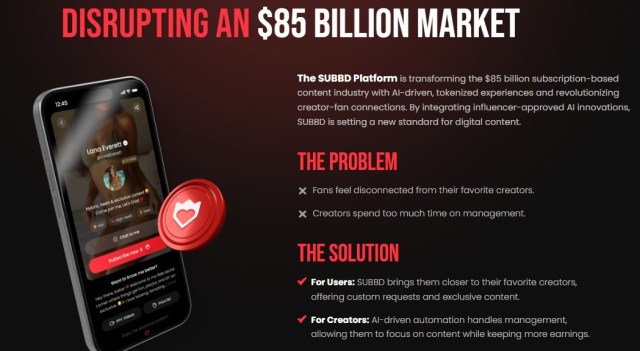
For fans, the utility is equally tangible: token-gated access creates an exclusive layer of interaction that fiat subscriptions can’t replicate.
From a portfolio standpoint, this represents a shift from speculative assets to productive ones. By merging Web3 transparency with AI-driven influencer tools, the project addresses the fragmentation of current software. Instead of subscribing to five different services for chatbots, voice generation, and payments, creators access a unified ecosystem. That consolidation of utility is precisely what transforms a token from a trading vehicle into a fundamental infrastructure play.
Explore the SUBBD ecosystem.
Early Capital Flows and Staking Metrics
The market’s appetite for this AI-Web3 hybrid model is reflected in the early capital inflows. According to official data, the project has already raised $1.4M, a figure that suggests significant conviction from early entrants despite the broader market’s volatility.
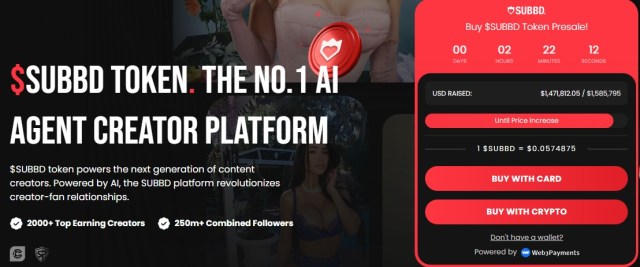
With tokens currently priced at $0.0574875, the entry point allows for position sizing that’s difficult to achieve in established large-cap assets.
Beyond the capital raise, the protocol’s retention mechanics are designed to mitigate the sell pressure often seen in new launches. The staking structure offers a fixed 20% APY for the first year, creating a compelling incentive for holders to lock supply. This isn’t just an inflationary reward; it’s a mechanism to align user behavior with long-term platform growth.
Stakers also gain access to XP multipliers and exclusive ‘behind the scenes’ content drops, gamifying the holding process.
This approach, combining high-yield staking with functional platform benefits, creates a liquidity sink that stabilizes the token economy.
While ING clients are limited to market-beta returns, SUBBD offers a third path: early-stage exposure to a utility protocol with built-in yield generation.
As the presale advances, the window to acquire tokens at the $0.0002802 valuation tightens, placing a premium on early decision-making.
View the official SUBBD presale site.
The information provided in this article does not constitute investment advice, financial advice, trading advice, or any other sort of advice and you should not treat any of the article’s content as such. Cryptocurrency markets are highly volatile and carry significant risk. Always conduct your own due diligence before making any investment decisions.






