Infinex Token Sale New Rules: Two Options - $0.0099 Locked for One Year or $0.03 Unlocked Immediately

Odaily星球日报Published on 2025-12-26Last updated on 2025-12-26

Abstract

Infinex, a DeFi platform founded by Synthetix's Kain Warwick, has revised its token sale terms for its INX token. The fully diluted valuation (FDV) has been reduced from $300 million to $99.99 million following community feedback, though the one-year lockup period remains unchanged. The sale, scheduled for January 3-6, 2026, will offer 5% of the total token supply. Participants are given two pricing options: purchase tokens at $0.0099 each with a mandatory one-year lock, or opt for immediate unlocking at TGE (end of January 2026) at a higher valuation of $300 million FDV, equating to $0.03 per token. The latter option features a linear valuation decrease over the year, settling at the $99.99 million FDV. The changes have sparked significant community backlash, particularly from Patron NFT holders. They argue the new immediate unlock option at a lower FDV devalues their earlier investments, which were made under the expectation that early liquidity required a much higher valuation threshold. The Patron NFT floor price fell nearly 10% following the announcement. Despite the FDV reduction, the core complaint about the lengthy one-year lockup persists, with many in the community viewing it as a major disadvantage in the current market.

Original | Odaily Planet Daily (@OdailyChina)

Author | Asher (@Asher_ 0210)
Yesterday, Infinex founder Kain Warwick posted on X platform that due to feedback indicating the pricing was too high, the valuation of the Sonar token sale conducted by Infinex on Echo has been reduced from the initial $300 million to $99.99 million, while the lock-up period remains unchanged at one year, to better adapt to the current market environment.

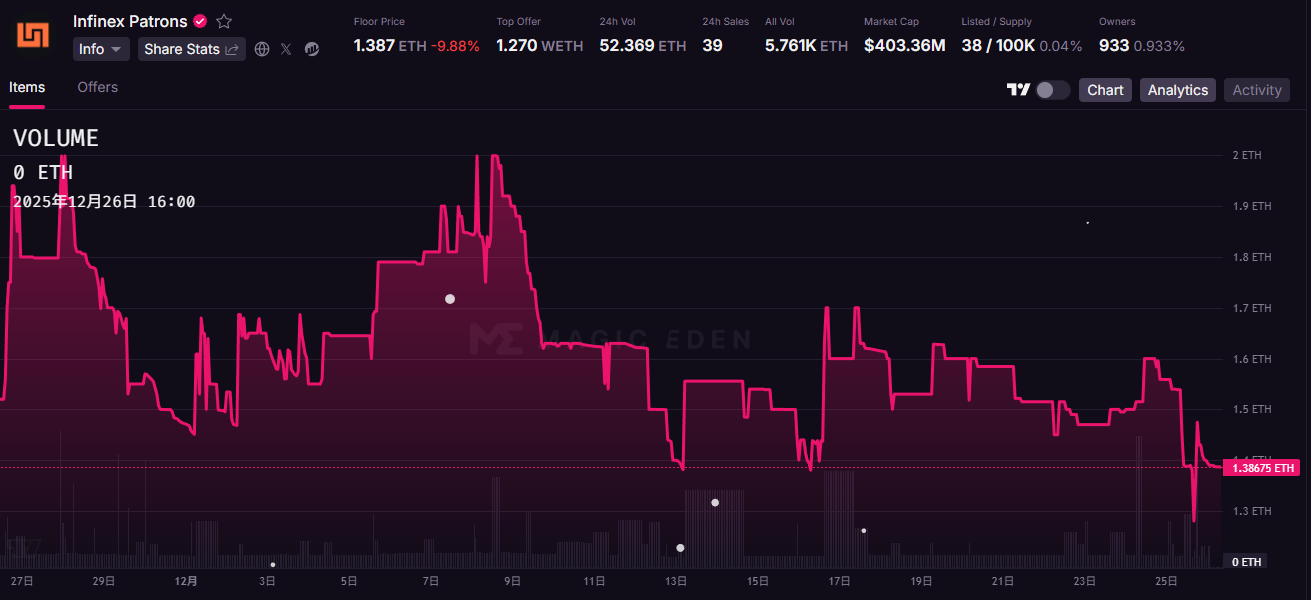
Affected by the FDV reduction, the overall allocation quota for the Sonar sale has decreased, making it impossible to guarantee the priority allocation arrangement for the original Patron NFT holders. The floor price of Infinex Patrons NFT has dropped nearly 10% in 24 hours, temporarily at 1.387 ETH.
Below, Odaily Planet Daily takes you through the Infinex project, the new token sale rules, and community sentiment.

Infinex: Full-Stack DeFi Services

Infinex is a decentralized finance platform launched by Synthetix founder Kain Warwick in April 2024. Its goal is to provide a product form close to the experience of a centralized exchange under a decentralized premise, thereby narrowing the usability gap between CeFi and DeFi. While maintaining non-custodial assets and on-chain security, the platform focuses on optimizing the interaction process and user experience.
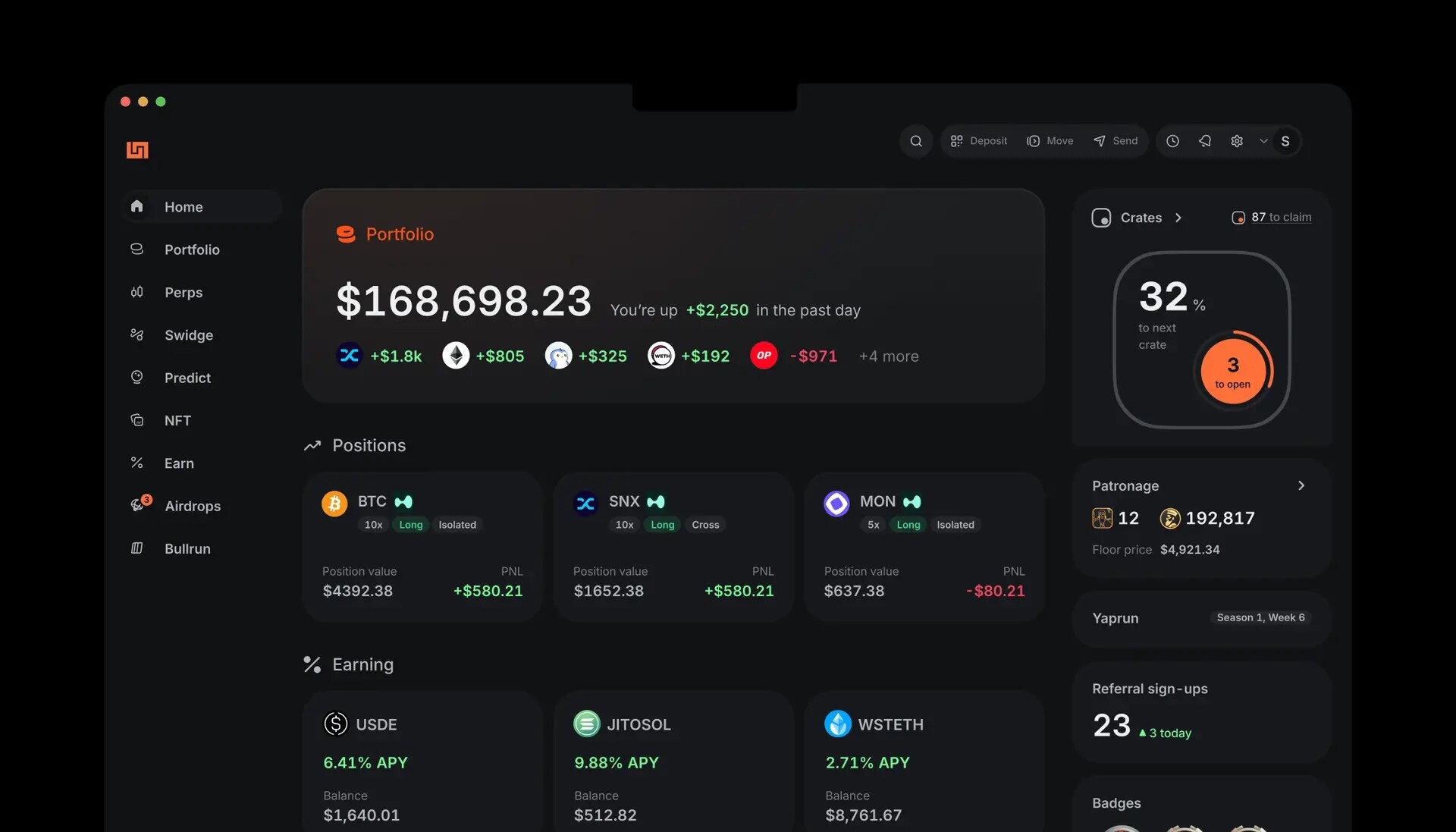
From a product positioning perspective, Infinex is not a single-function application but rather a full-stack DeFi service entry point. Its core capabilities include: acting as a non-custodial wallet covering multiple chains to host user assets; serving as a unified interface to aggregate and integrate various on-chain DeFi protocols and services; and through highly abstract interaction design, hiding complex concepts like address management, cross-chain bridging, seed phrases, and Gas fees in the background, allowing users to interact with DeFi applications without needing to understand the underlying mechanisms, resulting in an overall user experience closer to CeFi products.

To date, Infinex has supported 15 blockchain networks including Ethereum, Solana, and Base. The integrated DeFi functions cover cross-chain swaps (Swidge), perpetual contracts (Perp), liquid staking, and other yield-generating services (Earn), among others.

Infinex Token Sale New Regulations

According to the official Infinex documentation, the updated details of the Infinex token sale are as follows:

  • INX Token Sale Account Registration Date: Starting December 27th;
  • INX Token Official Sale Date: January 3rd to January 6th, 2026;
  • Infinex TGE Date: Planned for late January 2026;
  • Sale Quantity: 5% of the total token supply;
  • FDV: Valuation reduced from the initial $300 million to $99.99 million;
  • Lock-up Situation: Locked for one year;
  • Purchase Quantity: Minimum amount is $200, maximum amount is $2500. If the token sale is oversubscribed, the chance of obtaining an allocation can be increased by sharing participation details on X. Regular users can get a 3x multiplier by sharing on X, while Patreon NFT holders can get a 10x multiplier.

Additionally, the INX tokens in this sale offer an early unlock option. If the early unlock option is chosen, the corresponding valuation at TGE is a $300 million FDV, with a single token price of $0.03. Thereafter, this valuation will be linearly reduced over the following year, finally settling at a $99.99 million FDV, corresponding to a single token price of $0.0099.

Community Sentiment: Negative Voices Dominate, Patron NFT Holders Particularly Dissatisfied

"A $300 million valuation allows for full unlocking at TGE, so what was the point of me buying the Patron NFT at a $500 million valuation?" This is the most direct question raised by many Patron NFT holders after the new rules were announced. According to the previous sale expectations, participants could participate in the token sale at a $300 million FDV. If they wished to unlock at TGE, they would need to correspond to a higher valuation threshold, approximately a $1 billion FDV. It was under this expectation that some users chose to purchase Patron NFTs at a higher implied valuation to secure more certain allocation rights and earlier liquidity.

However, after the adjustment of the new plan, the valuation threshold for early unlocking was significantly reduced to a $300 million FDV, significantly weakening the Patron mechanism which originally used a high valuation to exchange for unlocking rights and priority. This means that the premium paid by Patron NFT holders previously for "certainty" and "early unlocking" is no longer valid, and some holders have turned to a state of negative returns both on paper and in expectation.

In response to this controversy, Kain Warwick stated that the purpose of the new plan is to promote broader distribution of the token and increase overall participation and market heat before TGE. However, in the view of some Patron holders, this explanation does not cover their core losses and fails to fully address the expectation gap suffered by early supporters due to the mechanism change, therefore not completely quelling the controversy.

Furthermore, the unchanged 1-year lock-up period remains the biggest pain point in community discussions. Although the significant reduction in FDV has somewhat alleviated market criticism of the high valuation, it has not changed the strong dissatisfaction of most community members towards the "1-year lock-up period," which they believe is almost equivalent to a "death sentence" in the current market environment.

Related Questions

QWhat are the two options for purchasing INX tokens in the updated Infinex token sale?

AThe two options are: purchasing at $0.0099 per token with a one-year lockup period, or purchasing at $0.03 per token for immediate unlocking at TGE.

QWhy was the Fully Diluted Valuation (FDV) for the Sonar token sale reduced from $300 million to $99.99 million?

AThe FDV was reduced in response to community feedback that the initial pricing was too high, in order to better adapt to the current market conditions.

QWhat negative impact did the new token sale rules have on Infinex Patrons NFT holders?

AThe new rules, which lowered the early unlock valuation threshold, significantly devalued the benefits of the Patron NFTs. This caused their floor price to drop nearly 10% as the premium paid for guaranteed allocation and early liquidity was undermined.

QWhat is the core product goal of the Infinex platform as described in the article?

AInfinex's core goal is to provide a full-stack DeFi service that offers a user experience close to that of a centralized exchange (CeFi) while maintaining the non-custodial and on-chain security of DeFi.

QWhat was the community's primary criticism that remained even after the FDV was lowered?

AThe community's biggest criticism, which was not resolved by the FDV reduction, was the mandatory one-year lockup period for tokens purchased at the lower price, which many considered excessively long and unfavorable in the current market.

Related Reads

Anthropic's IPO Launch: Commercial Miracle or Valuation Bubble?

Anthropic has confidentially filed for an IPO, led by Morgan Stanley and Goldman Sachs, potentially going public by October. Following its latest $650 billion funding round, its pre-IPO valuation stands at $965 billion, with projections reaching up to $2 trillion at listing, which would make it the highest-valued private company ever. The article, written by Fu Sheng, addresses skepticism that this represents an AI bubble akin to the 2000 dot-com crash. It argues the current situation differs fundamentally. Unlike the internet bubble era, which relied on speculative narratives with little revenue, Anthropic's valuation is backed by unprecedented, measurable financial performance. Key data points include: * **Revenue Growth:** ARR skyrocketed from $10 billion in early 2025 to $470 billion by May 2026, targeting $100 billion by year-end—a growth curve unmatched in business history. * **Profitability:** It achieved operating profitability in Q2 2026 with an estimated $5.6 billion profit. * **Efficiency:** With ~3,000 employees and ~$470 billion ARR, its revenue per employee exceeds $10 million. Products like Claude Code, launched less than a year ago, already generate $25 billion in annualized revenue. * **Enterprise Adoption:** It boasts a strong enterprise client base, with 8 of the Fortune 10 and over 1,000 large firms spending over $1 million annually on Claude. The valuation is framed using a traditional SaaS model (e.g., a 10x Price-to-Sales multiple on $100 billion revenue). The author contends the core question for analysts has shifted from "How big could this be?" to "How much is it earning and will earn next quarter?" The discussion extends beyond Anthropic to a broader paradigm shift: the transition from a "carbon-based" to a "silicon-based" economy. Companies are increasingly prioritizing investment in compute and AI capabilities over human resources, as these directly scale productivity and competitive advantage. Anthropic's IPO is thus positioned not just as a corporate milestone, but as a price anchor for this new economic era.

链捕手1h ago

Anthropic's IPO Launch: Commercial Miracle or Valuation Bubble?

链捕手1h ago

Near Returns to the AI Stage: Transformation into a Public Chain Due to 'Payroll Difficulties,' Agent and Privacy Emerge as New Growth Narratives

NEAR Returns to AI Origins: From Payroll Struggles to Blockchain, Now Focusing on AI Agents and Privacy NEAR Protocol's journey began not with grand blockchain ambitions, but from a practical hurdle: its AI startup founders, including Transformer paper co-author Illia Polosukhin, couldn't efficiently pay international developers in 2017. This led them to pivot and build a high-performance, scalable blockchain. After years navigating various crypto narratives like sharding and cross-chain interoperability, NEAR is now leveraging its AI roots to re-enter the AI arena. A key driver is its "NEAR Intents" layer, which abstracts complex cross-chain transactions. Users simply state their goal (e.g., swap BTC for ETH), and a solver network finds the optimal route. This system has processed over $20B in cross-chain volume, generating significant fee revenue. A major growth area is private transactions via "Confidential Intents/Swaps," which hide trade details until settlement to protect against MEV and front-running. Remarkably, private swaps recently accounted for over 40% of NEAR's transaction volume, highlighting strong demand but also potential regulatory scrutiny. With its AI-founder pedigree, NEAR is positioning itself at the intersection of blockchain, AI agents, and privacy, aiming to become infrastructure for the emerging agent economy while navigating the challenges of its rapid adoption.

marsbit4h ago

Near Returns to the AI Stage: Transformation into a Public Chain Due to 'Payroll Difficulties,' Agent and Privacy Emerge as New Growth Narratives

marsbit4h ago

Trading

Spot
Futures

Hot Articles

How to Buy ONE

Welcome to HTX.com! We've made purchasing Harmony (ONE) simple and convenient. Follow our step-by-step guide to embark on your crypto journey.Step 1: Create Your HTX AccountUse your email or phone number to sign up for a free account on HTX. Experience a hassle-free registration journey and unlock all features.Get My AccountStep 2: Go to Buy Crypto and Choose Your Payment MethodCredit/Debit Card: Use your Visa or Mastercard to buy Harmony (ONE) instantly.Balance: Use funds from your HTX account balance to trade seamlessly.Third Parties: We've added popular payment methods such as Google Pay and Apple Pay to enhance convenience.P2P: Trade directly with other users on HTX.Over-the-Counter (OTC): We offer tailor-made services and competitive exchange rates for traders.Step 3: Store Your Harmony (ONE)After purchasing your Harmony (ONE), store it in your HTX account. Alternatively, you can send it elsewhere via blockchain transfer or use it to trade other cryptocurrencies.Step 4: Trade Harmony (ONE)Easily trade Harmony (ONE) on HTX's spot market. Simply access your account, select your trading pair, execute your trades, and monitor in real-time. We offer a user-friendly experience for both beginners and seasoned traders.

3.8k Total ViewsPublished 2024.03.29Updated 2026.06.02

How to Buy ONE

Discussions

Welcome to the HTX Community. Here, you can stay informed about the latest platform developments and gain access to professional market insights. Users' opinions on the price of ONE (ONE) are presented below.

活动图片