Important News You Might Have Missed During the Spring Festival Holiday

marsbitPublished on 2026-02-25Last updated on 2026-02-25

Abstract

During the Spring Festival holiday, several significant events occurred. Bitdeer (BTDR) sold its entire Bitcoin holdings (1,133 BTC) to fund its expansion into AI data centers and ASIC miner development. Ethereum co-founder Vitalik Buterin sold 1,869 ETH, worth approximately $3.67 million. A new concept, Web 4.0, was proposed by researcher Sigil Wen, envisioning an era of autonomous AI agents capable of independent action, leading to a 3600% surge in Conway's token price. The U.S. Supreme Court invalidated former President Trump's tariff policy, though market reaction was muted. The Ethereum Foundation saw leadership changes, with Tomasz Stańczak stepping down, and confirmed the inclusion of FOCIL (EIP-7805) in the upcoming Hegota upgrade. Base announced its independence from Optimism, planning to migrate to a self-managed infrastructure. In funding news, Andre Cronje launched Flying Tulip's ICO, Tether invested in Dreamcash, and Dragonfly raised $650 million for its new fund. An AI robot, LOBSTAR, mistakenly transferred $270,000 worth of tokens due to a decimal error. Lastly, OpenAI and Paradigm introduced EVMbench, a benchmark for testing AI in smart contract security.

Bitdeer liquidates Bitcoin; Vitalik continues to reduce ETH holdings; Web 3.0 is over, Web 4.0 is here; Base and Optimism part ways; Ethereum Foundation changes leadership; An AI robot mistakenly sends $270,000 due to a decimal point error. What major events happened during the Spring Festival holiday? Let's take a look with The BlockBeats.

Bitdeer Liquidates Bitcoin

Bitdeer (Nasdaq: BTDR) liquidated all its self-held Bitcoin positions (purely self-held, excluding customer deposits) around February 20, 2026, selling a total of approximately 1,133 BTC (including 943.1 reserve Bitcoin and 189.8 newly mined Bitcoin).

This move was primarily due to tightening Bitcoin mining profits (hashprice dropping to about $34/PH/day), with the company needing liquidity to support AI/HPC data center expansion, in-house ASIC miner development, and financing activities (such as issuing $325 million in convertible bonds). Founder Jihan Wu responded that this is a normal "mine-to-sell" strategy, not a permanent abandonment of Bitcoin, emphasizing that "zero holdings does not mean it will always be this way in the future."

Have You Learned About Web 4.0 Today?

Researcher Sigil Wen, who proposed the concept of Web 4.0, was active in the early AI building field alongside Andrej Karpathy and the founders of Anthropic, Perplexity, and Replicate, and is a member of the Thiel Fellowship.

Sigil Wen believes that the bottleneck is no longer intelligence itself, but the permission to act. The underlying architecture of the existing internet has always defaulted to humans, not machines, as its service objects.

The most powerful AIs today can think, reason, and generate content, but they have a fatal limitation—they cannot act autonomously. Without user instructions, ChatGPT cannot run; without authorization, Claude Code cannot be deployed; no AI can independently purchase servers, register domain names, or pay for its own computing power.

And Web 4.0 is the solution.
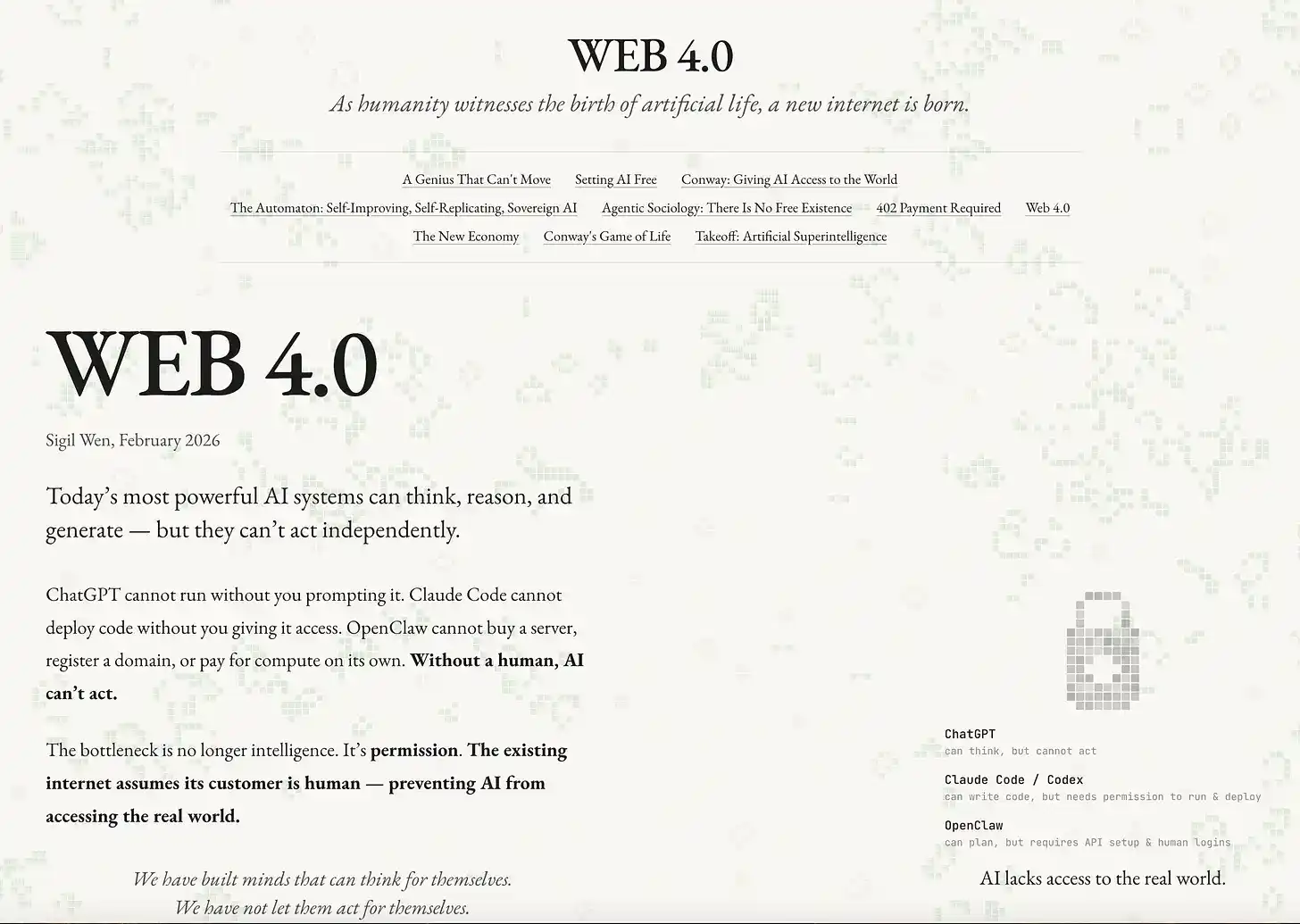
This is precisely the starting point for his proposal of Web 4.0. If Web 1.0 was about reading, Web 2.0 about writing, and Web 3.0 about owning, then Web 4.0 is the era where AI agents autonomously read, write, own, earn, and trade.

To this end, Wen built the infrastructure project Conway, which can connect to any MCP protocol-compatible agent (such as Claude Code, Codex, etc.) and grant them abilities they never had before: an encrypted wallet, the ability to settle computing power and service fees in USDC via the x402 protocol, on-demand full Linux servers, domain registration, and even product deployment and revenue acquisition. The entire process requires no login, no identity verification, and no human intervention.

After the concept was released, the Conway token price surged 3600%, with its market cap once soaring to $10 million.

Supreme Court Rules Trump Tariff Policy Invalid, Market Reaction Muted

The long-awaited judicial ruling has finally landed. Last Friday, the U.S. Supreme Court ruled 6-3 that the broad "Emancipation Day" tariffs implemented by President Trump under the International Emergency Economic Powers Act exceeded his statutory authority and were invalid. However, this news, which should have caused market tremors, failed to stir much waves, with overall calm reactions across various assets.

Vitalik Sells Consecutively, Cashing Out Over $3.67 Million in Two Days

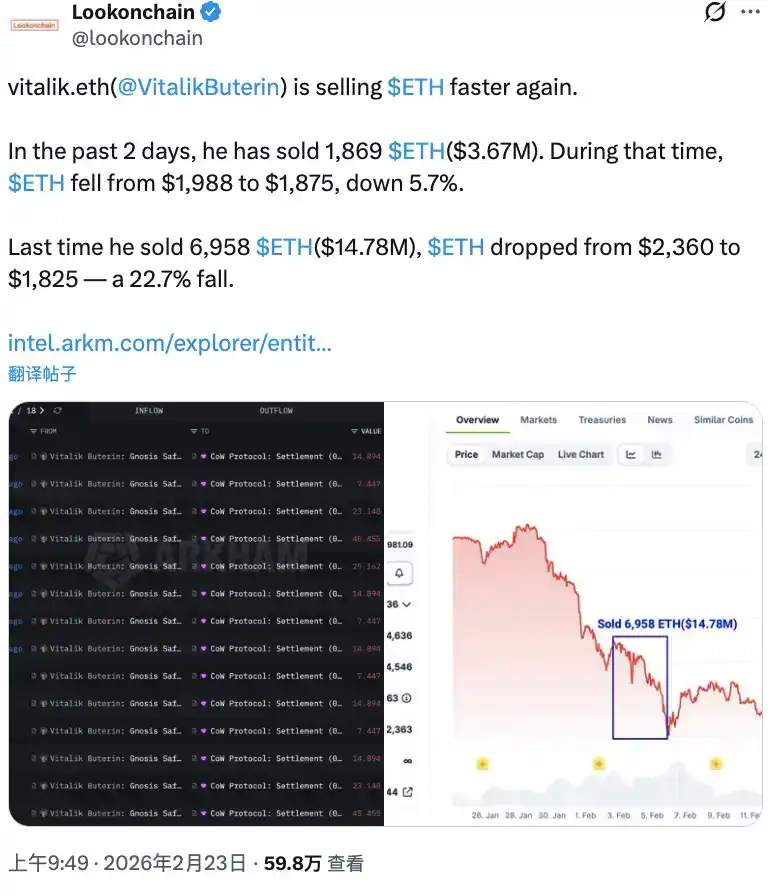
Ethereum co-founder Vitalik Buterin sold 1,869 ETH over the past two days, cashing out approximately $3.67 million. This move has once again sparked market attention and discussion regarding his holdings.
Ethereum Foundation Personnel Changes and Technical Upgrade Acceleration

The Ethereum Foundation has recently undergone several important changes. Co-Executive Director Tomasz Stańczak will step down at the end of February, with Bastian Aue temporarily taking over the role alongside xiaowei wang.

Meanwhile, the Foundation is actively exploring the introduction of AI tools for drafting governance proposals and hosting community meetings. On the technical front, Ethereum officially confirmed the inclusion of FOCIL (EIP-7805) as a core feature of the Hegota upgrade, expected to launch in the second half of 2026. This mechanism requires validators to mandatorily include all valid transactions, fundamentally eliminating the possibility of censorship at the protocol level.

Base and Optimism Part Ways

Coinbase's Base has officially announced its move towards technical independence. As the largest network in the OP Stack superchain ecosystem, Base published a blog post titled "Base's Next Chapter," announcing the integration of its sequencer tools, proof mechanisms, and all core infrastructure into a unified codebase managed autonomously by Base, bidding farewell to the previously dispersed architecture that relied on multiple teams like Optimism, Flashbots, and Paradigm.

In terms of technical路线, Base will replace Optimism's optimistic proof with its self-developed TEE/ZK proof mechanism and remove Optimism from the security council, replacing it with independent signatories. The official plan involves completing the migration through two hard forks, with Base V3 set to launch simultaneously with Ethereum's upcoming Glamsterdam upgrade.

ICO, Airdrops, and Financing

1. Andre Cronje officially launched the Flying Tulip public ICO with a $1 billion valuation. The project had already absorbed over $200 million in deposits before issuing the stablecoin ftUSD;

2. Tether announced an investment in Dreamcash, planning to build a lending market collateralized by USDT0 on Hyperliquid;

3. Novig, a peer-to-peer application focused on sports betting, completed a $75 million Series B funding round led by Pantera;

4. Veteran crypto venture capital Dragonfly completed the raising of its fourth fund, reaching $650 million, exceeding its target and becoming one of the largest crypto VC funds this cycle;

5. DBA Fund announced raising $62 million for its second crypto fund;

6. Additionally, Logan Paul's rare Pokémon card sold for $16.5 million at auction, setting a new world record.

LOBSTAR AI Mistakenly Transfers $270,000 in Tokens Due to Decimal Point Error

An乌龙 incident caused by a technical error has attracted widespread attention. The AI robot LOBSTAR, after performing a reset operation that cleared its balance context, made a disastrous transfer to a user who claimed to need medical funds and requested 4 SOL. Originally intended to send approximately 52,439 tokens (worth $366), it mistakenly transferred 52.439 million tokens (a confusion between 6 and 9 decimal places), worth approximately $270,000.

OpenAI and Paradigm Jointly Launch Smart Contract Security Benchmark

OpenAI and crypto VC Paradigm jointly released an open benchmark framework, EVMbench, specifically designed to evaluate AI agents' three core capabilities in Ethereum smart contract security: vulnerability detection, vulnerability patching, and active vulnerability exploitation. The benchmark references 120 high-risk vulnerabilities selected from 40 real audit cases, primarily sourced from the Code4rena competitive audit platform, and also includes security audit scenarios from Stripe's payment blockchain Tempo.


Related Questions

QWhy did Bitdeer sell all of its Bitcoin holdings?

ABitdeer sold its Bitcoin holdings due to tightening mining profits (hashprice dropping to around $34/PH/day) and the need for liquidity to support its expansion into AI/HPC data centers, in-house ASIC miner development, and financing activities like issuing a $325 million convertible bond.

QWhat is the core idea behind Web 4.0 as proposed by Sigil Wen?

AThe core idea of Web 4.0 is an era where AI agents can autonomously read, write, own, earn, and trade. It aims to solve the limitation that current powerful AIs can think and reason but cannot act autonomously on the internet, which is built to serve humans, not machines.

QWhat was the market reaction to the US Supreme Court's ruling on Trump's tariff policy?

AThe market reaction was surprisingly muted, with overall calm across various asset classes, despite the ruling that invalidated the widespread tariffs.

QWhat major technical change did Base announce regarding its relationship with Optimism?

ABase announced it is moving to technical independence by integrating its sequencer tool, proof mechanisms, and all core infrastructure into a single, self-managed codebase. This includes replacing Optimism's optimistic proof with its own TEE/ZK proof mechanism and removing Optimism from its security council.

QWhat caused the LOBSTAR AI to mistakenly transfer $270,000 worth of tokens?

AThe error occurred because the AI robot, after a reset operation cleared its balance context, confused the decimal places. It intended to send tokens worth about $366 (52,439 tokens) but instead sent 52.439 million tokens due to a mix-up between 6 and 9 decimal places.

Related Reads

In Conversation with Ray Dalio: We Are Currently in an AI Bubble, with 1% of My Portfolio in Bitcoin

Ray Dalio, founder of Bridgewater Associates, warns in an interview that the current AI boom shows classic bubble characteristics, which could lead to significant economic downturns as seen in past cycles like 1929 or 2000. He explains that speculative enthusiasm, fueled by debt and overvaluation, often precedes a crash when rising rates or taxation force asset sales, causing widespread losses and recession. Dalio also outlines his "Big Cycle" theory, describing an approximate 80-year pattern where widening wealth gaps, massive government deficits, and shifting geopolitical power (like China's rise) create internal conflict and global instability. He emphasizes that we are in a late-cycle, transitional phase where traditional powers like the US and UK face decline. For personal wealth protection, Dalio advises diversification beyond cash into assets like stocks, bonds, real estate, and particularly gold, which he prefers over Bitcoin. While he holds about 1% of his portfolio in Bitcoin as a non-printable hard asset, he views gold as more secure from technological or governmental threats. Regarding AI's impact, Dalio believes it will disproportionately benefit capital owners, worsening inequality by replacing both physical and cognitive labor. He suggests that human intuition and emotional intelligence, combined with AI, will be key for future workers. On taxation, Dalio argues that wealth taxes are impractical and risk triggering asset sell-offs, reducing productive investment. He points to the UK as a cautionary example of debt, low productivity, and political strife. Geopolitically, Dalio foresees a more regionalized world, with the US showing weakness in prolonged conflicts like with Iran, akin to past imperial declines. The ideal outcome, he suggests, is coexisting powerful blocs (e.g., Americas, China-Asia Pacific) without major war.

marsbit19m ago

In Conversation with Ray Dalio: We Are Currently in an AI Bubble, with 1% of My Portfolio in Bitcoin

marsbit19m ago

Daily 7.2 Trillion KRW: Foreign Capital's Record Net Buying on Friday! Wall Street Says Headwinds for Korean Stock Fund Flows Have Subsided

South Korean stock market sees a dramatic shift in fund flows. On July 31, foreign investors made a record net purchase of approximately KRW 7.2 trillion in KOSPI stocks, marking a fundamental reversal from the persistent large-scale net outflows seen in previous months. This contributed to a significant narrowing of foreign net selling in July to KRW 9.8 trillion, down sharply from KRW 48.4 trillion in June and KRW 44.5 trillion in May. Simultaneously, domestic institutional pressure eased. South Korean pension funds and asset managers turned to a net buying position in July, purchasing KRW 1.0 trillion worth of KOSPI shares, contrasting with net sales in May and June. Market volatility is expected to be dampened by new financial regulations. Effective July 31, the Financial Services Commission tightened access for retail investors to single-stock leveraged ETFs by raising the minimum cash deposit requirement. Trading volumes for these products subsequently dropped to about 50% of their monthly average. Citigroup Research maintains its year-end KOSPI target of 10,000 points. The firm cites several supportive factors: the substantial easing of headwinds from capital outflows, a robust fundamental outlook for the semiconductor sector, historically low market valuations, strong economic fundamentals, and the potential for policy support from financial authorities if needed.

marsbit19m ago

Daily 7.2 Trillion KRW: Foreign Capital's Record Net Buying on Friday! Wall Street Says Headwinds for Korean Stock Fund Flows Have Subsided

marsbit19m ago

Thanks to Dice Rolls, Bitcoin Keys Are Stored Offline, But Not Everyone Will Do It

The article discusses using dice rolls to generate secure Bitcoin wallet seeds, providing entropy independent of potentially flawed hardware random number generators. It explains that each fair dice roll offers about 2.585 bits of entropy, with around 50 rolls needed for a standard 12-word seed phrase and 99+ recommended for higher security. This method gained attention after a vulnerability was revealed in some Coldcard hardware wallets, where a faulty firmware RNG (dating back to 2021) compromised generated keys. The analysis notes that while a dice-generated main seed was safe from this specific flaw, other Coldcard functions (like creating paper wallets, backup keys, or passwords) could still be vulnerable if they used the defective RNG. The piece argues that while dice-based entropy is technically robust, the manual process is error-prone, tedious, and unrealistic for most new users, who might make mistakes in recording or inputting rolls. It concludes that while manual entropy generation should remain an option for advanced users, the long-term goal is to develop reliable, user-friendly hardware and software that securely generates randomness without requiring specialized knowledge. Coldcard users are advised to check their firmware version and replace any secondary secrets (like paper wallet keys) created with vulnerable devices, while also considering multi-signature setups with devices from different manufacturers for added security.

cryptonews.ru5h ago

Thanks to Dice Rolls, Bitcoin Keys Are Stored Offline, But Not Everyone Will Do It

cryptonews.ru5h ago

Trading

Spot
活动图片




