"I was clearly wrong about Anthropic."
Musk has suddenly changed his tune.
A few months ago, he was still calling Anthropic "hypocritical and evil," asserting it "cannot win." Now, he has turned around to call it a leader in the current AI field:
No company has made a model as strong as Mythos/Fable.
He also predicted that Anthropic will soon release Mythos 2.
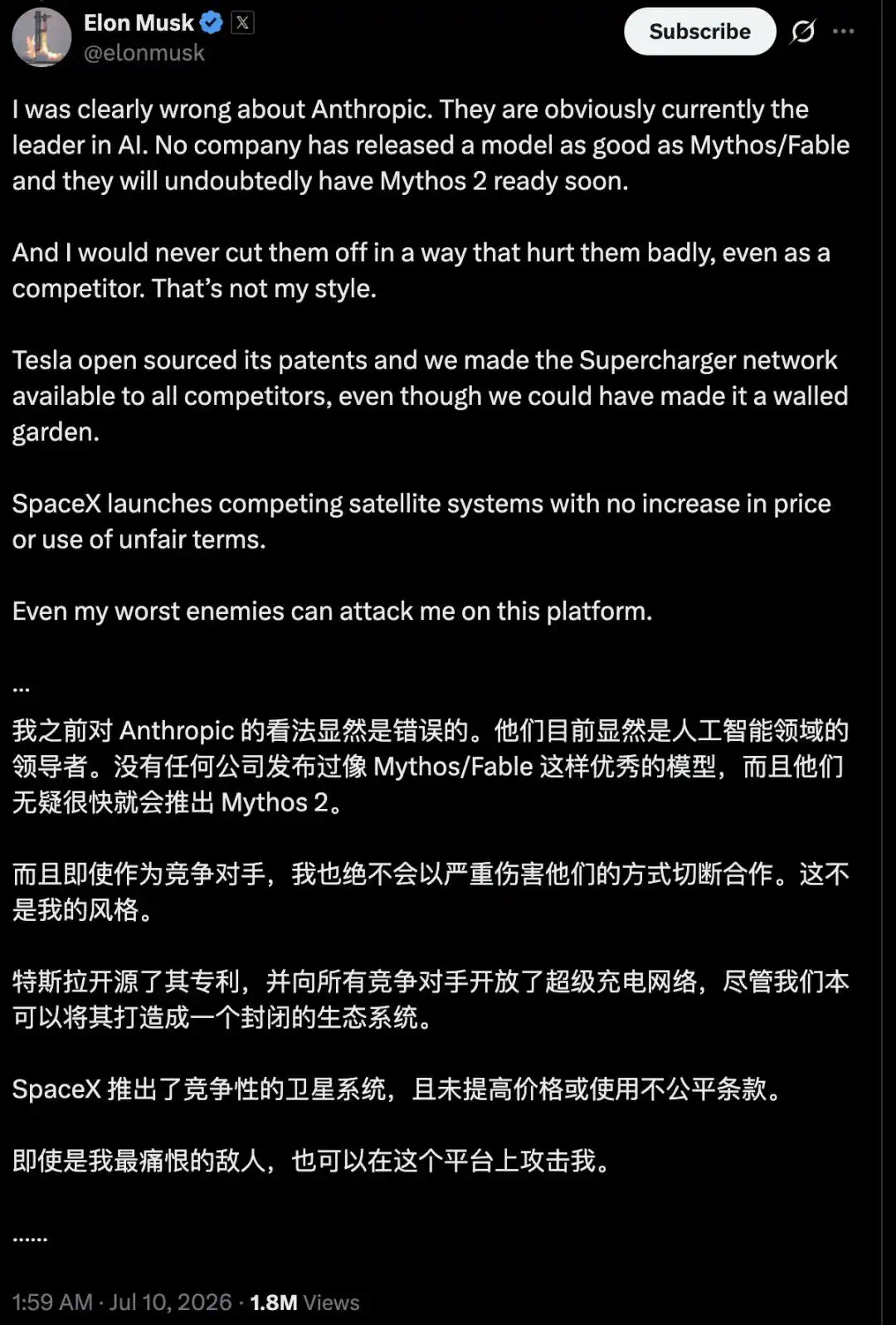
This change of tune was triggered by a user on X stirring the pot.
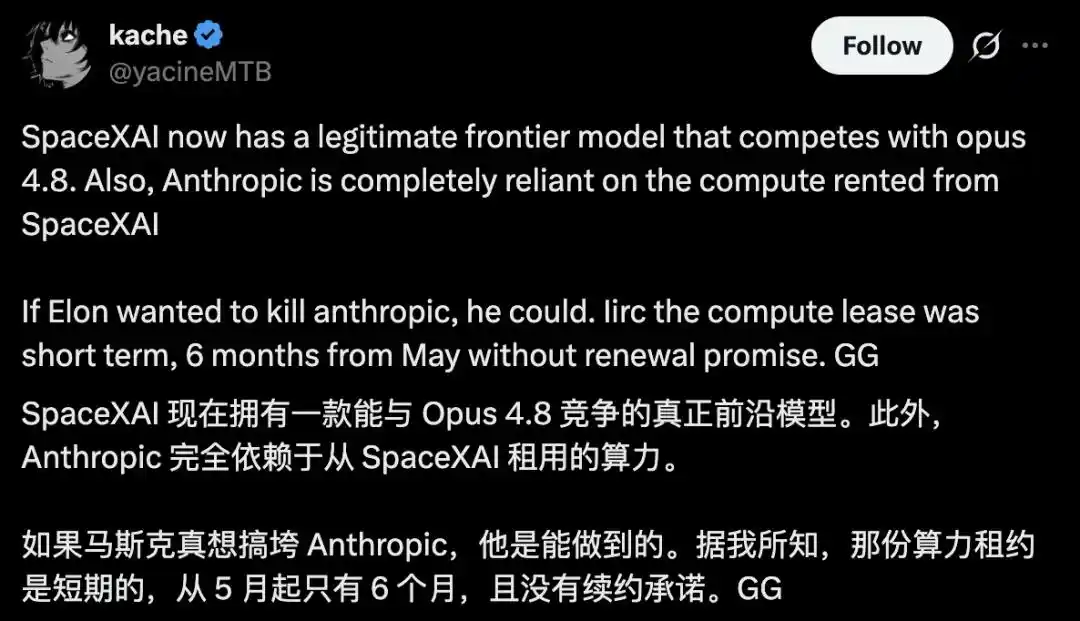
The user said that SpaceXAI (the new name after xAI merged into SpaceX) now has cutting-edge models capable of competing with Claude Opus 4.8, while Anthropic entirely depends on renting computing power from SpaceXAI. In other words, Musk could cripple Anthropic at any time if he wanted to.
The timing makes this statement even more intriguing.
Just on July 8th, Musk had publicly launched his own new model, Grok 4.5, touting it as faster and cheaper.
Following common sense, he should have taken the opportunity to tout "Grok will eventually catch up with Claude." But this time he didn't. Instead, he first admitted his mistake, then turned around to praise his competitor.
It's worth noting that at the end of June, he had still claimed: Internal testing of Grok 4.5 was approaching, or might have even surpassed, Claude Opus. He even boasted about releasing a brand-new, from-scratch model every month within the year to catch up with competitors in one go.
The reality was harsh.
On Artificial Analysis's intelligence leaderboard, Grok 4.5 was still behind Fable 5 and GPT-5.5. His own flagship couldn't even claim the top spot among non-Anthropic models. Yet this time, Musk didn't double down.
For someone who rarely admits mistakes publicly, this is already quite unusual. Moreover, those 220,000 GPUs capable of cutting off Anthropic's computing power are currently in his own hands.
From "Cannot Win" to "AI Leader," Musk's 180-Degree Turn
Just half a year ago, Musk was still calling Anthropic "misanthropic and evil"; even earlier, in September last year, he asserted it "cannot win."
What exactly happened in these six months to go from "cannot win" to "AI leader"?
Starting last September, Musk had almost never said a single good word about Anthropic publicly.
First was that damning verdict: Winning was never in Anthropic's range of possible outcomes.
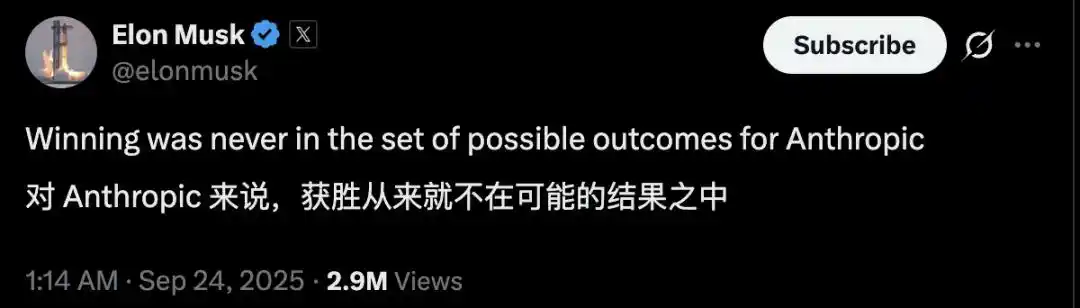
In January this year, he punned on Anthropic's name, saying it was destined to become "misanthropic" (hating humankind).
In February, right after Anthropic announced raising $30 billion and its valuation soaring to $380 billion, Musk immediately opened fire, accusing the other side of "massive theft of training data," firing off three words in a row: "Self-righteous, sanctimonious, hypocritical," and added that it "hates Western civilization."
In March, he pressed further: Is there a more hypocritical company than Anthropic?
Throughout this past half year or more, Musk's attacks on Anthropic almost covered business ethics, training data, model values, and competitive prospects—picking on every conceivable flaw.
But despite the criticism, he had also grudgingly acknowledged Claude's capabilities.
For example, in January this year, he complained that Anthropic had cut off xAI engineers' access to Claude's latest programming features, saying it hurt their reputation, but then turned around to admit that Anthropic had "made something special in programming."
What calculations lie behind this sudden 180-degree change in attitude?
Did Musk Change His Tune Because He Became Anthropic's Landlord?
In May this year, Anthropic and SpaceX struck a major computing power deal: Anthropic would take the entire capacity of SpaceX's Colossus 1 data center in Memphis.
How big is this "entire capacity"? Over 300 megawatts (MW) of power, or more than 220,000 Nvidia GPUs.
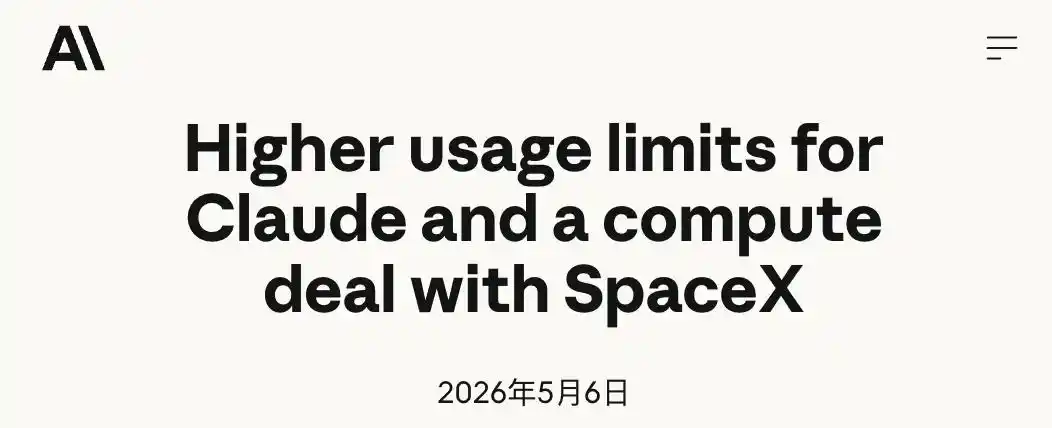
May 6, 2026: Anthropic officially announced an agreement with SpaceX, securing the entire capacity of the Colossus 1 data center—over 300 MW, more than 220,000 Nvidia GPUs. (Source: Anthropic website)
The price was equally staggering. According to SpaceX's filed S-1 prospectus, Anthropic committed to paying $1.25 billion per month until May 2029, with either party able to terminate with 90 days' notice.
$1.25 billion per month. This isn't a one-time purchase but a cash flow locked in for years. According to TechCrunch, by July 2026, Anthropic was already one of SpaceX's largest customers.
The deal was beneficial for both sides: SpaceX secured a heavyweight client worthy of inclusion in its prospectus, and Anthropic locked in a multi-year supply of computing power.
Thus, a微妙 situation emerged: While competing head-to-head with xAI (now merged into SpaceXAI) on models, Anthropic was also betting its survival on SpaceX's server rooms.
And this deal explains the softening of Musk's stance.
On the day the collaboration was announced, May 6th, he wrote: He had spent a lot of time with Anthropic's leadership, learning about how they ensure Claude is beneficial to humanity, and was "impressed," saying "no one triggered my evil detector."
Behind this change of tune, that $1.25 billion monthly contract certainly played a significant role.
"That's Not My Style"
Faced with the hypothetical "You could cut them off anytime," Musk gave a clear answer: No.
Even as a competitor, I would never cut them off in a way that severely harms them. That's not my style.
To prove his point, he cited three past examples in one breath:
Tesla open-sourced its patents; the Supercharger network is open to all competitors; SpaceX launches satellites for rivals without raising prices or setting unfair terms.
Of course, Anthropic's sense of security doesn't need to rely entirely on Musk's "style."
The 90-day termination notice period is there. If SpaceX were to breach the contract, it would have to pay contractual penalties.
Moreover, cutting off supply would mean Musk losing $1.25 billion in real money every month. Conversely, by carrying Anthropic's computing load, SpaceX engineers can closely observe how to serve a rapidly expanding AI giant.
Ultimately, killing a customer is like shutting down your own cash register. Keeping this deal brings far more benefits than destroying it.
Behind this lies the new logic of this round of AI competition.
Past tech battles were about封锁 and垄断.
But in the era of large models, model companies are highly dependent on each other's computing power, chips, and data centers.
Thus, more and more giants have come to understand the same principle: Instead of betting solely on their own victory, it's better to place chips on the entire赛道.
Yesterday's arch-rivals can form ever-tightening computing power alliances today. Competition and cooperation are no longer mutually exclusive.
Musk's change of tune merely brings this logic to the forefront.
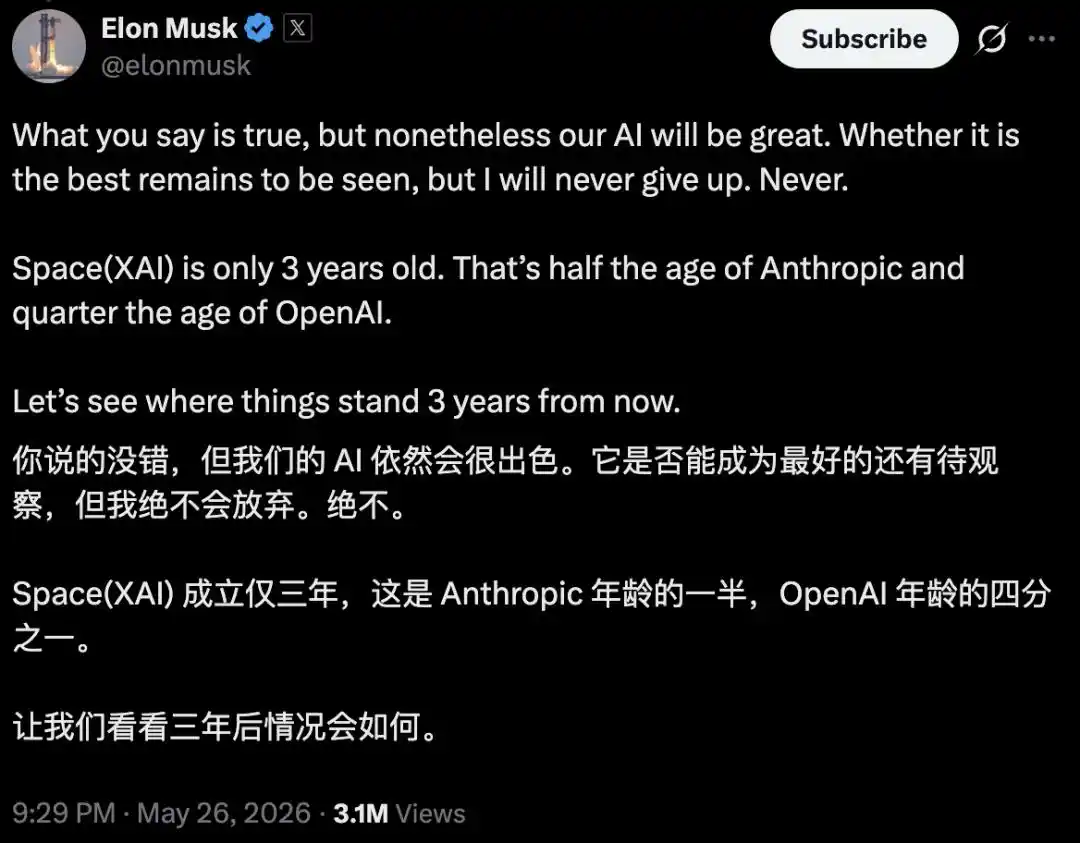
But he didn't close the door completely. At the end of May, he left a remark: SpaceXAI is only 3 years old, half the age of Anthropic and a quarter of OpenAI's age. Let's see where things stand in three years.
Acknowledging an opponent's lead doesn't mean conceding defeat entirely.
References:
https://x.com/elonmusk/status/2075278580955685036
https://x.com/elonmusk/status/2059265588677976277https://www.businessinsider.com/elon-musk-anthropic-ai-leader-rival-claude-spacexai-2026-7?utm_source=chatgpt.com
https://www.forbes.com/sites/siladityaray/2026/02/13/misanthropic-and-evil-musk-rails-against-anthropic-after-30-billion-fundraise-announcement/
This article is from the WeChat public account "Xinzhiyuan," author: ASI Apocalypse