Hyperliquid Traders Drive CXMT Trading Volumes to Peak Levels on IPO Day

cryptonews.ruPublished on 2026-07-27Last updated on 2026-07-27

Abstract

On July 27th, ChangXin Memory Technologies (CXMT), a major Chinese DRAM manufacturer, made its highly anticipated debut on the Shanghai Stock Exchange (SSE), becoming China's most valuable publicly traded AI-infrastructure company. The IPO coincided with record trading volumes for CXMT on the Hyperliquid blockchain platform (HIP-3), peaking at over $9 million. The stock surged 470-530% at its debut, pushing its market cap over $483 billion, driven by massive demand exceeding the IPO's supply. On Hyperliquid, pre-IPO trading saw prices fluctuate significantly, with the futures market reaching $234 million in early hours. Notably, a former major Bitcoin trader shifted entirely to trading CXMT futures. The event highlights how crypto derivatives platforms are being used for early price discovery and potential hedging against volatility in major traditional market IPOs.

ChangXin Memory Technologies (CXMT) held its long-awaited IPO on Monday, July 27th. The stock listing coincided with a surge of activity on the Hyperliquid exchange, as CXMT attracted attention from both large and retail traders.

CXMT's IPO was expected to be the largest stock listing on the Shanghai Stock Exchange since 2011. As Cryptopolitan reported, the buzz around Chinese AI-related stocks was seen as a new opportunity, and crypto traders immediately seized it.
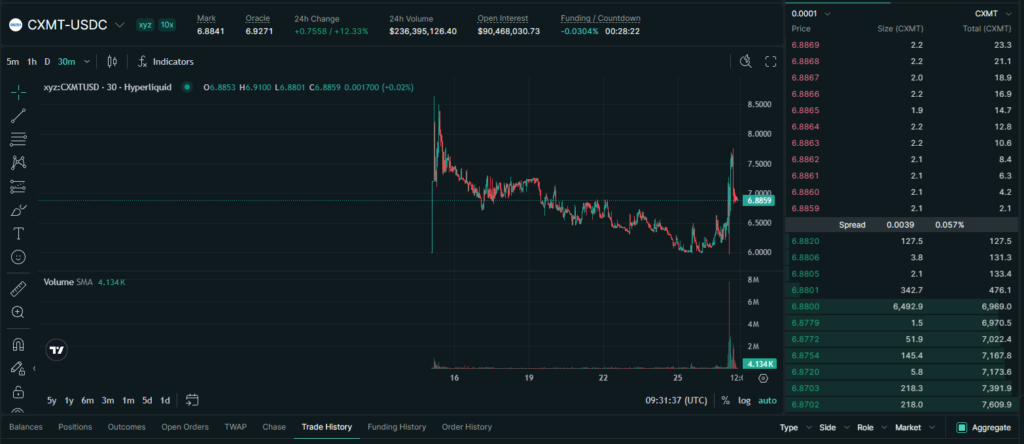
The CXMT exchange saw a record surge in activity, alongside an influx of large crypto investors taking directional positions in one of mainland China's largest IPOs. | Source: HIP-3

The CXMT exchange is already available through TradeXYZ after the platform acquired rights to this ticker on Hyperliquid for 500 HYPE.

As of July 27th, CXMT on HIP-3 exceeded $45 million, and after an initial record spike, daily trading volume reached a new peak, surpassing $9 million. The IPO day saw significant selling as both perpetual futures and the underlying shares were in price discovery.

CXMT Shares Soar in Shanghai Trading

Chipmaker CXMT became China's most valuable AI infrastructure company after its shares surged 470-530% upon its debut on the Shanghai exchange. The company's total market capitalization is estimated at over $483 billion, making it the most valuable company listed on an exchange in mainland China.

The stock market debut also tests the resilience of forecasts for chipmaker and AI-related stocks. CXMT is a major DRAM producer, a basic component used in consumer electronics and data centers.

Funds raised from the IPO are expected to be directed towards production expansion and additional R&D.

Beyond CXMT's business model, a key driver for the rapid price surge was peak demand for the shares, significantly exceeding IPO volumes.

The demand spread to blockchain trading as well, with Hyperliquid offering an entry point for early price discovery speculation. On the first day of trading, the HIP-3 market for CXMT reached 1.14% of the volumes on the Shanghai Stock Exchange, jumping to $234 million in the first hours after the IPO.

Former Major $BTC Market Player Shifts to CXMT

On the HIP-3 platform, the price of CXMT shares fluctuated from over $8 to $5.99. The price range set by perpetual futures traders was closer to the actual IPO price than the company's initial target price of $1.20 per share.

Following the IPO, the HIP-3 company held 13 large positions in CXMT shares, of which seven showed bullish sentiment, taking long positions.

The leader still holds a short position with a notional value of $17.87 million. After the price rise, the volume investment leader incurred an unrealized loss of $1.24 million.

Another major player, primarily known for their positions in $BTC, has fully switched to trading CXMT. Their position still stands at $4.81 million, fluctuating between a profit of $300k and small temporary losses. Large players are still waiting for the stock to choose its own direction in the first days after the IPO.

At this point, it is unknown whether any of the major investors managed to secure IPO shares directly from the company. In that case, selling CXMT shares short would be a hedging strategy in case of a sharp price drop after the initial hype. Such a scenario also points to Hyperliquid as a hedging tool that could be used in other upcoming major IPOs.

end-content

Related Questions

QWhat company conducted a highly anticipated IPO and what was the date?

AThe company ChangXin Memory Technologies (CXMT) conducted its highly anticipated IPO on Monday, July 27th.

QWhich trading platform acquired the rights to trade the CXMT ticker on Hyperliquid?

AThe trading platform TradeXYZ acquired the rights to trade the CXMT ticker on Hyperliquid for 500 HYPE.

QHow much did CXMT's shares surge on its Shanghai stock exchange debut?

ACXMT's shares surged 470-530% on its debut on the Shanghai stock exchange.

QWhat was the estimated total market capitalization of CXMT after its IPO?

AThe estimated total market capitalization of CXMT after its IPO was over $483 billion.

QWhat did a trader known for major Bitcoin positions do regarding CXMT, according to the article?

AAccording to the article, a trader known for major Bitcoin positions fully switched to trading CXMT, with a current position worth $4.81 million.

Related Reads

Qualcomm Chip Price Hike Deals a Blow to Android Phones

Qualcomm has officially announced a new round of price increases for its entire chip portfolio, effective September 1. The hikes, reaching up to 18% for the flagship Snapdragon 8 Elite Gen 6 Pro, follow similar moves by MediaTek, intensifying cost pressures on the already strained smartphone industry. CEO Cristiano Amon confirmed the plan, citing the need to offset rising industry-wide costs and restore declining profit margins. Qualcomm's Q3 FY2026 results showed a 25% drop in net profit, with mobile revenue plunging 20% year-over-year, hitting its lowest level since 2021. The surge in AI computing demand has led memory manufacturers to prioritize HBM production, creating a shortage in general-purpose DRAM and NAND Flash chips. Their prices soared by 93%-98% and 55%-60% respectively in Q1 2026, causing the memory cost share in smartphones to jump from 10%-15% to over 30%. Coupled with the soaring cost of advanced nodes like TSMC's 2nm and packaging, overall chip costs have reached historic highs. These upstream pressures are forcing downstream smartphone brands like Xiaomi, OPPO, and vivo to cut orders for mid-to-low-end models by up to 20% and use cost-saving measures like older chipsets. Reportedly, the Snapdragon 8E5 will be repurposed as a "long-lasting" chip for sub-brand phones in H2 2026. Amid this cost crisis, the Android market remains sluggish. Q2 2026 smartphone shipments in China fell 4.3% year-over-year, marking five consecutive quarters of decline. Major Android brands saw market share drop, while Huawei and Apple, with their in-house chip advantages, gained share. Qualcomm is diversifying into automotive and IoT sectors to reduce reliance on smartphones, but these new segments cannot yet fill the mobile revenue gap. Industry observers warn that the full impact of component cost hikes will hit in the second half of 2026, likely leading to higher-than-expected price increases for Android flagships and a further contraction in the Chinese smartphone market.

marsbit10m ago

Qualcomm Chip Price Hike Deals a Blow to Android Phones

marsbit10m ago

Breaking: GPT-5.6 Prices Slashed Effective Today

OpenAI has announced significant price cuts for its GPT-5.6 model API, effective immediately. The entry-level **GPT-5.6 Luna** sees the most drastic reduction, with input prices dropping 80% to $0.20 per million tokens and output prices falling to $1.20 per million tokens. The mid-tier **GPT-5.6 Terra** is reduced by 20%, now costing $2.00 (input) and $12.00 (output) per million tokens. The flagship **GPT-5.6 Sol** maintains its original price but introduces a new **Fast mode**, offering speeds up to 2.5 times faster for double the cost. The company attributes these price reductions to efficiency gains achieved through **GPT-5.6 Sol's own involvement in optimizing its production systems**. The model assisted in rewriting GPU kernels and improving speculative decoding, leading to a 20% reduction in end-to-end service costs and over 15% improvement in token generation efficiency. OpenAI emphasizes this process remained human-led. A key focus of the降价 is to lower the barrier for running **AI agent workflows**. By making the capable, tool-calling Luna model significantly cheaper, OpenAI aims to enable more frequent use in cost-sensitive, high-volume tasks like code review and monitoring. This creates a potential feedback loop: model-assisted efficiency gains lead to lower costs, which enables broader agent deployment, which in turn drives further optimization. The new pricing and features will also apply to Codex and ChatGPT Work subscriptions. The changes intensify competition in the large language model market, with OpenAI directly challenging rivals like Anthropic to respond.

marsbit39m ago

Breaking: GPT-5.6 Prices Slashed Effective Today

marsbit39m ago

South Koreans' 'Gambling Nature' is Actually Forced by Life

This article explores how systemic pressures in South Korea, rather than inherent "gambling" tendencies, drive widespread speculative financial behavior. It begins by noting the high frequency of flights from South Korea to Macau, symbolizing the search for outlets beyond domestic restrictions. The core argument is that ordinary life goals—stable employment, home ownership, and financial security—have become increasingly tied to asset markets due to structural economic factors. South Korea's development model, historically reliant on corporate leverage (chaebols), has evolved into a society where household debt and personal leverage are normalized as pathways to social mobility. Key mechanisms discussed include: * **Housing Policy:** Government measures to improve affordability, like extending mortgage terms to 50 years and the unique *jeonse* (key money) rental system, embed high leverage into the housing market. * **Financial Products:** The recent approval and explosive popularity of single-stock 2x leveraged ETFs (e.g., on Samsung and SK Hynix), easily accessed via mobile apps, lowered barriers to high-risk trading. * **Social Pressure:** Media narratives around soaring corporate profits (e.g., SK Hynix) and employee bonuses create a fear of missing out, pushing individuals to use leverage to "catch up." The article concludes that this "leveraged life" is a product of institutional history and policy choices. When traditional paths to success feel constrained, and policy facilitates debt-based solutions for housing and investment, speculative behavior becomes a rational, if risky, strategy for many. The rapid cycle of regulatory approval for leveraged ETFs followed by a market crash and official apology in mid-2026 exemplifies the system's inherent contradictions. Ultimately, the "bet" is not just on assets, but on using future earnings to secure a place in the present society.

marsbit39m ago

South Koreans' 'Gambling Nature' is Actually Forced by Life

marsbit39m ago

Trading

Spot
活动图片