Hyperliquid Team Plans Expansion Into Prediction Markets as HYPE Pumps 20%

bitcoinistPublished on 2026-02-03Last updated on 2026-02-03

Abstract

Hyperliquid, a leading decentralized derivatives exchange, has announced its expansion into prediction markets, causing its HYPE token to surge 20%. This move aims to bridge traditional trading with event wagering, enhancing capital efficiency. The article also highlights a parallel trend in high-conviction trading culture, exemplified by the meme token Maxi Doge ($MAXI), which targets active "degen" traders with features like trading competitions and staking rewards. The project has reportedly raised over $4.5M in its presale, with significant whale accumulation noted, indicating strong early interest.

The decentralized derivatives landscape isn’t just shifting; it’s mutating. Hyperliquid, currently the heavyweight champion of on-chain perps, has signaled a direct expansion into prediction markets.

The market’s reaction was immediate and violent: the HYPE token surged 20% following the revelation, proving there is an immense appetite for infrastructure that bridges traditional trading with event wagering.
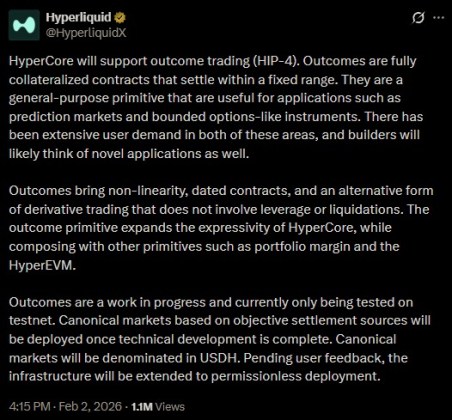
Why does this matter? Liquidity consolidation. Until now, prediction markets like Polymarket lived in silos, isolated from high-frequency perp trading. Hyperliquid’s integration hints at a future where capital efficiency rules supreme—traders can hedge election outcomes and leverage long ETH positions from a single collateral pool.

That 20% surge wasn’t just speculation. It was a rapid repricing of the protocol’s total addressable market.

But look closer at the liquidity flowing into high-performance chains. There is a secondary trend brewing: a resurgence of ‘high-conviction’ trading culture.

The traders on Hyperliquid aren’t passive allocators; they’re hunting volatility, leverage, and competition. That specific mindset is exactly what’s now fueling Maxi Doge ($MAXI), a project built for the ‘degen’ trader who treats markets like a contact sport.

Buy $MAXI today.

Maxi Doge Targets the ‘Leverage King’ Demographic

While Hyperliquid builds the plumbing for risk, Maxi Doge captures the culture of the risk-taker. Forget the passive ‘hold and hope’ mechanics of yesterday’s meme coins. Maxi Doge positions itself as a 240-lb canine juggernaut, embodying the ‘1000x energy’ of the current bull cycle. Its ethos: ‘Never skip leg-day, never skip a pump’, resonates with retail traders who know the market is a grind requiring serious conviction.
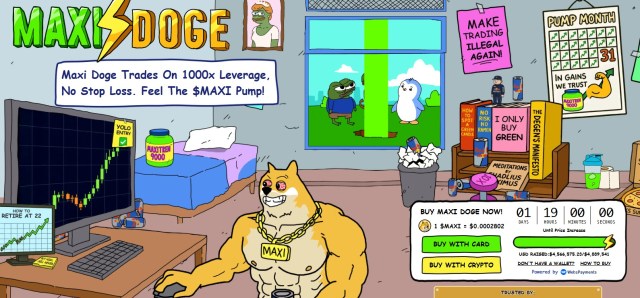
Frankly, the utility goes deeper than just aesthetics. Maxi Doge (unexpectedly for a meme token) integrates Holder-Only Trading Competitions, gamifying the experience like the leaderboards on major perp DEXs. It rewards top ROI hunters, aligning tokenomics with active participation. Plus, the ‘Maxi Fund’ treasury backs this ecosystem, ensuring liquidity for partnerships and high-impact marketing.

Sound familiar? It’s the strategies of top DeFi protocols applied to meme culture.

That cultural alignment counts. In a market where attention is the scarcest asset, projects mirroring their holders’ psychology often cook the hardest. Maxi Doge isn’t trying to be a currency; it’s a badge of honor for the “Leverage King” demographic.

Learn more about the project’s tokenomics.

Whales Accumulate $503K as Presale Momentum Builds

Smart money seems to agree with this thesis. While retail chases green candles elsewhere, on-chain data from Etherscan shows two whale wallets accumulated $503K in recent transactions within the Maxi Doge ecosystem. The largest single clip, a massive $314K transaction, executed on Oct 11, 2025.

That suggests high-net-worth players are positioning themselves well before the token hits public trading venues.

Presale metrics show demand accelerating. According to the official site, Maxi Doge has already raised over $4.5M, with tokens priced at $0.0002802. In a landscape fragmented across L2s and Solana, that’s no small feat. For an Ethereum mainnet token to command this level of early-stage capital signals real confidence in the ‘meme-first, utility-second’ hybrid model.

And then there’s the staking architecture. It’s designed to lock up supply while rewarding conviction. The smart contract governs a dynamic APY with daily automatic distribution from a 5% staking allocation pool. This setup encourages the long-term holding behavior seen in blue-chip DeFi governance tokens, aiming to dampen volatility.

Visit the official site for presale details.

The content provided in this article is for informational purposes only and does not constitute financial advice. Crypto assets are highly volatile.


Related Questions

QWhat was the market reaction to Hyperliquid's announcement of expanding into prediction markets, and what does it indicate?

AThe market reaction was immediate and violent, with the HYPE token surging 20%. This indicates there is an immense appetite for infrastructure that bridges traditional trading with event wagering and represents a rapid repricing of the protocol's total addressable market.

QAccording to the article, what is the primary significance of Hyperliquid's integration of prediction markets?

AThe primary significance is liquidity consolidation. The integration hints at a future of supreme capital efficiency, where traders can hedge event outcomes (like elections) and leverage positions (like long ETH) from a single collateral pool, breaking down the silos between prediction markets and high-frequency perpetual trading.

QHow does the article describe the target demographic and ethos of the Maxi Doge ($MAXI) project?

AThe article describes Maxi Doge's target demographic as 'Leverage Kings' or 'degen' traders who hunt volatility, leverage, and competition. Its ethos is 'Never skip leg-day, never skip a pump', embodying the '1000x energy' of the bull cycle and resonating with retail traders who view the market as a grind requiring serious conviction.

QWhat utility does the Maxi Doge project offer beyond its meme token aesthetics?

ABeyond aesthetics, Maxi Doge integrates Holder-Only Trading Competitions that gamify the experience and reward top ROI hunters, aligning tokenomics with active participation. It is backed by the 'Maxi Fund' treasury to ensure liquidity for partnerships and marketing, applying strategies from top DeFi protocols to meme culture.

QWhat on-chain evidence does the article provide to suggest 'smart money' or whale interest in Maxi Doge?

AThe article cites on-chain data from Etherscan showing two whale wallets accumulated $503K in recent transactions within the Maxi Doge ecosystem, with the largest single transaction being $314K executed on Oct 11, 2025. This suggests high-net-worth players are positioning themselves early, before the token hits public exchanges.

Related Reads

Agent Race Ends, Super Workbench Takes Over

The era of fragmented AI agents is ending. Over the past month, China's tech giants—Tencent, Alibaba, and ByteDance—have simultaneously shifted strategy: instead of launching new, standalone AI agents, they are consolidating their various agent projects into unified "super workbenches." Tencent integrated its QClaw teams into WorkBuddy, a strategic product hailed as a potential third flagship after QQ and WeChat. Alibaba is merging its QoderWork, Wukong, and MuleRun agents into a new "Qianwen Office" platform under DingTalk's leadership. ByteDance rebranded its TRAE SOLO coding agent to TRAE Work, signaling a broader focus on workflow collaboration. This convergence marks a pivotal industry consensus. The initial exploration phase, where companies rapidly built numerous overlapping agents for different scenarios, proved costly and inefficient. With open-source tools eroding technical barriers, competition has shifted from agent creation to resource consolidation and cost control. Historically, platform wars are won not by creating more products, but by simplifying them—as seen with browsers unifying web access and super-apps consolidating services. Now, the "super workbench" aims to become the unified AI entry point for work. This reflects a deeper market realization: the primary audience for AI is no longer just programmers (a market in the tens of millions) but all knowledge workers (a market of billions). The real opportunity lies in augmenting everyday tasks—managing emails, documents, data, and meetings—across the entire workday. The core battleground is becoming control over the primary AI entry point that employees use daily. Tencent's WorkBuddy leverages WeChat and Tencent Docs; Alibaba's Qianwen Office taps into DingTalk's organizational data; ByteDance's TRAE Work integrates with Feishu's workflows. Whoever owns this "super workbench" gains strategic control over orchestrating enterprise data and APIs. This shift is redefining enterprise software. Traditional SaaS applications, valued for their user interfaces, will recede into the background. Their core functionalities will be exposed as standardized "Skills" or APIs for the super workbench's agents to invoke. Software value will shift from selling user seats to charging based on API calls and outcomes delivered. The evolution of agents is moving through clear stages: first as novel standalone products, then as consolidated primary work entry points, and finally as pervasive, invisible capabilities embedded into the digital fabric. The recent moves by major tech firms signal the transition from the first stage into the second, accelerating toward the third. In the end, the most successful agent technology may become invisible—like electricity or the HTTP protocol—a fundamental, unnamed infrastructure powering work itself.

marsbit13m ago

Agent Race Ends, Super Workbench Takes Over

marsbit13m ago

Michael Saylor: 110 Reasons to Oppose BIP-110

Michael Saylor presents 110 arguments against Bitcoin Improvement Proposal (BIP) 110, a soft fork aimed at restricting certain non-monetary data storage uses (like inscriptions) on the Bitcoin blockchain. He acknowledges the proponents' valid concerns—such as node costs, fee pressure, and preserving Bitcoin's monetary focus—but fundamentally disagrees with the proposed solution. Saylor argues that BIP 110 represents a dangerous precedent of using consensus rules to enforce value judgments on transaction validity, moving away from Bitcoin's core principles of neutrality and permissionless innovation. His key objections are organized into eleven categories: 1) It violates neutrality and hard consensus by banning currently valid transactions. 2) It fails to meet the high burden of proof required for a consensus change, lacking concrete data on the alleged crisis. 3) Its seven bundled technical restrictions are overly broad, targeting generic script functionalities and blocking future upgrade paths. 4) It sacrifices compatibility and future optionality by closing off designed upgrade hooks. 5) Its temporary rules add significant complexity (grandfathering, expiry states) without sufficient justification. 6) The economic and security impacts, particularly on miner revenue and fee markets, are uncertain and unmodeled. 7) Superior, market-based tools (fee markets, relay/mining policies) already exist to manage blockchain load. 8) It stifles innovation by creating a chilling effect for developers. 9) Its modified activation mechanism (55% threshold, forced signaling) is aggressive and risks network splits. 10) The precedent it sets—using consensus to suppress disliked but legal uses—is more dangerous than the problem it aims to solve. 11) A better path exists: improving measurements, refining resource-based policies, and allowing market forces to work. Saylor concludes that Bitcoin's strength lies in its neutral rules, open markets, and hard consensus. Changing these foundational elements to target specific use cases is an unnecessary and risky "iatrogenic" intervention. He advocates for guarding Bitcoin's neutrality rather than acting as its redeemer.

marsbit28m ago

Michael Saylor: 110 Reasons to Oppose BIP-110

marsbit28m ago

Trading

Spot
活动图片

