Hyperliquid Team Plans Expansion Into Prediction Markets as HYPE Pumps 20%

bitcoinistPublished on 2026-02-03Last updated on 2026-02-03

Abstract

Hyperliquid, a leading decentralized derivatives exchange, has announced its expansion into prediction markets, causing its HYPE token to surge 20%. This move aims to bridge traditional trading with event wagering, enhancing capital efficiency. The article also highlights a parallel trend in high-conviction trading culture, exemplified by the meme token Maxi Doge ($MAXI), which targets active "degen" traders with features like trading competitions and staking rewards. The project has reportedly raised over $4.5M in its presale, with significant whale accumulation noted, indicating strong early interest.

The decentralized derivatives landscape isn’t just shifting; it’s mutating. Hyperliquid, currently the heavyweight champion of on-chain perps, has signaled a direct expansion into prediction markets.

The market’s reaction was immediate and violent: the HYPE token surged 20% following the revelation, proving there is an immense appetite for infrastructure that bridges traditional trading with event wagering.
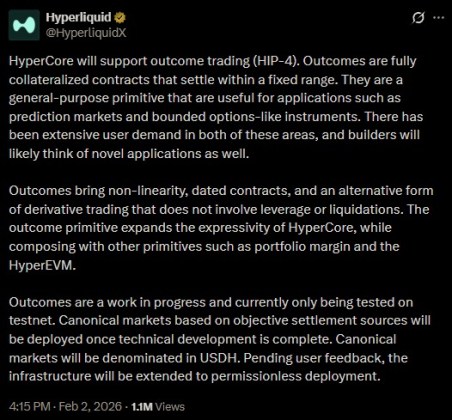
Why does this matter? Liquidity consolidation. Until now, prediction markets like Polymarket lived in silos, isolated from high-frequency perp trading. Hyperliquid’s integration hints at a future where capital efficiency rules supreme—traders can hedge election outcomes and leverage long ETH positions from a single collateral pool.

That 20% surge wasn’t just speculation. It was a rapid repricing of the protocol’s total addressable market.

But look closer at the liquidity flowing into high-performance chains. There is a secondary trend brewing: a resurgence of ‘high-conviction’ trading culture.

The traders on Hyperliquid aren’t passive allocators; they’re hunting volatility, leverage, and competition. That specific mindset is exactly what’s now fueling Maxi Doge ($MAXI), a project built for the ‘degen’ trader who treats markets like a contact sport.

Buy $MAXI today.

Maxi Doge Targets the ‘Leverage King’ Demographic

While Hyperliquid builds the plumbing for risk, Maxi Doge captures the culture of the risk-taker. Forget the passive ‘hold and hope’ mechanics of yesterday’s meme coins. Maxi Doge positions itself as a 240-lb canine juggernaut, embodying the ‘1000x energy’ of the current bull cycle. Its ethos: ‘Never skip leg-day, never skip a pump’, resonates with retail traders who know the market is a grind requiring serious conviction.
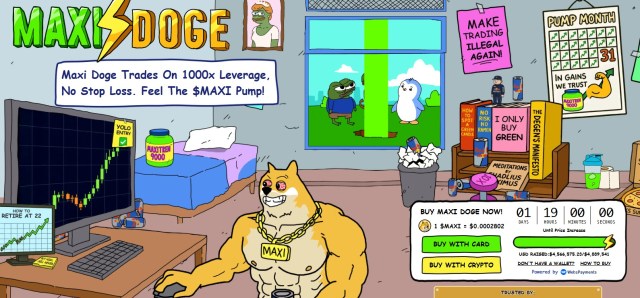
Frankly, the utility goes deeper than just aesthetics. Maxi Doge (unexpectedly for a meme token) integrates Holder-Only Trading Competitions, gamifying the experience like the leaderboards on major perp DEXs. It rewards top ROI hunters, aligning tokenomics with active participation. Plus, the ‘Maxi Fund’ treasury backs this ecosystem, ensuring liquidity for partnerships and high-impact marketing.

Sound familiar? It’s the strategies of top DeFi protocols applied to meme culture.

That cultural alignment counts. In a market where attention is the scarcest asset, projects mirroring their holders’ psychology often cook the hardest. Maxi Doge isn’t trying to be a currency; it’s a badge of honor for the “Leverage King” demographic.

Learn more about the project’s tokenomics.

Whales Accumulate $503K as Presale Momentum Builds

Smart money seems to agree with this thesis. While retail chases green candles elsewhere, on-chain data from Etherscan shows two whale wallets accumulated $503K in recent transactions within the Maxi Doge ecosystem. The largest single clip, a massive $314K transaction, executed on Oct 11, 2025.

That suggests high-net-worth players are positioning themselves well before the token hits public trading venues.

Presale metrics show demand accelerating. According to the official site, Maxi Doge has already raised over $4.5M, with tokens priced at $0.0002802. In a landscape fragmented across L2s and Solana, that’s no small feat. For an Ethereum mainnet token to command this level of early-stage capital signals real confidence in the ‘meme-first, utility-second’ hybrid model.

And then there’s the staking architecture. It’s designed to lock up supply while rewarding conviction. The smart contract governs a dynamic APY with daily automatic distribution from a 5% staking allocation pool. This setup encourages the long-term holding behavior seen in blue-chip DeFi governance tokens, aiming to dampen volatility.

Visit the official site for presale details.

The content provided in this article is for informational purposes only and does not constitute financial advice. Crypto assets are highly volatile.

Related Questions

QWhat was the market reaction to Hyperliquid's announcement of expanding into prediction markets, and what does it indicate?

AThe market reaction was immediate and violent, with the HYPE token surging 20%. This indicates there is an immense appetite for infrastructure that bridges traditional trading with event wagering and represents a rapid repricing of the protocol's total addressable market.

QAccording to the article, what is the primary significance of Hyperliquid's integration of prediction markets?

AThe primary significance is liquidity consolidation. The integration hints at a future of supreme capital efficiency, where traders can hedge event outcomes (like elections) and leverage positions (like long ETH) from a single collateral pool, breaking down the silos between prediction markets and high-frequency perpetual trading.

QHow does the article describe the target demographic and ethos of the Maxi Doge ($MAXI) project?

AThe article describes Maxi Doge's target demographic as 'Leverage Kings' or 'degen' traders who hunt volatility, leverage, and competition. Its ethos is 'Never skip leg-day, never skip a pump', embodying the '1000x energy' of the bull cycle and resonating with retail traders who view the market as a grind requiring serious conviction.

QWhat utility does the Maxi Doge project offer beyond its meme token aesthetics?

ABeyond aesthetics, Maxi Doge integrates Holder-Only Trading Competitions that gamify the experience and reward top ROI hunters, aligning tokenomics with active participation. It is backed by the 'Maxi Fund' treasury to ensure liquidity for partnerships and marketing, applying strategies from top DeFi protocols to meme culture.

QWhat on-chain evidence does the article provide to suggest 'smart money' or whale interest in Maxi Doge?

AThe article cites on-chain data from Etherscan showing two whale wallets accumulated $503K in recent transactions within the Maxi Doge ecosystem, with the largest single transaction being $314K executed on Oct 11, 2025. This suggests high-net-worth players are positioning themselves early, before the token hits public exchanges.

Related Reads

How Risky is the "Death Spiral" of MSTR and STRC?

Summary: This article explores the perceived "death spiral" risk between MicroStrategy (MSTR), its Bitcoin holdings, and its perpetual preferred stock (STRC), drawing comparisons to the LUNA-UST collapse. While both systems feature price anchors, high yields for holders, and potential feedback loops, their core mechanisms differ fundamentally. The MSTR-STRC structure relies on continuous financing to sustain its high dividend payouts, primarily through stock ATM offerings. A negative feedback cycle could occur: falling MSTR stock price makes raising equity capital harder, increasing pressure to sell Bitcoin, which undermines STRC confidence and further depresses MSTR. However, unlike LUNA-UST's automated, direct linkage, the MSTR-STRC loop is weaker and has brakes: STRC dividends can be deferred or rates lowered, and STRC holders have a $100/share liquidation preference in bankruptcy, providing a price floor. The company's sustainability hinges on its ability to continue financing. Its current ~$900 million USD reserves cover only about 6.3 months of its ~$1.71 billion annual interest/dividend burden. The next six months are critical, aligning with both the potential bottom in Bitcoin's four-year cycle and the depletion timeline of its reserves. While a LUNA-style catastrophic collapse is deemed highly unlikely due to structural differences, the key question is whether MicroStrategy can navigate this period through healthy deleveraging to restart its capital engine.

Foresight News13m ago

How Risky is the "Death Spiral" of MSTR and STRC?

Foresight News13m ago

How Much Debt Does Strategy Really Have? Is There a Risk of Implosion?

MicroStrategy's Debt Risk: A Turning Point in the "Never Sell" Strategy As of June 3, 2026, MicroStrategy holds 843,706 bitcoins (valued at ~$53.1B) but faces significant financial obligations. Its capital structure includes $6.75B in convertible notes and $15.48B in perpetual preferred stock (led by the $8.5B STRC series), creating an annual payout burden of ~$1.71B. With software revenue at only ~$500M, interest and dividend obligations far exceed operating income. A critical shift occurred in late May 2026 when the company sold 32 bitcoins for ~$2.5M to cover dividends, breaking CEO Michael Saylor's long-standing "never sell" pledge. This symbolic move triggered a sharp decline in both Bitcoin's price and MSTR stock, reflecting market fears about cash flow sustainability. The core of the strain is the STRC perpetual preferred stock, designed as a "permanent loan" with no maturity date but requiring high monthly dividends (currently 11.5%). Its business model relies on a three-part cycle: issuing new STRC shares, using proceeds to buy more Bitcoin and fund a USD reserve, and using that reserve to pay dividends. This cycle depends on continuous investor demand for STRC and Bitcoin's price appreciation. Analysis shows Bitcoin needs to appreciate at least 2.3% annually to cover the $1.71B in yearly obligations at current holdings. With Bitcoin price down ~22% from March 2026 highs, this pressure has intensified. The company's $900M USD reserve can only cover about 7 months of payments if STRC issuance stalls. Key risks are not immediate bankruptcy or forced Bitcoin liquidation (as BTC is not collateral), but rather: 1) The erosion of MSTR's premium to its Bitcoin holdings (mNAV), which would cripple its ability to raise cheap capital; 2) A vicious cycle where stagnant Bitcoin prices reduce STRC demand, draining the USD reserve and forcing BTC sales, further depressing prices. The period from February 2027 to September 2028 is a crucial test, with over $5.9B in convertible notes facing put options or maturity. In essence, MicroStrategy has evolved from a simple Bitcoin holder into a complex financial entity acting like a "private Bitcoin bank," leveraging its BTC holdings to create layered financial products. Its survival depends on maintaining Bitcoin's price trend, its stock premium, and market appetite for its preferred shares. The recent token sale marks not a betrayal of its Bitcoin thesis, but an admission that the leveraged strategy must eventually be paid for.

marsbit23m ago

How Much Debt Does Strategy Really Have? Is There a Risk of Implosion?

marsbit23m ago

Anthropic Cries Wolf: Is the AGI Threat Real, or Just an IPO Story?

Anthropic has published an article titled "When AI builds itself," discussing the emerging concept of "recursive self-improvement," where AI begins to actively participate in designing, training, testing, and optimizing its own subsequent versions. The company presents internal data showing that by May 2026, over 80% of code merged into its codebase was written by Claude, its AI model. Claude's capabilities have expanded to handling complex, open-ended engineering tasks, achieving a 76% success rate in such areas, and even contributing to research processes, such as optimizing code performance and conducting AI safety experiments. Anthropic outlines an evolution from human-driven development to AI-assisted workflows, culminating in the current stage where AI agents can autonomously write, run, and delegate code. The company cautions that the path toward a "closed loop," where AI continuously improves itself, is becoming visible. It calls for coordinated global mechanisms to potentially slow or pause frontier AI development to allow safety research and societal structures to catch up. However, the timing of this warning coincides with Anthropic's preparations for an IPO, framing the narrative not just as a safety concern but also as a demonstration of Claude's advanced capabilities and its integral role in accelerating Anthropic's own R&D—creating a potential "flywheel" effect for competitive advantage. This contrasts with OpenAI's recent, more policy-oriented discussion of the same risks, highlighting the competitive dynamics in the AI industry as companies position themselves in both the technological and regulatory landscape.

marsbit1h ago

Anthropic Cries Wolf: Is the AGI Threat Real, or Just an IPO Story?

marsbit1h ago

Trading

Spot
Futures
活动图片

