The inflection point of the crypto market in 2025 lies not in price, but in structure: the capital side has shifted from retail to institution-led, the asset side has upgraded from "crypto-native narratives" to an on-chain dollar system centered around stablecoins and RWA, and the regulatory side has moved from gray-area games to normalized global regulation. Institutional capital has become the marginal buyer through compliant channels such as spot ETFs, reducing market volatility but increasing sensitivity to macro interest rates; stablecoin annual transaction volume has surged to become a global settlement infrastructure, while yield-bearing/algorithmic stablecoin collapses exposed systemic fragility; RWA (especially on-chain U.S. Treasuries) scaled up, promoting the integration of on-chain yield curves with traditional finance. Regulatory clarity further lowered the barrier for institutional participation, pushing crypto from a speculative cycle towards an infrastructure stage that is modelable, configurable, and auditable. Looking ahead to 2026, the core variables will be the cost of compliant capital, the quality of on-chain dollars, and the sustainability of real yields.
I. Institutions Become Marginal Buyers: Volatility Declines, Interest Rate Sensitivity Rises
In the early stages of crypto market development, price action and market rhythm were almost entirely dominated by retail traders, short-term speculative capital, and community sentiment. The market exhibited extremely high sensitivity to social media heat, narrative shifts, and on-chain activity metrics. This pricing mechanism, driven primarily by sentiment and narratives, was often summarized as "community beta." Under this framework, asset price increases were often not driven by fundamental improvements or long-term capital allocation, but by rapid accumulation of FOMO sentiment; conversely, once expectations reversed, panic selling was quickly amplified in the absence of long-term capital to absorb it. This structure caused core assets like Bitcoin and Ethereum to exhibit highly nonlinear price volatility characteristics for a considerable period: steep during uptrends and sharp during drawdowns, with market cycles dominated by sentiment rather than capital constraints. Retail investors were both the main participants and key amplifiers of volatility in this process, their trading behavior more biased towards short-term price changes rather than risk-adjusted returns, thus keeping the crypto market in a state of high volatility, high correlation, and low stability for a long time.
However, from 2024 to 2025, this long-standing market structure underwent a fundamental shift, with specific ETF AUM data as shown in the figure. With the successive approval and successful operation of U.S. spot Bitcoin ETFs, crypto assets for the first time gained a compliant channel for systematic allocation by large-scale institutional capital. Unlike previous "suboptimal paths" through trusts, futures, or on-chain custody, ETFs, with their standardized, transparent, and compliant structure, significantly reduced the operational and compliance costs for institutions entering the crypto market. Entering 2025, institutional capital is no longer just periodically "testing the waters" with crypto assets, but is continuously absorbing positions through ETFs, regulated custody solutions, and asset management products, gradually evolving into the marginal buyer in the market. The key to this change lies not in the scale of capital itself, but in the transformation of the nature of capital: the source of new market demand has shifted from sentiment-driven retail investors to institutional investors whose core logic is asset allocation and risk budgeting. When the marginal buyer changes, the market's pricing mechanism is also remolded. The primary characteristic of institutional capital is lower trading frequency and longer holding periods. Unlike retail investors who frequently enter and exit based on short-term price fluctuations and舆论 signals, the decisions of pension funds, sovereign wealth funds, family offices, and large hedge funds are typically based on medium to long-term portfolio performance, and their allocation process requires investment committee discussions, risk control reviews, and compliance assessments. This decision-making mechanism naturally inhibits impulsive trading and causes position adjustments to manifest more as gradual rebalancing rather than emotional chasing of rising prices and selling of falling ones. Against the backdrop of the increasing proportion of institutional capital, the weight of high-frequency short-term trading in the market's transaction structure declines, and price movements begin to reflect capital allocation directions more than immediate sentiment changes. This change is reflected directly in the volatility structure: although prices still adjust with macro or systemic events, extreme short-term amplitudes caused by sentiment have significantly收敛, especially in core assets with the deepest liquidity like Bitcoin and Ethereum. The market overall presents a kind of "static sense of order" closer to traditional assets; price movements no longer rely entirely on narrative leaps, but gradually return to being constrained by capital.
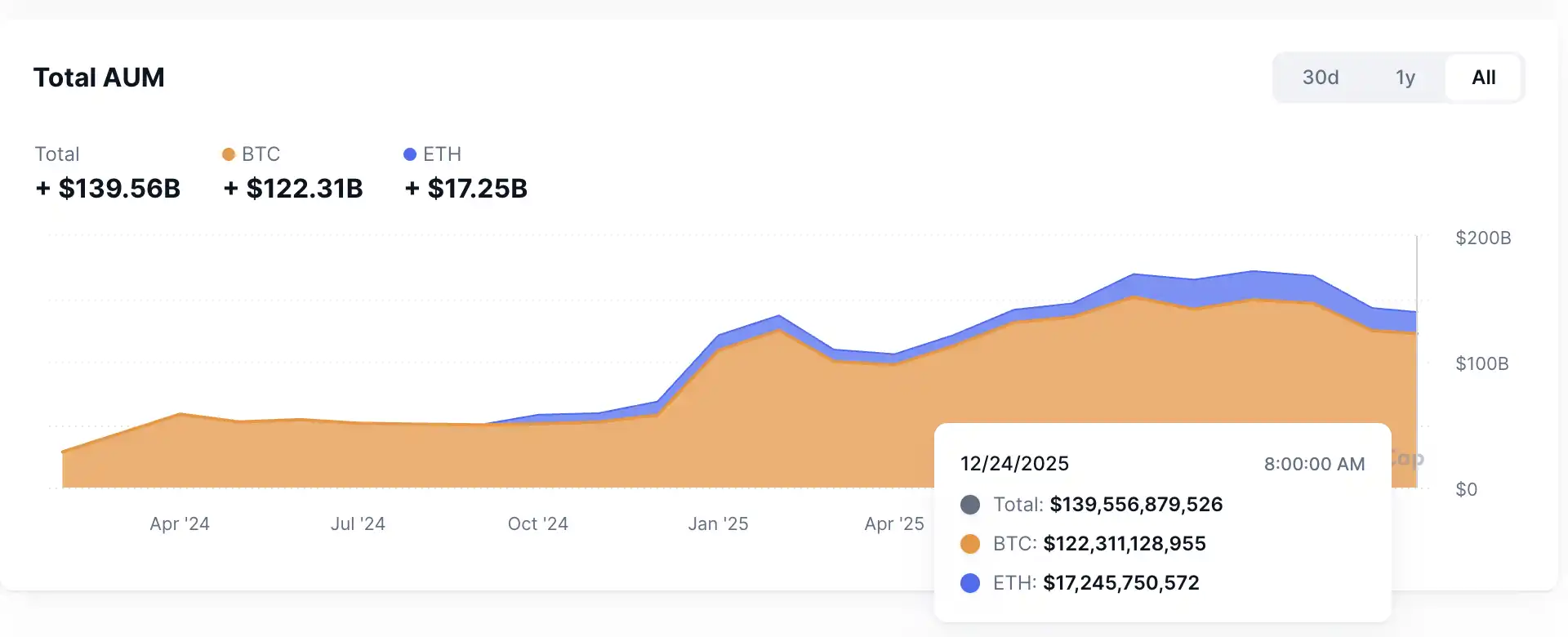
At the same time, the second significant characteristic of institutional capital is its high sensitivity to macro variables. The core goal of institutional investment is not to maximize absolute returns, but to optimize risk-adjusted returns, which determines that its asset allocation behavior is inevitably deeply influenced by the macroeconomic environment. In the traditional financial system, interest rate levels, liquidity tightness, risk appetite changes, and cross-asset arbitrage conditions constitute the core input variables for institutional position adjustments. When this logic is introduced into the crypto market, the price action of crypto assets begins to have a stronger correlation with macro signals. Market practices in 2025 have clearly shown that changes in interest rate expectations have a significantly enhanced impact on Bitcoin and the overall crypto assets. When major central banks, especially the Federal Reserve, adjust their policy rate paths, institutions' allocation decisions regarding crypto assets are also reassessed accordingly. The logic behind this is not a change in confidence in the crypto narrative, but a recalculation of opportunity cost and portfolio risk.
In summary, the process of institutions becoming the marginal buyers of the crypto market in 2025 marks the transition of crypto assets from a stage of "narrative-driven, sentiment-priced" to a new stage of "liquidity-driven, macro-priced." The decline in volatility does not mean the disappearance of risk, but rather a migration of the source of risk: from internal sentiment shocks to high sensitivity to macro interest rates, liquidity, and risk appetite. For research in 2026, this change has methodological significance. The analytical framework needs to shift from simply focusing on on-chain metrics and narrative changes to systematically studying capital structure, institutional behavioral constraints, and macro transmission paths. The crypto market is being incorporated into the global asset allocation system, and its price no longer only answers "what story the market is telling," but increasingly reflects "how capital is allocating risk." This transformation is one of the most profound structural changes in 2025.
II. Maturation of the On-Chain Dollar System: Stablecoins Become Infrastructure, RWA Brings the Yield Curve On-Chain
If the large-scale entry of institutional capital in 2025 answered the question of "who is buying crypto assets," then the maturation of stablecoins and real-world asset tokenization (RWA) further answers the more fundamental questions of "what to buy, what to use for settlement, and where the yield comes from." It is at this level that the crypto market completed a key leap in 2025 from a "crypto-native financial experiment" to an "on-chain dollar financial system." Stablecoins are no longer just a medium of exchange or a safe-haven tool, but have evolved into the clearing and pricing foundation of the entire on-chain economic system; at the same time, RWA represented by on-chain U.S. Treasuries began to scale, giving the on-chain world for the first time a sustainable, auditable low-risk yield anchor, fundamentally changing the yield structure and risk pricing logic of DeFi.
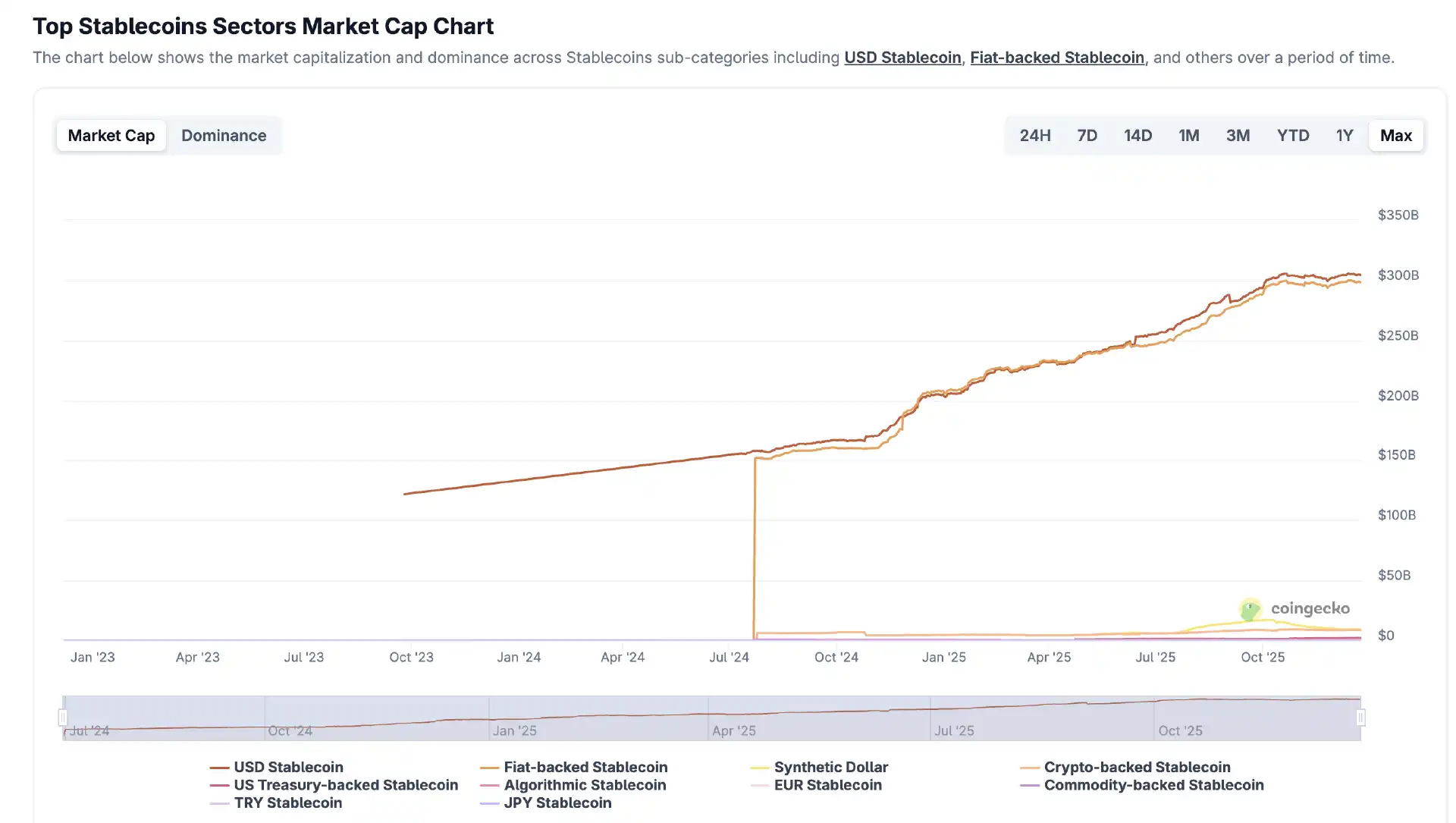
From a functional perspective, stablecoins have indisputably become the core infrastructure of on-chain finance in 2025. Their role has long surpassed that of "price-stable trading tokens," and they now fully undertake multiple functions such as cross-border settlement, trading pair pricing, DeFi liquidity hub, and institutional capital entry/exit channel. Whether in centralized exchanges, decentralized trading protocols, or in RWA, derivatives, and payment scenarios, stablecoins constitute the underlying轨道 of capital flow. On-chain transaction volume data clearly shows that stablecoins have become an important extension of the global dollar system, with their annualized on-chain transaction scale reaching tens of trillions of U.S. dollars, far exceeding the payment systems of most individual countries. This fact means that blockchain truly assumed the role of a "functional dollar network" for the first time in 2025, rather than just an ancillary system for high-risk asset trading. More importantly, the widespread adoption of stablecoins has changed the risk structure of on-chain finance. After stablecoins became the default unit of account, market participants can trade, lend, and allocate assets without being directly exposed to the price volatility of crypto assets, thereby significantly lowering the participation barrier. This is particularly critical for institutional capital. Institutions do not inherently seek the high volatility returns of crypto assets, but value predictable cash flows and risk-controllable sources of yield. The maturity of stablecoins allows institutions to obtain "dollar-denominated" exposure on-chain without bearing traditional crypto price risk, laying the foundation for the subsequent expansion of RWA and yield-bearing products.
Against this background, the scaling of RWA, especially on-chain U.S. Treasuries, became one of the most structurally significant developments in 2025. Unlike early attempts dominated by "synthetic assets" or "yield mapping," RWA projects in 2025 began to introduce real-world low-risk assets directly on-chain in a manner closer to traditional financial asset issuance. On-chain U.S. Treasuries are no longer just a conceptual narrative, but exist in an auditable, traceable, and composable form, with clear sources of cash flow,明确的期限结构, and directly linked to the risk-free interest rate curve in the traditional financial system.
However, precisely as stablecoins and RWA expanded rapidly, 2025 also集中暴露 the other side of the on-chain dollar system, namely its potential systemic fragility. Especially in the field of yield-bearing and algorithmic stablecoins, multiple de-pegging and collapse events sounded the alarm for the market. These failure cases were not isolated incidents, but集中反映了 the same type of structural problems: implicit leverage brought by recursive re-staking, opacity of collateral structure, and high concentration of risk in a few protocols and strategies. When stablecoins are no longer solely backed by short-term Treasuries or cash equivalents, but pursue higher yields through complex DeFi strategies, their stability no longer comes from the assets themselves, but from an implicit assumption of持续的市场繁荣. Once this assumption is broken, de-pegging is no longer a technical fluctuation, but may evolve into a systemic shock. Multiple events in 2025 showed that the risk of stablecoins does not lie in "whether they are stable," but in "whether the source of stability can be clearly identified and audited." Yield-bearing stablecoins can indeed provide returns significantly higher than the risk-free rate in the short term, but these returns are often built on leverage叠加 and liquidity mismatch, and their risks are not fully priced. When market participants treat these products as "cash-like" equivalents, the risk is systemically amplified. This phenomenon forced the market to re-examine the role positioning of stablecoins: are they payment and settlement tools, or financial products embedded with high-risk strategies? This question was raised for the first time in 2025 at a real cost.
Therefore, looking ahead to 2026, the research focus is no longer "whether stablecoins and RWA will continue to grow." From a trend perspective, the expansion of the on-chain dollar system is almost irreversible. The真正关键的问题 lies in "quality stratification." The differences between different stablecoins in terms of collateral asset transparency, term structure, risk isolation, and regulatory compliance will be directly reflected in their cost of capital and usage scenarios. Similarly, the differences between different RWA products in legal structure,清算机制, and yield stability will determine whether they can become part of institutional-grade asset allocation. It is foreseeable that the on-chain dollar system will no longer be a homogeneous market, but will form a clear hierarchical structure: products with high transparency, low risk, and strong compliance will obtain lower funding costs and wider adoption; while products relying on complex strategies and implicit leverage may be marginalized or even gradually phased out. From a more macro perspective, the maturity of stablecoins and RWA has embedded the crypto market into the global dollar financial system for the first time. The on-chain world is no longer just an experimental field for value transfer, but has become an extension of dollar liquidity, yield curves, and asset allocation logic. This transformation, reinforced by the entry of institutional capital and the normalization of the regulatory environment, jointly pushes the crypto industry from cyclical speculation towards infrastructure development.
III. Regulatory Normalization: Compliance Becomes a Moat, Reshaping Valuation and Industry Organization
In 2025, global crypto regulation entered a stage of normalization. This change is not reflected in a single law or regulatory event, but in a fundamental shift in the overall "survival assumption" of the industry. For many years prior, the crypto market always operated in a highly uncertain institutional environment. The core question was not growth or efficiency, but "is this industry allowed to exist?" Regulatory uncertainty was seen as part of the systemic risk, and capital often needed to reserve additional risk premiums for potential compliance shocks, enforcement risks, and policy reversals when entering. Entering 2025, this long-unresolved issue was阶段性解决 for the first time. As major jurisdictions in Europe, the US, and Asia-Pacific陆续形成 relatively clear and enforceable regulatory frameworks, the market's attention began to move from "whether it can exist" to "how to expand under compliance premises." This shift has had a profound impact on capital behavior, business models, and asset pricing logic.
Regulatory clarity first significantly lowered the institutional门槛 for institutions to enter the crypto market. For institutional capital, uncertainty itself is a cost, and regulatory ambiguity often means unquantifiable tail risks. In 2025, as key links such as stablecoins, ETFs, custody, and trading platforms were gradually brought into clear regulatory scope, institutions were finally able to assess the risks and returns of crypto assets within existing compliance and risk control frameworks. This change does not mean that regulation has become looser, but that it has become predictable. Predictability itself is a prerequisite for the large-scale entry of capital. Once regulatory boundaries are defined, institutions can absorb these constraints through internal processes, legal structures, and risk models, without having to treat them as "uncontrollable variables." As a result, more long-term capital began to enter the market in a systematic manner, with participation depth and allocation scale increasing simultaneously. Crypto assets are gradually being incorporated into a broader asset allocation system. More importantly, regulatory normalization changed the competitive logic at the enterprise and protocol levels.
The profound impact of regulatory normalization lies in its reshaping of the industry's organizational form. As compliance requirements are gradually implemented in issuance, trading, custody, and settlement, the crypto industry began to show a stronger trend of centralization and platformization. More products chose to complete issuance and distribution on regulated platforms, and trading activities also concentrated towards venues with licenses and compliant infrastructure. This trend does not mean the disappearance of the decentralized ideal, but means that the "entrance" for capital formation and flow is being reorganized. Token issuance gradually evolved from disorderly peer-to-peer sales to a more process-oriented, standardized operation closer to traditional capital markets, forming a new form of "Internet capital marketization." In this system, issuance, disclosure, lock-up periods, distribution, and secondary market liquidity are more tightly integrated, and market participants' expectations of risk and return也随之更加稳定. This change in industry organization is directly reflected in the adjustment of asset valuation methods. In previous cycles, crypto asset valuation highly relied on metrics such as narrative strength, user growth, and TVL, while consideration of institutional and legal factors was relatively limited. Entering 2026, as regulation became a quantifiable constraint, valuation models began to introduce new dimensions. Regulatory capital占用, compliance costs, legal structure stability, reserve transparency, and the accessibility of compliant distribution channels gradually became important variables affecting asset prices. In other words, the market began to impose "institutional premiums" or "institutional discounts" on different projects and platforms. Those entities that can operate efficiently within the compliance framework and internalize regulatory requirements into operational advantages can often obtain funding support at a lower cost of capital; while models that rely on regulatory arbitrage or institutional ambiguity face valuation compression or even the risk of marginalization.
IV. Conclusion
The inflection point of the crypto market in 2025 is essentially three things happening simultaneously: the migration of capital from retail to institutions, the formation of assets from narratives to an on-chain dollar system (stablecoins + RWA), and the落地 of rules from gray areas to normalized regulation. These three together push crypto from a "high-volatility speculative product" to a "modelable financial infrastructure." Looking ahead to 2026, research and investment should focus on three types of core variables: the transmission strength of macro interest rates and liquidity to crypto, the quality stratification of on-chain dollars and the sustainability of real yields, and the institutional moat constituted by compliance costs and distribution capabilities. Under the new paradigm, the winners will not be the projects that tell the best stories, but the infrastructure and assets that can expand sustainably under the three constraints of capital, yield, and rules.






