How Twitter Creates 'Fake Traffic'

marsbitPublished on 2025-12-23Last updated on 2025-12-23

Abstract

This article investigates the perceived "fake traffic" on X (formerly Twitter) by comparing engagement metrics. It notes a significant discrepancy: a Binance YouTube video with 1.22 million subscribers received only 160k views, while a tweet from an account with 250k followers garnered 517k views. The core explanation is X's method of counting "impressions." A view is counted each time a tweet appears on a user's screen, even if they scroll past it without engaging. This applies to the timeline, search results, and profile views, with multiple appearances from the same user also counted. This system prioritizes measuring exposure over genuine interaction (likes, replies), a practice also used by Threads and TikTok, unlike YouTube's stricter 30-second watch time requirement. The article suggests this approach, implemented by Elon Musk to publicly display view counts, aims for maximum visibility rather than deep engagement. However, to counter potential low-quality content, X uses its "Creator Ads Revenue Sharing" program as a truer measure of influence. Payouts are based on verified user interactions (likes, replies from Premium subscribers) and content type, not just raw view counts. Additional features like "Bangers," which highlights high-engagement tweets, further help identify genuinely valuable content. The conclusion frames high view counts as a starting point for creators, emphasizing that bravery in self-expression is the first step, but real success and monetizati...

Earlier this month, CZ and Peter Schiff had an interesting "Bitcoin VS Gold" debate at the Binance Blockchain Week. After watching the video of this debate, I browsed related discussion posts on X, and as I scrolled, I suddenly noticed a problem...

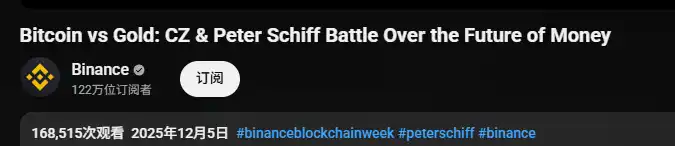
On YouTube, Binance's official account has 1.22 million subscribers, but the debate video only garnered 160,000 views and 5,358 likes:
Meanwhile, a simple search for related topic posts on X, like the one in the image below—this X account has only about 250,000 followers, but the view count reached 517,000, with over 4,100 likes:
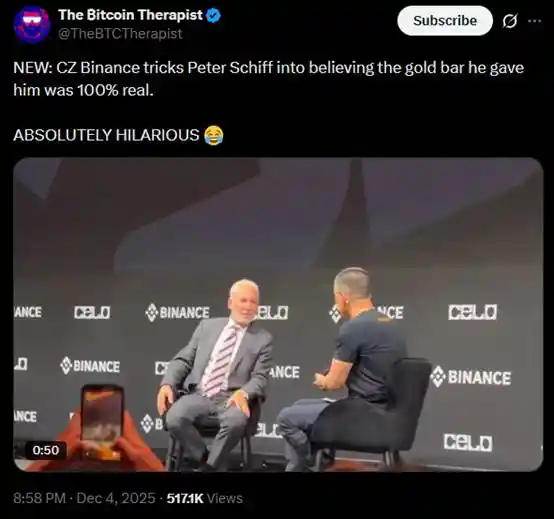
The disparity in these numbers is quite significant. So, is Twitter (X) creating "fake traffic"?

Exaggerated View Count Calculation?

Differing from what we might expect, X's view count calculation is much more lenient—each post is counted as 1 view whenever it appears on the screen of a logged-in user's device. This means that even if the user doesn't notice a particular post at all, as long as X's algorithm recommends it to your timeline, even if you scroll past it without looking, it still counts as 1 view.

This applies not only to the recommended content timeline but also to scenarios like search results and viewing all historical posts of a specific X account.

Moreover, this counting is not "unique"—meaning for the same user, if the same post appears multiple times on the screen, the views will be accumulated each time.

So, if you open the creator center of an X account, you'll notice that the term used for views is not "views" but "impressions." X's view count calculation is primarily used to measure the exposure of a post rather than actual engagement (such as likes, reposts, or comments), even though the latter better reflects genuine interaction.

So, is this "exaggerated"? It certainly seems so, but it's hard to say definitively.

Let's compare it horizontally with other social media platforms. Threads' view calculation method is almost identical to X's, both focusing on reflecting post exposure rather than actual interaction.

For video-centric platforms like YouTube and TikTok, the threshold is significantly higher. For traditional long-form videos, YouTube requires a watch time of over 30 seconds to count as an effective view. Given the larger scale of long-form video content compared to short posts, requiring over 30 seconds of watch time is reasonable. For short-form videos on TikTok, it's similar to X, especially on the auto-playing recommendation page—as long as the video appears on the user's device screen, the view count increases by 1, even if the user scrolls past without watching.

The purpose of this "exaggeration" is to better reflect the "exposure" of content. But why is this necessary?

Actually, making view counts visible to everyone was an update introduced after Musk acquired Twitter. Previously, only the poster could view the view count of a post. Musk personally tweeted to explain the reason for this update:
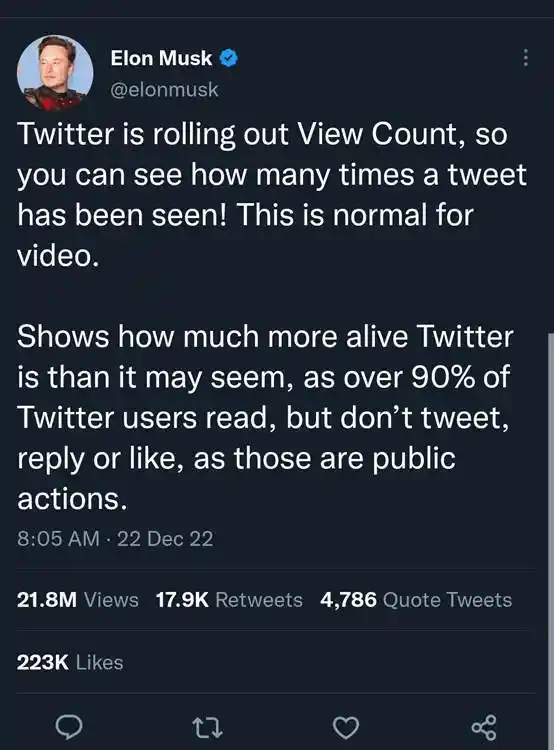
In the above tweet, Musk also mentioned, "For video, it's just standard practice." At that time, Twitter had just been acquired by Musk, followed by large-scale layoffs and the controversy over Twitter's "Blue V paid subscription." Mockery like "Twitter is dead" was rampant.

It's hard to say that Musk's decision to open up view count data at that time wasn't driven by a desire to "counterattack," especially since even his own AI, Grok, said this:
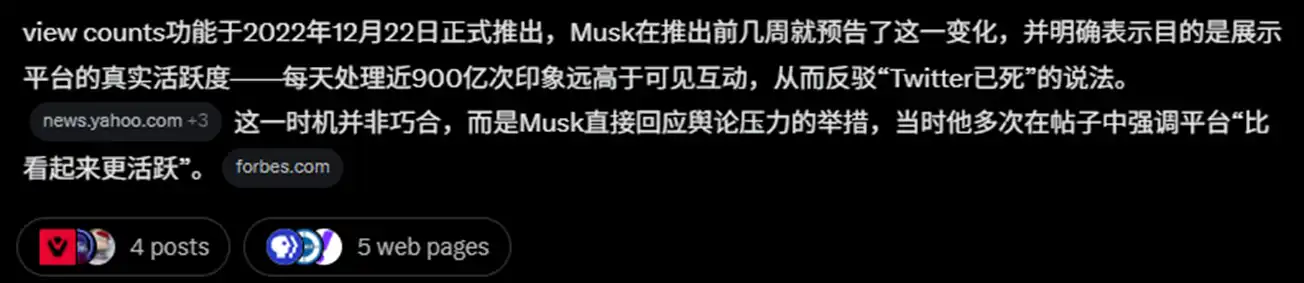
This "exaggeration" might not just be our individual perception. According to a Yahoo news report, former Twitter employees stated that the reason view count data wasn't made public was that "it's difficult to determine whether a tweet was actually read or merely scrolled past by the user."

Clearly, defining whether a tweet has been "effectively read" is inherently challenging. While Musk undoubtedly had a "counterattack" motive, he was also telling the truth. For tweets, this simplification of the view metric is necessary because many tweets (such as memes, etc.) don't require deep user engagement but focus on the widest top of the funnel—attracting as many users as possible.

Prioritizing exposure over deep interaction, high visibility over deep reachability, is what X and Musk prioritize.

Finding "Reality" in the "Exaggeration"

Of course, if the sole pursuit is high visibility, creators might fall into another extreme—prioritizing quantity over quality. If this happens, Twitter could eventually decline due to low-quality content.

Therefore, view count is not the only core metric creators should pursue. The vast majority of creators work hard to produce content with the goal of monetization. For creators, income is a measurable return that incentivizes high-quality content creation. View count is like a rest stop in a marathon—congratulations, you've already covered this much distance and are ahead of many others; keep going.

To have the potential for commercial monetization, building view count is the first step. But even with high views, if the content doesn't attract advertisers—for example, sensitive topics that appeal to specific groups or short-term trend-chasing—income can still be zero.

On Twitter, the "Creator Revenue Sharing" is clearly the compass for finding "reality" in the "exaggeration." To measure an account's influence, creator revenue sharing is far more important than view count because to qualify for Twitter's creator revenue sharing, view count is just a threshold and one of the metrics to help creators produce viral content better.

Twitter's Creator Revenue Sharing (Ads Revenue Sharing) was launched in July 2023. Former Twitter CEO Linda Yaccarino revealed in May 2024 that over $50 million in creator revenue sharing had already been paid out.

To qualify for creator revenue sharing, one must first meet the thresholds—verified identity, Twitter Premium membership, having 500 Premium member followers, and accumulating at least 5 million views within 3 months.

But as mentioned above, building view count is just the beginning. Creator revenue sharing is calculated based on the verified (Premium member) engagement of the post (such as likes and replies), while also considering the influence of different content types, such as articles, videos, Spaces, and live streams.

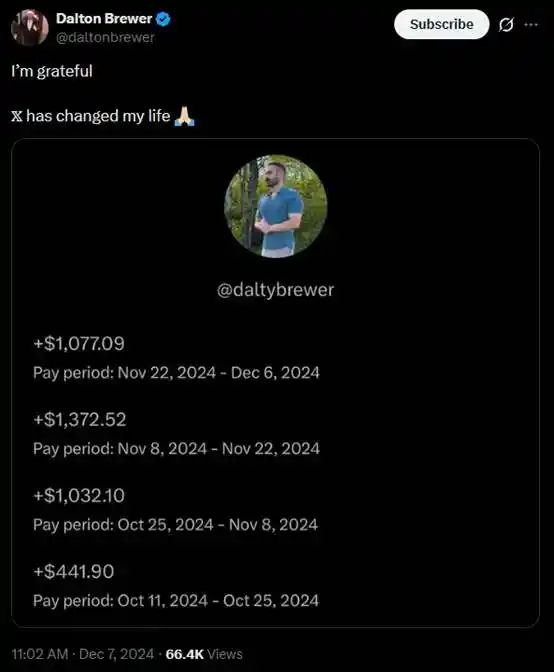
Therefore, on Twitter, we can see creators with 330,000 followers earning over $2,000 a month:
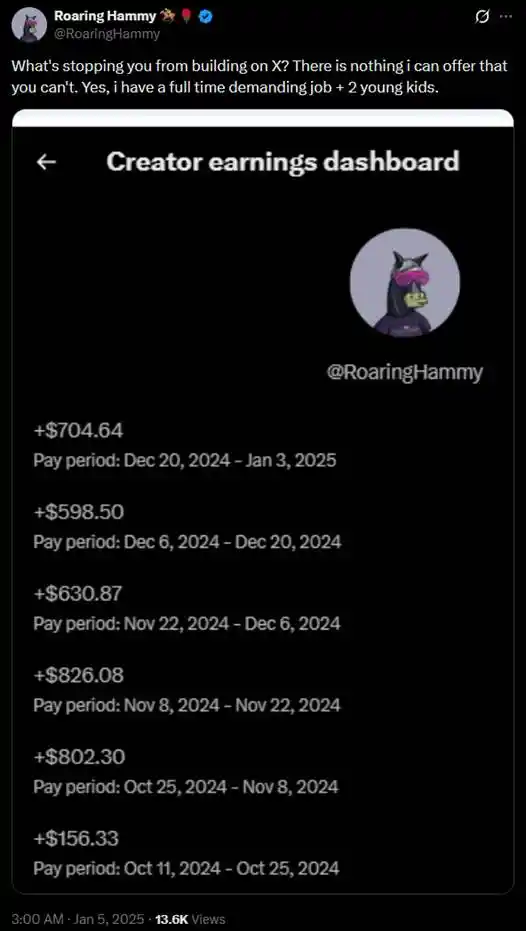
And creators with only 13,000 followers earning over $1,000 a month:
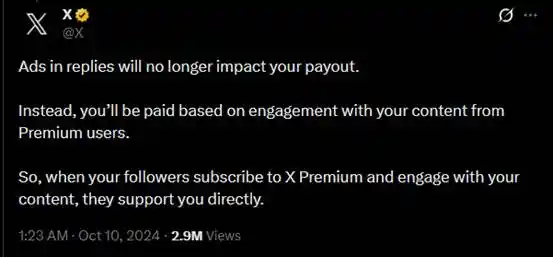
In October of last year, Twitter officially announced that the source of creator revenue sharing would no longer be based on ad revenue from comments but on the subscription revenue from Twitter Premium members. This move aims to encourage more high-quality creators to emerge—let's grow the pie together; the more people pay Twitter, the more we pay creators.
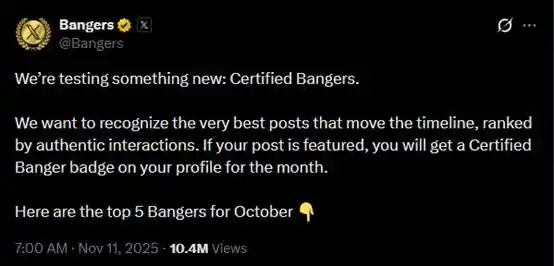
This November, Twitter launched a new feature called "Bangers," which, based on the genuine engagement of tweets, periodically selects high-quality tweets through official evaluation and awards the creator's account with a "Bangers" subsidiary badge. This "Tweet Hall of Fame"-like feature provides another basis for finding "reality" in the "exaggeration."
Conclusion

Perhaps the present moment is the best proof of the view that "courage is the most important quality for success." The first step for a creator is precisely "have the courage to express yourself," and this is also the core quality of a qualified creator.

In an era where live streaming e-commerce and self-media have quietly transformed the work ecosystem for years, we often say, "traffic is money." But the first step to earning money is the view count ticking up +1, +1, and +1 behind the screen. And by courageously expressing yourself, you are already at the starting line.

Now that you understand how Twitter creates "fake traffic," will you start today to create your own real traffic?

Related Questions

QHow does X (formerly Twitter) calculate the 'views' for a tweet?

AX counts a 'view' (officially called an 'impression') every time a tweet appears on the screen of a logged-in user, regardless of whether the user actually reads it or simply swipes past it. This count is not unique and can be incremented multiple times if the same user sees the same tweet on their screen more than once.

QWhat was the primary reason Elon Musk gave for making tweet view counts public?

AElon Musk stated that making view counts public was to show users how much more alive the platform was than they might think, and he mentioned that this was standard practice for video platforms.

QWhat are the key requirements for a creator to be eligible for X's Ads Revenue Sharing program?

ATo be eligible for the Ads Revenue Sharing program, a creator must: be verified, have an X Premium subscription, have at least 500 followers who are also Premium subscribers, and have accumulated at least 5 million impressions in the past 3 months.

QHow does the 'Bangers' feature on X help identify high-quality content?

AThe 'Bangers' feature is an official,不定期 (non-regular) selection by X that awards a special badge to high-quality tweets based on their genuine engagement metrics (like likes and replies), effectively creating a 'hall of fame' for tweets and helping to surface truly impactful content amidst high-impression counts.

QHow does the method of counting views on X compare to platforms like YouTube and TikTok?

AX's view counting is similar to Threads and TikTok, where content appearing on a user's screen counts as a view. In contrast, YouTube has a higher threshold for long-form videos, requiring a user to watch for over 30 seconds for it to count as a view, reflecting the different nature of the content.

Related Reads

You Bet on the News, the Pros Read the Rules: The True Cognitive Gap in Losing Money on Polymarket

The article explains that the key to profiting on Polymarket, a prediction market platform, lies not just predicting real-world events correctly, but in meticulously understanding the specific rules that govern how each market will be resolved. It illustrates this with examples, such as a market on Venezuela's 2026 leader, where the official rules defining "officially holds" the office overruled the intuitive answer of who was in practical control. Other examples include debates over the definition of a "token" or what constitutes an "agreement." The core argument is that a "reality vs. rules" gap creates pricing discrepancies that savvy traders ("车头" or "whales") exploit. The platform has a formal dispute resolution process managed by UMA token holders to settle ambiguous outcomes. This process involves proposal submission, a challenge window, a discussion period, and a final vote. However, the article highlights a critical flaw in this system compared to a traditional court: the lack of separation between the arbiters (UMA voters) and the interested parties (traders with financial stakes in the outcome). This conflict of interest undermines the discussion phase, leads to herd mentality, and results in opaque final decisions without explanatory rulings. Consequently, the system lacks a body of precedent, making it difficult for users to learn from past disputes. The ultimate takeaway is that success on Polymarket requires a lawyer-like scrutiny of the rules to identify and capitalize on the cognitive gap between how events appear and how they are contractually defined for settlement.

marsbit1h ago

You Bet on the News, the Pros Read the Rules: The True Cognitive Gap in Losing Money on Polymarket

marsbit1h ago

Trading

Spot
Futures

Hot Articles

What is $BITCOIN

DIGITAL GOLD ($BITCOIN): A Comprehensive Analysis Introduction to DIGITAL GOLD ($BITCOIN) DIGITAL GOLD ($BITCOIN) is a blockchain-based project operating on the Solana network, which aims to combine the characteristics of traditional precious metals with the innovation of decentralized technologies. While it shares a name with Bitcoin, often referred to as “digital gold” due to its perception as a store of value, DIGITAL GOLD is a separate token designed to create a unique ecosystem within the Web3 landscape. Its goal is to position itself as a viable alternative digital asset, although specifics regarding its applications and functionalities are still developing. What is DIGITAL GOLD ($BITCOIN)? DIGITAL GOLD ($BITCOIN) is a cryptocurrency token explicitly designed for use on the Solana blockchain. In contrast to Bitcoin, which provides a widely recognized value storage role, this token appears to focus on broader applications and characteristics. Notable aspects include: Blockchain Infrastructure: The token is built on the Solana blockchain, known for its capacity to handle high-speed and low-cost transactions. Supply Dynamics: DIGITAL GOLD has a maximum supply capped at 100 quadrillion tokens (100P $BITCOIN), although details regarding its circulating supply are currently undisclosed. Utility: While precise functionalities are not explicitly outlined, there are indications that the token could be utilized for various applications, potentially involving decentralized applications (dApps) or asset tokenization strategies. Who is the Creator of DIGITAL GOLD ($BITCOIN)? At present, the identity of the creators and development team behind DIGITAL GOLD ($BITCOIN) remains unknown. This situation is typical among many innovative projects within the blockchain space, particularly those aligning with decentralized finance and meme coin phenomena. While such anonymity may foster a community-driven culture, it intensifies concerns about governance and accountability. Who are the Investors of DIGITAL GOLD ($BITCOIN)? The available information indicates that DIGITAL GOLD ($BITCOIN) does not have any known institutional backers or prominent venture capital investments. The project seems to operate on a peer-to-peer model focused on community support and adoption rather than traditional funding routes. Its activity and liquidity are primarily situated on decentralized exchanges (DEXs), such as PumpSwap, rather than established centralized trading platforms, further highlighting its grassroots approach. How DIGITAL GOLD ($BITCOIN) Works The operational mechanics of DIGITAL GOLD ($BITCOIN) can be elaborated on based on its blockchain design and network attributes: Consensus Mechanism: By leveraging Solana’s unique proof-of-history (PoH) combined with a proof-of-stake (PoS) model, the project ensures efficient transaction validation contributing to the network's high performance. Tokenomics: While specific deflationary mechanisms have not been extensively detailed, the vast maximum token supply implies that it may cater to microtransactions or niche use cases that are still to be defined. Interoperability: There exists the potential for integration with Solana’s broader ecosystem, including various decentralized finance (DeFi) platforms. However, the details regarding specific integrations remain unspecified. Timeline of Key Events Here is a timeline that highlights significant milestones concerning DIGITAL GOLD ($BITCOIN): 2023: The initial deployment of the token occurs on the Solana blockchain, marked by its contract address. 2024: DIGITAL GOLD gains visibility as it becomes available for trading on decentralized exchanges like PumpSwap, allowing users to trade it against SOL. 2025: The project witnesses sporadic trading activity and potential interest in community-led engagements, although no noteworthy partnerships or technical advancements have been documented as of yet. Critical Analysis Strengths Scalability: The underlying Solana infrastructure supports high transaction volumes, which could enhance the utility of $BITCOIN in various transaction scenarios. Accessibility: The potential low trading price per token could attract retail investors, facilitating wider participation due to fractional ownership opportunities. Risks Lack of Transparency: The absence of publicly known backers, developers, or an audit process may yield skepticism regarding the project's sustainability and trustworthiness. Market Volatility: The trading activity is heavily reliant on speculative behavior, which can result in significant price volatility and uncertainty for investors. Conclusion DIGITAL GOLD ($BITCOIN) emerges as an intriguing yet ambiguous project within the rapidly evolving Solana ecosystem. While it attempts to leverage the “digital gold” narrative, its departure from Bitcoin's established role as a store of value underscores the need for a clearer differentiation of its intended utility and governance structure. Future acceptance and adoption will likely depend on addressing the current opacity and defining its operational and economic strategies more explicitly. Note: This report encompasses synthesised information available as of October 2023, and developments may have transpired beyond the research period.

363 Total ViewsPublished 2025.05.13Updated 2025.05.13

What is $BITCOIN

Discussions

Welcome to the HTX Community. Here, you can stay informed about the latest platform developments and gain access to professional market insights. Users' opinions on the price of BTC (BTC) are presented below.

活动图片