How an Anthropic Engineer Saved 300 Million Tokens in a Week: A Claude Code Caching Guide

marsbitPublished on 2026-05-24Last updated on 2026-05-24

Abstract

Anthropic engineers reveal how prompt caching in Claude Code dramatically reduces token consumption. By reusing already-processed context, cached tokens cost only 10% of regular input tokens. The author saved over 300 million tokens in a week, with 91 million cached tokens in a single day counted as roughly 9 million for billing. Caching works via prefix matching across three layers: system (instructions, tools), project (CLAUDE.md, rules), and conversation (chat history). As long as the beginning of a request matches cached content, Claude reuses it instead of reprocessing. Key points for users: - Claude Code's cache TTL is 1 hour (vs. 5 minutes for API/Sub-agents). Avoid pausing a session beyond this. - Switching models (including enabling "Opus plan" mode) breaks cache, forcing a full reprocess. - For task switching, use a clear session handoff instead of letting an old session expire. - Place large documents in Projects, not directly in chat, for better caching. High cache reuse benefits both users (longer sessions) and Anthropic (lower costs). Monitoring cache hit rates is crucial internally. By managing context as an asset and avoiding cache-breaking habits, users can make their Claude Code sessions more efficient and cost-effective.

Editor's Note: When many people use Claude Code, the most intuitive feeling is that Token consumption is too fast, and long sessions can easily eat up the quota. But from the perspective of an Anthropic engineer, what truly affects cost is often not how much code you write, but whether the system consistently reuses context that has already been processed.

The core of this article is how to save Tokens through caching mechanisms. The author reused over 300 million Tokens through caching in one week, with a single-day cache hit reaching 91 million. Since the cost of a cached Token is only 10% of a regular input Token, this means 91 million cached Tokens are billed roughly equivalent to 9 million regular Tokens. The reason Claude Code long sessions seem more "durable" isn't because the model works for free, but because a large amount of repeated context is successfully reused.

The key to prompt caching is "don't break the cache." Claude Code caches system prompts, tool definitions, CLAUDE.md, project rules, and conversation history in layers; as long as the prefix of subsequent requests remains consistent, Claude can directly read from the cache instead of reprocessing the entire context. Anthropic internally also monitors prompt cache hit rates because it affects not only user quotas but also directly impacts model service costs and operational efficiency.

For ordinary users, you don't need to understand all the underlying details, just master a few key habits: don't let a session sit idle for more than 1 hour; perform a clean session handoff when switching tasks; avoid frequently switching models; put large documents into Projects instead of repeatedly pasting them into the conversation.

This article is less about a Token-saving trick and more about providing a Claude Code usage approach closer to an engineer's mindset: treat context as an asset to manage, let the cache be continuously reused, and make long sessions do less repetitive computation.

The following is the original text:

I saved 300 million Tokens this week, 91 million in a single day, over 300 million in a week.
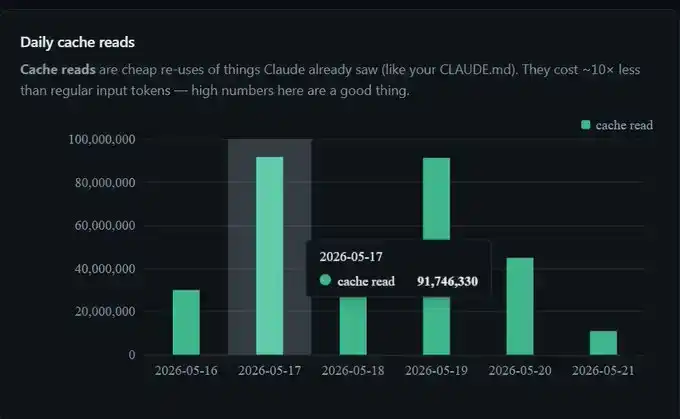
I didn't change any settings. This is just prompt caching working normally in the background.

But after I truly understood what caching is and how to avoid "breaking" it, with the same usage quota, my sessions could last longer. So, here is a compiled 80/20 introductory guide to Claude Code prompt caching, without delving into deep API-level details.

TL;DR

Cached Tokens cost only 10% of regular input Tokens. 91 million cached Tokens are billed approximately equivalent to 9 million Tokens.

Claude Code subscription cache TTL is 1 hour; API default is 5 minutes; Sub-agent is always 5 minutes.

Caching is divided into three layers: system, project, and conversation.

Switching models mid-conversation breaks the cache, including enabling "opus plan" mode.

How is caching actually billed?

Every cached Token costs 10% of a regular input Token.
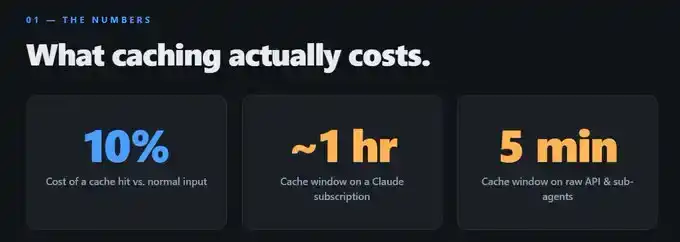
So, when my dashboard shows 91 million Tokens hitting cache on a particular day, the actual billing is roughly equivalent to processing only 9 million Tokens. This is also why, compared to having no cache, using Claude Code for long periods makes the session feel almost "free" to extend.

Two numbers on the dashboard are worth focusing on:

Cache create: The one-time cost incurred when writing content to the cache. It starts to take effect in the next round of conversation.
Cache read: Tokens Claude reuses from the cache, such as your CLAUDE.md, tool definitions, previous messages, etc. Cost is 10 times cheaper compared to reprocessing them as input.
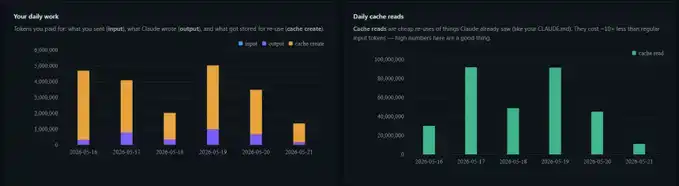
If your Cache read number is high, it means you are effectively utilizing the cache; if this number is low, it means you are repeatedly paying for the same context.

Anthropic's Thariq once said something that left a deep impression on me: "We actually monitor prompt cache hit rates, and if the hit rate gets too low, it triggers an alert, even declaring a SEV-level incident."

He also wrote a great X article. When cache hit rates are high, four things happen simultaneously: Claude Code feels faster, Anthropic's service costs decrease, your subscription quota seems more durable, and long coding sessions become more realistic.

But if the hit rate is low, everyone loses.
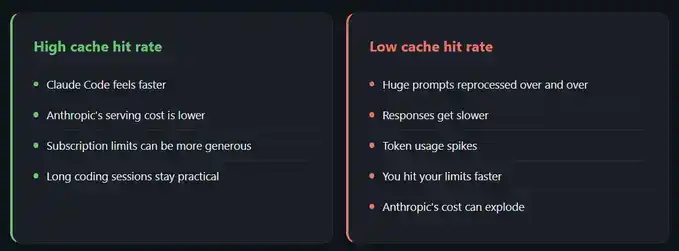
So, the incentives are actually aligned: Anthropic wants your cache hit rate higher, and you yourself want the hit rate higher. What truly holds things back are some seemingly insignificant habits that quietly reset the cache.

How does the cache grow with each conversation turn?

Caching relies on prefix matching.

Without getting too deep into technical details, you just need to understand one thing: as long as the content before a certain position is completely identical to what's already cached, Claude can reuse those cached Tokens.

A brand new session typically unfolds like this:
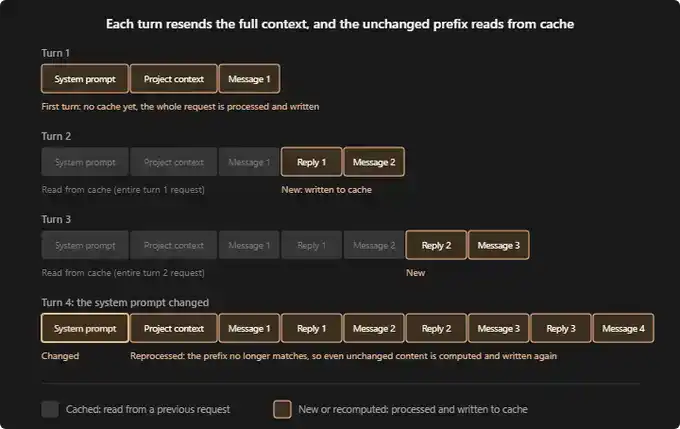
According to Claude Code documentation, a fresh session usually runs like this:

First conversation turn: No cache exists yet. The system prompt, your project context (like CLAUDE.md, memory, rules), and your first message are all processed from scratch and written to the cache.

Second conversation turn: All content from the first turn is now cached. Claude only needs to process your new reply and the next message. This round is much cheaper.

Third conversation turn: Same logic. Previous conversation remains in the cache, only the latest round of interaction needs reprocessing.

The cache itself can be divided into three layers:
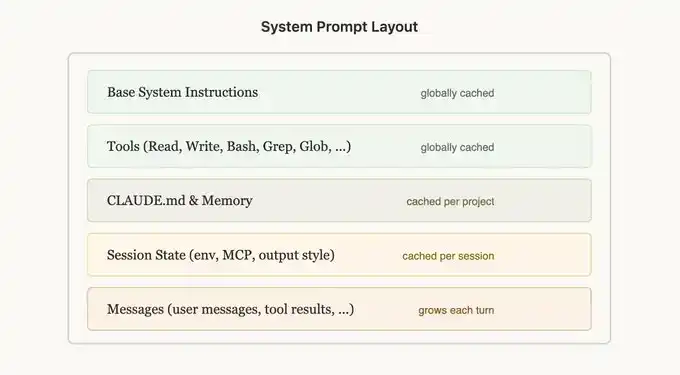
From Thariq's X article:

System layer: Includes base instructions, tool definitions (read, write, bash, grep, glob), and output style. This layer is cached globally.

Project layer: Includes CLAUDE.md, memory, project rules. This layer is cached per project.

Conversation layer: Includes replies and messages, growing with each conversation turn.

If anything in the system or project layer changes mid-session, everything must be recached from scratch. This is the most "expensive" operation. Imagine: you're already on the 16th message, then suddenly change the system prompt, or pause for an hour, all Tokens from message 1 onward need to be reprocessed.

The confusion between 1 hour and 5 minutes

This is the most easily misunderstood point.

Claude Code subscription: Default TTL is 1 hour.

Claude API: Default TTL is 5 minutes. You can pay a higher cost to increase it to 1 hour.
Sub-agent on any plan: Always 5 minutes.

Claude.ai web chat: Not officially documented. Likely same as subscription, but I haven't confirmed.

A few months ago, many people complained that Claude subscription quotas were being consumed too quickly. Some thought Anthropic had quietly reduced TTL from 1 hour to 5 minutes without notifying users. But that wasn't the case; Claude Code's TTL remains 1 hour.

The problem is, Claude Code and API documentation are kept separate, and these are two completely different things, leading to much confusion.

If you're running many Sub-agent workflows, or using the API directly, the 5-minute figure is important. But for 95% of Claude Code users, what really matters is that 1-hour window.

Three habits that cover 95% of users

The following are parts I find truly useful for daily use.

Don't pause too long

If you've been idle for more than an hour, previous content has mostly expired from the cache. Your next message will rebuild the cache. In such cases, instead of resuming an old session that has "gone cold," it's often cheaper to do a clean handoff and start a new session.

When switching tasks, just start fresh

/compact or /clear inherently break the cache, so it's better to use that moment for a true reset.

I made a session handoff skill to replace /compact. It summarizes what we've completed, what pending decisions remain, which files are most important, and where to continue next. Then I run /clear, paste this summary in, and can proceed as if nothing was interrupted.

The compact command sometimes runs slowly too. This handoff skill usually finishes in under a minute.

In Claude chat, put large documents into Projects

The caching mechanism on Claude.ai isn't officially documented in great detail, but Projects clearly use different optimizations compared to regular chat threads. So, if you need to paste large documents, it's better to put them in a Project rather than directly into the chat.

Which operations quietly break the cache?

A few things can completely reset the cache without obvious warning.

Switching models: Because caching relies on prefix matching, and each model has its own cache. Switching models means the next request will read the full history with no cache hits.

"Opus plan" mode: This setting uses Opus for planning and Sonnet for execution. I recommended it in some token optimization videos for a reason. But it's important to understand that each plan switch is essentially a model switch, meaning the cache must be rebuilt. In the long run, it still helps extend session quota, but you need to know what's happening under the hood.

Editing CLAUDE.md mid-session is okay: This change doesn't take effect immediately; it applies on the next restart. Therefore, the currently running cache isn't affected.

My free Token dashboard

The screenshot I showed earlier is from a token dashboard.
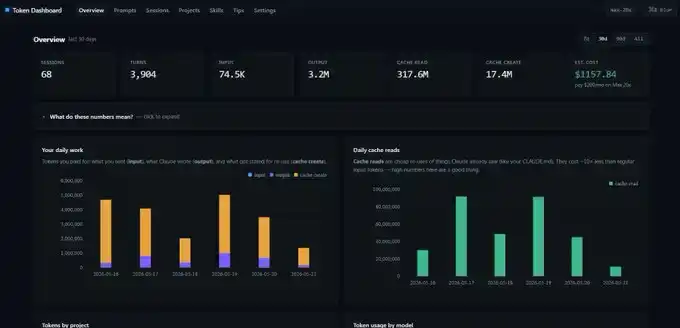
It's a simple GitHub repo. You give the link to Claude Code, have it deploy locally on localhost, and it will read all your past session records instead of starting statistics from scratch. You immediately see daily input, output, cache create, and cache read data.

One thing to note: this dashboard counts Token data on your local device. If you switch from desktop to laptop, the numbers won't match exactly. Each device has its own statistical view.

Summary

Prompt caching is something you can research deeply. Thariq's article covers it more completely than here; if you want the full picture, it's worth reading.

But you don't need to understand all the details to benefit. You just need to grasp the key 80/20: cached Tokens are 10 times cheaper than regular Tokens; Claude Code TTL is 1 hour; switching models breaks the cache; making a clean handoff between tasks is usually more cost-effective than forcing an old session back to life after it "expires."

Related Questions

QWhat is the core mechanism described in the article for significantly reducing Claude Code costs?

AThe core mechanism is prompt caching, where previously processed context (system prompts, tool definitions, project files, conversation history) is stored and reused. If a new request's prefix matches the cached content, Claude reads from the cache instead of reprocessing, costing only 10% of a standard input token.

QWhat is the key financial benefit of high cache read rates mentioned in the article?

ATokens read from the cache are billed at only 10% of the cost of standard input tokens. This means high cache read rates make a Claude Code subscription last significantly longer, as repeated context is not fully re-processed and paid for.

QWhat are the three main layers of prompt caching in Claude Code, according to the article?

AThe three layers are: 1. System Layer (global cache for base instructions, tool definitions like read/write/bash, and output style). 2. Project Layer (cached per project, includes CLAUDE.md, memory, project rules). 3. Conversation Layer (cached per session, includes the growing history of messages and replies).

QWhat is the single most common user action that will completely reset the prompt cache in an active Claude Code session?

ASwitching the model mid-conversation. Because cache relies on prefix matching and each model has its own cache, switching models forces Claude to reprocess the entire context from scratch with no cache hits.

QWhat practical habit does the author recommend for switching tasks to better preserve caching benefits?

APerform a clear session handoff instead of letting a session idle past the TTL. The author uses a custom 'session handoff skill' to summarize progress, pending decisions, and key files before using /clear. This summary is pasted into the new session, providing continuity while allowing a fresh, efficiently cached session to begin.

Related Reads

How to Define "Real U.S. Stocks": Differences Between On-Chain Tokens, Price Contracts, and Direct Broker Connections

**Title:** Defining "Real US Stocks": Differences Among On-Chain Tokens, Price Contracts, and Broker-Direct Access **Summary:** In 2026, using stablecoins to purchase US stocks is mainstream, but products marketed as "buying US stocks with USDT" offer fundamentally different assets. This article analyzes three primary models. **1. Tokenized Stocks:** These are on-chain tokens representing economic exposure to underlying stocks, held by an issuer or custodian. They offer benefits like 24/7 trading and DeFi composability (e.g., use as loan collateral). However, users lack direct legal shareholder status; dividends may not be paid in cash, and voting rights are typically non-binding advisory expressions. Examples include platforms like Ondo Finance. **2. Stock Futures / Equity Perpetuals:** These are derivative contracts tracking a stock's price, allowing leveraged long/short positions 24/7, similar to crypto perpetuals. They offer high efficiency and flexibility but involve funding fees, which can be a significant long-term cost, especially during strong trends. Crucially, they confer no ownership rights (dividends, voting) to the holder. **3. Broker-Direct Model:** This model provides access to real securities via licensed broker-dealers. Stocks/ETFs are bought and held within the US clearing and custodial system (e.g., DTCC), making it the only path to genuine stock ownership. Users receive cash dividends and formal proxy voting rights (where applicable). It supports thousands of stocks and ETFs, far exceeding the coverage of the other two models. Key advantages include no funding fees, a clean cost structure for long-term holds, and the potential to transfer holdings to other brokers. Some platforms facilitate stablecoin (USDT/USDC) deposits, reducing reliance on traditional banking. A critical distinction exists *within* the broker-direct model: the underlying brokerage architecture (e.g., Fully Disclosed IB, Omnibus IB, Self-Clearing) determines how client assets are held, protected, and how safeguards like SIPC insurance are conveyed. Users should verify the specific clearing structure and regulatory compliance of any platform. In conclusion, "buying US stocks with USDT" can mean holding an on-chain economic proxy (Tokenized Stocks), trading a price derivative (Stock Futures), or owning the actual security (Broker-Direct). For users seeking full ownership rights and long-term investment, the broker-direct model is the definitive choice, though its implementation details require careful scrutiny.

marsbit1h ago

How to Define "Real U.S. Stocks": Differences Between On-Chain Tokens, Price Contracts, and Direct Broker Connections

marsbit1h ago

NVIDIA Launches DSX Platform, Expanding into AI Factory Infrastructure

NVIDIA has unveiled the DSX platform at its GTC Taipei event, marking a strategic expansion from GPU sales into comprehensive AI factory infrastructure solutions. The platform addresses challenges like power supply, cooling, and resource orchestration as AI models scale, shifting the industry focus from single-chip performance to overall infrastructure efficiency. DSX integrates NVIDIA's chips, systems, software, and partner technologies to cover the entire AI factory lifecycle—from design and simulation to deployment and operations. It aims to accelerate deployment, improve reliability and operational efficiency, and reduce the cost per generated token in AI inference. The software suite includes DSX MaxLPS, which uses 45°C liquid cooling and rack-level optimization to allow up to 40% more GPUs per megawatt, and DSX OS, an open-source platform for AI factory operations. The platform also encompasses reference designs, digital twin simulation (DSX Sim), dynamic workload adjustment based on grid conditions (DSX Flex), and data exchange between systems. Early adopters include cloud providers like CoreWeave and Lambda. Major hardware partners, including Dell, HPE, Lenovo, and Supermicro, are developing DSX-ready systems. Pilot projects for DSX Flex are underway with energy providers. Strategically, DSX represents NVIDIA's ongoing transition from an AI chip supplier to a full-stack AI infrastructure platform provider, aiming to set industry standards and solidify its market leadership.

marsbit1h ago

NVIDIA Launches DSX Platform, Expanding into AI Factory Infrastructure

marsbit1h ago

After Burning Tens of Billions of Dollars in Tokens, Silicon Valley Giants Start Limiting Employee Token Usage

After burning tens of billions of dollars on AI tokens, major Silicon Valley firms are now restricting employee usage. Companies like Microsoft, Uber, and Salesforce, which heavily promoted AI for "efficiency," are facing a cost crisis. The practice of "tokenmaxxing"—pushing employees to maximize AI tool usage—led to wasteful spending on trivial tasks like checking the weather or writing birthday messages, with studies showing significant hidden costs for bug fixes and code rewrites. The core issue is a misalignment between individual productivity gains and actual business value. While employees use AI to automate tasks they dislike, such as writing reports, this often doesn't translate to increased company revenue or improved core business outcomes. For instance, AI-generated code speeds up development but also sees an 800% increase in "code churn" (code being discarded or rewritten). As a result, only 14% of CFOs report seeing a clear, measurable return on AI investments. Firms are now shifting strategies. Microsoft has revoked most internal licenses for Claude Code, while others are implementing monitoring and cost controls. New tools from companies like Harness and CloudZero aim to track AI spending and tie costs to business results. Some AI vendors, like HubSpot, are moving from token-based pricing to charging based on outcomes, such as "resolved conversations" or "leads generated." This represents a necessary correction in the AI adoption cycle. The challenge now is for companies to move beyond using AI merely to speed up old tasks and instead rethink their workflows and business models fundamentally. The future of enterprise AI depends on proving its value, not just its usage.

marsbit1h ago

After Burning Tens of Billions of Dollars in Tokens, Silicon Valley Giants Start Limiting Employee Token Usage

marsbit1h ago

Trading

Spot
Futures

Hot Articles

How to Buy PEOPLE

Welcome to HTX.com! We've made purchasing ConstitutionDAO (PEOPLE) simple and convenient. Follow our step-by-step guide to embark on your crypto journey.Step 1: Create Your HTX AccountUse your email or phone number to sign up for a free account on HTX. Experience a hassle-free registration journey and unlock all features.Get My AccountStep 2: Go to Buy Crypto and Choose Your Payment MethodCredit/Debit Card: Use your Visa or Mastercard to buy ConstitutionDAO (PEOPLE) instantly.Balance: Use funds from your HTX account balance to trade seamlessly.Third Parties: We've added popular payment methods such as Google Pay and Apple Pay to enhance convenience.P2P: Trade directly with other users on HTX.Over-the-Counter (OTC): We offer tailor-made services and competitive exchange rates for traders.Step 3: Store Your ConstitutionDAO (PEOPLE)After purchasing your ConstitutionDAO (PEOPLE), store it in your HTX account. Alternatively, you can send it elsewhere via blockchain transfer or use it to trade other cryptocurrencies.Step 4: Trade ConstitutionDAO (PEOPLE)Easily trade ConstitutionDAO (PEOPLE) on HTX's spot market. Simply access your account, select your trading pair, execute your trades, and monitor in real-time. We offer a user-friendly experience for both beginners and seasoned traders.

6.9k Total ViewsPublished 2024.03.29Updated 2025.03.21

How to Buy PEOPLE

Discussions

Welcome to the HTX Community. Here, you can stay informed about the latest platform developments and gain access to professional market insights. Users' opinions on the price of PEOPLE (PEOPLE) are presented below.

活动图片