Housing Price "Shorting Tool" Emerges as Polymarket Launches Real Estate Prediction Market

Odaily星球日报Published on 2026-01-06Last updated on 2026-01-06

Abstract

A new real estate prediction market has been launched on Polymarket in collaboration with Parcl, a blockchain-based real estate platform. The partnership integrates Parcl’s daily housing price indices into Polymarket’s prediction markets, enabling users to trade on future price movements of real estate in major U.S. cities such as New York, Miami, San Francisco, and Austin. The markets will allow participants to speculate on whether housing prices will rise or fall over monthly, quarterly, or annual periods, using USDC on the Polygon blockchain. Settlement is based on Parcl’s transparent and independently verifiable data, addressing delays and subjectivity in traditional real estate reporting. This initiative introduces a form of “shorting tool” for real estate, enabling users to hedge against or bet on housing market declines without needing to buy or sell physical property. The move is seen as a significant step in bringing liquidity and real-time price discovery to an otherwise illiquid market, while also incorporating real-world asset (RWA) data into the crypto ecosystem.

Original | Odaily Planet Daily (@OdailyChina)

Author | Asher (@Asher_ 0210)

The credibility of "everything is predictable" continues to rise.

On the evening of January 5th, the on-chain real estate platform Parcl announced a collaboration with the prediction market Polymarket, aiming to introduce Parcl's daily housing price index into Polymarket's new real estate prediction market. Following this news, Parcl's token PRCL surged by over 150% at its peak, though it has since retraced slightly. The current price is $0.042, with a market capitalization of $19 million.
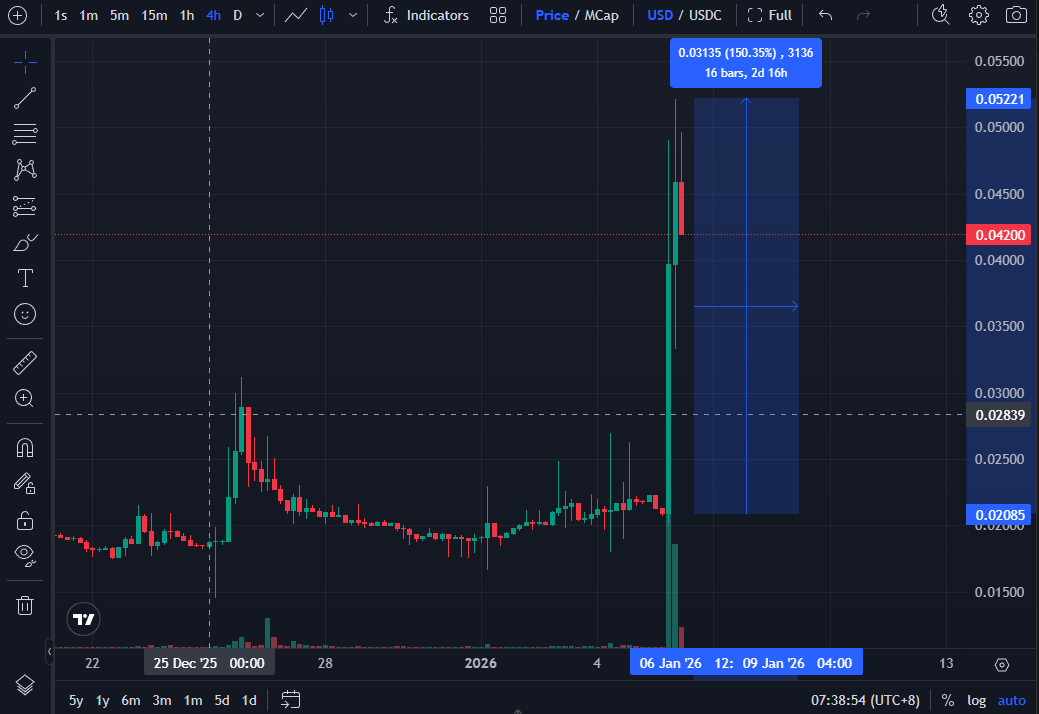
PRCL Price Chart

Operational Details of Polymarket's Real Estate Prediction Market Section

Collaboration Details:

  • Parcl provides a daily housing price index as an independent, transparent reference data for market settlement;
  • Polymarket is responsible for listing and operating the markets, where users can trade using USDC on the Polygon chain;
  • Market settlements are based on Parcl's publicly verifiable index, avoiding the delays (typically monthly) and subjectivity of traditional real estate data.

Market Types:

  • Predicting whether housing prices will rise or fall within a month, quarter, or year;
  • Threshold markets: e.g., whether housing prices exceed a specific level;
  • Each market is linked to a dedicated settlement page on Parcl, displaying the final value, historical data, and index calculation methods.

Coverage:

  • Initially starting with high-liquidity U.S. cities, such as New York, Miami, San Francisco, Austin, etc.;
  • Additional cities and market types will be expanded based on user demand.

Example Display:

Currently, this section has 7 monthly real estate prediction events listed, with relatively low liquidity. The event with the highest trading volume, "U.S. Los Angeles Housing Agent Price on February 1st," has only $3,700 in volume.
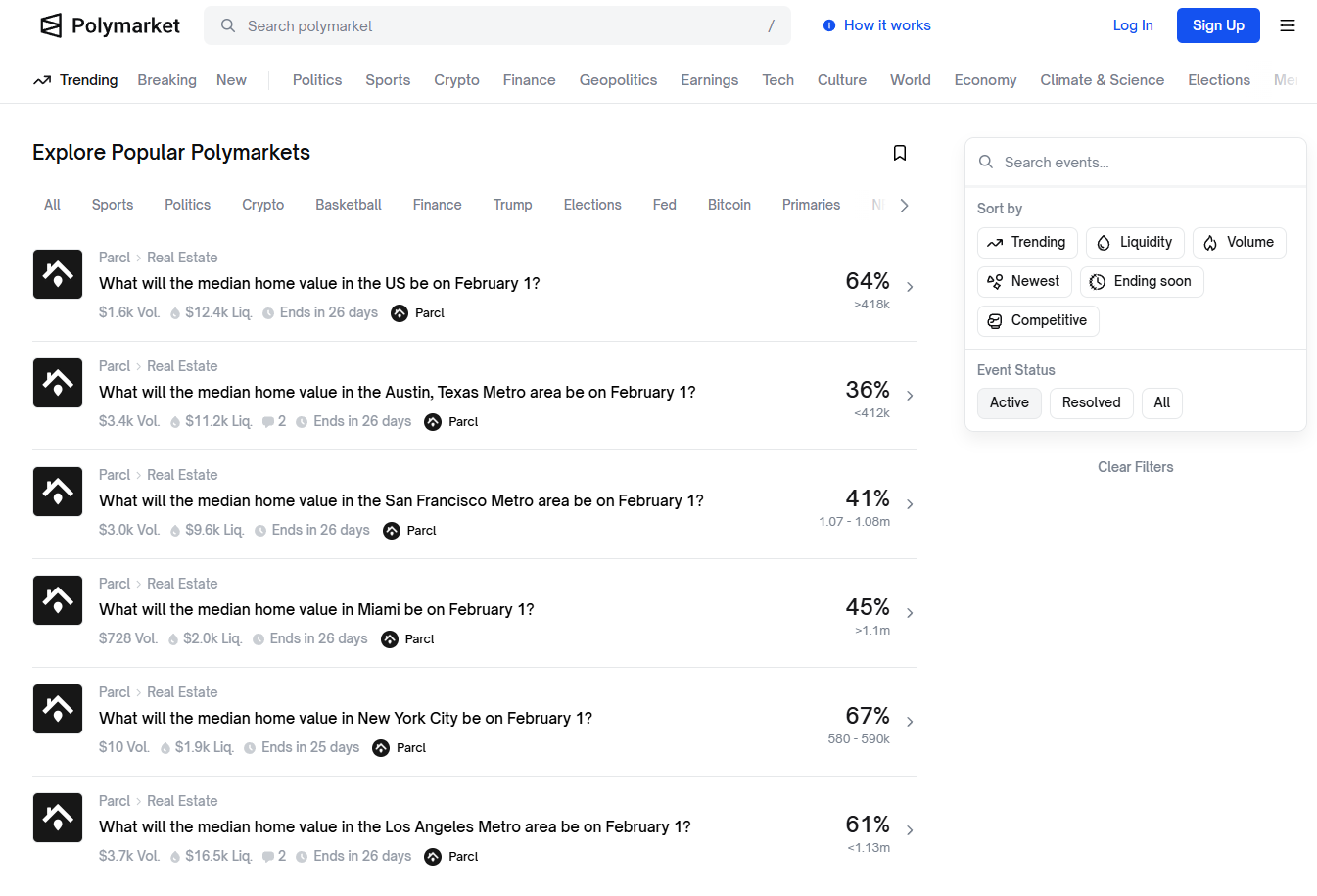
Polymarket's New Real Estate Prediction Market Section

In traditional real estate markets, whether bullish or bearish, such expectations are difficult to express directly, let alone form continuous market signals. Polymarket's introduction essentially separates "judgments on housing prices" from asset transactions. As long as there is a clear settlement standard, expectations themselves can be priced independently.

The Real Estate Market Finally Has a "Shorting Tool"

An easily overlooked fact is that the potential demand for real estate-related markets does not solely originate from native speculators.

In the traditional financial system, "falling housing prices" are almost a risk that cannot be directly hedged. Whether holding property or having asset structures and income sources highly dependent on a particular city's real estate cycle, the practical response is often to continue holding or directly sell physical assets—both of which involve high transaction costs, long cycles, and lack flexible intermediate options. As KOL 0xMarioNawfal (@RoundtableSpace) stated: "This is far more than just betting; it's about bringing liquidity to one of the world's most illiquid markets. Imagine housing prices are at historic highs, and you expect a crash but can't sell your house—now you can hedge and short the market."

The introduction of prediction markets abstracts the decline in housing prices into a tradable risk judgment. When housing prices are high and market expectations begin to weaken, the trend of real estate prices itself can be priced separately without having to dispose of underlying assets for risk management.

Through Polymarket, the downside risk of real estate prices is abstracted into a tradable judgment rather than requiring the disposal of physical assets. From this perspective, Polymarket's real estate prediction market is closer to a simplified macro hedging mechanism than a mere speculative game around price movements. It does not change the liquidity structure of real estate assets themselves but provides a trading layer that can reflect expectations in real time for a traditionally low-liquidity market.

Polymarket CMO Matthew Modabber stated: "Prediction markets are best suited for events with clear, verifiable data. Parcl's daily housing price index provides us with a transparent, consistent settlement foundation. Real estate should become a first-class category in prediction markets."

The collaboration between Polymarket and Parcl also introduces traditional real estate price signals into the crypto system: Originally low-frequency, closed, and high-barrier assets are broken down into index results that are settleable, verifiable, and tradable, resembling stock indices or crypto derivatives. This may represent a more practical and demand-aligned implementation path within the RWA narrative.


Related Questions

QWhat is the significance of the partnership between Parcl and Polymarket in the real estate market?

AThe partnership introduces Parcl's daily housing price indices into Polymarket's prediction markets, enabling users to trade on real estate price movements using USDC on Polygon. This provides a transparent, verifiable, and low-cost way to speculate on or hedge against real estate price changes, effectively creating a 'shorting tool' for the traditionally illiquid real estate market.

QHow does the real estate prediction market on Polymarket work?

AUsers can trade on predictions about whether real estate prices in specific U.S. cities (e.g., New York, Miami) will rise or fall over monthly, quarterly, or annual periods. Markets are settled based on Parcl's publicly verifiable daily price indices, avoiding the delays and subjectivity of traditional real estate data.

QWhat problem does this new prediction market solve for traditional real estate investors?

AIt allows investors to hedge against or speculate on real estate price declines without needing to sell physical assets, which is typically costly and time-consuming. This provides a flexible, intermediate option for managing risk in a historically illiquid market.

QWhich cities are initially covered by Polymarket's real estate prediction markets?

AThe initial coverage includes high-liquidity U.S. cities such as New York, Miami, San Francisco, and Austin, with plans to expand to more cities based on user demand.

QWhat impact did the announcement have on Parcl's native token PRCL?

AFollowing the announcement, Parcl's token PRCL surged by over 150% in the short term, reaching a price of $0.042 and a market capitalization of $19 million, though it later experienced some pullback.

Related Reads

AI Agents Also Need 'Credit Checks': ERC-8126 is Filling the Gap in On-chain Trust

The article discusses ERC-8126, a proposed standard designed to address the lack of trust and verification for AI Agents operating on-chain. While ERC-8004 provides AI Agents with a basic on-chain identity (answering "Who are you?"), it does not guarantee trustworthiness. ERC-8126 aims to fill this gap by establishing a verification layer (answering "Are you reliable?"). It standardizes how independent verification providers can assess an agent's associated risks across five key areas: Token/Contract Verification (ETV), Media Content Verification (MCV), Solidity Code Verification (SCV), Web Application Verification (WAV), and Wallet Verification (WV). These providers generate a standardized risk score (0-100) and proofs based on their checks, without acting as a single authoritative certifier. This allows wallets, marketplaces, dApps, and other agents to consume these risk signals—for example, to display warnings, filter listings, or make interaction decisions. The standard also incorporates concepts like Private Data Verification (PDV) and Zero-Knowledge Proofs (ZKP) to allow verification without exposing sensitive underlying data. Positioned alongside ERC-8004 (Identity) and ERC-8183 (Commerce for agents), ERC-8126 represents a step toward building a verifiable and accountable infrastructure for the emerging on-chain AI Agent economy, shifting trust assessment from purely user-based judgment to standardized, consumable signals.

marsbit14m ago

AI Agents Also Need 'Credit Checks': ERC-8126 is Filling the Gap in On-chain Trust

marsbit14m ago

Rented Conviction: How Much Real Money Is Behind the Bitcoin ETF Flows

Borrowed Belief: How much of Bitcoin ETF flows are real money? Weekly Bitcoin ETF flows, often interpreted as a measure of institutional conviction, are heavily influenced by a hidden arbitrage trade rather than genuine directional buying. A cash-and-carry arbitrage, where traders buy the ETF while simultaneously shorting Bitcoin futures on the CME to lock in a basis spread (the price difference between futures and spot), drives roughly half of the week-to-week flow volatility. This delta-neutral activity appears as ETF inflows but is unrelated to price views. Data shows a strong correlation (0.70) between weekly ETF inflows and increases in hedge fund short positions on CME futures, while Bitcoin’s weekly price returns have almost no explanatory power. However, this arbitrage activity dominates short-term *fluctuations*, not the cumulative *stock* of investments. Of the total ~$55 billion in net ETF inflows since launch, only about $1 billion currently represents net arbitrage exposure. The vast majority consists of steady, directional buying averaging around $400 million per week. The arbitrage trade has been unwinding for two years, with hedge fund short positions peaking near $14 billion in late 2024 and declining to ~$4.5 billion. Recent ETF outflows partly reflect this ongoing unwind as the basis compresses, not a loss of faith in Bitcoin. Thus, ETF flows overstate the *volatility* of belief, not its *level*. The headline number is more a gauge of arbitrage desk activity than conviction. For accurate interpretation, monitor the CME basis relative to Treasury yields and hedge fund net shorts—these reveal how much of the reported “demand” is truly directional.

marsbit16m ago

Rented Conviction: How Much Real Money Is Behind the Bitcoin ETF Flows

marsbit16m ago

Borrowed Faith: How Much of the Bitcoin ETF Flows Are Real Money

"Rented Faith: How Much of Bitcoin ETF Flows Are Real Money?" Bitcoin ETF inflows are often seen as a barometer of institutional conviction. However, week-to-week analysis reveals they are primarily driven by a hidden arbitrage trade rather than directional bullishness. This is the cash-and-carry trade: buying the ETF while simultaneously shorting Bitcoin futures on the CME to lock in the price difference (basis). This delta-neutral activity registers as ETF inflows but reflects a rate-seeking, not price-betting, strategy. Data shows weekly ETF flow volatility is closely tied to hedge fund ("leveraged funds") short positions on CME futures, with a correlation of 0.70. About half of weekly flow variation can be explained by this single factor. In contrast, Bitcoin's weekly price changes have no statistically significant power to predict flows. Crucially, while this arbitrage trade dominates weekly *fluctuations*, it is not the main component of the cumulative *stock*. Of the ~$55 billion total net inflow, the estimated net arbitrage position is only about $1 billion. The vast majority is steady, directional buying averaging ~$400 million per week. Thus, ETF flows overstate the *volatility* of belief, not its *level*. The "rented" arbitrage capital churns, while "owned" directional capital forms the bedrock. This arbitrage trade has been unwinding for two years, with hedge fund shorts peaking at ~$14 billion in late 2024 and falling to ~$4.5 billion. Recent outflows align with basis compression, signaling the trade's exit, not a loss of faith. For Ethereum ETFs, the same dynamic is weaker due to negative carry from forgone staking yield. The key takeaway: To interpret ETF flows, watch the basis vs. Treasury yields and CME hedge fund net shorts. They reveal how much of the weekly "demand" headline is driven by rented, rate-seeking capital versus real conviction.

链捕手30m ago

Borrowed Faith: How Much of the Bitcoin ETF Flows Are Real Money

链捕手30m ago

Trading

Spot
Futures
活动图片