Hormuz Strait Reopening: Will the Fed Turn "Dovish" and the Market Reprice "Rate Cuts"?

marsbitPublished on 2026-06-16Last updated on 2026-06-16

Abstract

The article outlines two key factors that may lead the U.S. Federal Reserve, under Chair Wash, to adopt a more dovish stance at the upcoming FOMC meeting. First, the anticipated reopening of the Strait of Hormuz is expected to ease oil and energy prices, thereby reducing upward inflationary pressures. This shift could lead the Fed to view energy prices as a neutral or even deflationary factor. Second, recent core CPI data showed significant cooling, with a monthly increase of only 0.21%, contrasting with the still-strong core PCE. This divergence supports a dovish interpretation. Market implications are significant. While the FOMC is expected to remove "easing bias" language and project unchanged rates for the year—moves already priced in—Chair Wash's potential for more dovish commentary presents an upside risk. Consequently, there is room for the market to further price out remaining hike expectations and increase expectations for rate cuts. The report notes that the 2-year Treasury yield, though down recently, remains well above February levels, indicating further potential downside as inflation risks fade.

Written by: Zhao Ying

Source: Wall Street News

Two major catalysts for disinflation are simultaneously unfolding, providing ample justification for Fed Chair Wash to adopt a more dovish stance at this week's Federal Open Market Committee (FOMC) meeting.

According to a report from Citi Research released on June 15th via Wind Trading Desk, the planned reopening of the Strait of Hormuz is expected to push oil prices lower, eliminating the upside risk to inflation from energy prices. Meanwhile, last week's core CPI data came in surprisingly cool, with a month-on-month increase of only 0.21%.

The combination of these two developments further weakens the rationale for the Fed to maintain a hawkish stance, bringing the path to eventual rate cuts back onto the table.

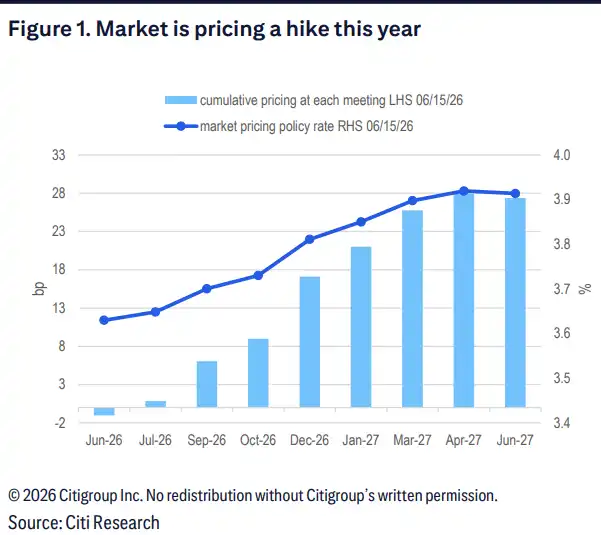
For the markets, this assessment has direct pricing implications. The two-year Treasury yield has fallen by about 13 basis points compared to a week ago, but remains more than 60 basis points higher than its February level. There is still room for market pricing of rate hikes to be compressed, and for pricing of rate cuts to be further increased.
Energy Price Pressures Ease, Upside Inflation Risks Blunt

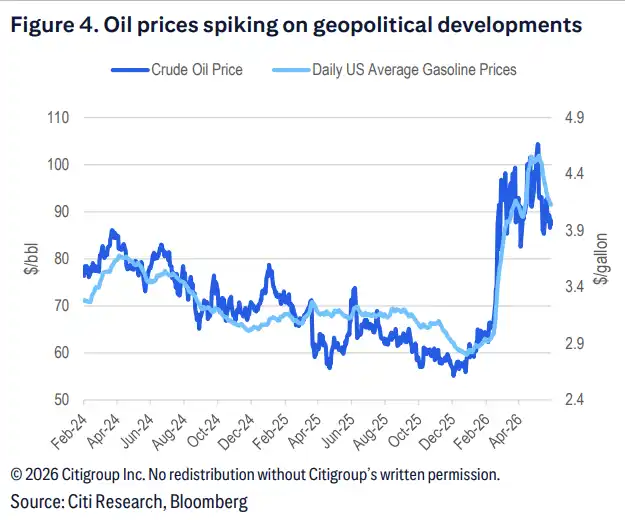
Expectations for the reopening of the Strait of Hormuz are a core driver of the current dovish narrative. Once the strait resumes passage, increased crude oil supply will lead to lower oil and other energy prices.

Gasoline prices have been declining for a full month, with the national average dropping from around $4.50 per gallon to $4.00. Citi expects further declines following other energy commodities. This trend is likely to produce at least several months of negative overall inflation readings in the coming months, prompting Fed officials to shift their characterization of energy prices from an "inflation risk" to a "neutral or even disinflationary factor."
Core CPI Cools, Divergence Among Inflation Metrics Intensifies

On the core inflation front, although May's core PCE is still expected to remain strong, core CPI has shown clear signs of cooling, with a month-on-month increase of only 0.21%.

Core PCE is increasingly becoming an "outlier" among current inflation metrics—both trimmed-mean PCE and core CPI are closer to target levels and show a clearer downward trend. This divergence is being increasingly recognized by both markets and Fed officials, also providing data support for a dovish stance.

FOMC Hawkish Adjustments Fully Priced In, Dovish Signals Have Upside Potential

The report expects this week's FOMC statement to remove the "easing bias" wording, and the median dot in the interest rate projections (dot plot) will indicate rates held steady this year. However, these hawkish adjustments are already fully anticipated by the market and do not constitute new information.

The real variable lies in Chair Wash's wording. Considering the latest developments regarding the Strait of Hormuz reopening and the cooling trend in core inflation, the risk of Wash delivering more dovish signals at this meeting is tilting to the upside. If his wording proves more accommodative than expected, the market's repricing of the rate cut path could accelerate.

Room for Treasury Yields to Fall Further, Market Pricing Has Adjustment Room

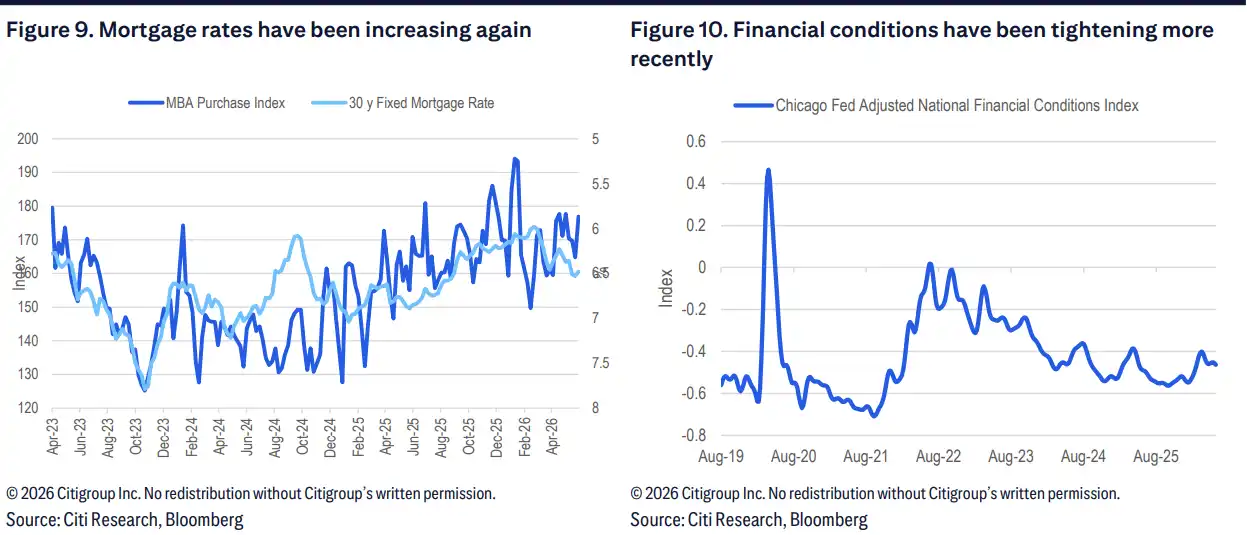
From a market pricing perspective, the report believes implied probabilities of rate hikes in interest rate futures remain elevated. Although the two-year Treasury yield has fallen about 13 basis points from a week ago, it is still over 60 basis points higher than its February level, indicating the market has not fully priced in the impact of receding inflation risks.

As the previously supporting upside inflation risks to the hawkish outlook gradually dissipate, the market is expected to further compress pricing for rate hikes while simultaneously increasing pricing for rate cuts, leaving further room for Treasury yields to decline.
Related Questions

QAccording to the article, what are the two catalysts for inflation decline that could push the Fed towards a dovish turn?

AThe two catalysts are: 1) The planned reopening of the Strait of Hormuz, which is expected to push down oil prices and reduce energy price pressure on inflation. 2) The cooler-than-expected core CPI data for the previous week, which showed a monthly increase of only 0.21%.

QHow does the article describe the trend of gasoline prices and its expected impact?

AGasoline prices have been falling for a month, with the national average dropping from about $4.50 per gallon to $4.00. Citi expects them to fall further in line with other energy prices. This trend is projected to deliver several months of negative overall inflation readings and lead the Fed to view energy prices as a neutral or even deflationary factor rather than an inflation risk.

QWhat divergence in inflation indicators does the article highlight, and why is it significant?

AThe article highlights a divergence between core PCE and other inflation metrics like core CPI and trimmed-mean PCE. While core PCE remains strong, core CPI and trimmed-mean PCE are closer to the Fed's target and show a clearer disinflationary trend. This growing recognition of the divergence provides data support for a more dovish Fed stance.

QWhat is the market's current pricing for interest rates according to the report, and what potential adjustment does it see?

AThe market has already priced in expected hawkish adjustments from the FOMC, such as removing "accommodative bias" language. However, the report states that interest rate futures still imply an overly high probability of rate hikes. There is room for the market to further price out hikes and increase pricing for rate cuts, suggesting Treasury yields have more room to fall.

QWhat is the key variable for the market at the upcoming FOMC meeting, according to the article's analysis?

AThe key variable is the tone and wording of Fed Chair Wash's statements. Given the latest developments (Strait of Hormuz reopening, cooling core inflation), the risk is tilted towards Wash delivering a more dovish message than expected. If his wording is more temperate, the market's repricing of the rate cut path could accelerate.

Related Reads

Can Japan Buy Growth with AI? Will the Bond Market Believe It?

Japan's cabinet has introduced the 2026 Basic Policy on Economic and Fiscal Management and Reform, shifting its primary fiscal target. The new framework moves away from the traditional annual primary balance goal and instead prioritizes a stable reduction of the debt-to-GDP ratio. This change is tied to a strategy of increased "responsible proactive fiscal" spending, aiming to boost long-term growth through investments in strategic sectors like AI, semiconductors, energy, and robotics. The government estimates total public and private investment in 62 key technologies could exceed 370 trillion yen by 2040. The market reaction has been mixed and cautious. While equity markets may respond to policy signals, bond markets are focused on fiscal credibility. Concerns center on whether the weakening of the clear primary balance anchor could lead to looser fiscal discipline. If investors doubt that these strategic investments will generate sufficient productivity gains, tax revenue, and nominal growth to outpace rising interest costs, they may demand higher yields on Japanese Government Bonds (JGBs). Recent volatility in the yen and JGB yields, with the 10-year yield briefly reaching 2.9%, reflects this skepticism. The success of this new framework hinges on two factors: whether Japan can achieve a nominal growth rate consistently higher than its long-term interest rates, and whether future budgets demonstrate disciplined control over bond issuance. The government's narrative is that strategic investment is essential to break Japan's cycle of low growth, aging, and labor shortages. However, the bond market will continuously assess the credibility of this plan, pricing the risk that it may represent fiscal expansion rather than a viable growth strategy.

marsbit21m ago

Can Japan Buy Growth with AI? Will the Bond Market Believe It?

marsbit21m ago

Misjudged A-Shares: Resilience, Expectations, and Confidence

China's A-share market recently faced selling pressure, especially in tech sectors, initially triggered by a global tech sell-off that began in South Korea. However, the article argues this is a case of "mistaken injury" and highlights the market's underlying resilience. This resilience stems from three main pillars: **1) Tech Sector Fundamentals:** Unlike Korea's market dominated by a few memory chip stocks, China's tech sector is diversified across computing, communications, electronics, and semiconductors, supported by dual narratives of global AI supply chains and domestic substitution. Core areas like optical modules and fiber optics continue to show strong earnings growth. **2) "National Team" Support:** State-backed institutions and large corporations have made significant market purchases and announced buybacks, providing liquidity and signaling confidence. This is seen as a stabilizing policy signal, often associated with market bottoms. **3) Broader Market Pillars:** Other major sectors are showing endogenous recovery momentum. Consumer stocks benefit from stabilizing CPI and signs of sector recovery (e.g., liquor price hikes). Cyclical sectors like aluminum have high earnings, potential price increases due to tight supply, and low valuations. The financial sector offers stable dividends and low valuations. The conclusion is that the sell-off was driven by external contagion, not a collapse in fundamentals. With strong policy support and recovering momentum across key sectors, the A-share market possesses the toughness to regain stability.

marsbit52m ago

Misjudged A-Shares: Resilience, Expectations, and Confidence

marsbit52m ago

Trading

Spot
活动图片





