Hiring Plummets by 80%, Is the Crypto Talent Market Saturated?

比推Published on 2026-01-19Last updated on 2026-01-19

Abstract

The cryptocurrency job market in early 2026 has seen a significant slowdown, with an 80% year-on-year decline in new job postings during the first two weeks of January compared to the same period in 2025. Only 85–90 new roles were detected across major crypto-focused job platforms, excluding direct corporate pages. Despite this sharp drop, the market isn't entirely saturated. Most openings (60%) are technical or engineering roles, with a strong preference for experienced professionals—65% of positions target mid-to-senior level candidates, often requiring 5+ years of experience (7+ for management roles). Key hiring is concentrated in infrastructure, stablecoins, and fintech/payment startups, with growth-stage companies (Series A and beyond) leading recruitment efforts. A notable shift is the rising competition for talent between ecosystems, particularly Solana’s growing challenge to Ethereum’s long-standing dominance. In 2024, Solana attracted a larger share of new developers (22%) than Ethereum (16%) for the first time since 2016, fueled by increased funding and ecosystem growth. The author suggests that 2026 will favor projects with strong fundamentals, real users, and sustainable revenue models, as the industry moves away from speculative token launches and focuses on tangible value creation.

Written by: willthetrill

Compiled by: Chopper, Foresight News


Is the hiring market in the cryptocurrency industry saturated now? Both yes and no. Although there were layoffs sporadically in December, overall, hiring momentum remained strong in the fourth quarter.

To uncover the truth, I specifically extracted data from major vertical recruitment websites in the crypto industry for the first two weeks of January 2026 (this data does not include official company recruitment pages). The results showed that only 85-90 new unique positions were added during this period.

This year's start has been quite quiet. In contrast, the data for January 2025 was quite impressive, with a total of 1,192 positions posted in that single month, making it the highest month for recruitment in all of 2025.
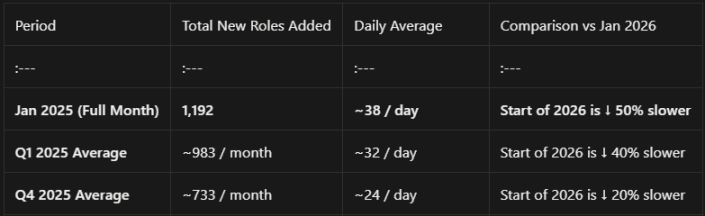
Data as of January 12, 2026

In the first two weeks of January 2025, the average number of daily job postings was about 38; in the same period of 2026, the average number of daily job postings was only about 6.5.

Recruitment activity in early January decreased by approximately 80% compared to the same period last year. This data confirms the widespread speculation: the industry's start this year is far less heated than last year.

Analyzing the details of the above job data, the main characteristics of the current recruitment market are as follows:

  • Job Type Distribution: Technical / Engineering positions account for 60%, Non-Technical / Business Development positions account for 40%.

  • Job Grade Distribution: Specialist / Senior Specialist / Manager / Department Head and other mid-to-senior level positions account for about 65%. This signal indicates that companies are prioritizing the recruitment of experienced talent to lead key projects related to core product development and business growth.

  • Experience Requirements: Most positions require candidates to have more than 5 years of relevant experience; management positions require more than 7 years of experience.

When conducting screening interviews with candidates, I often ask them: What currently attracts you to the crypto industry? The answers are invariably two: prediction markets and stablecoins. Therefore, it's not surprising that the data shows about 60% of recruitment demand is concentrated in infrastructure teams, stablecoin projects, and payment / fintech infrastructure startups. Furthermore, the talent war between the Kalshi and Polymarket platforms continues, and this competition is expected to persist.

Currently, the most aggressive recruiters are those growth-stage companies (i.e., companies that have completed Series A funding or later rounds). A quick glance at the recruitment pages of several companies and information on the Ashby platform also confirms this conclusion.

  • Series A Companies: Lifi Protocol has 13 open positions, Privy IO (acquired) has 10 open positions, Crossmint has 10 open positions, Coinflow Labs has 14 open positions;

  • Series B Companies: TurnkeyHQ has 12 open positions;

  • Series C Companies: Raincards has 49 open positions;

  • Series D Companies: Anchorage has 66 open positions.

However, perhaps more interesting is the change in talent flow.

Having worked full-time in crypto recruitment for 5 years, I can't help but recall: "Has there ever been a public chain ecosystem, like Solana, that challenged Ethereum's dominance in the recruitment and developer growth arena?" The answer is: No, at least never on this scale.

Looking back, other public chains like Polkadot and Cosmos have all experienced phases of rapid developer growth, but they never managed to pose a challenge to Ethereum of the same magnitude in terms of market share and sustained recruitment scale.

Solana is the first ecosystem with the real strength to compete with Ethereum. In 2024, it set a historic record, achieving, for the first time since 2016, a higher percentage of new contributing developers than Ethereum. Solana attracted over 22% of the crypto industry's new developers, while Ethereum's share was about 16%. This phenomenon is quite rare, considering that in the past, Ethereum almost monopolized the vast majority of new talent.
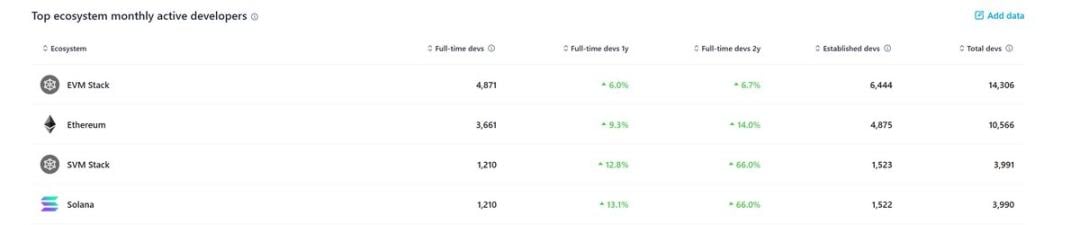
Data source: Electric Capital "Developer Report", as of January 14, 2026

In the third quarter of 2025 alone, 23 Solana ecosystem projects completed financing, raising $211 million, a 70% year-on-year increase in ecosystem financing scale.

For example: When a project completes a $13.5 million financing round (like Raikucom did in Q3 2025), its first priority is to recruit 5-10 senior engineers to build the core engineering team and business development team. These types of positions often do not appear on public recruitment websites but are filled through investor / angel investor networks, hackathon events, and targeted headhunting.

The crypto industry is constantly evolving, and the landscape of the recruitment market will change accordingly. Through token issuance, crypto technology can push internet capital markets to maximize development, but the reality is that the vast majority of tokens issued in the past two years have seen their prices fall.

I believe that in 2026, the ripple effects of this phenomenon will gradually become apparent, affecting how companies raise risk capital, their market expansion strategies, and, of course, their talent recruitment strategies.

The projects that will stand out this year will undoubtedly be those with solid business fundamentals, a real user base, solving actual needs, and most importantly, generating revenue.


Twitter:https://twitter.com/BitpushNewsCN

Bitpush TG Discussion Group:https://t.me/BitPushCommunity

Bitpush TG Subscription: https://t.me/bitpush

Original link:https://www.bitpush.news/articles/7604019

Related Questions

QAccording to the data, by what percentage did the daily job posting rate in the crypto industry drop in the first two weeks of January 2026 compared to the same period in 2025?

AThe daily job posting rate dropped by approximately 80% in the first two weeks of January 2026 compared to the same period in 2025.

QWhat are the two main areas that candidates cite as their reason for joining the crypto industry, which also account for 60% of the hiring demand?

AThe two main areas are prediction markets and stablecoins.

QWhich blockchain ecosystem is highlighted as the first to seriously challenge Ethereum's dominance in developer recruitment and growth?

AThe Solana ecosystem is highlighted as the first to seriously challenge Ethereum's dominance.

QWhat type of companies are currently the most aggressive in their hiring, according to the article?

AGrowth-stage companies (those that have completed Series A funding or later) are currently the most aggressive in their hiring.

QWhat key characteristic is mentioned for projects that are predicted to stand out in 2026?

AProjects that are predicted to stand out in 2026 are those with solid business fundamentals, a real user base, that solve actual needs, and, most importantly, are able to generate revenue.

Related Reads

From Survival to Accelerated Growth: The Journey of Zcash's Three-Year Rise as Told by the Founder of ZODL

**From Survival to Accelerated Growth: Zcash Founder Details the 3-Year Rise** Three years ago, Zcash (ZEC) was a struggling pioneer in privacy technology, with a price near $30, low shielded supply (11%), and a community mired in governance disputes. Today, ZEC trades around $600, with over 31% of its supply (~$3B) in user-controlled shielded pools. This transformation resulted from breaking key constraints. First, **governance shackles were removed**. The old model guaranteed funding to two entities (ECC and ZF) regardless of performance, creating a monopoly. In 2024, ECC rejected further direct funding, forcing a change. The NU6 upgrade ended direct funding, allocating 8% to community grants and 12% to a protocol-controlled treasury for retroactive rewards, expiring in 2028 unless renewed by overwhelming consensus. The entities also relinquished their trademark-based veto power, freeing community governance. Second, the **product focus shifted** from pure cryptography to user growth. Previously, engineering excelled at privacy tech but failed to attract users. In early 2024, the team (later ZODL) pivoted to building products users wanted, like the Zodl wallet (default privacy, hardware support, cross-asset swaps). This drove shielded supply to grow over 400% in ZEC terms, with 86.5% of recent transactions being shielded, representing real user adoption. Third, the **narrative evolved** from the limiting "privacy coin" label to "unstoppable private money." This clarified Zcash's value proposition: a Bitcoin-like monetary policy with verifiable private payments via advanced cryptography. This structural narrative—protocol (Zcash), asset (ZEC), gateway (Zodl)—enabled broader exchange listings, institutional interest, and ETF filings. Finally, **organizational constraints were broken**. In early 2026, the ECC team left its non-profit structure after disputes over control, forming Zcash Open Development Lab (ZODL). ZODL raised $25M from top VCs (Paradigm, a16z, etc.), gaining the capital and agility of a startup to scale consumer products. Current metrics show strong momentum: social discussion volume for ZEC surged 15,245% in a year, with 81% positive sentiment. The focus is now on enhancing user experience (Zodl wallet), scalability (Tachyon project targeting Visa-level throughput with 25-second blocks), and post-quantum security (quantum-recoverable wallets coming soon). Zcash is positioned to become faster, more usable, scalable, and quantum-resistant.

marsbit12m ago

From Survival to Accelerated Growth: The Journey of Zcash's Three-Year Rise as Told by the Founder of ZODL

marsbit12m ago

Five Counterparty Risk Architectures: A Settlement-Layer Methodology for Classifying TradFi Models in Crypto Exchanges

**Summary:** This companion piece reframes the five TradFi-on-crypto exchange architectures, previously classified by "architectural fingerprint," through the lens of counterparty risk. The core question is: whose balance sheet bears the loss first in a stress scenario, and has it historically done so? Each of the five models corresponds to a distinct risk holder with its own documented failure modes. * **Model 1 (Stablecoin-Settled CEX Perpetuals):** Risk is held by the stablecoin issuer (e.g., reserve composition, bank connectivity) and the CEX's own book. History includes Tether's banking disconnections (2017) and reserve misrepresentations (CFTC 2021 Order). * **Model 2 (CFD Brokers):** Risk resides on the broker's balance sheet (B-book model). Regulatory differences (e.g., ESMA's mandatory negative balance protection vs. Mauritius FSC's lack thereof) define loss allocation rules, as seen in the 2015 SNB event (Alpari UK insolvency). * **Model 3 (Off-Chain Custody & Transfer Agent Chain):** Risk lies with the off-chain custodian/platform. User asset recovery depends on Terms of Use and corporate structure, exemplified by the Celsius bankruptcy ruling (2023) where Earn Account assets were deemed property of the estate. * **Model 4 (DEX Perpetual Protocols):** No single balance sheet bears risk. Loss absorption relies on a protocol's insurance fund and Auto-Deleveraging (ADL) mechanism, as demonstrated in the GMX V1 (2022) and dYdX v3 YFI (2023) incidents. * **Model 5 (Regulated CCP - DCM-DCO-FCM):** The most institutionalized model concentrates risk in the Central Counterparty (CCP). However, history shows CCPs can employ non-standard tools under extreme stress, such as mass trade cancellation (LME Nickel, 2022) or enabling negative price settlements (CME WTI, 2020). The report argues that regulatory choices and counterparty risk structures are co-extensive, not in an upstream-downstream relationship. It concludes with five separate observation checklists (not predictions) for monitoring the structural vulnerabilities of each risk model.

marsbit29m ago

Five Counterparty Risk Architectures: A Settlement-Layer Methodology for Classifying TradFi Models in Crypto Exchanges

marsbit29m ago

Trading

Spot
Futures
活动图片