Hawkish Rate Cut Triggers Rally Then Plunge: The Truth Behind Bitcoin's 'Painting the Door' Pattern

marsbitPublished on 2025-12-11Last updated on 2025-12-11

Abstract

The Federal Reserve cut interest rates by 25 basis points on December 11, 2025, triggering a brief Bitcoin surge to $94,476, followed by a sharp reversal to $91,384. The initial rally was driven by algorithmic misinterpretation of a headline announcing the Fed’s $40 billion monthly Treasury purchases, mistakenly seen as quantitative easing (QE). In reality, these were short-term Reserve Management Purchases (RMP) aimed at maintaining banking system liquidity, not stimulating risk assets. The market downturn accelerated as traders digested the Fed’s hawkish undertones: upward revisions to 2026 GDP growth (from 1.8% to 2.3%) and lower unemployment projections signaled economic strength, reducing the urgency for further rate cuts. This "no-landing" scenario weakened Bitcoin’s appeal as an inflation hedge or safe-haven asset. Additionally, the Fed’s internal division—with three dissenting votes reflecting stark policy disagreements—highlighted unprecedented uncertainty about future monetary policy. Despite the rate cut, real interest rates remained restrictive due to persistent inflation. The episode underscored that Bitcoin can no longer rely solely on Fed-driven liquidity narratives and may face continued pressure as markets repricing risk amid economic resilience and policy ambiguity.

At 3:00 AM Beijing time on December 11, 2025, Federal Reserve Chair Jerome Powell finally pressed the button that had long been priced in by the market: a 25 basis point interest rate cut.

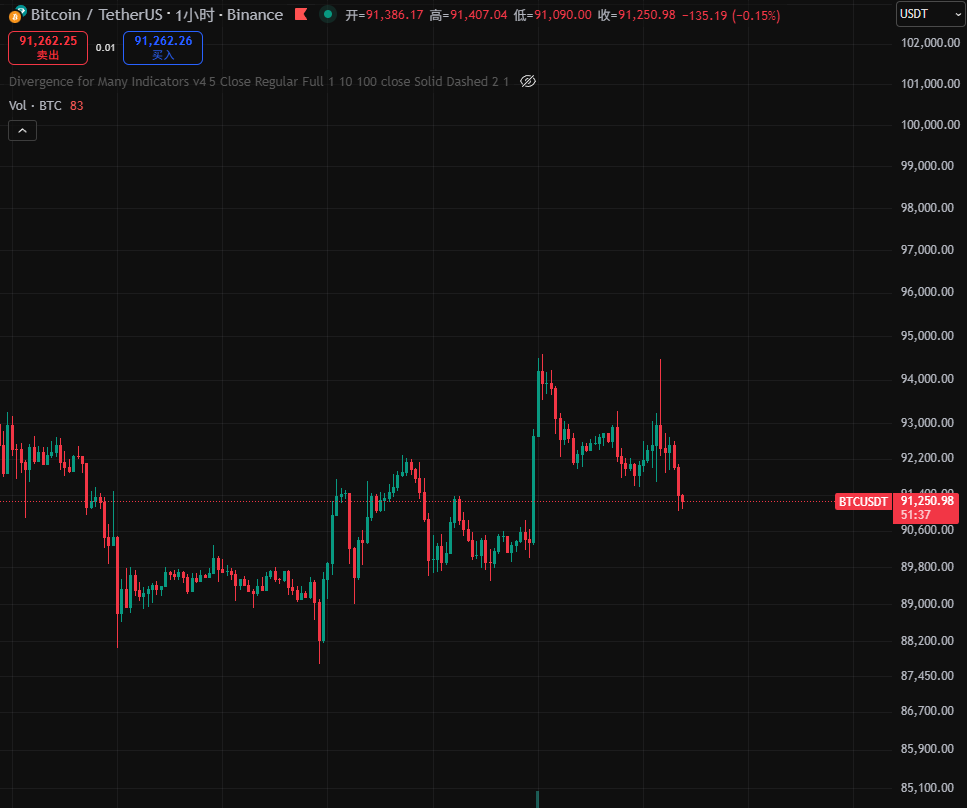
The subsequent script was supposed to follow the crypto market's playbook: the liquidity floodgates open, the US Dollar Index plunges, and Bitcoin charges towards the $100,000 mark. Indeed, for the first 15 minutes, that's exactly how it played out—Bitcoin instantly surged violently to $94,476, with the sound of alerts for liquidated short positions ringing out across exchanges.

However, the狂欢 (celebration) lasted less than an hour. As Wall Street traders finished parsing the Federal Open Market Committee (FOMC) statement and the Summary of Economic Projections (SEP) line by line, market sentiment underwent a cliff-like reversal. Bitcoin not only gave back all its gains but also bled steadily over the next few hours to $91,384, tracing out a classic inverted-V 'liquidation' pattern.
Why, under the seemingly dual tailwinds of a "rate cut + bond buying," did major capital choose to decisively flee?

This wasn't a simple case of "buy the rumor, sell the news"; it was a time-arbitrage game caused by algorithms misreading headlines and humans correcting the logic. When you dissect the three core details of this FOMC meeting—the upward revision of GDP expectations, the fake QE, and the unprecedented internal rift—you'll find that $94,000 was not the starting point for a bull market, but a trap set by macro fundamentals for the bulls.


The Algorithm's Illusion: The $40 Billion "Fake QE"

Revisiting the sharp rally at 3:00 AM, its core driver wasn't the rate cut itself (after all, the CME FedWatch Tool had already priced in an 88% probability), but a highly misleading breaking news headline: The Federal Reserve announced it would purchase $40 billion in short-term Treasury securities per month.

For high-frequency trading algorithms and headline-scanning media, the keyword scraping logic was非常简单 (very simple): "Fed" + "Buying Bonds" = "QE" = "Liquidity Injection".

Instantly, machines filled buy orders. The market mistakenly believed the Fed had launched quantitative easing alongside the rate cut—a double happiness.

But the devil was in the details of the operational guidelines subsequently released by the New York Fed. This was not QE (Quantitative Easing) aimed at suppressing long-term rates and stimulating the economy, but RMP (Reserve Management Purchases) targeting only short-term Treasuries.

The details showed that the Fed was buying bonds because reserve balances in the banking system had fallen to the edge of "ample levels," and to address potential liquidity drainage from the upcoming April tax season. In other words, this $40 billion is merely a patch to fix the "plumbing" of the interbank market, aimed at preventing repo rate spikes from causing financial system gridlock, not injecting water into the risk asset pool.

When human traders realized this capital would be locked in bank reserve accounts and wouldn't spill over into Bitcoin or the Nasdaq, the first round of valuation correction began. Those funds chasing the highs above $94,000 were essentially paying for their cognitive blind spot regarding monetary policy tools.


The "Backstab" from GDP Data: Prosperity is Bitcoin's Enemy

If the "fake QE" only triggered an emotional pullback, then the revision of GDP data in the Summary of Economic Projections (SEP) fundamentally shook the logical foundation of Bitcoin's "rate cut bull" thesis.

In the updated projections, the Fed significantly raised its 2026 US GDP growth forecast from 1.8% in September to 2.3%. Simultaneously, the 2027 unemployment rate expectation was lowered from 4.3% to 4.2%.

This data sent an extremely hawkish signal to the market: the US economy is not only not in recession but is demonstrating surprising resilience at this level of interest rates. This isn't the Fed's imagination; it's a lagging confirmation of real data.

If we look at real-time data, the situation is even "hotter."
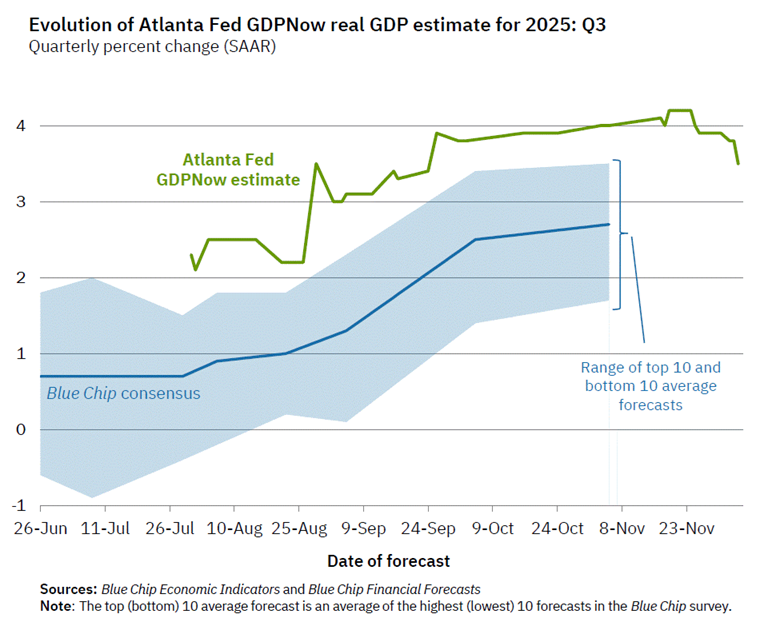
Atlanta Fed GDPNow

The model shows the Q3 2025 real GDP growth estimate once surged near 4%, far exceeding the Blue Chip consensus expectation of 2.5%. This indicates the US economy is in a period of extremely strong expansion, not on the brink of recession.

For traditional financial markets, this is good news for a "soft landing" or even "no landing"; but for Bitcoin, this is the most awkward script.

First, strong economic growth means the Fed has no urgent need to cut rates at all. Powell emphasized during the press conference that "the economy is strong but needs rebalancing," essentially hinting that the future path of rate cuts would be longer and more diluted. The market originally expected the Fed to flood the system with liquidity because the economy couldn't hold up (recessionary cuts), but instead got cuts offered as a precautionary measure because the economy is actually too strong (preventive cuts).

Second, the upward GDP revision directly pushed up the pricing of the neutral rate (R-star). When the US economy can grow at 2.3% or higher, capital can get decent risk-free or low-risk returns by staying in dollar-denominated assets (like US stocks and bonds). This削弱 (weakens) Bitcoin's appeal as an "inflation hedge" and "recession hedge" asset.


Broken Consensus: The Largest Internal Split in 37 Years

The final blow that caused Bitcoin to continue its steady decline below the $92,000 level came from the market's deep suspicion about the Fed's control.

This vote saw the most severe dissent since 2019, and arguably in 37 years. Among the 12 voting members, a staggering 3 dissented, a rate of 25%.

Even more unsettling was the composition of the opposition, showing completely opposing policy fractures: On one side was Trump-appointed Governor Miran, who thought the cut was too small, advocating for a direct 50 basis point cut, representing the aggressive easing camp. On the other side were Kansas City Fed President Schmid and Chicago Fed President Goolsbee, who believed there should be no cut at all, advocating for holding rates steady, representing the stubborn hawkish camp.

This "internal conflict" scenario is extremely rare in Fed history. It sent a dangerous signal to the market: Powell has lost absolute control of the Committee. The Fed内部 (internally) is completely unable to reach a consensus on the two core issues: "is inflation controlled" and "is the labor market deteriorating."

The dot plot further confirmed this split. Although the median suggests one more cut next year, as many as 7 officials (including non-voters) actually opposed this cut or favor higher rates next year than expected. This means every FOMC meeting going forward will become a political博弈 (game) full of variables.

Capital doesn't most fear bad news, but uncertainty. A divided Fed means the predictability of monetary policy plummets to rock bottom. For crypto markets reliant on liquidity expectations, this is a blow to the head. Institutional capital choosing to take profits around $91,000 is precisely to avoid the risks brought by this policy chaos.


The Real Interest Rate Noose Remains Tight

Looking beyond last night's candlestick, when we examine the longer-term macro environment, we find the pressure on Bitcoin hasn't eased with the rate cut.

Although the nominal rate was cut by 25 basis points, the pace of decline in inflation data remains slow (the core PCE expectation was only slightly adjusted to 2.4%). This means the inflation-adjusted "real interest rate" remains at restrictive levels.

Powell admitted during the press conference that inflation risks remain tilted to the upside and job growth might be overestimated. But he didn't provide clear guidance for subsequent cuts, instead repeatedly emphasizing "no preset path." This ambiguous stance, combined with the $40 billion "fake QE" and strong GDP expectations, creates an extremely awkward "middle ground."

In this zone, the economy is too good to need flooding, and inflation is too high to allow flooding.


Conclusion: Awaiting a New Narrative Amid Deleveraging

This rally-then-plunge script taught all crypto investors a lesson: at this point in late 2025, the macro narrative relying solely on the single factor of "Fed rate cut" has失效 (failed). The market is shifting from "hunting for liquidity" to "repricing risk."

As the Nasdaq Index meets resistance and falls back from its historical highs, traditional financial markets have already begun trading the "hawkish cut" logic. For Bitcoin, having lost its "recession hedge" halo in the short term and failing to receive the support of "flooding liquidity," a回调 (pullback) to clean out leverage might be an unavoidable fate.

Over the next 24 hours, pay close attention to ETF flow data. If institutional capital认可 (endorses) the above correction in macro logic, then the selling pressure we saw last night might just be the beginning.


Related Questions

QWhat was the immediate market reaction to the Fed's rate cut announcement, and why did it reverse so quickly?

AThe immediate reaction was a sharp spike in Bitcoin's price to $94,476, driven by algorithmic trading misinterpreting the Fed's announcement of buying $40 billion in short-term Treasuries as a new Quantitative Easing (QE) program. The rally reversed within an hour as human traders realized the purchases were merely 'Reserve Management Purchases' (RMP) to address banking system plumbing and seasonal liquidity needs, not a stimulus injection that would benefit risk assets like Bitcoin.

QHow did the upward revision of the GDP forecast in the Summary of Economic Projections (SEP) impact the market's outlook for Bitcoin?

AThe Fed's significant upward revision of the 2026 GDP growth forecast from 1.8% to 2.3% was a hawkish signal that fundamentally undermined the 'rate cut bull' thesis for Bitcoin. It indicated the U.S. economy was resilient and growing strongly, reducing the urgency for the Fed to cut rates aggressively. This meant future rate cuts would be slower and shallower ('preventive cuts' rather than 'recession cuts'), making high-yielding dollar assets more attractive and diminishing Bitcoin's appeal as an anti-inflation or anti-recession hedge.

QWhat was unprecedented about the FOMC vote, and why did it create uncertainty for markets?

AThe vote saw the most severe internal dissent in 37 years, with 3 out of 12 voting members (25%) opposing the decision. The dissent came from both sides: one member wanted a larger 50 basis point cut (dovish), while two members wanted no cut at all (hawkish). This rare 'left-right confrontation' signaled that Chair Powell had lost absolute control of the committee, creating high policy unpredictability. Markets, especially those like crypto that rely on liquidity expectations, detest such uncertainty, leading to risk-off moves and selling.

QAccording to the article, what was the true nature of the Fed's $40 billion bond-buying operation, and how did it differ from Quantitative Easing (QE)?

AThe $40 billion monthly purchase of short-term Treasuries was not QE. It was a Reserve Management Purchase (RMP) designed to maintain 'ample' reserves in the banking system and prevent a liquidity crunch ahead of the tax season. Unlike QE, which aims to压低长期利率 and stimulate the economy by injecting liquidity into risk assets, these RMP funds are locked in bank reserve accounts to ensure financial system stability and do not flow into markets like cryptocurrencies or stocks.

QWhat is the broader macro implication of a 'hawkish cut' for Bitcoin's price action in the short term, as concluded in the article?

AThe 'hawkish cut' creates an awkward 'middle ground' where the economy is too strong to warrant massive stimulus, yet inflation remains too high to allow for easy money. This scenario invalidates the simple 'Fed rate cut' narrative for Bitcoin. The article concludes that the market is shifting from 'hunting for liquidity' to 'repricing risk,' leading to a short-term correction to deleverage. The price action suggests the sell-off pressure seen could be just the beginning, especially if institutional ETF flows confirm this macro logic.

Related Reads

Trading

Spot
Futures

Hot Articles

What is SONIC

Sonic: Pioneering the Future of Gaming in Web3 Introduction to Sonic In the ever-evolving landscape of Web3, the gaming industry stands out as one of the most dynamic and promising sectors. At the forefront of this revolution is Sonic, a project designed to amplify the gaming ecosystem on the Solana blockchain. Leveraging cutting-edge technology, Sonic aims to deliver an unparalleled gaming experience by efficiently processing millions of requests per second, ensuring that players enjoy seamless gameplay while maintaining low transaction costs. This article delves into the intricate details of Sonic, exploring its creators, funding sources, operational mechanics, and the timeline of significant events that have shaped its journey. What is Sonic? Sonic is an innovative layer-2 network that operates atop the Solana blockchain, specifically tailored to enhance the existing Solana gaming ecosystem. It accomplishes this through a customised, VM-agnostic game engine paired with a HyperGrid interpreter, facilitating sovereign game economies that roll up back to the Solana platform. The primary goals of Sonic include: Enhanced Gaming Experiences: Sonic is committed to offering lightning-fast on-chain gameplay, allowing players and developers to engage with games at previously unattainable speeds. Atomic Interoperability: This feature enables transactions to be executed within Sonic without the need to redeploy Solana programmes and accounts. This makes the process more efficient and directly benefits from Solana Layer1 services and liquidity. Seamless Deployment: Sonic allows developers to write for Ethereum Virtual Machine (EVM) based systems and execute them on Solana’s SVM infrastructure. This interoperability is crucial for attracting a broader range of dApps and decentralised applications to the platform. Support for Developers: By offering native composable gaming primitives and extensible data types - dining within the Entity-Component-System (ECS) framework - game creators can craft intricate business logic with ease. Overall, Sonic's unique approach not only caters to players but also provides an accessible and low-cost environment for developers to innovate and thrive. Creator of Sonic The information regarding the creator of Sonic is somewhat ambiguous. However, it is known that Sonic's SVM is owned by the company Mirror World. The absence of detailed information about the individuals behind Sonic reflects a common trend in several Web3 projects, where collective efforts and partnerships often overshadow individual contributions. Investors of Sonic Sonic has garnered considerable attention and support from various investors within the crypto and gaming sectors. Notably, the project raised an impressive $12 million during its Series A funding round. The round was led by BITKRAFT Ventures, with other notable investors including Galaxy, Okx Ventures, Interactive, Big Brain Holdings, and Mirana. This financial backing signifies the confidence that investment foundations have in Sonic’s potential to revolutionise the Web3 gaming landscape, further validating its innovative approaches and technologies. How Does Sonic Work? Sonic utilises the HyperGrid framework, a sophisticated parallel processing mechanism that enhances its scalability and customisability. Here are the core features that set Sonic apart: Lightning Speed at Low Costs: Sonic offers one of the fastest on-chain gaming experiences compared to other Layer-1 solutions, powered by the scalability of Solana’s virtual machine (SVM). Atomic Interoperability: Sonic enables transaction execution without redeployment of Solana programmes and accounts, effectively streamlining the interaction between users and the blockchain. EVM Compatibility: Developers can effortlessly migrate decentralised applications from EVM chains to the Solana environment using Sonic’s HyperGrid interpreter, increasing the accessibility and integration of various dApps. Ecosystem Support for Developers: By exposing native composable gaming primitives, Sonic facilitates a sandbox-like environment where developers can experiment and implement business logic, greatly enhancing the overall development experience. Monetisation Infrastructure: Sonic natively supports growth and monetisation efforts, providing frameworks for traffic generation, payments, and settlements, thereby ensuring that gaming projects are not only viable but also sustainable financially. Timeline of Sonic The evolution of Sonic has been marked by several key milestones. Below is a brief timeline highlighting critical events in the project's history: 2022: The Sonic cryptocurrency was officially launched, marking the beginning of its journey in the Web3 gaming arena. 2024: June: Sonic SVM successfully raised $12 million in a Series A funding round. This investment allowed Sonic to further develop its platform and expand its offerings. August: The launch of the Sonic Odyssey testnet provided users with the first opportunity to engage with the platform, offering interactive activities such as collecting rings—a nod to gaming nostalgia. October: SonicX, an innovative crypto game integrated with Solana, made its debut on TikTok, capturing the attention of over 120,000 users within a short span. This integration illustrated Sonic’s commitment to reaching a broader, global audience and showcased the potential of blockchain gaming. Key Points Sonic SVM is a revolutionary layer-2 network on Solana explicitly designed to enhance the GameFi landscape, demonstrating great potential for future development. HyperGrid Framework empowers Sonic by introducing horizontal scaling capabilities, ensuring that the network can handle the demands of Web3 gaming. Integration with Social Platforms: The successful launch of SonicX on TikTok displays Sonic’s strategy to leverage social media platforms to engage users, exponentially increasing the exposure and reach of its projects. Investment Confidence: The substantial funding from BITKRAFT Ventures, among others, emphasizes the robust backing Sonic has, paving the way for its ambitious future. In conclusion, Sonic encapsulates the essence of Web3 gaming innovation, striking a balance between cutting-edge technology, developer-centric tools, and community engagement. As the project continues to evolve, it is poised to redefine the gaming landscape, making it a notable entity for gamers and developers alike. As Sonic moves forward, it will undoubtedly attract greater interest and participation, solidifying its place within the broader narrative of blockchain gaming.

1.3k Total ViewsPublished 2024.04.04Updated 2024.12.03

What is SONIC

What is $S$

Understanding SPERO: A Comprehensive Overview Introduction to SPERO As the landscape of innovation continues to evolve, the emergence of web3 technologies and cryptocurrency projects plays a pivotal role in shaping the digital future. One project that has garnered attention in this dynamic field is SPERO, denoted as SPERO,$$s$. This article aims to gather and present detailed information about SPERO, to help enthusiasts and investors understand its foundations, objectives, and innovations within the web3 and crypto domains. What is SPERO,$$s$? SPERO,$$s$ is a unique project within the crypto space that seeks to leverage the principles of decentralisation and blockchain technology to create an ecosystem that promotes engagement, utility, and financial inclusion. The project is tailored to facilitate peer-to-peer interactions in new ways, providing users with innovative financial solutions and services. At its core, SPERO,$$s$ aims to empower individuals by providing tools and platforms that enhance user experience in the cryptocurrency space. This includes enabling more flexible transaction methods, fostering community-driven initiatives, and creating pathways for financial opportunities through decentralised applications (dApps). The underlying vision of SPERO,$$s$ revolves around inclusiveness, aiming to bridge gaps within traditional finance while harnessing the benefits of blockchain technology. Who is the Creator of SPERO,$$s$? The identity of the creator of SPERO,$$s$ remains somewhat obscure, as there are limited publicly available resources providing detailed background information on its founder(s). This lack of transparency can stem from the project's commitment to decentralisation—an ethos that many web3 projects share, prioritising collective contributions over individual recognition. By centring discussions around the community and its collective goals, SPERO,$$s$ embodies the essence of empowerment without singling out specific individuals. As such, understanding the ethos and mission of SPERO remains more important than identifying a singular creator. Who are the Investors of SPERO,$$s$? SPERO,$$s$ is supported by a diverse array of investors ranging from venture capitalists to angel investors dedicated to fostering innovation in the crypto sector. The focus of these investors generally aligns with SPERO's mission—prioritising projects that promise societal technological advancement, financial inclusivity, and decentralised governance. These investor foundations are typically interested in projects that not only offer innovative products but also contribute positively to the blockchain community and its ecosystems. The backing from these investors reinforces SPERO,$$s$ as a noteworthy contender in the rapidly evolving domain of crypto projects. How Does SPERO,$$s$ Work? SPERO,$$s$ employs a multi-faceted framework that distinguishes it from conventional cryptocurrency projects. Here are some of the key features that underline its uniqueness and innovation: Decentralised Governance: SPERO,$$s$ integrates decentralised governance models, empowering users to participate actively in decision-making processes regarding the project’s future. This approach fosters a sense of ownership and accountability among community members. Token Utility: SPERO,$$s$ utilises its own cryptocurrency token, designed to serve various functions within the ecosystem. These tokens enable transactions, rewards, and the facilitation of services offered on the platform, enhancing overall engagement and utility. Layered Architecture: The technical architecture of SPERO,$$s$ supports modularity and scalability, allowing for seamless integration of additional features and applications as the project evolves. This adaptability is paramount for sustaining relevance in the ever-changing crypto landscape. Community Engagement: The project emphasises community-driven initiatives, employing mechanisms that incentivise collaboration and feedback. By nurturing a strong community, SPERO,$$s$ can better address user needs and adapt to market trends. Focus on Inclusion: By offering low transaction fees and user-friendly interfaces, SPERO,$$s$ aims to attract a diverse user base, including individuals who may not previously have engaged in the crypto space. This commitment to inclusion aligns with its overarching mission of empowerment through accessibility. Timeline of SPERO,$$s$ Understanding a project's history provides crucial insights into its development trajectory and milestones. Below is a suggested timeline mapping significant events in the evolution of SPERO,$$s$: Conceptualisation and Ideation Phase: The initial ideas forming the basis of SPERO,$$s$ were conceived, aligning closely with the principles of decentralisation and community focus within the blockchain industry. Launch of Project Whitepaper: Following the conceptual phase, a comprehensive whitepaper detailing the vision, goals, and technological infrastructure of SPERO,$$s$ was released to garner community interest and feedback. Community Building and Early Engagements: Active outreach efforts were made to build a community of early adopters and potential investors, facilitating discussions around the project’s goals and garnering support. Token Generation Event: SPERO,$$s$ conducted a token generation event (TGE) to distribute its native tokens to early supporters and establish initial liquidity within the ecosystem. Launch of Initial dApp: The first decentralised application (dApp) associated with SPERO,$$s$ went live, allowing users to engage with the platform's core functionalities. Ongoing Development and Partnerships: Continuous updates and enhancements to the project's offerings, including strategic partnerships with other players in the blockchain space, have shaped SPERO,$$s$ into a competitive and evolving player in the crypto market. Conclusion SPERO,$$s$ stands as a testament to the potential of web3 and cryptocurrency to revolutionise financial systems and empower individuals. With a commitment to decentralised governance, community engagement, and innovatively designed functionalities, it paves the way toward a more inclusive financial landscape. As with any investment in the rapidly evolving crypto space, potential investors and users are encouraged to research thoroughly and engage thoughtfully with the ongoing developments within SPERO,$$s$. The project showcases the innovative spirit of the crypto industry, inviting further exploration into its myriad possibilities. While the journey of SPERO,$$s$ is still unfolding, its foundational principles may indeed influence the future of how we interact with technology, finance, and each other in interconnected digital ecosystems.

54 Total ViewsPublished 2024.12.17Updated 2024.12.17

What is $S$

What is AGENT S

Agent S: The Future of Autonomous Interaction in Web3 Introduction In the ever-evolving landscape of Web3 and cryptocurrency, innovations are constantly redefining how individuals interact with digital platforms. One such pioneering project, Agent S, promises to revolutionise human-computer interaction through its open agentic framework. By paving the way for autonomous interactions, Agent S aims to simplify complex tasks, offering transformative applications in artificial intelligence (AI). This detailed exploration will delve into the project's intricacies, its unique features, and the implications for the cryptocurrency domain. What is Agent S? Agent S stands as a groundbreaking open agentic framework, specifically designed to tackle three fundamental challenges in the automation of computer tasks: Acquiring Domain-Specific Knowledge: The framework intelligently learns from various external knowledge sources and internal experiences. This dual approach empowers it to build a rich repository of domain-specific knowledge, enhancing its performance in task execution. Planning Over Long Task Horizons: Agent S employs experience-augmented hierarchical planning, a strategic approach that facilitates efficient breakdown and execution of intricate tasks. This feature significantly enhances its ability to manage multiple subtasks efficiently and effectively. Handling Dynamic, Non-Uniform Interfaces: The project introduces the Agent-Computer Interface (ACI), an innovative solution that enhances the interaction between agents and users. Utilizing Multimodal Large Language Models (MLLMs), Agent S can navigate and manipulate diverse graphical user interfaces seamlessly. Through these pioneering features, Agent S provides a robust framework that addresses the complexities involved in automating human interaction with machines, setting the stage for myriad applications in AI and beyond. Who is the Creator of Agent S? While the concept of Agent S is fundamentally innovative, specific information about its creator remains elusive. The creator is currently unknown, which highlights either the nascent stage of the project or the strategic choice to keep founding members under wraps. Regardless of anonymity, the focus remains on the framework's capabilities and potential. Who are the Investors of Agent S? As Agent S is relatively new in the cryptographic ecosystem, detailed information regarding its investors and financial backers is not explicitly documented. The lack of publicly available insights into the investment foundations or organisations supporting the project raises questions about its funding structure and development roadmap. Understanding the backing is crucial for gauging the project's sustainability and potential market impact. How Does Agent S Work? At the core of Agent S lies cutting-edge technology that enables it to function effectively in diverse settings. Its operational model is built around several key features: Human-like Computer Interaction: The framework offers advanced AI planning, striving to make interactions with computers more intuitive. By mimicking human behaviour in tasks execution, it promises to elevate user experiences. Narrative Memory: Employed to leverage high-level experiences, Agent S utilises narrative memory to keep track of task histories, thereby enhancing its decision-making processes. Episodic Memory: This feature provides users with step-by-step guidance, allowing the framework to offer contextual support as tasks unfold. Support for OpenACI: With the ability to run locally, Agent S allows users to maintain control over their interactions and workflows, aligning with the decentralised ethos of Web3. Easy Integration with External APIs: Its versatility and compatibility with various AI platforms ensure that Agent S can fit seamlessly into existing technological ecosystems, making it an appealing choice for developers and organisations. These functionalities collectively contribute to Agent S's unique position within the crypto space, as it automates complex, multi-step tasks with minimal human intervention. As the project evolves, its potential applications in Web3 could redefine how digital interactions unfold. Timeline of Agent S The development and milestones of Agent S can be encapsulated in a timeline that highlights its significant events: September 27, 2024: The concept of Agent S was launched in a comprehensive research paper titled “An Open Agentic Framework that Uses Computers Like a Human,” showcasing the groundwork for the project. October 10, 2024: The research paper was made publicly available on arXiv, offering an in-depth exploration of the framework and its performance evaluation based on the OSWorld benchmark. October 12, 2024: A video presentation was released, providing a visual insight into the capabilities and features of Agent S, further engaging potential users and investors. These markers in the timeline not only illustrate the progress of Agent S but also indicate its commitment to transparency and community engagement. Key Points About Agent S As the Agent S framework continues to evolve, several key attributes stand out, underscoring its innovative nature and potential: Innovative Framework: Designed to provide an intuitive use of computers akin to human interaction, Agent S brings a novel approach to task automation. Autonomous Interaction: The ability to interact autonomously with computers through GUI signifies a leap towards more intelligent and efficient computing solutions. Complex Task Automation: With its robust methodology, it can automate complex, multi-step tasks, making processes faster and less error-prone. Continuous Improvement: The learning mechanisms enable Agent S to improve from past experiences, continually enhancing its performance and efficacy. Versatility: Its adaptability across different operating environments like OSWorld and WindowsAgentArena ensures that it can serve a broad range of applications. As Agent S positions itself in the Web3 and crypto landscape, its potential to enhance interaction capabilities and automate processes signifies a significant advancement in AI technologies. Through its innovative framework, Agent S exemplifies the future of digital interactions, promising a more seamless and efficient experience for users across various industries. Conclusion Agent S represents a bold leap forward in the marriage of AI and Web3, with the capacity to redefine how we interact with technology. While still in its early stages, the possibilities for its application are vast and compelling. Through its comprehensive framework addressing critical challenges, Agent S aims to bring autonomous interactions to the forefront of the digital experience. As we move deeper into the realms of cryptocurrency and decentralisation, projects like Agent S will undoubtedly play a crucial role in shaping the future of technology and human-computer collaboration.

566 Total ViewsPublished 2025.01.14Updated 2025.01.14

What is AGENT S

Discussions

Welcome to the HTX Community. Here, you can stay informed about the latest platform developments and gain access to professional market insights. Users' opinions on the price of S (S) are presented below.

活动图片