HashKey Falls Below IPO Price on First Day of Trading, 'The Eastern Coinbase' Not Yet Established

Odaily星球日报Published on 2025-12-17Last updated on 2025-12-17

Abstract

HashKey Holdings (stock code: 03887.HK), known as the first Hong Kong-listed cryptocurrency exchange, debuted on the Hong Kong Stock Exchange on December 17. Despite strong pre-IPO interest—with its public offering oversubscribed by nearly 394 times—the stock price fell below its initial offering price of HK$6.68 within the first hour of trading. It closed the day at HK$6.67 after hitting a low of HK$6.12. The market response contrasts sharply with earlier optimism from crypto industry participants, who had hailed HashKey as a milestone for Hong Kong’s Web3 sector and even dubbed it the "Eastern Coinbase." However, the article points out significant gaps between HashKey and Coinbase in terms of scale: HashKey has only 138,000 registered users and average daily trading volumes in the millions of dollars, far below Coinbase’s pre-IPO user base of 56 million and billions in daily trades. HashKey has reported four consecutive years of losses, which the company attributes to high investment in technology and compliance during its early development phase. The IPO raised approximately HK$1.67 billion, with 40% earmarked for technology upgrades and another 40% for market expansion. The listing is seen by some as a symbolic step toward broader acceptance of crypto in traditional finance, yet the author suggests HashKey’s successful listing may remain an isolated case in Hong Kong. This is largely due to the influential backing of its major shareholder, Lu Weiding—chairman of Wanxia...

Original | Odaily Planet Daily (@OdailyChina)

Author | Golem (@web3_golem)
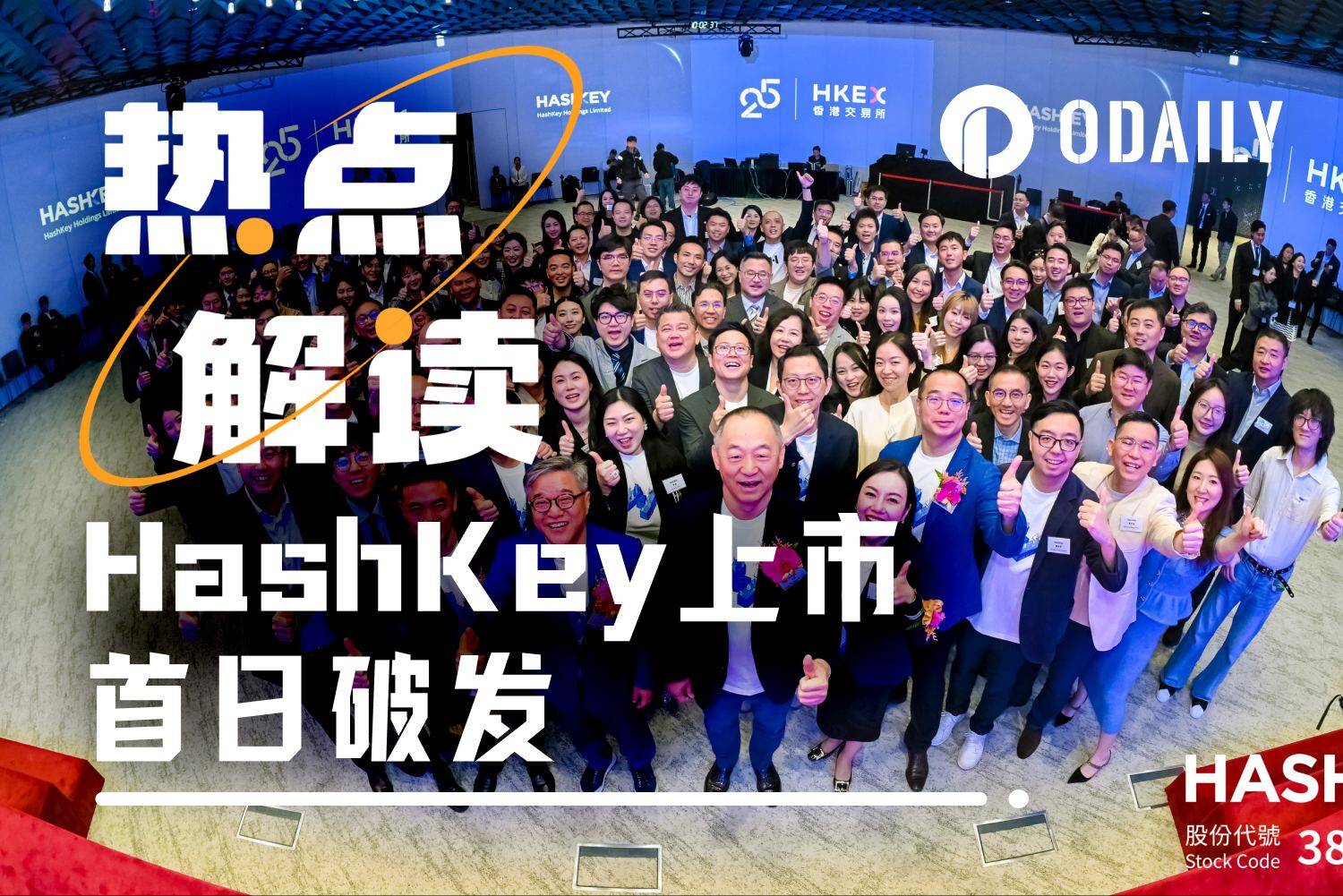
On December 17th, HashKey Holdings (03887.HK) officially listed on the stock exchange. Regrettably, the "first Hong Kong stock of a crypto exchange" fell below its IPO price of HK$6.68 within the first hour of trading.

According to Hong Kong stock market data, HASHKEY HLDGS saw its share price rise to a high of HK$7.12 during the session before declining steadily to a low of HK$6.12. It closed at HK$6.67 on its first day, close to the issue price.

This stock performance starkly contrasts with the high investor enthusiasm shown during HashKey Holdings' offering period. On December 12th, HashKey Holdings concluded its offering, selling 240.6 million shares at HK$6.68 per share, raising HK$1.67 billion (approximately US$206 million) from this Hong Kong IPO. The Hong Kong public offering portion was oversubscribed by 393.71 times, and the international placement portion was also oversubscribed.

Public opinion has become divided. On one hand, some crypto practitioners praise HashKey for pushing the crypto industry into the mainstream, calling it a significant milestone for Hong Kong's Web3 development. On the other hand, Hong Kong stock investors who scrambled to subscribe to the new shares were met with an immediate setback.

Statistics show the break-even rate for Hong Kong stocks in 2025 is between 24% and 30%; the first crypto stock hasn't escaped this range.

"The Eastern Coinbase": Wishful Thinking by Crypto Enthusiasts?

In early December, when HashKey Holdings completed its listing hearing and published its prospectus, Odaily provided an in-depth analysis of the numerous challenges facing HashKey Holdings' businesses, such as four consecutive years of financial losses, underperforming exchange operations, lack of competitiveness in its on-chain ecosystem, excessive R&D and compliance expenditures, and the decreasing scarcity of compliance licenses. We explicitly advised investors to consider the investment cautiously. (Related reading: Four consecutive years of losses, sluggish HSK, HashKey IPOs against the trend, will the capital market buy it?)

However, judging by the subsequent fervor in the HashKey IPO subscription market, expectations for the "first Hong Kong crypto stock" remained high, with the market seemingly less concerned about HashKey's loss-making status (the prospectus stated that losses were due to the trading platform still being in an early development stage and a period of high investment).

It is important to note that HashKey still allocated 40% of the funds from this offering for technology and infrastructure iteration, another 40% for market expansion and ecosystem partnerships, and the remaining 20% for operations and risk management, working capital, and general corporate purposes, respectively.

This clearly states, "I'm not profitable now, but I have growth potential. Place your bets, let's gamble on the future together."

The stock market, while valuing financial statements and corporate cash flow, has many well-known companies that are not profitable but possess high growth potential, and investors are willing to invest—for example, Amazon was unprofitable for 3 years before its IPO, but that didn't prevent it from growing into an e-commerce giant later. A more relevant example is Coinbase, which, like HashKey, took the compliance route and was also unprofitable before its IPO, yet that didn't stop it from being pursued by capital after listing.

But those comparing HashKey to the Eastern Coinbase often avoid the crucial points, emphasizing regional compliance as the commonality between HashKey and Coinbase, and highlighting HashKey's compliance premium and high growth potential.

In my view, the biggest gap between HashKey and Coinbase lies in the fact that Coinbase's massive compliance expenditures brought substantial returns to its actual business, whereas HashKey, despite obtaining a Hong Kong compliance license, shows little improvement in its business data.

Before its IPO in 2021, Coinbase's self-reported disclosures showed 56 million registered users, while HashKey Exchange currently has only 138,000 registered users; before its IPO, Coinbase's average daily trading volume had reached the billion-dollar level, while HashKey Exchange's average daily trading volume remains at the million-dollar level. As for HashKey's on-chain services and asset management business, they are even less comparable, and these two business segments contribute very limitedly to HashKey's revenue.

There were already signs that secondary market investors weren't buying the "analogy to Coinbase." In yesterday's dark pool trading on Futu, HashKey Holdings' stock price had already fallen below the issue price.

However, in this lackluster macro environment, discussing the significance of HashKey's listing抛开 its stock performance恰好 hit the collective sweet spot for the crypto industry's desire to break into the mainstream.

Exception? Or the First Case?

Judging everything based on one day's performance is indeed short-sighted. Let's take a longer view. For the Chinese crypto community, another significant meaning of HashKey's listing in Hong Kong is that it symbolizes a further "loosening" and acceptance of the crypto industry by the Hong Kong capital market. HashKey's listing fired the first shot; perhaps more high-quality crypto projects will take root and sprout in Hong Kong in the future, even triggering a bull run. The strategic significance represented by HashKey for crypto far exceeds its own value.

From this perspective, who has the chance to be the next runner?

My judgment is that HashKey's listing might be an isolated case for crypto companies in Hong Kong, and this is due to one key figure.

Xiao Feng, this often publicly visible crypto celebrity is not the largest shareholder of HashKey. The real controller of HashKey is Lu Weiding, the chairman of Wanxiang Group, who stood beside him ringing the bell this morning.

Lu Weiding (third from left) and Xiao Feng (third from right)

Lu Weiding is the major controlling shareholder of HashKey, holding 43.2% of the shares and able to exercise voting rights for 22.9% held by an employee share platform, while Xiao Feng, as the founder of Hashkey, holds 16.3%; other investors collectively hold 17.6%. The shareholding structure shows Lu Weiding's absolute authority in HashKey.

Lu Weiding took over as chairman of Wanxiang Group after his father, Lu Guanqiu, passed away. Wanxiang Group was originally a large domestic实体 enterprise, starting from automotive parts manufacturing and later engaging in real estate, tourism, agricultural products, finance, energy, metal resources, and other industries.

After taking over as chairman, Lu Weiding vigorously developed Wanxiang Group's financial industry. The group owns numerous financial enterprises including Minsheng Life Insurance, Allinpay, Zhejiang Fund, Puxing Jueneng, Wanxiang Trust, Wanxiang Leasing, Tonghui Futures, etc., building a Wanxiang financial control empire.

Why is Lu Weiding crucial to HashKey's ability to list?

Because besides being the chairman of Wanxiang Group and the major controlling shareholder of HashKey, Lu Weiding's roles also include being a deputy to the 14th National People's Congress, vice chairman of the All-China Federation of Industry and Commerce, member of the Zhejiang Provincial Committee of the Chinese People's Political Consultative Conference, and meritorious entrepreneur of Zhejiang Province. These identities and the resources they represent provide HashKey with stronger support.

One must ask, under the current regulatory environment, how can other followers replicate this advantage? Will their path to listing be as smooth? Therefore, labeling HashKey as the "model for Hong Kong crypto" would create misjudgments for entrepreneurs and investors.

For a long time to come, HashKey will not only be the "first Hong Kong crypto stock" but more likely a lone runner who squeezed onto the track at a fleeting moment of right timing, geographical convenience, and human harmony.


Related Questions

QWhat was the performance of HashKey Holdings' stock on its first day of trading on the Hong Kong Stock Exchange?

AHashKey Holdings' stock price fell below its IPO price of HK$6.68 within the first hour of trading. It reached a high of HK$7.12 and a low of HK$6.12 before closing near the issue price at HK$6.67.

QHow does the market's pre-IPO enthusiasm for HashKey contrast with its first-day trading performance?

AThere was extremely high pre-IPO enthusiasm, with the Hong Kong public offering portion receiving 393.71 times oversubscription and the international placement also being oversubscribed. This high demand sharply contrasts with the stock's first-day price drop below the offering price.

QWhat are the key reasons the article suggests that comparing HashKey to an 'Eastern Coinbase' is not accurate?

AThe comparison is inaccurate due to a significant gap in user base and trading volume. Before its IPO, Coinbase had 56 million registered users and daily trading volumes in the billions of dollars, while HashKey has only 138,000 registered users and daily volumes in the millions of dollars.

QWho is the major controlling shareholder of HashKey Holdings, and why is this significant for its ability to list?

AThe major controlling shareholder is Lu Weiding, Chairman of Wanxiang Group, who holds 43.2% of the shares and controls 22.9% of the votes through an employee持股 platform. His status as a National People's Congress representative and his extensive political and business connections provided crucial support for HashKey's successful listing.

QAccording to the article, why might HashKey's listing be an isolated case rather than a precedent for other crypto firms in Hong Kong?

AHashKey's listing may be an isolated case because its success was heavily dependent on the unique political and business resources of its major shareholder, Lu Weiding. Other crypto firms are unlikely to be able to replicate this specific advantage, making it difficult for them to achieve a similar listing.

Related Reads

The AI Investment Landscape Is Being Reshaped: Beyond the 'Magnificent Seven', What Opportunities Lie in the Semiconductor Supply Chain?

AI Investment Map is Reshaping: Opportunities Beyond the 'Magnificent Seven' Since ChatGPT ignited the AI wave, investment initially focused on the "Magnificent Seven" tech giants dominating cloud infrastructure. However, the rise of DeepSeek and debates on AI capital expenditure effectiveness are shifting this dynamic. Investors now recognize opportunities deeper in the supply chain—the companies providing the essential "picks and shovels." Early concerns about an AI investment "arms race" and potential low returns were partly alleviated by strong Q1 earnings from cloud providers, validating robust compute demand. This has highlighted a more certain investment thesis: regardless of which AI applications ultimately win, massive capital expenditure will first fuel demand for semiconductors and related components. This "pick-and-shovel" logic has driven semiconductor ETFs to record highs. Key beneficiaries include: * **Memory Chipmakers (e.g., SK Hynix, Samsung, Micron)**: High Bandwidth Memory (HBM) is a critical bottleneck for AI training. * **Photonics Companies**: Crucial for high-speed data transfer within AI data centers. * **The Broader "AI-11" Semiconductor Ecosystem**: This encompasses foundries & lithography (TSMC, ASML), logic & custom chips (AMD, Broadcom, Intel, Marvell), and enterprise storage (SanDisk, Western Digital). Every dollar of AI infrastructure spending flows through this chain. While the "Magnificent Seven" remain dominant in market size, their earnings growth premium over the rest of the S&P 500 ("S&P 493") is narrowing. Market attention and marginal investment are shifting towards the expanding semiconductor supply chain. The investment narrative is evolving from "betting on the ultimate AI winner" to "investing in the certainty of the infrastructure build-out." Understanding this shift from the demand side to the supply side is key to identifying future AI investment opportunities.

marsbit3m ago

The AI Investment Landscape Is Being Reshaped: Beyond the 'Magnificent Seven', What Opportunities Lie in the Semiconductor Supply Chain?

marsbit3m ago

600 People, $66 Billion: The First Major Cash-Out in the Era of Large Models

The first systematic "big cash-out" of the AI era occurred in October 2025, when over 600 current and former OpenAI employees sold a total of $6.6 billion in shares via a secondary market. Approximately 75 individuals maxed out a $30 million per-person sale limit, while around 525 others cashed out an average of $8.3 million each. This event, exceeding the scale of any 2024 US IPO, functioned as a "shadow IPO." It marked a radical departure from the traditional Silicon Valley path of waiting for a public listing, instead allowing employees to convert equity to cash after just two years of tenure—a direct retention tool in a fiercely competitive talent market where rivals like Meta have offered packages worth hundreds of millions. This massive liquidity event presents a dual-edged sword for OpenAI. While it helps retain talent, it also risks triggering a brain drain as newly wealthy employees may depart. Furthermore, it creates a dilemma for those who sold: they forfeited potential future gains as the company's valuation soared from $400 billion to $852 billion within months. In stark contrast, employees at rival Anthropic demonstrated greater reluctance to sell during their own secondary offering. The financial narratives of the two labs also diverge sharply. OpenAI, while achieving over $20 billion in annualized revenue by 2025, faces massive projected losses (up to $14 billion in 2026), a long path to cash flow positivity, and significant revenue-sharing payments to Microsoft. Anthropic reports rapid revenue growth, improving gross margins, and a faster path to profitability. OpenAI's trajectory is thus balanced precariously between skyrocketing valuation based on funding narratives and the pressures of sustained financial losses post-cash-out. The event underscores that the AI race has evolved into a capital and human experiment, where immense wealth crystallizes the complex calculations of greed, fear, and ambition within the industry.

marsbit22m ago

600 People, $66 Billion: The First Major Cash-Out in the Era of Large Models

marsbit22m ago

NVIDIA Begins Adding Soap to the Bubble

NVIDIA is taking on a dual role: not just as a leading chip supplier, but as a massive capital allocator across the entire AI supply chain. In 2026, the company has committed over $40 billion in investments within five months, targeting everything from optical fiber manufacturing and data center operations to foundational AI model development. This investment spree, described as a systematic "sprinkler" approach, primarily funds companies that are major buyers of NVIDIA's own GPUs. Critics, including analysts from Goldman Sachs, label this a "circular revenue" loop—comparable to a supplier financing a customer to buy more of its products. A prominent example is NVIDIA's investment in OpenAI, which is expected to generate around $13 billion in revenue for NVIDIA, much of which may be reinvested back into OpenAI. While CEO Jensen Huang dismisses the "circular financing" critique as "absurd," arguing the investments are confidence votes in long-term generational shifts, some analysts express discomfort. They note that while investments in critical supply chain components like optics are strategically sound, funding new cloud providers like CoreWeave feels like "pre-paying for your own GPUs." The strategy carries significant risks. If the AI investment cycle turns, the market may question how much demand is genuine versus artificially sustained by NVIDIA's own balance sheet. Despite posting record-breaking earnings—$215.9 billion in annual revenue and $120 billion in net profit for FY2026—NVIDIA's stock fell after its report, signaling that "beating expectations" may no longer be enough to assure investors about the duration of the AI spending boom. The article concludes that while a bubble isn't necessarily a fraud, NVIDIA's actions resemble adding soap to a bubble—making it appear more robust and durable. This creates a complex scenario requiring extreme冷静 from investors to distinguish between real structural growth and financial engineering.

marsbit39m ago

NVIDIA Begins Adding Soap to the Bubble

marsbit39m ago

Short Positions Have Been Squeezed Out: Will the Next Leg of the U.S. Stock AI Rally Continue in Seoul?

"Short Squeeze Exhausted: Will the Next Leg of the AI Rally Continue in Seoul?" A Nomura report suggests the US AI stock rally, which saw the S&P 500 rise ~16.6% in 28 days largely driven by 10 key stocks, may be pausing. The fuel from short covering, CTA fund positioning, and volatility-control strategies is nearing its limit. For the rally to continue, new momentum from retail and sentiment-driven FOMO (Fear Of Missing Out) is needed. South Korea's market provided a potential answer on the very day the report was published. The KOSPI index surged 4.32%, triggering a buy-side circuit breaker, led by massive gains in chip giants SK Hynix (+11.98%) and Samsung. This surge is characterized by retail "hynix FOMO" and overseas funds precisely buying into AI themes via chip-focused ETFs, shifting from broad Korean market ETFs. The Korean rally is a high-beta extension of the US AI capital expenditure story, as major cloud providers plan massive infrastructure spending, directly benefiting memory chip leaders. However, this linkage also implies vulnerability. The sustainability of this next leg depends on whether US tech stocks correct, the trajectory of US inflation (with upcoming CPI data key), and geopolitical tensions around the Strait of Hormuz. Seoul has emerged as the new epicenter of the AI trade, but its fate remains tied to these broader macro and market dynamics.

marsbit44m ago

Short Positions Have Been Squeezed Out: Will the Next Leg of the U.S. Stock AI Rally Continue in Seoul?

marsbit44m ago

Trading

Spot
Futures
活动图片




