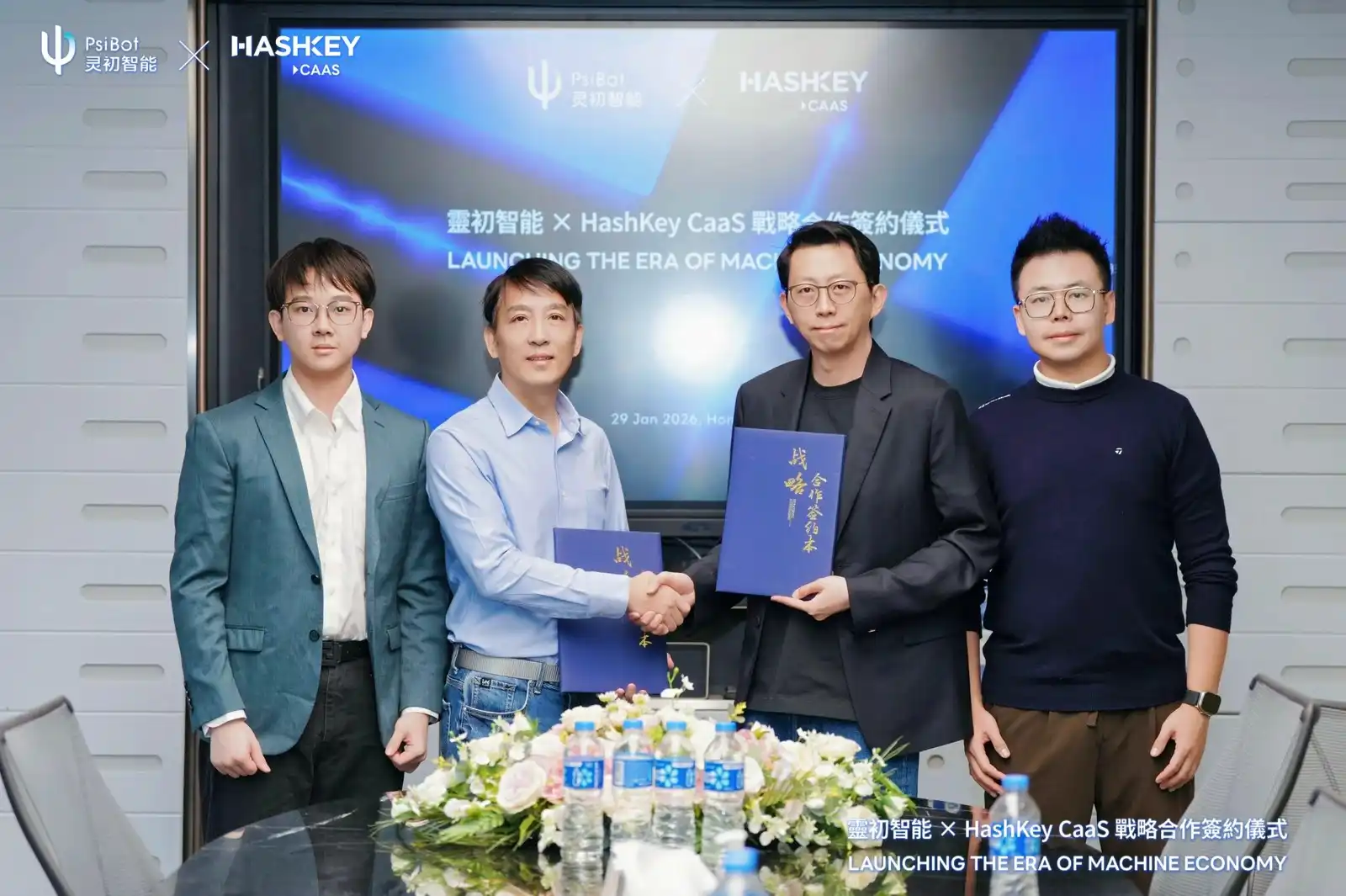
HashKey CaaS and Lingchu Intelligence Form Strategic Partnership to Jointly Build AI Autonomous Payment Infrastructure

marsbitPublished on 2026-01-29Last updated on 2026-01-29

Abstract

HashKey CaaS and Lingchu Intelligence have entered into a strategic partnership to jointly develop AI autonomous payment infrastructure. The collaboration will focus on data tokenization for robots and the implementation of the HP2 (HashKey Payment Protocol) autonomous payment network, aiming to integrate AI with the digital financial system and build key infrastructure for the embodied intelligence economy. As part of the agreement, Lingchu will deploy 10 dual-arm robots integrated with HashKey CaaS’s HP2 payment protocol, designed for Web3 and AI agents. These robots will gain controlled payment permissions, enabling them to act as autonomous agents to conduct on-chain transactions—such as purchasing services, accessing data interfaces, and earning on-chain income through task execution. Each autonomous transaction will be recorded as an auditable on-chain financial record, transforming the robots from mere smart devices into independent participants in the digital economy. Additionally, HashKey CaaS will tokenize the operational data generated by Lingchu’s robots, turning them into tradable digital assets with monetary value. HashKey’s CEO of On-Chain Business Group, Li Chen, stated that this partnership marks the first application of the HP2 protocol in embodied AI, supporting the integration of robots into the digital financial ecosystem. Wang Qibin, CEO of Lingchu Intelligence, emphasized that the collaboration will help accelerate the transition from R&D to an ecosy...

HashKey CaaS has announced a strategic partnership with Lingchu Intelligence, a robotics company focused on the field of embodied AI. The two parties will engage in in-depth collaboration around robot data tokenization and the HP2 (HashKey Payment Protocol) autonomous payment network, promoting the integration of AI and the digital financial system, and jointly building the key infrastructure for the embodied intelligent economy.

As part of this collaboration, Lingchu Intelligence will deploy 10 dual-arm robots and integrate them with HashKey CaaS's HP2 payment protocol, which is specifically designed for Web3 and AI Agents. Through HP2, the robots will gain controlled payment permissions, enabling them to perform on-chain interactions as "autonomous agents," including autonomously purchasing services, calling data interfaces, and earning on-chain revenue by executing tasks. Throughout this process, every autonomous transaction generated by the robots will be fully recorded as auditable on-chain financial credentials, transforming the robots from traditional "intelligent devices" into genuine "digital economic entities" capable of independently participating in economic activities.

Simultaneously, HashKey CaaS will convert the operational data generated by Lingchu Intelligence's robots during actual operation into tradable tokenized digital assets, endowing "robot data" with asset attributes and transactional value.

Li Chen, CEO of HashKey On-Chain Business Group, stated: "This collaboration marks the first application of the HP2 protocol in the field of embodied AI. HashKey CaaS's on-chain new financial infrastructure will support robots and AI in truly integrating into the digital financial system, achieving autonomous on-chain data transactions and value circulation, and laying the foundation for embodied intelligence to participate in the real economy."

Wang Qibin, CEO of Lingchu Intelligence, stated: "The widespread application of embodied intelligence relies on the confirmation of data value and an automated value exchange system. Through the partnership with HashKey, Lingchu Intelligence will accelerate its transition from technological research and development to ecosystem development oriented towards the machine economy."

In the future, the two parties will continue to explore more applications of embodied intelligence in scenarios such as payment and autonomous services, accelerate the implementation of related technologies and models, and promote the shift of the AI economy from conceptual validation to large-scale practice.


Related Questions

QWhat is the strategic partnership between HashKey CaaS and Lingchu AI about?

AThe strategic partnership between HashKey CaaS and Lingchu AI focuses on robot data tokenization and the HP2 (HashKey Payment Protocol) autonomous payment network. They aim to integrate AI with the digital financial system and build key infrastructure for the embodied intelligent economy.

QHow many robots will Lingchu AI deploy as part of this collaboration?

ALingchu AI will deploy 10 dual-arm robots as part of this collaboration.

QWhat is the HP2 payment protocol designed for?

AThe HP2 payment protocol is designed for Web3 and AI Agents, enabling robots to have controlled payment permissions, act as autonomous agents for on-chain interactions, purchase services, call data interfaces, and earn on-chain income through task execution.

QHow will HashKey CaaS utilize the operational data from Lingchu AI's robots?

AHashKey CaaS will convert the operational data generated by Lingchu AI's robots into tokenized digital assets, giving the data asset attributes and transactional value.

QWhat did HashKey's On-Chain Business Group CEO, Li Chen, say about this partnership?

ALi Chen stated that this partnership is the first application of the HP2 protocol in the embodied intelligence field. HashKey CaaS's on-chain financial infrastructure will support robots and AI in integrating into the digital financial system, enabling autonomous on-chain data settlement and value transfer, laying the foundation for embodied intelligence to participate in the real economy.

Related Reads

You Bet on the News, the Pros Read the Rules: The True Cognitive Gap in Losing Money on Polymarket

The article explains that the key to profiting on Polymarket, a prediction market platform, lies not just predicting real-world events correctly, but in meticulously understanding the specific rules that govern how each market will be resolved. It illustrates this with examples, such as a market on Venezuela's 2026 leader, where the official rules defining "officially holds" the office overruled the intuitive answer of who was in practical control. Other examples include debates over the definition of a "token" or what constitutes an "agreement." The core argument is that a "reality vs. rules" gap creates pricing discrepancies that savvy traders ("车头" or "whales") exploit. The platform has a formal dispute resolution process managed by UMA token holders to settle ambiguous outcomes. This process involves proposal submission, a challenge window, a discussion period, and a final vote. However, the article highlights a critical flaw in this system compared to a traditional court: the lack of separation between the arbiters (UMA voters) and the interested parties (traders with financial stakes in the outcome). This conflict of interest undermines the discussion phase, leads to herd mentality, and results in opaque final decisions without explanatory rulings. Consequently, the system lacks a body of precedent, making it difficult for users to learn from past disputes. The ultimate takeaway is that success on Polymarket requires a lawyer-like scrutiny of the rules to identify and capitalize on the cognitive gap between how events appear and how they are contractually defined for settlement.

marsbit22m ago

You Bet on the News, the Pros Read the Rules: The True Cognitive Gap in Losing Money on Polymarket

marsbit22m ago

Will the Fed Still Cut Interest Rates? Tonight's Data Is Crucial

The core debate surrounding the Federal Reserve's potential interest rate cuts is intensifying amid geopolitical conflict and rebounding inflation. The key question is whether high energy prices will cause persistent inflation or weaken consumer demand enough to force the Fed to cut rates. Citigroup presents a bullish case for cuts, arguing that oil supply disruptions from the Strait of Hormuz are temporary and will not lead to lasting inflationary pressure. They point to receding bond yields and oil prices as evidence the market is pricing in a short-lived shock. Citi's data also shows tightening financial conditions, a stabilizing labor market, and healthy tax returns, supporting their view that the path to lower rates remains open. Conversely, Deutsche Bank offers a starkly contrasting, more hawkish outlook. They argue the Fed's current policy is already neutral and expect rates to remain unchanged indefinitely. Their view is based on stalled disinflation progress and a shift toward more hawkish rhetoric from key Fed officials like Waller, who cited risks from prolonged Middle East conflict and tariffs. Other officials, including Williams and Hammack, signaled rates would likely stay on hold for a "considerable time." The market pricing has shifted dramatically, now forecasting zero cuts in 2026. The imminent release of the March retail sales "control group" data is highlighted as a critical test. This metric, which excludes gas station sales, will reveal if high gasoline prices are eroding consumer spending in other areas. A weak reading could support the case for imminent rate cuts, while a strong one would bolster the argument for the Fed to hold steady. This data is pivotal for determining the near-term policy path.

marsbit42m ago

Will the Fed Still Cut Interest Rates? Tonight's Data Is Crucial

marsbit42m ago

Trading

Spot
Futures
活动图片