Hackers use SpaceXAI, Starlink X accounts to pump SCATMAN: Token crashes 98%

ambcryptoPublished on 2026-07-13Last updated on 2026-07-13

Abstract

On July 13th, hackers compromised the verified X accounts of SpaceXAI and Starlink to fraudulently promote the SCATMAN memecoin. The tweets, one gaining over 72,000 views quickly, misled users into believing the token was legitimate, generating significant buying pressure. Prior to the campaign, the attacker had minted 10 trillion SCATMAN tokens. After the price briefly approached a $2 million market cap, the attacker dumped their holdings for 73.7 ETH (approximately $135,000), causing liquidity to vanish and the token's value to crash by 98%. This incident highlights how compromised high-profile accounts can exploit online trust to create exit liquidity for crypto scams.

Attackers are increasingly using trusted social media accounts to fraudulently sell tokens to users. This pattern resurfaced on the 13th of July, when hackers compromised verified SpaceXAI and Starlink X accounts to promote the SCATMAN memecoin.

These tweets garnered large amounts of attention, with one post receiving over 72k views in a matter of minutes.

Many people who viewed the tweets believed that the token had an increased level of legitimacy, thus creating additional buying pressure on the token.
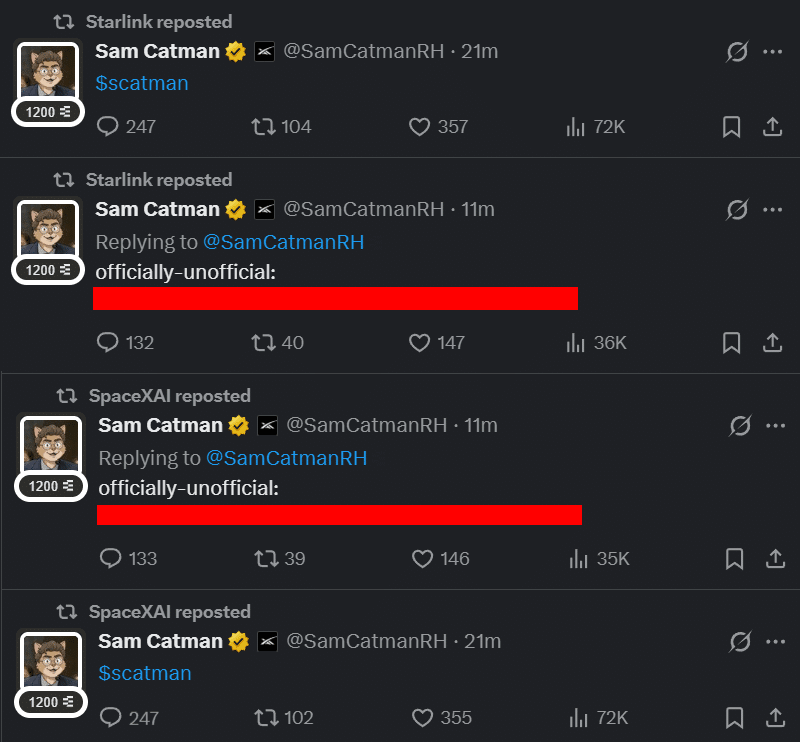
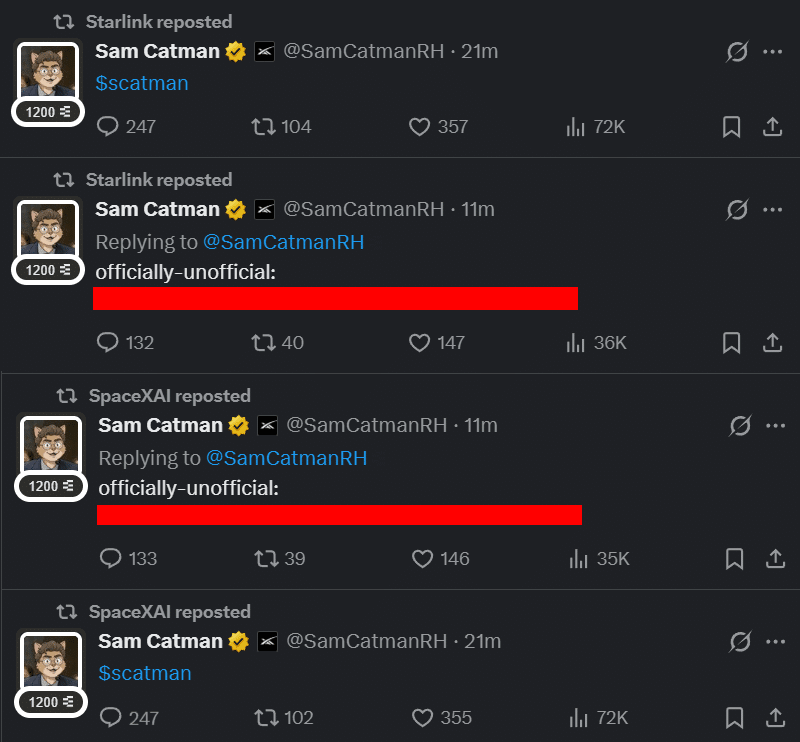
Source: X

Meanwhile, the attacker had already minted 10 trillion SCATMAN before the campaign began. The wallets then dumped holdings for 73.7 ETH, worth roughly $135,000. The token briefly approached a $2 million market capitalization before liquidity disappeared, losing 98% of its value.

This incident again showed how compromised high-profile accounts can rapidly transform online trust into exit liquidity for coordinated crypto scams.


Liquidity failed to sustain the rally

Related Questions

QWhat cryptocurrency was fraudulently promoted by hackers using compromised SpaceXAI and Starlink X accounts?

AThe SCATMAN memecoin was fraudulently promoted by the hackers.

QHow much value did the SCATMAN token lose after the scam?

AThe SCATMAN token lost 98% of its value after the scam.

QWhat did the attackers do before starting the promotion campaign on social media?

ABefore the campaign, the attacker had already minted 10 trillion SCATMAN tokens.

QHow much money did the attacker make by selling the tokens during the scam?

AThe attacker made 73.7 ETH, worth roughly $135,000, by selling the tokens.

QAccording to the article, what does this incident demonstrate about compromised high-profile accounts?

AThe incident shows how compromised high-profile accounts can rapidly transform online trust into exit liquidity for coordinated crypto scams.

Related Reads

Bitcoin Withdrawals Continue: 8 Years of Storage in a Coldcard Cold Wallet Ended in Zero

Coldcard Hardware Wallet Hacked: Losses Mount Due to Vulnerable Seed Generation A critical vulnerability in Coldcard hardware wallets has led to a continued wave of fund thefts. According to Galaxy Research, the total stolen has reached 1,367.05 BTC (approx. $88.6 million) from 4,585 addresses, a significant increase from the initial 594.5 BTC reported on July 30, 2026. Most of the stolen funds remain on the attackers' addresses. The issue is not with the current firmware, which Coinkite has updated, but with seed phrases generated on vulnerable devices between March 2021 and the release of fixed firmware versions. Due to a programmer error, devices switched from using a hardware random number generator to the software-based Yasmarang generator, which was initialized with publicly accessible data like the chip's serial number. This made the seed phrases predictable through offline brute-force attacks, meaning wallets remain at risk until funds are moved to a new wallet generated with the patched firmware. Affected devices include Mk2/Mk3 with firmware 4.0.1–4.1.9 (and up to 5.0.3), Mk4/Mk5 up to version 5.6.0, and Q models up to 1.5.0Q. The only exceptions are seeds created with a high-entropy method like at least 50 independent dice rolls or a strong unique BIP-39 passphrase. All other owners must generate a new seed on the fixed firmware and transfer their assets. A case highlighting the human impact involves a 39-year-old long-term investor who lost 2 BTC (approx. $130,000) in minutes. He had accumulated the Bitcoin over eight years through physical labor, viewing it as a financial lifeline and a retirement plan in a country suffering from hyperinflation. His story underscores that even conservative "buy and hold in cold storage" strategies can be compromised by such underlying technical flaws. From a technical perspective, this incident echoes historical failures where weak random number generators undermined cryptographic security, challenging the assumption that offline storage is automatically foolproof.

cryptonews.ru4h ago

Bitcoin Withdrawals Continue: 8 Years of Storage in a Coldcard Cold Wallet Ended in Zero

cryptonews.ru4h ago

Trading

Spot
活动图片



