Got Ripped Off by Polymarket, This Time the Bug is a "Time Warp"

Odaily星球日报Published on 2026-03-09Last updated on 2026-03-09

Abstract

Title: Polymarket's "Time Warp" Bug During Daylight Saving Transition Causes User Losses On March 8, 2024, Polymarket, a prediction market platform, encountered a significant timing error due to the transition from Eastern Standard Time (EST) to Eastern Daylight Time (EDT) in the US. This annual clock adjustment, which skips the hour from 2:00 AM to 3:00 AM, disrupted the platform's automated event creation and settlement system. The issue affected Polymarket's "Crypto Up or Down" hourly prediction markets for assets like BTC, ETH, SOL, and XRP. Events scheduled to run from 1:00 AM to 2:00 AM ET were impacted. Due to the time change, the platform's front-end and API incorrectly displayed the event duration as "March 8, 1-1 AM ET"—a logically impossible interval—instead of the correct "1:00 AM to 3:00 AM ET" (which still represents one actual hour). This bug caused substantial problems for automated trading systems that rely on precise timing data from the API. One user, "@richrichardoz," reported losses exceeding $100,000 because their trading bot malfunctioned upon receiving identical start and end times. The user and others have called for Polymarket to switch its time standard to UTC (Coordinated Universal Time) to avoid such issues and to compensate affected users. The incident highlights a critical design flaw in using local time (which is subject to bi-annual changes) instead of UTC, the global standard for financial systems. This ensures time remains consistent, mo...

Original | Odaily Planet Daily (@OdailyChina)

Author | Azuma (@azuma_eth)

In conventional understanding, time is linear, but the crypto world has its "exceptions".

Yesterday, Eastern Time (ET) completed the switch from standard time to daylight saving time as per convention (generally on the second Sunday of March at 2:00 AM), moving the clock forward by one hour, jumping directly from 2:00 AM on March 8 to 3:00 AM. The time didn't vanish into thin air; it's just that the Eastern Time zone switches between Eastern Standard Time (EST) and Eastern Daylight Time (EDT) based on custom, aiming to artificially adjust the time scale to make fuller use of daylight hours (and save electricity in the process).

For daily life, this switch doesn't cause much impact, but on the prediction market Polymarket, yesterday's time zone change directly sparked an unexpected controversy.

Polymarket Runs Into Timing Controversy

The controversy occurred in the "Crypto Up or Down" prediction events on Polymarket.

Polymarket offers cryptocurrency up/down prediction events with timeframes of year, month, week, day, 4 hours, 1 hour, 15 minutes, and 5 minutes, covering mainstream tokens like BTC, ETH, SOL, and XRP. These events are automatically created and settled based on Eastern Time and have become a significant source of trading volume on Polymarket.

At 1:00 AM on March 8 (still under Eastern Standard Time at that moment), Polymarket launched a new batch of 1-hour up/down prediction events for BTC, ETH, SOL, and XRP. The relevant links are as follows.

  • BTC (Final Result: Up): https://polymarket.com/event/bitcoin-up-or-down-march-8-1am-et
  • ETH (Final Result: Down): https://polymarket.com/event/ethereum-up-or-down-march-8-1am-et
  • SOL (Final Result: Down): https://polymarket.com/event/solana-up-or-down-march-8-1am-et
  • XRP (Final Result: Down): https://polymarket.com/event/xrp-up-or-down-march-8-1am-et

According to the event's resolution rules — comparing the opening price and closing price of the 1-hour candlestick on Binance USDT trading pairs, starting from the event's start time — the above four events have all been settled.

However, because the end time of this batch of events coincided with the daylight saving time switch, the moment Eastern Time reached 2:00 AM, it directly jumped to 3:00 AM (meaning the period from 2:00 AM to 3:00 AM was skipped), causing some timing confusion for this batch of events on the Polymarket platform itself.


As shown on Polymarket's frontend interface, perhaps because 2:00 AM did not exist in yesterday's Eastern Time reckoning, the time period currently displayed for this batch of events is "March 8, 1-1 AM ET" (i.e., March 8, 1:00 AM - 1:00 AM). Under normal timing conditions, such events should display a 1-hour time period (for example, the previous day's similar event was "March 7, 1-2 AM ET", i.e., 1:00 AM - 2:00 AM). If accounting for the daylight saving time switch, a more reasonable time period for this batch should be "March 8, 1-3 AM ET" (i.e., 1:00 AM - 3:00 AM, still essentially 1 hour).

So no matter how you look at it, the currently displayed "March 8, 1-1 AM ET" is very strange.

Chinese user "Xiao Z" (@richrichardoz) posted on X about this, stating that besides the frontend, Polymarket's API also returned the "1-1 AM ET" time period, causing automated programs relying on the API data to "all crash", estimating losses exceeding $100,000 because of this.

"Xiao Z" further explained that the start time and end time being exactly the same is a market state that is logically impossible. Many automated trading systems rely on the end time to determine the trading window; this error directly caused his program to lose a large sum of money. Therefore, he suggested that Polymarket change the time standard for related events to UTC time and compensate users affected by the data issue.
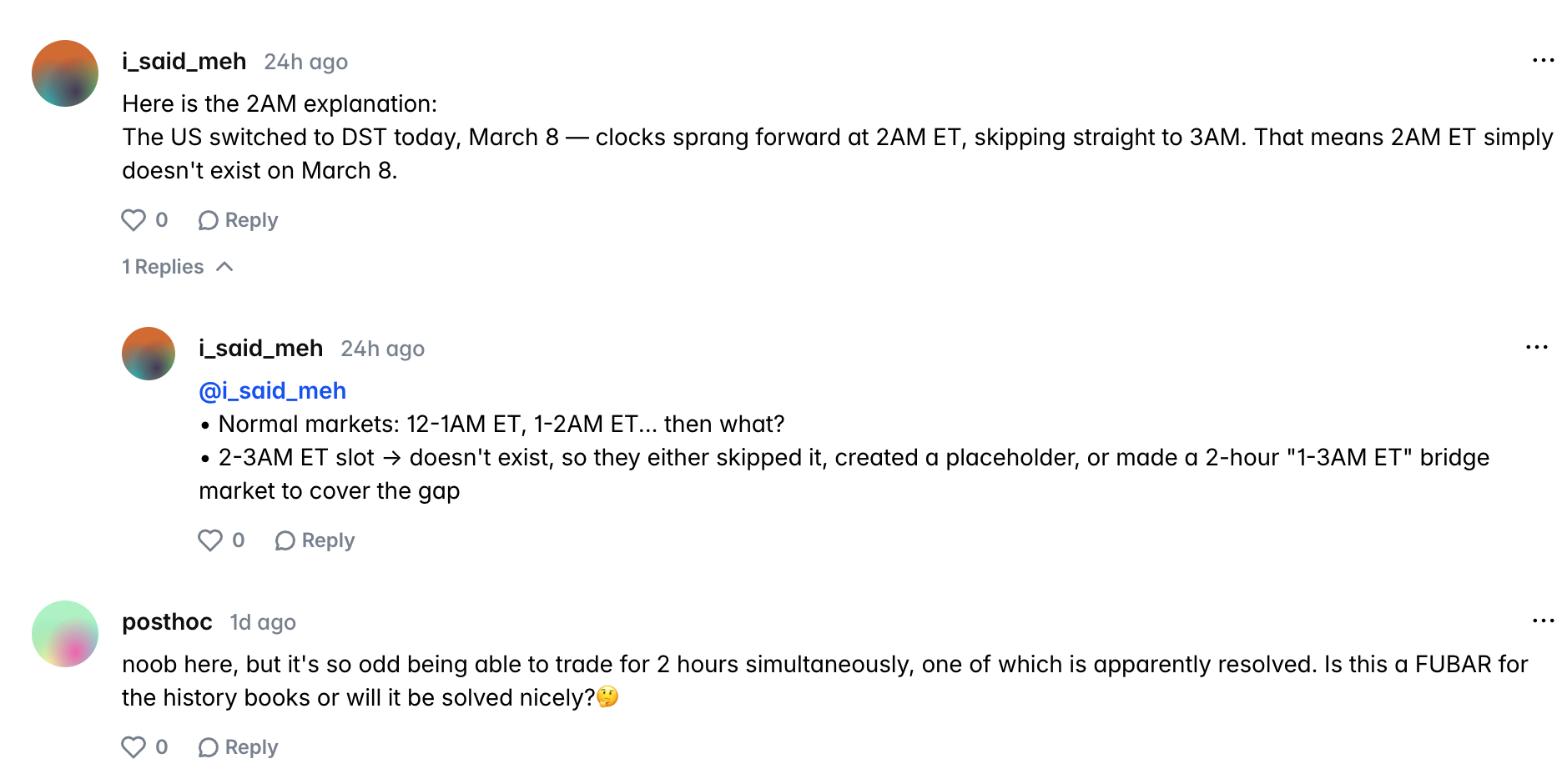
Besides this user, many external users have also left comments under the related events expressing confusion, but as of writing, Polymarket has not responded through official channels.

Time Standards in Traditional Financial Markets

Looking back at this controversy, although the scale of impact isn't huge, it exposed a fundamental design flaw in Polymarket's "Crypto Up or Down Market" events.

Influenced by historical customs, economic status, and industry practices, Eastern Time is still widely used across various industries. However, this is not very friendly to financial systems because Eastern Time switches between daylight saving time and standard time every year — artificially moving the clock forward or backward by one hour at specific times, resulting in "jumps" and "overlaps" in time respectively.

In modern financial systems, UTC time has long become the de facto universal standard. In the vast majority of financial infrastructure, internal systems typically use UTC timestamps as the sole standard time. Local times like Eastern Time are still used, but in terms of system logic, they often only exist in the presentation layer for users. This design is precisely to avoid the uncertainty of time systems, ensuring that time remains monotonic, unique, and globally consistent in financial transactions, settlements, and automated systems.

The key contradiction in Polymarket's controversy lies in the fact that the related events used Eastern Time as the timing standard but failed to fully consider the potential variable of the daylight saving time switch, ultimately causing confusion in the frontend and API data. Among the current user base of prediction markets, an increasing number of participants are trading via APIs and automated programs. Some minor issues that originally only affected frontend display can easily be amplified into real financial losses in automated systems.

Judging from the outcome, this controversy might not be considered a serious incident, and theoretically it could only happen at most twice a year, but what it reveals is a more serious design problem — as prediction markets gradually move towards becoming financial infrastructure, they must also adhere to the engineering standards used by financial infrastructure.


Related Questions

QWhat was the specific bug that occurred on Polymarket related to time?

AThe bug was a 'time warp' caused by the switch from Eastern Standard Time (EST) to Eastern Daylight Time (EDT), where the hour from 2:00 AM to 3:00 AM was skipped. This led to a batch of 1-hour prediction events being incorrectly labeled with a time range of '1-1 AM ET' instead of the proper one-hour duration.

QWhich prediction markets on Polymarket were affected by this timing issue?

AThe affected markets were the 1-hour 'up or down' prediction events for Bitcoin (BTC), Ethereum (ETH), Solana (SOL), and XRP that started at 1:00 AM ET on March 8.

QWhat was the financial impact reported by user '@richrichardoz' due to this bug?

AUser '@richrichardoz' (also referred to as '小Z') reported that their automated trading systems, which relied on the API's end time data, malfunctioned due to the incorrect time data, resulting in estimated losses of over $100,000.

QWhat is the suggested solution to prevent such timing issues on Polymarket according to the article?

AThe article suggests that Polymarket should change the time standard for its events to UTC (Coordinated Universal Time) to avoid the complexities and inconsistencies of local time changes like daylight saving time.

QWhy does the article state that UTC time is the de facto standard in modern financial systems?

AUTC time is the standard because it provides a monotonic, unique, and globally consistent time reference. Financial infrastructure uses UTC internally to avoid the uncertainties caused by local time changes, such as daylight saving time transitions, which can disrupt trading, settlement, and automated systems.

Related Reads

Annual Salary of Millions Competing for Electricians, Meta Rushes to Open Its Own Technical School

The AI boom is facing an unexpected bottleneck: a severe shortage of skilled construction workers and electricians. As tech giants like Meta, OpenAI, and Alphabet race to build massive data centers—such as OpenAI's $16 billion "Stargate" project—they are hitting a critical labor wall. The U.S. needs an estimated 130,000 more electricians, 240,000 construction workers, and 150,000 supervisors by 2030 for AI infrastructure alone, but tens of thousands of electrician jobs go unfilled each year. While AI companies offer high premiums, with electricians earning up to $280,000 annually, worker scarcity still causes massive losses—delays on a single project can cost $14.2 million per month. The complexity of building AI data centers, which require immense power (equivalent to powering hundreds of thousands of homes), sophisticated electrical systems, and advanced liquid cooling solutions, demands highly skilled technicians who are in short supply. To combat this, companies are investing heavily in training. Meta has committed $115 million to a free training school offering tuition, housing, and stipends, targeting 5,000 new workers. OpenAI is partnering with unions to secure skilled labor. These efforts are paying off, with a significant rise in Gen Z interest in trade schools over college. However, the power demands are staggering. AI data centers are driving a rapid surge in electricity consumption, projected to account for up to 12% of U.S. power use by 2028 and raising costs for consumers. Furthermore, the construction boom is project-based, leading to a potential future glut of trained workers once building peaks, which could depress wages industry-wide. The race for AI supremacy now depends as much on skilled hands as on advanced chips.

marsbit8m ago

Annual Salary of Millions Competing for Electricians, Meta Rushes to Open Its Own Technical School

marsbit8m ago

OpenAI No Longer Sells Its Most Expensive Model for Profit

OpenAI is shifting its business strategy away from promoting its most expensive, flagship models for every task. Recent price cuts—80% for GPT-5.6 Luna and 20% for Terra—signal a deeper change: the company now actively advises users that many tasks don't require the most powerful model. Instead, OpenAI recommends a tiered approach: use the high-end GPT-5.6 Sol for complex planning and analysis, then delegate execution to cheaper models like Luna. This mirrors moves by Anthropic, which recently launched Claude Opus 5 at half the price of its top model, Fable 5. Both companies are de-emphasizing flagship models as primary revenue drivers, using them instead for brand prestige and technological showcases. The industry is entering a "mass-market" phase, similar to automotive, where high-volume, cost-effective models handle daily operations and drive scale. OpenAI's price reductions are partly enabled by AI models themselves optimizing underlying code and infrastructure, creating a self-reinforcing cycle of efficiency gains and cost reduction. Competition is shifting from "who is smartest" to "who offers the best value." The goal is no longer selling individual models but fostering widespread API adoption and ecosystem lock-in. By making AI calls cheap and ubiquitous, companies like OpenAI aim to become the indispensable, utility-like infrastructure powering automated workflows—the "water and electricity" of software, quietly embedded everywhere.

marsbit8m ago

OpenAI No Longer Sells Its Most Expensive Model for Profit

marsbit8m ago

Will the Fed Definitely Raise Interest Rates in September? How Will Crypto and U.S. Stocks Withstand the Pressure?

The market's expectation for a September Fed rate hike surged dramatically in early August, jumping from under 50% to over 80% within a week. This shift followed a contentious July FOMC meeting, where a 9-3 vote to hold rates revealed growing dissent from hawkish members advocating for an immediate hike to combat persistent inflation. The primary catalyst for this repricing is rising oil prices, driven by renewed geopolitical tensions around the Strait of Hormuz, which threaten global supply. Energy costs directly influence inflation metrics, making the upcoming July CPI report (due August 12th) a critical data point. If it shows inflation reaccelerating, the probability of a September hike will solidify. For Bitcoin and crypto assets, this is typically bearish news. Bitcoin continues to behave as a high-beta, liquidity-sensitive risk asset. A rate hike raises the opportunity cost of holding non-yielding assets and could drive capital toward money markets, pressuring crypto prices in the short term. However, historical patterns suggest that if a hike is perceived as the end of a tightening cycle rather than the start, any negative price impact may be brief. U.S. stocks, particularly crypto-linked equities like Coinbase and growth-oriented tech stocks, are also vulnerable. Higher rates increase discount rates in valuation models, putting pressure on high-multiple companies. This coincides with a pivotal tech earnings season where investor focus has shifted from massive AI capital expenditure to tangible revenue and cash flow generation. Companies with negative cash flow and weak growth narratives could face heightened volatility if borrowing costs rise in September. In summary, a September Fed hike has evolved into a mainstream market scenario. Key factors to watch are oil prices, the July CPI report, and Fed communications, which will determine the final decision and its impact on volatile crypto and equity markets.

marsbit19m ago

Will the Fed Definitely Raise Interest Rates in September? How Will Crypto and U.S. Stocks Withstand the Pressure?

marsbit19m ago

Trading

Spot
活动图片






