Google CEO Sundar Pichai was genuinely forthright this time, offering a candid revelation:
Honestly, our Gemini is a bit behind in the coding department...
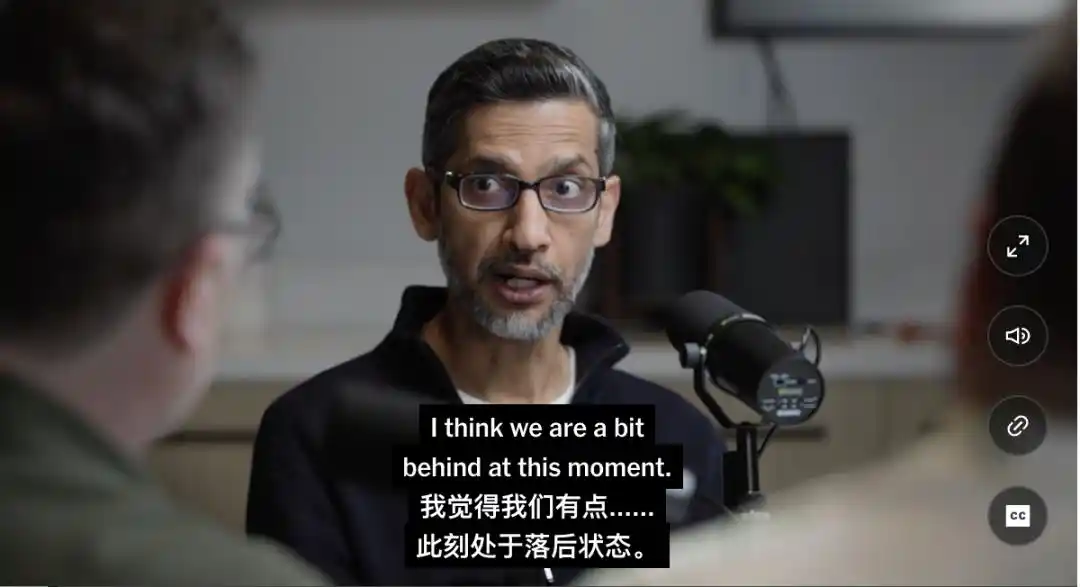
(Gemini: How could this come from my own boss!)
So, right after Google I/O concluded—
with a full suite of new AI products like Gemini 3.5 Flash, Gemini Omni, Gemini Spark just served up.
In the latest interview on The New York Times' tech podcast, Pichai responded to several of the most pointed questions with thorough candor.

He talked extensively about topics like the capabilities of Gemini, AI anxiety, and was remarkably transparent, laying bare the company's situation and his genuine thoughts:
In the wave of Coding Agents, Google indeed isn't at the forefront.
Speaking from the heart, the progress speed over the past one or two years makes me feel that AGI might be closer than previously imagined.
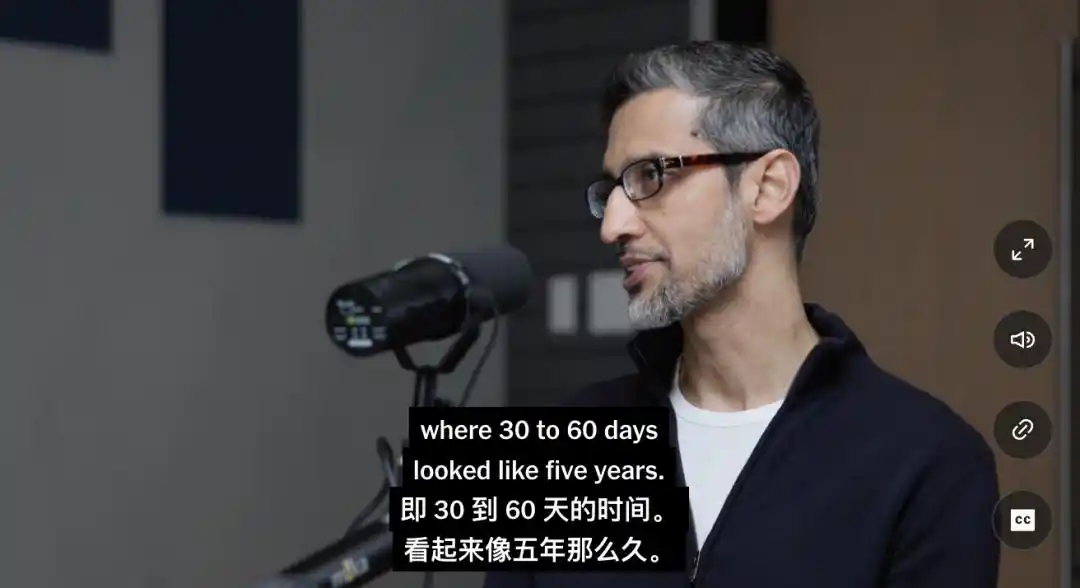
The changes in the AI field are happening at a ridiculous pace! The transformations that occur in just 30 to 60 days today would have taken perhaps 5 years to see in the past.
People's fear of AI isn't just unfounded worry, because jobs, income, and future lives will indeed be reshaped.
...
Below are key excerpts from this podcast, edited and compiled around core viewpoints, with some text moderately edited without changing the original meaning~
Pichai Admits in His Own Words: Gemini is Lagging in Coding
Q: The last time you were on the show was 2023, right after Bard launched, and everyone felt Google was still catching up in AI. How do you see Google's position in this AI race now?
Pichai: That question takes me back. Thinking about it now, even three years ago feels like a long time.
Honestly, the technological progress in recent years has been insane.
Google has certainly been moving forward, but the pace of change in this industry is so fast. We are at the forefront in some directions, but there are other areas where we haven't fully caught up yet.
Actually, looking at overall capabilities in text, multimodality, voice, audio, and reasoning, I think we are quite strong.
But when it comes to agentic programming with tool use, instruction following, and those long-horizon tasks that require many steps over a long time, I think we are indeed a bit behind. (doge)
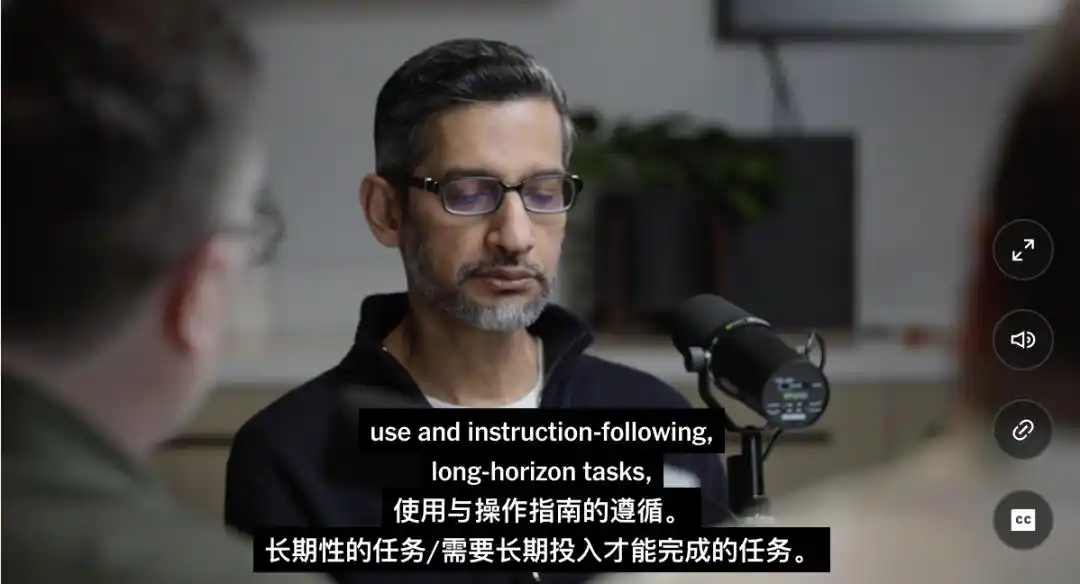
Of course, we are catching up, but it's hard to keep up with the incredibly fast pace in this field.
Every top lab has its own training cycles, and the timing isn't always perfectly aligned. A lab might feel unbeatable and ahead of everyone three months ago, but the wind can shift in no time.
That's what happens when you're at the frontier.
I think Google is the only major company truly still at this frontier. Sure, there are a few startups making very rapid progress, but Google has been investing in this for many years.
Gemini 3.5 Flash is indeed a significant step forward for us. It has addressed some previous shortcomings. Models only get better when they are put out into the real world, used, and then iterated upon based on user feedback.
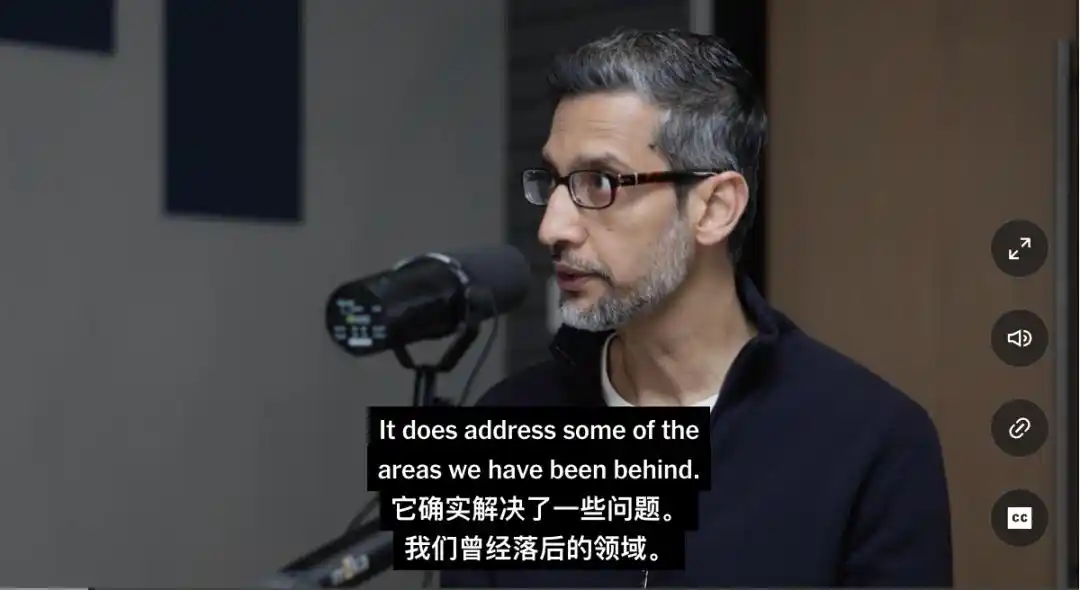
Especially for coding, real-world usage data is crucial.
In the past, we might not have had a product entry point that directly reached developers like Claude Code, nor the kind of high-frequency usage scenarios Anthropic gets through Cursor.
So Antigravity 2.0 is very important for us. It's been in use internally at Google for a while, and I mentioned it at Google I/O—
The internal token usage growth has been incredibly steep, something I've never seen before at Google: doubling every week. People are genuinely using the models to get work done.
Q: It sounds like, if there's one area where you feel Google isn't fully at the forefront yet, it's coding, right?
Pichai: Actually, programming plays a crucial role in everything we do.
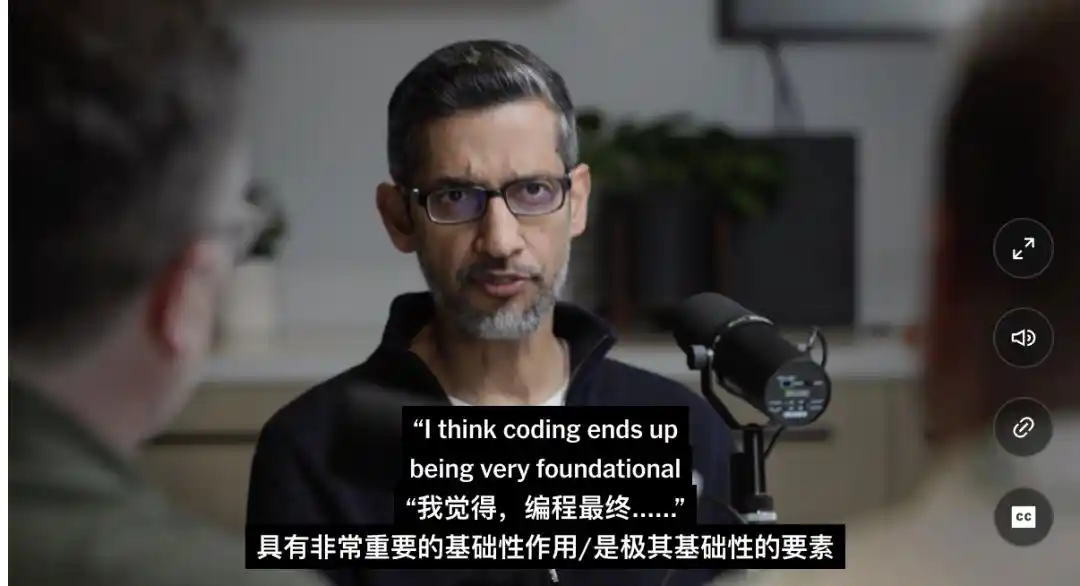
I believe it's an area worth deeply exploring. In some aspects of programming, we've achieved good results.
However, for those long-horizon tasks that require senior developers to handle complex codebases, we still have significant room for improvement. We are very aware of this and are working hard to make progress.
Gemini 3.5 Flash Just Launched, Google is Still Catching Up in Coding
Q: Gemini 3.5 Flash was released just a day ago. Normally, it would take a few days for everyone to truly understand and test a new model.
However, we've also received some feedback on pricing and product quality. I'm curious, what's your initial assessment of this product?
Pichai: We definitely need a day or two to let it stabilize.
This is a new model, a push in a new direction. It does bring some advances, but there might also be some regressions. However, these issues can be addressed quickly through post-training.
Some of the glitches and behaviors we're seeing now, I believe, are relatively easy to fix.
Also, at this Google I/O, we announced a lot of things in a single day.
So, to avoid service disruptions, we temporarily tightened some usage limits, but you'll soon see improvements in those limits.
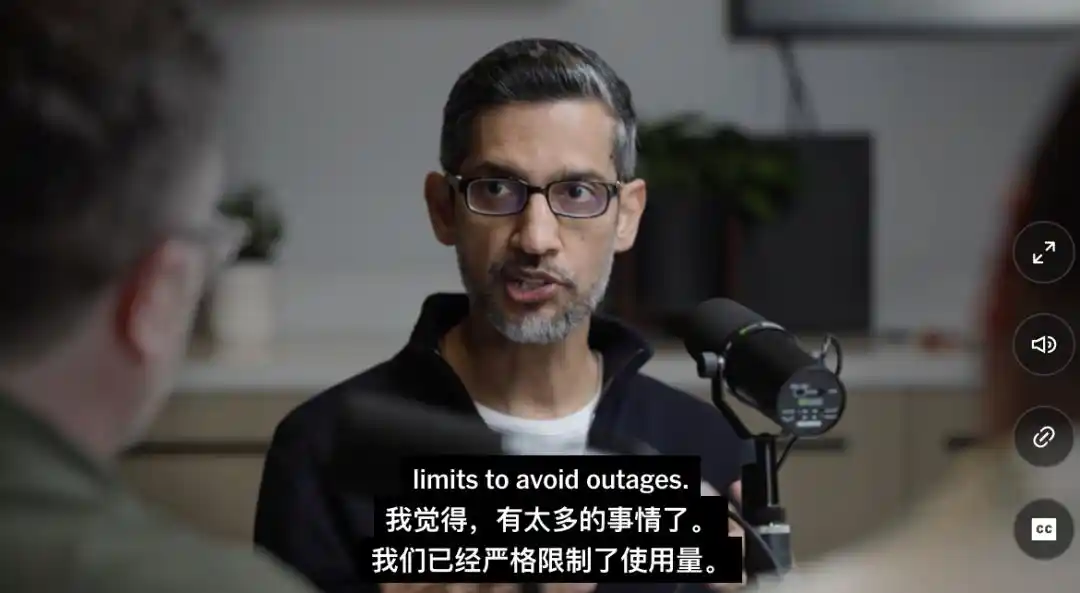
I understand the frustration when people hit limits; I'd feel the same. But we'll resolve these issues quickly.
Q: One reason for the success of some AI companies is their intense focus.
Everyone knows Anthropic and OpenAI have heavy investments in coding. OpenAI was criticized last year for spreading itself too thin, but now it's tightening its focus.
Do you think Google is focused enough on coding? Or are you betting on too many directions simultaneously, diluting resources, time, and attention?
Pichai: I think everyone sees that the coding field has reached an inflection point, so everyone is responding to that change.
We certainly have heavy investment in this direction. I don't think it's a problem of focus. Google is a large company with sufficient scale, so we can focus on multiple important directions at the same time.
For me, this isn't a fundamental issue. The key is that we are making progress and will continue to make progress.
The changes that happen in 30 to 60 days in this field now look like what 5 years used to be. It's that fast.
Search's Biggest Overhaul in 25 Years, But Google Isn't Ready to Fully Switch to AI Yet
Q: Another change that garnered a lot of attention this week was your modifications to the Google Search bar and entry point, arguably the biggest change in 25 years.
Many speculate that the classic web search interface might one day disappear, and AI Mode will become the default entry. Do you think that day will come? Would Google ever just rip off the band-aid and fully switch to AI Mode?
Pichai: I think it's very important to bring users along with the product evolution while ensuring the product meets their expectations.
I don't want to get too far ahead of user demand.
Looking at our past changes, user feedback has been positive, which is clearly reflected in long-term product metrics.
But users expect search to be fast. People use search to connect to existing information and content on the internet. This is very important for us. So, you'll see us continue to evolve the product, but we'll do it in a measured way.
A year ago, we didn't have AI Mode. Now many people are experiencing it, and we've made the path into AI Mode smoother than before.
It's a process of continuous evolution, but sources of information and links will always be a part of it.
Q: Kevin mentioned on the way here that he has barely done traditional Google searches in the past year, using AI search almost exclusively.
When you hear that, do you think: great, that's the user I want? Or does it send a chill down your spine? After all, the traditional search ad business is very profitable for Google.
Pichai: In AI Mode, in Agentic Mode, what these technologies can do for users is far more than what was possible a decade ago.
Commercial value ultimately depends on the total value you create for users. Over time, the value we provide to users will increase, competition will increase, and choices will increase.
So I believe that a suitable business model, combining subscriptions and advertising, will still exist.
Adam Smith's rules still apply in this new world.
The Public Fears AI, Pichai Admits: This Anxiety is Justified
Q: Let's talk about public perception of AI.
A survey by The New York Times and Siena this week showed about 16% of respondents think AI is overall a good thing, while 35% think it's overall a bad thing. How do you view this current AI backlash? How much ability does Google have to change public opinion?
Pichai: AI is now seen by many as the next most important technology humanity will face.
It's developing so fast, faster than humans can easily digest such massive change... So it's normal for people to be anxious.
Facing such significant technological change, unease is natural. Even technologies less complex than this have caused anxiety before. This time, the scope of impact and scale of change are indeed unprecedented.
From an industry perspective, what we can do is continue to improve the technology and also consistently show people the practical benefits AI can bring. That's an area where we can put in effort.
At the same time, infrastructure investments are getting larger, and we need to keep figuring out how to use them more effectively, how to truly translate them into value.
But ultimately, people aren't just worried about the technology itself.
A very real concern is that many worry about their jobs, income, and future lives being affected. There's a lot of discussion outside about whether jobs will be completely transformed, whether some positions will disappear, etc.
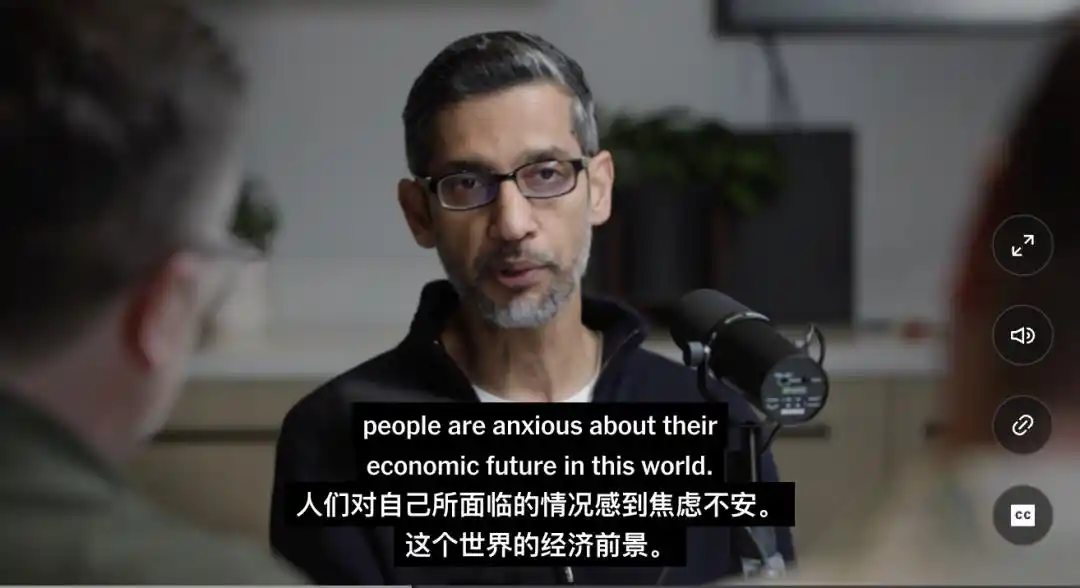
Personally, I think the future likely won't be as dire as some of the most pessimistic predictions.
Having discussions around AI is actually a healthy thing. Given the current development speed of AI, it's reasonable for people to have concerns, and we should indeed take them seriously.
AI Will Reshape Work, But Pichai Believes Young People Still Have Opportunities
Q: You're giving the commencement speech at Stanford next month. You've probably heard that several commencement speakers have... You know. How do you plan to talk about AI with the graduates?
Pichai: Every wave of technological advancement pushes the world forward.
In a sense, these graduates will become part of driving that progress and also part of responding to the technology's impact.
I've always been very optimistic about the next generation. The world is always worried about the next generation, but the next generation always rises to the challenge and builds a better world. I think it's the same now. My goal is to share my experiences with them.
Q: If speaking to a young person just graduating, how would you explain that their economic future is still worth being optimistic about?
Pichai: The most fundamental point is that in the future, each of us will have a new kind of capability. Many things that were previously impossible might suddenly become possible.
Think about when spreadsheets first appeared. I didn't experience that era firsthand, but I can hardly imagine how people did financial analysis before that.
Once spreadsheets arrived, the barrier to many tasks changed. AI is similar; it will dramatically push forward the starting point for many people.
It's the same with writing code. Moving forward at the current pace, many more people will be able to write code themselves in the future.
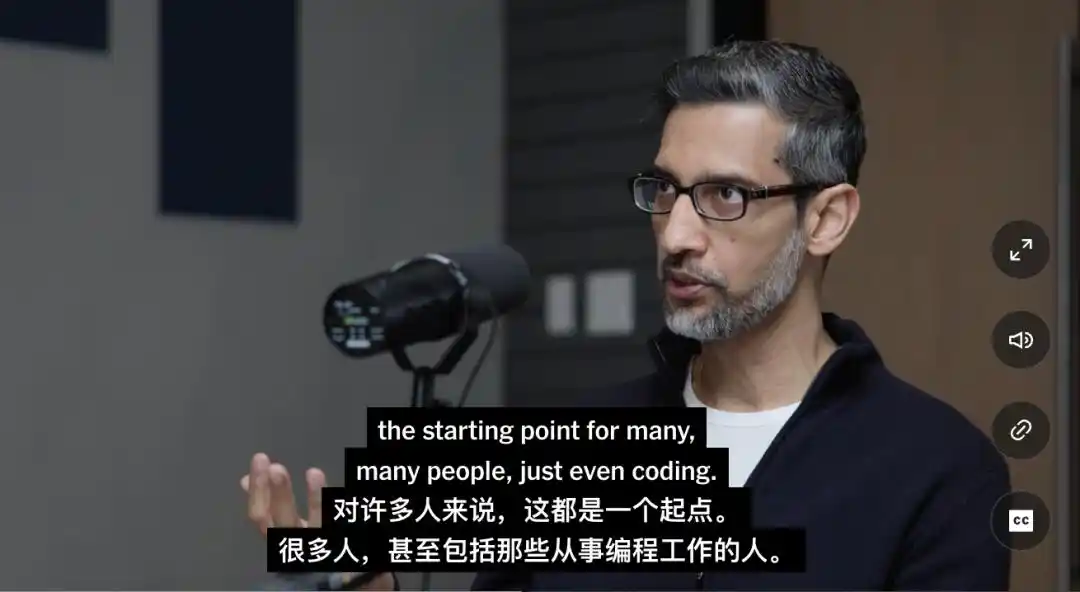
Moreover, many positive changes might ultimately arrive in ways more unexpected than we imagine now. For example, people might become more efficient and also have more leisure time—these things can happen simultaneously.
And I feel many jobs are quite exhausting.
Doctors are a classic example. What doctors most want to do is care for patients. But many doctors will tell you they don't actually spend that much time directly with patients.
AI can help free up some of that time, allowing them to refocus their energy on patients. The example of radiologists is also interesting; this topic has been discussed for a decade.
Take me, for example. I've already had many more scans in my lifetime than my father's generation, and the amount of information in each scan today is much greater. In the past, there were limitations with film; now everything is digital, and the information volume might be 10 times what it was.
Looking ahead 10 years, that number might increase another 10 times.
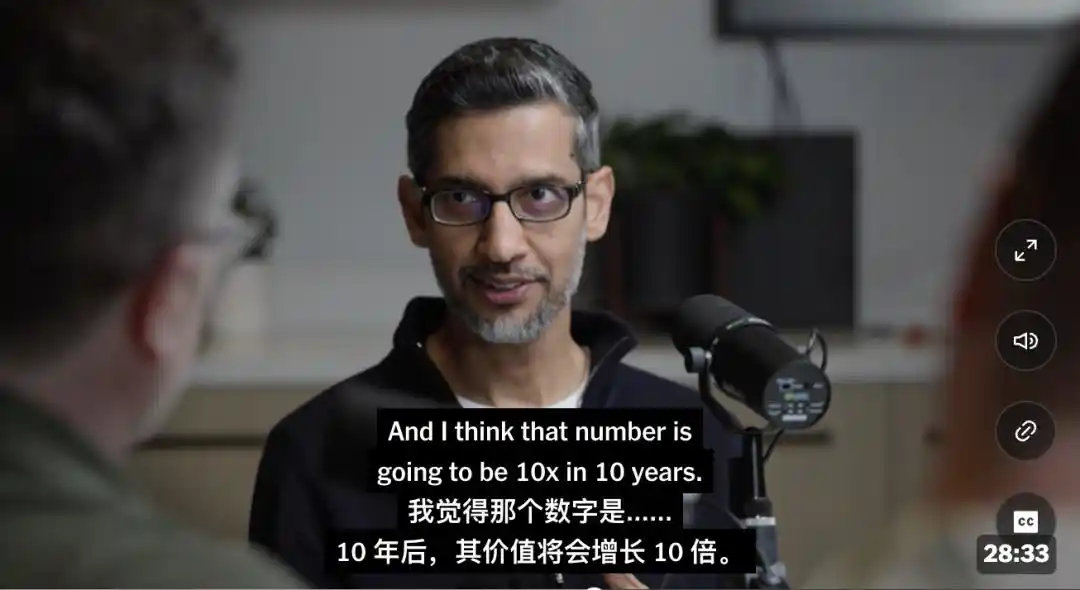
So what then? Humans certainly can't keep up alone. You really need AI to help. So the impact won't be linear.
Every major technological shift brings shocks, and this one is no different.
As a society, we of course need to seriously engage, have good discussions, and respond thoughtfully. But I also think there are many positive aspects of AI that haven't been fully articulated yet.
I don't quite agree with the extremely pessimistic narrative that the future is inevitably destined to be bad.
Agent, AGI, and the Singularity: Google Wants to Accelerate but Also Fears Losing Control
Q: One more question about safety. All major labs are pushing towards what you call "recursive self-improvement"—building AI systems that can rapidly improve themselves.
Do you think this can be achieved safely? Can you see a path to it now?
Pichai: I believe all responsible labs, if they truly approach such a moment, cannot have that discussion only within the company. It must be a much broader conversation.
At these stages of AGI, we must all avoid falling into a race dynamic.
Q: How do you view the term AGI? What's your take on the view that all progress is converging towards a single, world-changing thing?
Pichai: Technology is inevitably progressing towards AGI; this is indeed happening.
I understood this quite early. Otherwise, I wouldn't have pushed the company to pivot a decade ago, placing AI at the very core.
What I wanted to express back then was that even if AGI is 10 years away, the technology three years from now will be much more powerful than today's. So I didn't want people to think that because AGI might be a decade away, there's no need to act or prepare now.
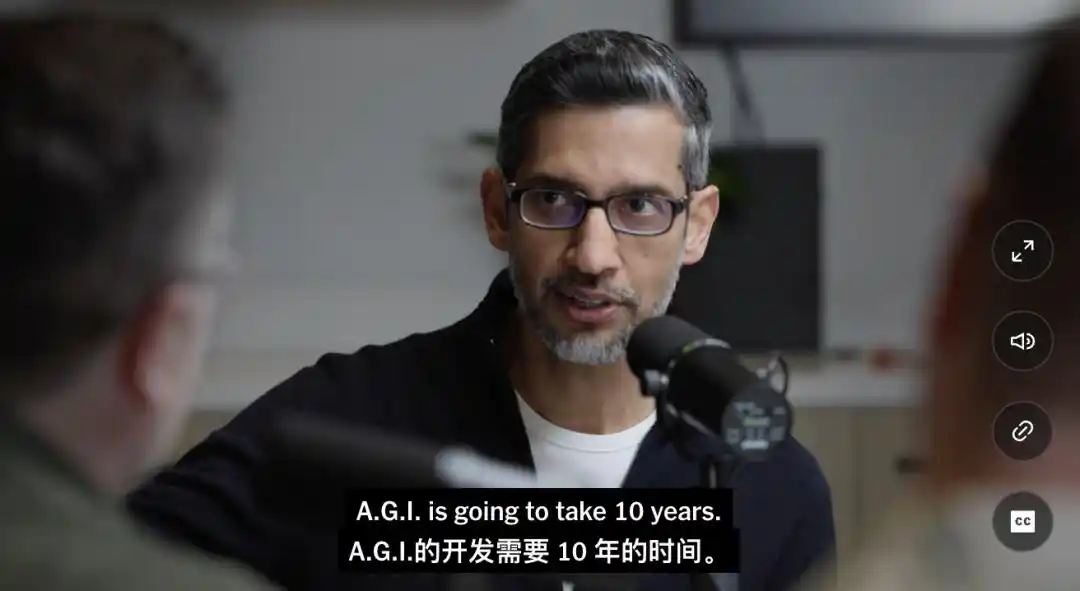
Q: Are you somewhat "brainwashed" by AGI now?
Pichai: I am very certain that this technology is making fundamental progress towards AGI.
I can't precisely predict whether it will appear in 3 to 5 years or 5 to 10 years. But the pace of progress over the past one or two years makes me feel it might be closer.
I now manage one of the world's largest companies and also have a responsibility to society, so the language I use when discussing this might differ from others.
But 10 years ago, on the I/O stage, I announced TPU and the AI-first data center. So, we have a clear understanding of where this technology is heading.
Q: In this year's keynote, Demis Hassabis had a very quotable line: We are standing "at the foothills of the singularity." From Google's perspective, what does that actually mean? Should people be excited, afraid, or both?
Pichai: Demis and I have talked about this topic many times.
Here, he defines the singularity as the arrival of AGI. If you believe that, then that's what the statement means. For him, that's his definition of the singularity.
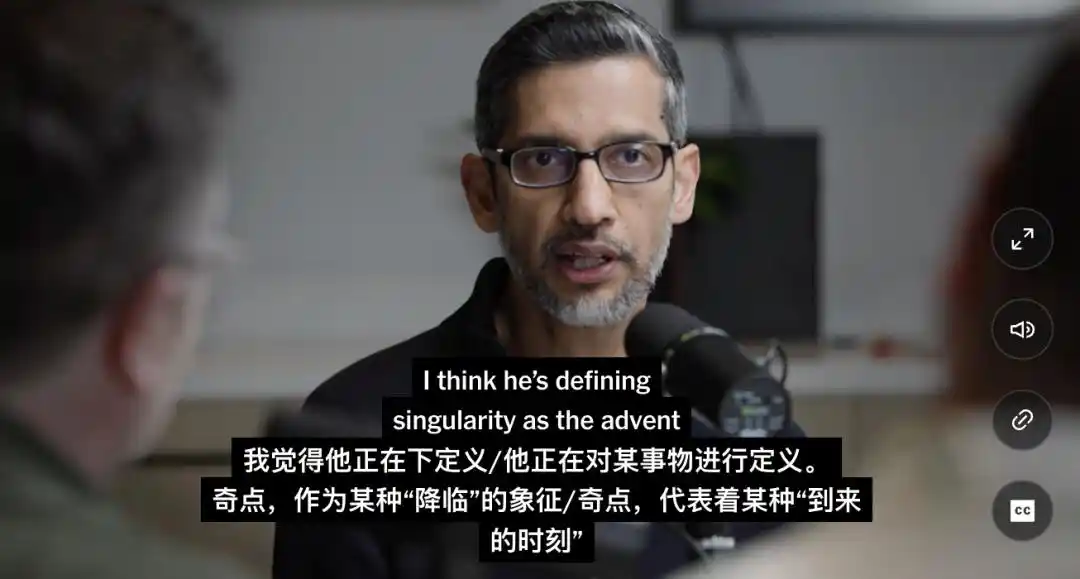
I think if you truly believe that, you should articulate it clearly, because we are all at the frontier, building this technology, and we genuinely want people to listen.
As a society, we need to digest this and prepare for it.
Reference Links:
[1]https://www.nytimes.com/2026/05/22/podcasts/sundar-pichai-understands-why-people-are-anxious-about-ai.html
This article is from the WeChat public account "Quantum Bit," author: Focus on Frontier Technology






