Goldman Sachs Bows Down, Bitcoin Finally Breaks Through the Gates of Wall Street

marsbitPublished on 2026-04-24Last updated on 2026-04-24

Abstract

Wall Street giants, including Goldman Sachs, Morgan Stanley, Charles Schwab, and the New York Stock Exchange, have reversed their long-standing opposition to Bitcoin and are now actively embracing it. After years of dismissing Bitcoin as a scam, a bubble, or a tool for illicit activities, these institutions are launching Bitcoin ETFs, enabling spot trading, and building dedicated crypto infrastructure. Goldman Sachs, which once called Bitcoin a "fraud tool," is now offering Bitcoin ETFs. Morgan Stanley, which internally banned the term "cryptocurrency," has launched its largest-ever ETF backed by Bitcoin. Charles Schwab has opened spot crypto trading for its retail clients, integrating Bitcoin alongside traditional assets. The NYSE is building robust infrastructure to support digital assets, signaling a long-term commitment. This dramatic shift is driven not by a change in ideology but by economic necessity. As Bitcoin repeatedly survived market crashes and grew into a multi-trillion-dollar asset class, ignoring it became too costly. Wall Street’s business model relies on capturing fees, and Bitcoin’s rise represented a massive wealth transfer occurring outside their ecosystem. The fear of missing out (FOMO) and client demand forced these institutions to capitulate. The article frames this as a historic surrender to Bitcoin’s mathematical inevitability. Unlike the trust-based traditional financial system, Bitcoin operates on decentralized, transparent, and unchangeable rul...

Written by: Sylvain Saurel

Compiled by: Chopper, Foresight News
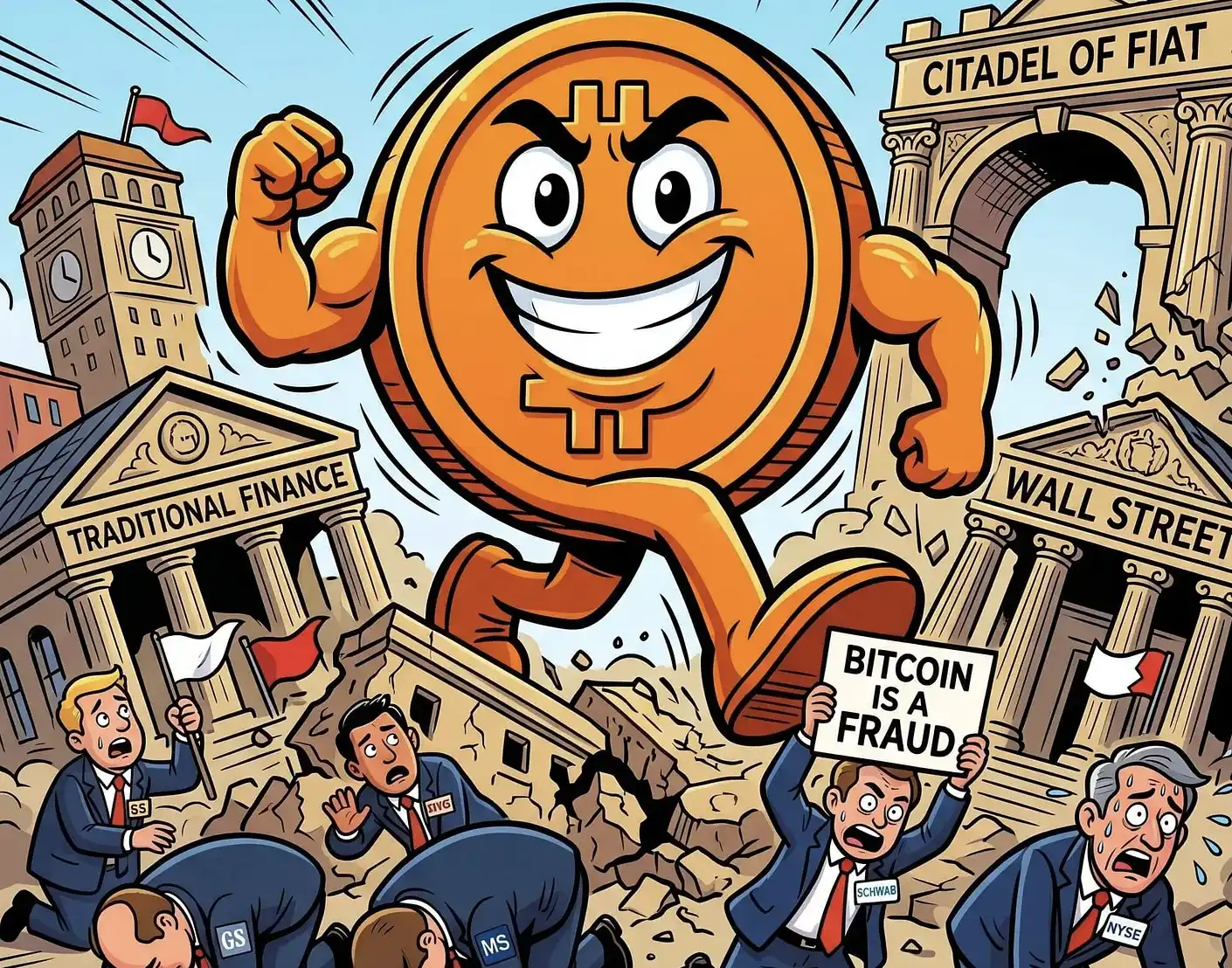
In the past few days, the axis of the financial world has completely reversed. We have just witnessed what could be called the most rapid, dazzling, and undisguised great shift in values in human history.

Wall Street, the stronghold of traditional finance, the ivory tower of fiat currency, has officially raised the white flag.

They are not just surrendering; they are scrambling to crown the victor.

For fifteen years, the giants of traditional finance told everyone that Bitcoin was a joke, a Ponzi scheme, a bubble, a tool for illegal transactions, a digital tulip, a gimmick cooked up by a bunch of cypherpunks in their basements. They first mocked it, then suppressed it, and now? They are desperate to own it.

Let's see how institutional dignity has collectively collapsed in these past few days.

The Fortress Crumbles: The List of Surrenders

Goldman Sachs: From 'Fraud Tool' to Bitcoin ETF

Yes, that Goldman Sachs. The global investment banking behemoth, once dubbed a "great vampire squid wrapped around the face of humanity" by Rolling Stone magazine, now has its tentacles reaching into the new digital asset realm.

For years, Goldman executives seized every opportunity to mock decentralized currency. We all remember the disdain on financial channels, the suited executives straightening their ties while earnestly telling the public: Bitcoin has no intrinsic value. Its CEO once publicly declared Bitcoin a "fraud tool." The purpose of this narrative was to keep wealth locked within their closed circle, to continue collecting tolls.

But now, the tune has completely changed. Goldman Sachs is launching a Bitcoin ETF. This hypocrisy is both shocking and expected. The institution that once warned you away from a "scam" is now charging you a management fee to hold it for you.

Why the sudden change of heart? Because Wall Street has no eternal morals, only eternal interests. When high-net-worth clients threatened to move their funds, clamoring for exposure to the best-performing asset of the decade, so-called morals vanished overnight. The "scam" magically transformed into an "innovative alternative asset." Goldman didn't have an epiphany; it felt the pressure.

Morgan Stanley: From Banned Word to Largest-Ever ETF Launch

If Goldman's reversal is a comedy, Morgan Stanley is a textbook case of historical irony. Not long ago, Morgan Stanley was extremely hostile to digital assets, even reportedly banning the use of the word "cryptocurrency" in internal company emails. It became Voldemort, an asset class that must not be named. They saw it as a plague, a virus that would contaminate their noble, heavily regulated mahogany-paneled boardrooms.

And now, just in recent days, Morgan Stanley welcomed the largest ETF launch in the company's history.

What is the underlying asset of this record-breaking, blockbuster financial product? You guessed it, Bitcoin.

The asset they once tried to erase from the corporate lexicon is now the crown jewel of the modern product line. Advisors who couldn't even type the word are now calling their wealthiest clients one by one, urging them to allocate 1% to 5% of their portfolio to "digital gold." This cognitive dissonance is staggering, but institutional FOMO (Fear Of Missing Out) overrode all prohibitions. They finally understood: you can't ban the future, but you can slap a stock ticker on it and sell it to the masses.

Charles Schwab: Opening the Door to Spot Trading for Retail Investors

While the investment banks play the ETF game, Charles Schwab went more direct: deciding to open direct cryptocurrency spot trading for its vast client base.

Schwab represents the average investor, the gatekeeper of middle-class wealth, retirement accounts, and mainstream investment portfolios. For years, they kept their clients corralled in the safe, predictable pastures of mutual funds, traditional stocks, and municipal bonds. Want to buy Bitcoin? You had to leave Schwab, venture into the wild west of crypto exchanges, and manage your own private keys.

Times have changed. By enabling spot crypto trading, Schwab effectively admits: a portfolio without Bitcoin is incomplete. This isn't just offering an ETF; it's allowing millions of ordinary investors to hold the underlying asset directly through a trusted brokerage account.

The significance of this move for Bitcoin's adoption cannot be overstated. It places this decentralized orange coin right next to Apple, Amazon, and the S&P 500 on the dashboard of the average American investor. It removes the barrier, erases the stigma, and opens the floodgates to a massive pool of capital that has been watching, eager to enter but hesitant.

New York Stock Exchange: Building the Infrastructure Full Throttle

Then there's the heart of traditional finance: the New York Stock Exchange (NYSE). The hallowed halls where traders once yelled on slips are now quietly and efficiently building dedicated crypto infrastructure.

The NYSE isn't just facilitating trades; it's laying the pipes. This infrastructure is live, integrated, and "running as smoothly as a cat on a warm laptop." When the underlying system of global equities decides to build roads and bridges for digital assets, the debate is over.

The New York Stock Exchange does not build infrastructure for passing fads, nor does it invest millions in technical integration for a Ponzi scheme. They build systems for things that are permanent. By integrating crypto assets at the exchange level, the old system formally connects itself to the new digital paradigm. They acknowledge that the future of value transfer, settlement, and asset ownership will, at least in part, run on crypto networks.

The Economics of Hypocrisy

To understand this massive and rapid shift, we must look beyond the surface announcements and delve into the underlying psychology and economic logic of Wall Street.

"First they ignore you, then they laugh at you, then they fight you, then you win."

Often misattributed to Gandhi, this phrase holds universal truth in the realm of disruptive innovation, and it perfectly fits Bitcoin's confrontation with traditional finance.

The Ignore and Laugh Phase (2009–2017)

Early on, Wall Street didn't care. Bitcoin was just a plaything for cypherpunks and libertarians. When it started gaining prominence, the laughter began, dismissed as "Monopoly money." A fixed supply of 21 million, decentralized, leaderless network daring to challenge the US dollar's sovereign currency? It was a top-tier joke at Davos and Wall Street cocktail parties.

The Fight Phase (2017–2023)

As Bitcoin rose from the ashes of bear markets again and again, the laughter turned to fear. It was in this phase that the Dimons threatened to fire any trader who dared buy Bitcoin, the SEC launched relentless crackdowns, and the media constantly published "Bitcoin is dead" obituaries, hundreds of times over.

They fought it because it threatened their business model. Traditional banks rely on gatekeepers, intermediaries, and fractional reserve alchemy. Bitcoin needs none of that. It's peer-to-peer, self-custodied, mathematically transparent. This scared them.

The Surrender Phase (Current Stage)

What happens when you spend 15 years trying to kill an idea, and it just won't die? When it grows into a multi-trillion dollar asset class completely outside your control?

You have to surrender.

Wall Street's pivot does not stem from a sudden intellectual awakening. They didn't read the Bitcoin whitepaper last night and suddenly understand the brilliance of Satoshi's proof-of-work mechanism.

No, they surrendered because Wall Street is, at its core, a fee-extraction machine. For over a decade, a historic wealth transfer of epic proportions happened completely outside their ecosystem. Native crypto exchanges made tens of billions in revenue while the old guard banks, hampered by arrogance and regulatory shackles, stood on the sidelines.

Ultimately, the numbers told the whole story. The opportunity cost of ignoring Bitcoin became too high to bear. They recognized the ultimate truth of our time: if you can't beat it, join it.

They decided: if people are going to buy Bitcoin, they might as well buy it through a Goldman ETF so Goldman can charge a 0.25% management fee; if they are going to trade it, they might as well trade it on Schwab. Wall Street isn't embracing the spirit of Bitcoin; it's acknowledging its inevitability and trying to get a piece of the action.

Mathematical Inevitability

There is a poetic justice to this sequence of events.

Traditional finance relies on trust: you must trust that the central bank won't debase the currency, that the commercial bank won't gamble away your deposits, that the clearinghouse will settle properly.

And history has repeatedly shown, from the 2008 financial crisis to the hyperinflation of the 2020s, that this trust is often abused.

Bitcoin relies on math. On open-source code, cryptographic hashes, rigid rules enforced by a network of nodes. It doesn't care about your pedigree, zip code, or assets under management. It just produces a block every 10 minutes, tick, tock, next block.

It is this relentless, unwavering consistency that finally broke the institutional resistance. Wall Street realized they were trying to argue against gravity. You cannot legislate away mathematics. You cannot PR away absolute digital scarcity.

The fiat system creaks under the weight of astronomical sovereign debt, endless money printing, and geopolitical turmoil. Bitcoin is the antithesis. In a world awash with financial fiction, it is a pure, un-manipulable ledger. The smart money finally saw it: Bitcoin is not a hedge against the old system; it is a lifeboat.

Everyone Will Bow Down Eventually

Let the last few days go down in financial history as the "Great Capitulation."

It is a validation for the early holders: the cypherpunks, the retail investors, the believers who held through 80% crashes, those laughed at by family at Thanksgiving dinners, the dreamers who saw the future before the institutions did.

They were right, and the suits were wrong.

And now, those suits are forced to buy this asset, at prices reflecting their years of ignorance, from the very people they once mocked.

Goldman bowed. Morgan Stanley bowed. Charles Schwab bowed. The New York Stock Exchange bowed.

They had no choice. The financial architecture of the 21st century is being rewritten, built on decentralized protocols.

The narrative has completely flipped. Holding Bitcoin is no longer seen as the risk. The biggest career risk in traditional finance is now *not* having exposure to Bitcoin. The institutions realized the train is leaving the station, and they are sprinting down the platform, throwing their briefcases on board, desperate for a seat.

We have moved past the adoption phase and into the assimilation phase. But make no mistake: it is not Wall Street assimilating Bitcoin; it is Bitcoin assimilating Wall Street.

The Trojan Horse is inside the city walls, and the soldiers are pouring out. The infrastructure is ready, the ETFs are listed and trading, the spot markets are open, the old gatekeepers have put their pride for a slice of the pie.

Bitcoin cannot be stopped. It never could be stopped. It is an idea whose time has come, backed by the most powerful computational network in human history.

So, welcome to the revolution, titans of Wall Street.

Related Questions

QWhat major shift in attitude towards Bitcoin has been observed among traditional financial institutions like Goldman Sachs recently?

ATraditional financial institutions like Goldman Sachs have shifted from dismissing Bitcoin as a 'fraud tool' and a 'joke' to actively embracing it by launching Bitcoin ETFs and offering crypto-related services, driven by client demand and the recognition of Bitcoin as a valuable asset class.

QHow did Morgan Stanley's stance on cryptocurrency change, and what significant action did they take?

AMorgan Stanley transitioned from internally banning the term 'cryptocurrency' to launching the largest ETF debut in its company history, which is based on Bitcoin, reflecting a complete reversal in their approach to digital assets.

QWhat role did Charles Schwab play in making Bitcoin more accessible to average investors?

ACharles Schwab opened up spot cryptocurrency trading for its vast client base, allowing ordinary investors to directly hold Bitcoin through their trusted brokerage accounts, thereby reducing barriers and stigma associated with crypto investments.

QWhy did Wall Street institutions ultimately decide to adopt Bitcoin despite years of opposition?

AWall Street institutions adopted Bitcoin due to the high opportunity cost of ignoring it, client pressure, and the realization that Bitcoin's mathematical scarcity and growing adoption made it an inevitable part of the financial landscape, allowing them to profit through fees and services.

QWhat does the article suggest about the future relationship between Bitcoin and traditional finance?

AThe article suggests that Bitcoin is assimilating Wall Street rather than being assimilated by it, with traditional institutions building infrastructure and integrating Bitcoin into their systems, marking a permanent shift in the financial architecture towards decentralized protocols.

Related Reads

Single-Day Plunge of 30%, Arthur Hayes Suddenly Liquidates: Why Did ZEC Get Exploded by Security Issues?

On June 5th, Zcash founder Zooko Wilcox disclosed a critical soundness vulnerability in the project's latest Orchard privacy pool. This flaw, found in the elliptic curve multiplication constraints, could allow an attacker to create unlimited counterfeit ZEC within the shielded pool, with transactions appearing valid. The vulnerability was discovered in late May by security researcher Taylor Hornby, who utilized Anthropic's new Opus 4.8 AI model for a targeted audit. The Zcash ecosystem had already performed an emergency network upgrade to patch the issue. However, the detailed disclosure triggered severe market panic, causing ZEC's price to plummet over 30% in a single day. Notably, prominent investor Arthur Hayes announced he had sold his entire ZEC position following the news. The incident starkly challenges the "technological trust" narrative central to privacy coins. Despite years of top-tier cryptographic audits, the bug persisted until uncovered with advanced AI-assisted research. This highlights the growing gap between theoretical perfection and practical implementation in privacy technology. The event serves as a industry-wide warning: in an AI-driven security landscape, the assumption that "undiscovered equals safe" is obsolete. It underscores the urgent need for continuous, proactive security practices combining AI audits, formal verification, and rapid response mechanisms.

foresightnews_api58m ago

Single-Day Plunge of 30%, Arthur Hayes Suddenly Liquidates: Why Did ZEC Get Exploded by Security Issues?

foresightnews_api58m ago

Breaking the Curse of DeFi Cascading Liquidations, Vitalik Proposes a New Solution

**Vitalik Buterin Proposes New DeFi Design to Eliminate Forced Liquidations** Ethereum co-founder Vitalik Buterin has published a proposal for a new decentralized finance (DeFi) architecture aimed at removing the automatic liquidation mechanisms prevalent in current lending protocols. The core idea involves creating synthetic assets using options as building blocks, fundamentally avoiding the抵押借贷结构 that triggers forced sell-offs. The proposal responds to a recurring flaw in DeFi: during sharp market downturns, mass自动清算 of under-collateralized positions can exacerbate price declines, creating systemic selling pressure and market instability, as evidenced by recent crypto market volatility. Buterin's model would split an asset like 1 ETH into two option-like derivatives, P and N, pegged to a price index with a set strike price and expiration. At expiry, an oracle determines the settlement price to allocate the underlying ETH between P and N holders. This design eliminates the "cliff" of instant liquidation. Instead, a position's value would gradually drift from its target peg if not actively rebalanced by the user, transferring the rebalancing decision from the protocol to the user or automated tools. A key advantage is the reduced reliance on high-frequency, real-time oracle price feeds, which are vulnerable to manipulation and errors in current systems. The delayed settlement in the options model allows for more robust, fault-tolerant oracle designs. However, significant challenges remain for practical adoption. High transaction costs (slippage) from frequent rebalancing on automated market makers (AMMs) could erode user funds. The model may not be suitable for stablecoins requiring a strict 1:1 dollar peg, as it inherently allows for value drift. Success would depend on developing new liquidity provisioning models and deep markets for these synthetic assets. The proposal represents a fundamental rethinking of DeFi risk management, challenging the industry to explore alternatives to被动集中平仓 rather than merely optimizing existing liquidation processes. It remains a theoretical framework awaiting implementation and testing by development teams.

foresightnews_api1h ago

Breaking the Curse of DeFi Cascading Liquidations, Vitalik Proposes a New Solution

foresightnews_api1h ago

Bitcoin's Decline Marks the Transformation of Crypto

Title: The Decline of Bitcoin Marks the Transformation of Crypto While Bitcoin's price recently fell below $70,000, down approximately 45% from its peak, the broader crypto industry is not following it into decline. Instead, crypto is maturing and evolving beyond its dependence on Bitcoin's price movements. Two of Bitcoin's core functions are being usurped. First, AI has captured its role as the primary speculative asset. AI, with its tangible revenue, explosive demand, and massive capital inflows ($700-830 billion in 2024), is siphoning off the speculative "hot money" that once drove Bitcoin. It also contributes to a sustained high-interest-rate environment, further tightening liquidity for assets like Bitcoin. Second, dollar-pegged stablecoins like USDC and USDT have replaced Bitcoin as the crypto market's foundational currency and primary on/off-ramp. Most trading pairs and on-chain transactions are now settled in stablecoins, severing the historical link where all capital inflows had to pass through Bitcoin first. This decoupling allows projects to thrive based on their own fundamentals rather than Bitcoin's price. Examples include Hyperliquid, an on-chain derivatives exchange with annual revenues of $8-13 billion, and prediction market platform Polymarket, valued at $200 billion with $3.65 billion in annual fees. These projects are evaluated on traditional metrics like revenue and user growth. New opportunities are emerging, particularly around privacy. Privacy coins like Zcash (ZEC) are seeing surging demand, while infrastructure like NEAR enables private, cross-chain asset transfers without requiring users to hold a specific token—privacy becomes a universal service layer. In this new paradigm, stablecoins are the universal cash, various project tokens represent equity, and privacy-enabled cross-chain coordination layers (like NEAR) act as the critical infrastructure connecting a fragmented, multi-chain ecosystem. Bitcoin is now just one asset among many. The era where the entire crypto market moved in lockstep with Bitcoin is over. The industry's health should now be judged by project fundamentals—real revenue, active users, and tokenomics that capture value—and the development of the underlying infrastructure enabling a mature, dollar-denominated crypto economy.

foresightnews_api1h ago

Bitcoin's Decline Marks the Transformation of Crypto

foresightnews_api1h ago

Lightspark CEO: In Ten Years, Bitcoin Will Be as Invisible as TCP/IP, Yet Power Trillions in Daily Transactions

A decade from now, Bitcoin will function like TCP/IP — invisible yet foundational, supporting trillions in daily transactions globally, according to Lightspark CEO David Marcus. In this future, a coffee shop in Lagos receives instant payment, a manufacturer in São Paulo settles an invoice with a supplier in Ho Chi Minh City, and a freelancer in Bangalore gets paid weekly from an Austin startup — all via Bitcoin's settlement layer, with none of the parties consciously interacting with it. This vision parallels the adoption of open protocols: first driven by necessity where existing systems fail, then scaling rapidly as tools mature and economic benefits become clear. The structural shift begins with wallets. Modern non-custodial wallets, like Spark, allow users to hold dollars, local currency, and Bitcoin in a single address, seamlessly switching between them. This eliminates friction and revolutionizes global custody, moving significant deposits to user-controlled keys not by ideology, but by superior utility. As a result, Bitcoin becomes the default savings layer for billions, as its fixed supply and appreciating value make it a rational choice for savers holding it alongside stablecoins in their everyday wallets. Businesses follow a similar path, from small companies in emerging markets to multinational corporations, holding Bitcoin alongside operational stablecoins. The latest trend is direct Bitcoin transactions for commerce. When both parties hold Bitcoin, transacting in it becomes the simplest option — no conversions, no intermediary currency. This starts in niche areas like high-value B2B settlements but grows as infrastructure makes sending Bitcoin as easy as stablecoins. An accelerating force is AI agents. By 2036, AI agents conducting commerce on behalf of individuals and firms will increasingly choose Bitcoin for settlement. Optimizing for speed, finality, and minimal counterparty risk across jurisdictions, they find Bitcoin's global, neutral, and programmable network ideal for netting and settling obligations. Thus, Bitcoin is becoming the native currency for machine commerce, just as it has become a native savings asset for humans. The global monetary system is being rebuilt from the protocol layer: open infrastructure, default self-custody, Bitcoin settling everything underneath, with stablecoins as the interface. Most users won't think about Bitcoin when they transact — and they won't need to.

foresightnews_api1h ago

Lightspark CEO: In Ten Years, Bitcoin Will Be as Invisible as TCP/IP, Yet Power Trillions in Daily Transactions

foresightnews_api1h ago

Trading

Spot
Futures
活动图片





