Gold beats Bitcoin in the ‘safe-asset’ debate once again: ‘Get out while you still can!’

ambcryptoPublished on 2026-03-30Last updated on 2026-03-30

Abstract

The ongoing debate between Gold and Bitcoin as safe-haven assets continues, with recent developments favoring gold. While Bitcoin initially outperformed gold during U.S.-Iran geopolitical tensions in early March 2026—even nearing $74,000—it has since lost momentum, struggling to maintain levels above $67,000. The XAU/BTC chart shows green candles on the 4-hour timeframe, indicating gold's current outperformance, though the bounce remains minimal and lacks clear trend reversal signals, with RSI in overbought territory. The correlation between Bitcoin and Gold stands at -0.47, reflecting opposing price movements. On-chain analysis reinforces Bitcoin's perception as a riskier asset compared to gold, a view echoed by critic Peter Schiff. Market cap rankings further highlight gold’s dominance, placing first while Bitcoin ranks 12th. At press time, Bitcoin traded around $67,258 and gold at $4,536. Despite Bitcoin briefly acting as a safe haven during gold’s worst five-day drop since 1983, the market remains divided heading into Q2 2026. The key takeaway is that both assets exhibit strength under different conditions, with no consensus yet on the true safe-haven asset.

The good old debate between Gold [XAU] and Bitcoin [BTC] never seems to conclude. Earlier in March, after the U.S.-Iran escalations, Bitcoin started outperforming gold. It even climbed back to around $74,000, acting as a hedge during geopolitical tensions.

But as we move towards the end of the month and the end of the first quarter of 2026, Bitcoin is losing its charm.

Gold vs. Bitcoin: An analysis

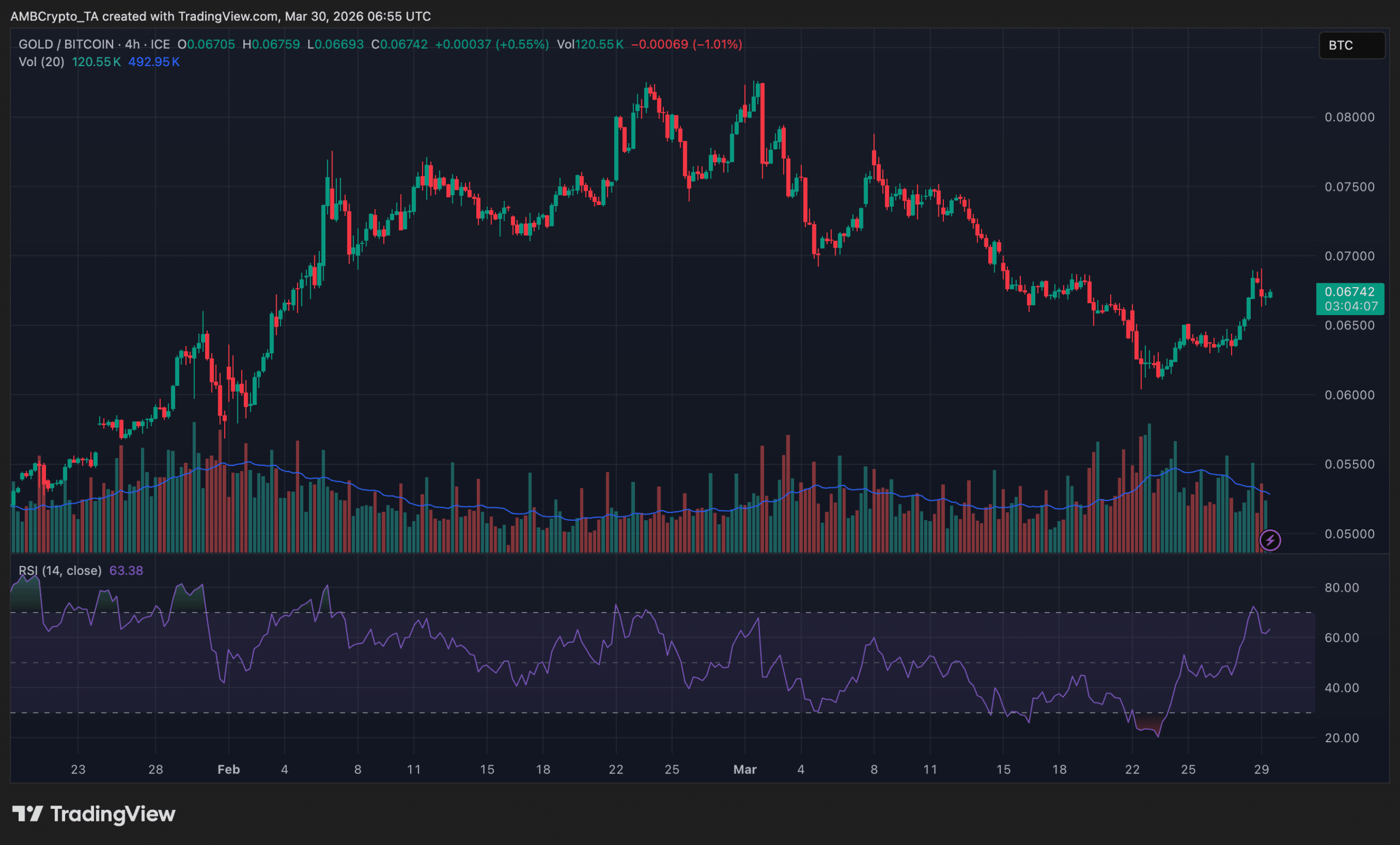
At the time of reporting, the XAU/BTC chart was showing green candles on the 4-hour time frame, indicating that gold was performing better than Bitcoin again. At the same time, Bitcoin was struggling to stay above the important $67,000 level.
Source: TradingView

Looking back, one can see that earlier this month, the chart dropped sharply. That meant Bitcoin was doing much better than Gold. Thereafter, both assets moved sideways for a while, showing a balance between them, but now things have shifted.

However, it’s also important to note that this bounce is currently minimal and does not hint at a real trend change. That said, the RSI was also around 72, in the overbought zone, which further confirmed the sentiment.

Bitcoin-Gold correlation hits rock bottom

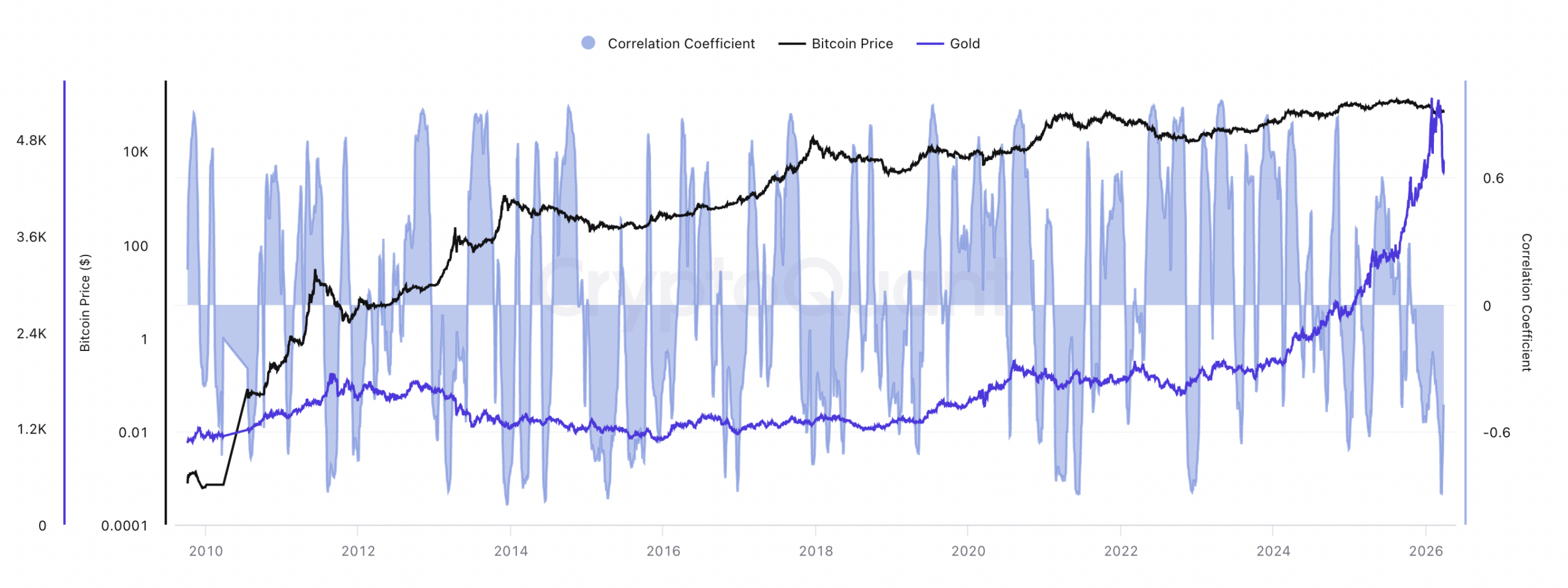
At press time, Bitcoin and Gold’s price correlation stood at -0.47, meaning that both assets were moving in opposite directions.
Source: CryptoQuant

So, according to on-chain analysis, Bitcoin is still being considered a risky asset in comparison to gold.

Bitcoin’s all-time critic, Peter Schiff, echoed this sentiment, noting,

Source: Peter Schiff/X

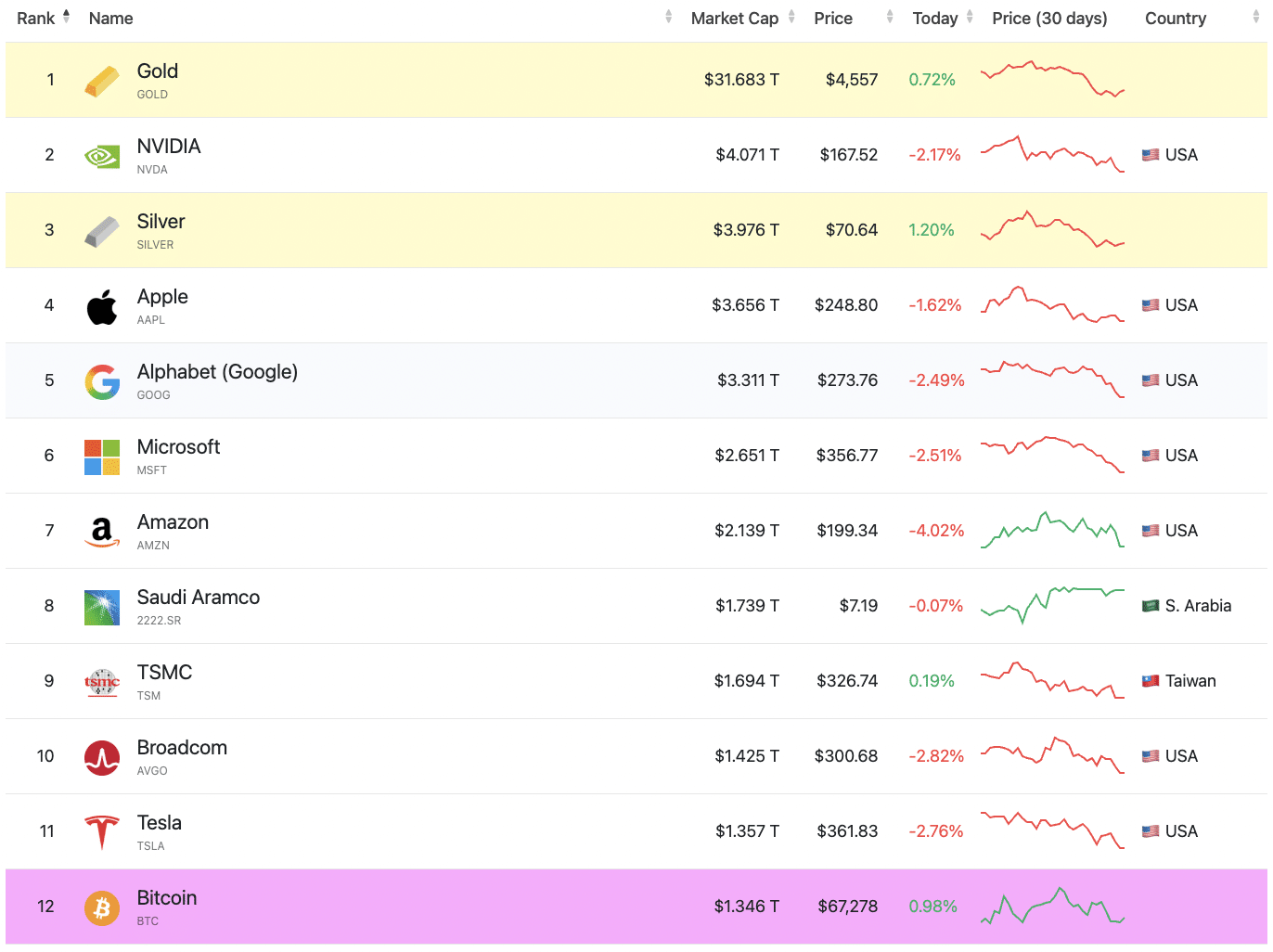
Schiff’s narrative was further supported by the asset market cap chart, which showed that Bitcoin was ranking 12th, whereas gold was at the top.
Source: CompaniesMarketCap

This comes as Bitcoin was trading around $67,258, and gold was priced at $4,536 at press time.

However, when you zoom out and look at the full month, Bitcoin was acting as a ‘safe haven’ when gold was witnessing its worst five-day drop since 1983.

Thus, as we move to Q2 of 2026, it remains to be seen whether the market is still divided or there is some agreement in terms of the actual ‘safe haven’ notion.


Final Summary

  • The Gold vs. Bitcoin debate continues to unfold, as both assets show strength at different times under different market conditions.
  • The negative correlation metric further confirms that both assets are not moving in the same direction.


Related Questions

QWhat was the price correlation between Bitcoin and Gold at the time of reporting, and what does it indicate?

AThe price correlation between Bitcoin and Gold was -0.47, indicating that the two assets were moving in opposite directions.

QAccording to the article, which asset was performing better on the XAU/BTC 4-hour chart at the time of reporting?

AGold was performing better than Bitcoin, as indicated by the green candles on the XAU/BTC 4-hour chart.

QWhat did the RSI level of 72 suggest about the market sentiment for the assets discussed?

AThe RSI level of 72 was in the overbought zone, which confirmed the sentiment that the bounce was minimal and not indicative of a real trend change.

QWho is cited in the article as a major critic of Bitcoin, and what was his stance?

APeter Schiff is cited as a major critic of Bitcoin, echoing the sentiment that Bitcoin is a risky asset compared to gold and advising people to 'get out while you still can'.

QHow did Bitcoin's role as a 'safe haven' asset compare to Gold's during the worst five-day drop for gold since 1983?

ABitcoin acted as a 'safe haven' asset during gold's worst five-day drop since 1983, outperforming gold and providing a hedge during that period of market stress.

Related Reads

Can Generative Models Finally Be Trained End-to-End? The Core Is a For Loop

This article introduces a novel training paradigm for generative models called Explorative Modeling (XM), which enables true end-to-end training. Traditionally, powerful generative models like autoregressive and diffusion models are not trained end-to-end. They are trained to predict a single small step but require iterative multi-step sampling for inference. This "exposure bias" leads to error accumulation and limits performance. The core challenge XM addresses is "mode blurring." In generative tasks, a single input (e.g., "generate a dog") corresponds to many valid outputs (multiple modes). Standard training objectives like reconstruction loss force the model to average these modes, producing unrealistic, blurry outputs. To avoid this, existing models break generation into many small, almost deterministic steps, sacrificing end-to-end training. XM tackles this by restructuring the training loop itself. Its key insight is to amplify "generative expressivity." For each training input, instead of generating one sample, the model generates K candidate outputs. Only the candidate closest to the real data is used for computing the loss and updating the model via backpropagation. This simple "best-of-K" mechanism is implemented as a short for-loop. By exploring multiple possibilities, the model learns to distribute its guesses across different modes rather than collapsing to their uninformative average. The paper demonstrates that "exploration" acts as a new, powerful scaling axis. Gains from XM increase with model size, data scale, and compute. Experiments show improvements in FID scores for image generation and significant efficiency gains, sometimes outperforming larger models without exploration. When pushed to the limit, XM enables fully single-step, end-to-end generative models. In robotics tasks, an "Explorative Policy" matched the performance of a 100-step Diffusion Policy with a single forward pass, drastically improving inference speed. While the best-of-K concept is not entirely new, the authors' contribution lies in formally understanding it as a direct method to boost generative expressivity without fragmenting the generation process. This work suggests that as models scale, enhancing exploration during training may become crucial for overcoming fundamental performance bottlenecks.

marsbit10m ago

Can Generative Models Finally Be Trained End-to-End? The Core Is a For Loop

marsbit10m ago

Annual Salary of Millions Competing for Electricians, Meta Rushes to Open Its Own Technical School

The AI boom is facing an unexpected bottleneck: a severe shortage of skilled construction workers and electricians. As tech giants like Meta, OpenAI, and Alphabet race to build massive data centers—such as OpenAI's $16 billion "Stargate" project—they are hitting a critical labor wall. The U.S. needs an estimated 130,000 more electricians, 240,000 construction workers, and 150,000 supervisors by 2030 for AI infrastructure alone, but tens of thousands of electrician jobs go unfilled each year. While AI companies offer high premiums, with electricians earning up to $280,000 annually, worker scarcity still causes massive losses—delays on a single project can cost $14.2 million per month. The complexity of building AI data centers, which require immense power (equivalent to powering hundreds of thousands of homes), sophisticated electrical systems, and advanced liquid cooling solutions, demands highly skilled technicians who are in short supply. To combat this, companies are investing heavily in training. Meta has committed $115 million to a free training school offering tuition, housing, and stipends, targeting 5,000 new workers. OpenAI is partnering with unions to secure skilled labor. These efforts are paying off, with a significant rise in Gen Z interest in trade schools over college. However, the power demands are staggering. AI data centers are driving a rapid surge in electricity consumption, projected to account for up to 12% of U.S. power use by 2028 and raising costs for consumers. Furthermore, the construction boom is project-based, leading to a potential future glut of trained workers once building peaks, which could depress wages industry-wide. The race for AI supremacy now depends as much on skilled hands as on advanced chips.

marsbit1h ago

Annual Salary of Millions Competing for Electricians, Meta Rushes to Open Its Own Technical School

marsbit1h ago

Trading

Spot
活动图片