Author: Wall Street News
Beneath a seemingly calm surface, the global financial markets are accumulating energy for a storm.
Yie-Hsin Hung, CEO of State Street Investment Management, told the Financial Times this week that the new Federal Reserve Chair, Wash, is deliberately reducing forward guidance, making it increasingly difficult for the market to grasp the path of monetary policy. "This will introduce volatility and uncertainty."
The USD/JPY exchange rate broke through the 162 mark this week, hitting a near 40-year low, raising renewed market alertness around the potential risks of yen carry trades. Vincent Mortier, Investment Director at Amundi, recommends: diversify risks as much as possible and hedge comprehensively.
Meanwhile, the U.S. stock index volatility (VIX) remains low, but underlying market pressure has quietly climbed to a multi-year high. UBS's derivatives strategy team's "Turbu-lens" market fragility indicator currently reads as high as 0.9 (on a scale of -1 to 1), the highest level since mid-September 2025. Historically, such readings have often presaged sharp, stage-wise spikes in the VIX. Concurrently, the second-quarter earnings season with high growth expectations of 24% is kicking off, and these lofty expectations further amplify potential downside risks.
For the market, the new Fed leadership is one of the most significant sources of uncertainty at present.
After taking office, the new Chair, Wash, has deliberately narrowed the scope and frequency of external communication, actively reducing forward-looking guidance on the next steps of monetary policy. The Financial Times cited analysts' views stating that from a macroprudential perspective, this approach is not unreasonable in itself—guiding market expectations is not the Fed's primary job, and more concise, coordinated external communication may do more good than harm.
However, when this policy narrative overlaps with Wash's ambitions to advance the reform agenda and the persistent turmoil in Iran, the situation becomes more complex. Inflationary concerns over rising oil prices have led to a noticeable pullback in bond markets this week. The root cause lies in investors' inability to determine whether Wash will respond to the recent modest but meaningful rise in oil prices with policy actions and to clarify his overall stance on the Fed's future policy direction. Bond yields are now nearing 4.6%, further increasing valuation pressure on equity markets.
The yen is once again becoming a potential 'tipping point' for global markets.
This week, the USD/JPY broke through 162, with the yen hitting its weakest level in 40 years, as markets bet that Japanese authorities will allow inflation to run at relatively high levels while remaining cautious about raising interest rates.
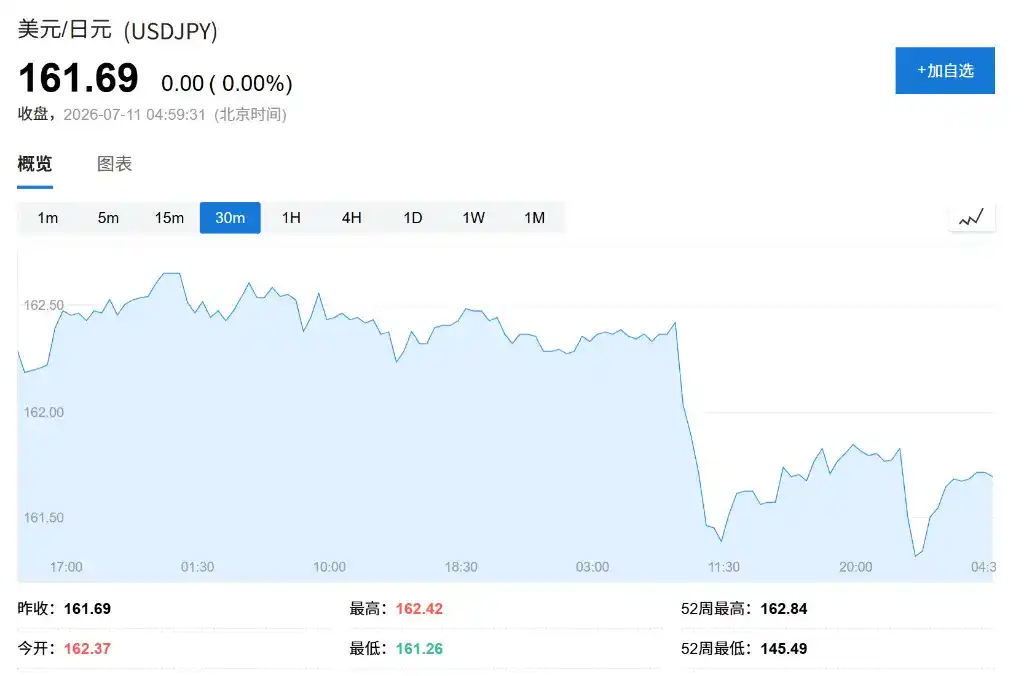
The systemic risk surrounding the yen stems mainly from two transmission paths. First, Japanese authorities, in order to intervene in the currency market and stabilize the yen, may need to sell dollar-denominated assets—particularly U.S. Treasury bonds—an operation that could trigger ripple effects in global bond markets. Second, there remain a large number of carry trade positions in the market that borrow cheap yen to buy other global assets. If the yen were to rebound sharply, these positions would face forced liquidation pressure, and the shockwave could spread to corners of the market currently difficult to predict. The Bank of England also noted this week that leveraged funds (i.e., borrowed money) have been an important driver of the recent strength in global equity markets, and their size has grown rapidly—this is never a comforting signal.
Barclays strategist Emmanuel Cau characterizes the current phase for U.S. stocks as a "dangerous summer window," believing that under the seemingly stable market benchmarks, undercurrents are surging. Barclays strategist Anshul Gupta's team points out that the recent retreat in the VIX coincides with a calendar window when seasonal volatility typically narrows, representing a "short-lived sweet spot" with limited persistence.
More noteworthy is the significant divergence between the index and individual stocks. UBS strategist Maxwell Grinacoff's team points out that current single-stock volatility exceeds index volatility by more than three times. The team warns that this gap is likely to narrow over the summer—by then, whether due to monetary policy repricing or geopolitical disturbances, it could trigger a sharp spike in index-level volatility. If systematic strategies further add leverage across the board, the fragility indicator reading "could truly hit +1."
The liquidity scarcity characteristic of summer acts as an amplifier. Every summer in the Northern Hemisphere, veteran traders and investors take holidays, often leaving more junior teams behind, trading volumes shrink, and market liquidity drops sharply. Spreads widen, and even in the absence of substantial new information, various assets such as stocks, bonds, and currencies are more prone to violent swings. The summer of 2024 serves as a vivid precedent: a not-so-severe disappointment in U.S. inflation data unexpectedly hammered the dollar, boosted the yen, and sold off tech stocks, with the Japanese stock market plunging 12% in a single day and rumors circulating that the Fed would cut rates urgently.
Against the macro backdrop described above, a high-expectations earnings season is now officially starting, further concentrating market risks.
Analysts' expectations for second-quarter earnings growth for S&P 500 index constituents are as high as 24%, with expectations for the Euro Stoxx 600 at 12%. Unlike past earnings seasons, analysts have continuously raised forecasts right up to the reporting period. This strong confidence conversely means that if actual results disappoint the market, there is greater room for adjustment and potentially steeper declines.
The technology sector warrants particular attention. According to Barclays' calculations, Apple, Meta, Amazon, Alphabet, Microsoft, and Nvidia have collectively lost about $2 trillion in market value since October last year. It is noteworthy that Nvidia, the chip giant with a market cap of $5 trillion, now has a P/E ratio similar to that of snack company Hershey, indicating a clear cooling of market enthusiasm for it.
Unexpected reversals have also occurred in gold and oil. After a strong start to 2026, gold prices have just posted their largest monthly decline since 2008, falling over 11%; oil prices have also bucked the trend and retreated amidst a chorus of warnings from energy experts. These changes collectively point to one reality: market consensus is breaking down, and the reliability of mainstream narrative logic has diminished significantly.
In terms of hedging strategy selection, given that stock differentiation and sector rotation may persist during the earnings season, index-level hedging tools may have limited effectiveness. Maxwell Grinacoff suggests, "Single-stock options may offer better tactical opportunities." Amundi's Vincent Mortier offers more macro advice: diversify risks as much as possible and hedge comprehensively—so that "you can relax and vacation all summer, which is a good goal."