Giants Enter the Arena and Asset Restructuring: The Logic of On-Chain Investment Against the Backdrop of Precious Metals Volatility

marsbitPublished on 2026-02-11Last updated on 2026-02-11

Abstract

The entry of major financial institutions like HSBC and J.P. Morgan into tokenized gold, alongside significant investments in platforms like Ondo Finance and PAXG, marks a shift toward blockchain-based real-world assets (RWA). This trend is particularly relevant amid recent volatility in gold and silver markets, where prices experienced sharp corrections in early 2026. Tokenized precious metals offer three key advantages over traditional forms: 1) **Enhanced Liquidity**: Assets like PAXG enable 24/7 trading, avoiding the time and spatial constraints of physical gold trading. During recent price swings, PAXG’s trading volume surged to $1.2 billion, demonstrating demand for instant rebalancing. 2) **Operational Efficiency**: Tokenized securities such as Ondo’s SLVon allow immediate settlement and capital reuse, unlike traditional T+2 ETF settlements. During a silver price crash, SLVon saw 45% turnover while traditional markets were closed. 3) **Yield Generation**: Assets like KAG and XAUm offer yields (e.g., 1.8%–3.2% annually) and enable collateralization for additional DeFi yield opportunities, maintaining portfolio returns even during corrections. In summary, tokenized metals provide superior liquidity, efficiency, and utility—transforming gold and silver into dynamic, productive assets especially valuable during market stress.

When HSBC launched its distributed ledger gold platform and J.P. Morgan enabled cross-border collateral settlement of tokenized gold bars through the Onyx network, the restructuring of underlying assets initiated by traditional financial giants had already begun. This trend has found the most direct confirmation in the capital markets: Ondo Finance (SLVon) secured heavy investment from Peter Thiel's Founders Fund and Coinbase Ventures; meanwhile, PAXG, through its deep compliance partnerships with PayPal and Mastercard, has directly integrated the trust of traditional payment systems into the digital asset space.

This article uses recent market movements in gold and silver as a case study to illustrate why institutions are increasingly favoring tokenized assets.

Entering February 2026, the global gold and silver markets are undergoing a stress test. After gold prices peaked at $5,600 at the end of January, the market experienced a brutal long squeeze influenced by consecutive hawkish statements from Fed officials. As of yesterday (February 5th), spot gold, after a rebound, fell back into high volatility, currently retreating to around $4,980, failing to hold above the $5,000 mark; silver's trajectory was similarly turbulent, currently quoted at $86.5.

This vertical drop followed by a price correction has become the ultimate proving ground for RWA (Real World Asset) assets. It not only tests investors' holding endurance but also vividly reveals how on-chain investment, backed by industry giants, fundamentally enhances capital control, granting professional investors superior disposal efficiency in extreme market conditions compared to traditional physical assets.

1. The Liquidity Premium During Price Volatility

In traditional physical or paper gold trading, price corrections are accompanied by significant liquidity lag. Firstly, there is a dual constraint of time and space: physical gold buybacks are typically limited by business hours and physical location; even Gold ETFs cannot respond to selling waves triggered by macro news, such as the nomination of Kevin Warsh for Fed Chair, during weekends or non-trading hours.

Secondly, the two-way cost erosion is particularly pronounced during volatile periods. In traditional channels, buyback premiums often expand asymmetrically during price declines, meaning investors bear not only paper losses but also higher realization spreads. Coupled with the T+n settlement system of the traditional financial system, the ability to quickly rotate funds between asset classes is severely limited. In contrast, gold and silver assets within a Web3 architecture offer 24/7 instant settlement capability, a form of liquidity with极高的 risk avoidance value during corrective markets.

2. The Positioning and Deep Advantages of On-Chain Assets

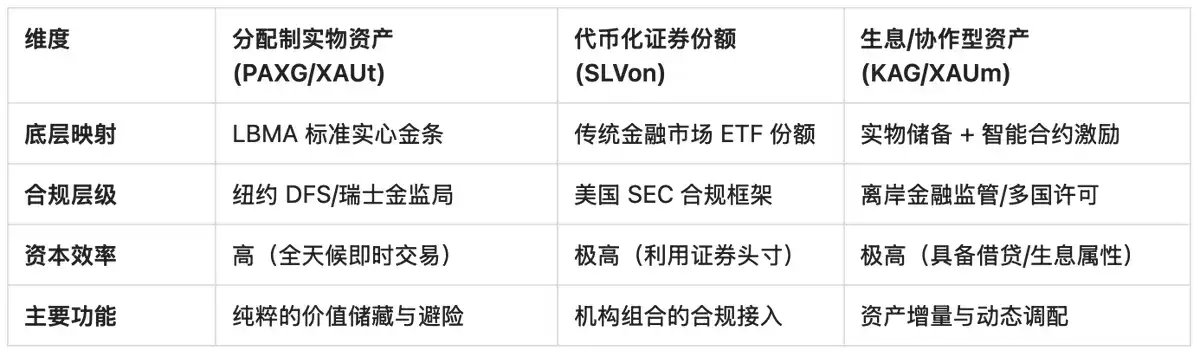
Based on research of current mainstream RWA projects, we can categorize on-chain precious metals into three complementary investment tracks according to their underlying structure and functional attributes, and explore their generational advantages over traditional models.

Category A: Digitized Form of Physical Holding (PAXG, XAUt, CGO)

The core logic of this track is the securitization of physical ownership through blockchain technology. Its advantages first manifest in extremely low operational thresholds and asset flexibility. Compared to the typical 3%-5% physical premium and high shipping/insurance costs associated with physical gold transactions, on-chain assets significantly reduce friction costs.

  • Quantitative Support: Represented by Comtech Gold (CGO), it supports investments starting from 1 gram (approx. $160), whereas the standard entry threshold for institutional-grade vaults is typically 12.4 kilograms (delivery bar). According to January 2026 data, PAXG's 24-hour trading volume surged to $1.2 billion during the gold price volatility, proving the real demand from institutions for "second-level position replenishment" using on-chain assets during extreme fluctuations.
  • Audit Premium: On-chain Proof of Reserve transforms the traditional quarterly spot checks into minute-by-minute logical verification. PAXG, combined with real-time reserve data provided by the Chainlink oracle, maintains its secondary market discount/premium consistently within ±0.1%, far superior to the buy-sell spreads in the physical market, which can fluctuate up to 2% during panic periods.

Category B: Tokenized Securitized Products (SLVon)

As an on-chain representation of traditional compliant financial products, SLVon (launched by Ondo Finance) demonstrates dimensional superiority in cross-market arbitrage and risk hedging. Its strategic value lies in introducing the stability of traditional securities assets into the 24-hour crypto trading logic.

  • Quantitative Support: In early February 2026, when silver prices unexpectedly plummeted during U.S. market closure, the turnover rate of SLVon on-chain reached 45% of its total supply, while traditional iShares Silver Trust (SLV) holders could only passively wait for the U.S. market to open.
  • Efficiency Comparison: Traditional ETF settlement cycles are T+1 or T+2, whereas SLVon, based on Solana or Ethereum layers, achieves instant settlement functionality. This means investors can immediately deploy funds from sold silver shares into DeFi protocols to capture short-term volatility opportunities yielding 15% or more, increasing capital turnover efficiency by more than 50 times compared to traditional brokerage accounts.

Category C: Yield-Bearing and High-Efficiency Collaborative Assets (KAG, XAUm)

This track彻底终结了 (completely ends) the history of zero yield on precious metals, transforming them into income-generating productive assets. In corrective markets, this positive yield characteristic acts as a buffer against price declines.

  • Quantitative Support: The fee-sharing model employed by Kinesis Silver (KAG) provided holders with an average annual yield (Yield) of 1.8% - 3.2% in 2025, which not only covered the holding cost of gold but also achieved asset appreciation.
  • Capital Reuse Rate: The performance of Matrixdock (XAUm) is even more significant. During this recent period of sharp gold price fluctuations, XAUm's Loan-to-Value (LTV) ratio remained at a稳健的 (robust) level of 85%. This means holders can borrow stablecoins for liquidity mining with yields above 10% without selling their gold positions. This strategy allows the internal rate of return (IRR) of the asset portfolio to maintain positive growth even during price corrections, demonstrating the collaborative depth of RWA assets in extreme market conditions.

3. Comprehensive Analysis of the Three Strategic Paths
4. Conclusion: Correction Periods are Opportunities for Asset Structure Upgrades

The market correction in early 2026 once again proves that the right to dispose of an asset is as important as ownership itself. The true value of on-chain assets lies in their provision of instant risk hedging tools during price declines, asset productivity during sideways movement, and seamless profit-taking channels during price increases.

For operators committed to building professional market analysis pages, emphasizing asset liquidity efficiency rather than单纯的 (mere) price predictions will be the core logic for establishing a professional barrier. The current price retracement provides a window to observe the liquidity performance of different on-chain metal projects under extreme stress tests, which holds significant reference value for establishing long-term, robust asset allocation plans.


Related Questions

QWhat are the three main categories of on-chain precious metal assets discussed in the article, and what is the core advantage of each?

AThe three categories are: A) Digitized form of physical holdings (e.g., PAXG, XAUt, CGO), with the core advantage of low operational thresholds and asset flexibility; B) Tokenized securitized products (e.g., SLVon), with the core advantage of enabling cross-market arbitrage and 24/7 risk hedging; C) Yield-bearing and high-efficiency collaborative assets (e.g., KAG, XAUm), with the core advantage of generating cash flow and allowing for capital reuse through lending and yield farming.

QHow did the article quantify the liquidity advantage of a tokenized asset like PAXG during a period of price volatility?

AThe article stated that during the gold price volatility in January 2026, PAXG's 24-hour trading volume surged to $1.2 billion. This demonstrated the real institutional demand for using on-chain assets for 'second-level position replenishment' during extreme market swings.

QAccording to the article, what key limitation of traditional gold ETFs does a tokenized product like SLVon solve?

ASLVon solves the limitation of traditional ETFs being bound by market trading hours and T+1 or T+2 settlement cycles. For example, when the silver price crashed during a U.S. stock market closure, SLVon holders could trade immediately on-chain, while iShares Silver Trust (SLV) holders had to wait for the U.S. market to open.

QWhat specific benefit do yield-bearing RWA assets like KAG and XAUm provide during a market correction, as per the article?

ADuring a market correction, the yield provided by assets like KAG and XAUm acts as a buffer against price depreciation. For instance, KAG provided an annual yield of 1.8%-3.2% in 2025, and XAUm maintained a high loan-to-value (LTV) ratio of 85%, allowing holders to borrow stablecoins for liquidity mining without selling their gold positions, thus maintaining positive portfolio returns.

QWhat major event triggered the sharp correction in gold and silver prices at the beginning of 2026, as described in the article?

AThe sharp correction was triggered by hawkish comments from Federal Reserve officials, following gold prices reaching a peak of $5,600 at the end of January. This led to a severe long squeeze, causing prices to fall, with spot gold eventually retreating to around $4,980.

Related Reads

The AI Agent Era Accelerates Its Arrival: Questflow Defines a New Paradigm of Financial Intelligence with On-Chain AI Brokerage

The AI Agent era is accelerating, with the CB Insights AI 100 list highlighting global investment confidence. The focus has shifted from whether AI works to its speed of deployment and ability to manage complex workflows, with autonomous AI Agents driving this transformation. At the forefront is Questflow, a Singapore-based startup redefining financial intelligence through its on-chain AI brokerage. Unlike tools that merely provide data dashboards, Questflow deploys AI Agents that proactively scan markets, form judgments, and execute trades via a conversational interface—operating 24/7 without requiring manual confirmation for each decision. This embodies the new AI paradigm of agents capable of executing multi-step workflows autonomously. Questflow's mission is to democratize institutional-grade trading intelligence. Historically reserved for the ultra-wealthy, this capability is now accessible starting from just $1 through Questflow's "AI Clone + Copy Trade" model. The platform charges only a 1% execution fee, aligning its incentives directly with users and eliminating traditional management or performance fees. The timing is opportune, aligning with key trends identified by CB Insights: the scalable deployment of AI Agents, accelerated AI adoption in financial services, and the maturation of on-chain infrastructure. With robust liquidity on platforms like Hyperliquid and Polymarket, alongside advancements in AI reasoning and non-custodial wallet security, Questflow is positioned to merge the roles of broker, fund, and exchange into a single, accessible platform for millions.

链捕手21m ago

The AI Agent Era Accelerates Its Arrival: Questflow Defines a New Paradigm of Financial Intelligence with On-Chain AI Brokerage

链捕手21m ago

Why Pricing Social Interactions is Doomed to Fail?

Titled "Why Putting a Price on Social Interaction Is Doomed to Fail," this article critiques attempts to monetize social networks directly through SocialFi models, arguing their inevitable failure stems from a fundamental misunderstanding of media dynamics. Using Marshall McLuhan's theory of "hot" and "cold" media, the author posits that social networks are inherently "cold" media. Their value isn't contained in individual posts but is co-created through user participation, interpretation, and fragmented, ongoing interaction (e.g., replies, shares). This ambiguity and need for user involvement are core to their function. The article asserts that SocialFi projects like Friend.tech failed because introducing real-time, tradable financial pricing (a definitive "hot" signal) into this "cold" environment doesn't add a layer—it replaces the medium's essence. The unambiguous price signal overshadows and nullifies the nuanced, participatory social signal. Users become traders, not participants, and when speculative profits vanish, the underlying social ecosystem—never genuinely cultivated—collapses entirely. This principle extends beyond crypto. The author argues platforms like Twitter have gradually "heated up" through metrics (likes, retweets counts, algorithmically defined value), shifting users from participants to performers and eroding organic engagement. The solution isn't to abandon capital but to manage its entry point. Successful models like Substack, Patreon, or Bandcamp allow capital to "condense" at specific, isolated nodes (e.g., subscriptions, one-time payments) without permeating and "heating" every social interaction. They preserve the core "cold," participatory medium while enabling monetization at designated boundaries. The NFT boom and bust serves as a stark parallel: the ancient "cold" medium of collecting (valued for story, community, gradual accumulation) was rapidly destroyed by platforms that introduced real-time floor prices, rarity scores, and trading dashboards, transforming collectors into speculators and vaporizing cultural value when prices fell. The core lesson: "Liquidity equals heat." Injecting high liquidity and definitive pricing into a "cold" participatory medium doesn't optimize it; it fundamentally alters and destroys its value-creating mechanism. The future lies not in pricing every social gesture but in finding precise, non-invasive points for capital to condense without overheating the entire ecosystem.

marsbit29m ago

Why Pricing Social Interactions is Doomed to Fail?

marsbit29m ago

Jensen Huang's CMU Speech: In the AI Era, Don't Just Watch, Build

Jensen Huang, CEO of NVIDIA and a first-generation immigrant, delivered the commencement address to Carnegie Mellon University's class of 2026. He shared his personal journey from a humble background to founding NVIDIA, emphasizing resilience, learning from failure, and the responsibility that comes with leadership. Huang framed the present moment as the dawn of the AI revolution, a shift he believes is more profound than previous computing waves. He described AI as fundamentally resetting computing—moving from human-written software to machines that understand, reason, and use tools. This will create a new industry for generating intelligence and transform every sector. While acknowledging AI's potential to automate tasks and displace some jobs, Huang distinguished between the *tasks* of a job and its core *purpose*. He argued AI will augment human capability, not replace humans. The real risk, he stated, is not AI itself, but people being left behind by those who effectively use AI. He presented AI as a generational opportunity for massive infrastructure investment—in chip factories, data centers, energy grids, and advanced manufacturing—that could re-industrialize nations like the U.S. and bridge the digital divide by making computing and intelligent tools accessible to all. Huang called for a balanced approach: advancing AI safely and responsibly, establishing prudent policies, ensuring broad access, and encouraging universal participation. He urged the graduates not to fear the future but to engage with optimism and ambition, reminding them of CMU's motto, "My heart is in the work." His core message was clear: this is their moment to actively build and shape the AI-powered future, not merely observe it.

marsbit1h ago

Jensen Huang's CMU Speech: In the AI Era, Don't Just Watch, Build

marsbit1h ago

Trading

Spot
Futures
活动图片




