Galaxy Prepares a $100M Hedge Fund as Bitcoin Weakens, Fueling Hyper’s $31.2M Presale

bitcoinistPublished on 2026-02-04Last updated on 2026-02-04

Abstract

Galaxy Digital is launching a $100M hedge fund to navigate Bitcoin's stagnation, signaling a shift in institutional strategy toward managing volatility. As capital rotates from stagnant Bitcoin into high-utility infrastructure, Bitcoin Hyper ($HYPER), a Bitcoin Layer 2 integrated with Solana Virtual Machine (SVM), gains traction. It addresses Bitcoin's scalability issues by combining Bitcoin's security with Solana's speed, enabling DeFi and dApps. The project has raised $31.2M in its presale, attracting significant whale investment, with strong staking incentives aimed at encouraging holding. This reflects growing confidence in Layer 2 solutions as a key narrative.

Institutional strategies are shifting as Bitcoin hits a wall at key technical levels.

Financial Times indicates that Galaxy Digital is positioning a new $100M hedge fund designed to handle volatility. That move signals one thing: smart money is prepping for a prolonged period of chop, not a straight vertical ascent.

This defensive posturing suggests a changing risk appetite. When the room’s biggest asset starts to stagnate, or drops below the 50-day moving average, capital usually doesn’t leave the ecosystem entirely. It rotates.

Traders are hunting for high-beta plays that offer actual utility, not just digital gold storage.

We’re seeing a clear divergence. While spot Bitcoin struggles for momentum, infrastructure protocols building on top of the network are soaking up liquidity. If Bitcoin is gold, the layers making it spendable are the rails.

That rotation is funneling capital straight into Layer 2 solutions and Bitcoin Hyper ($HYPER) is catching the overflow.

Buy $HYPER now.

Bitcoin Hyper Integrates SVM To Solve Network Congestion

Bitcoin’s biggest problem remains its rigidity. It’s secure, sure, but the base layer is a nightmare for developers trying to build complex apps, 7 transactions per second (TPS) simply doesn’t cut it.

Bitcoin Hyper ($HYPER) fixes this by introducing the first Bitcoin Layer 2 integrated with the Solana Virtual Machine (SVM).
Why does that architecture matter? Because it decouples settlement from execution. By using the SVM for the execution environment, Bitcoin Hyper gets sub-second finality (speed usually reserved for Solana) while anchoring final settlement on Bitcoin’s secure L1.
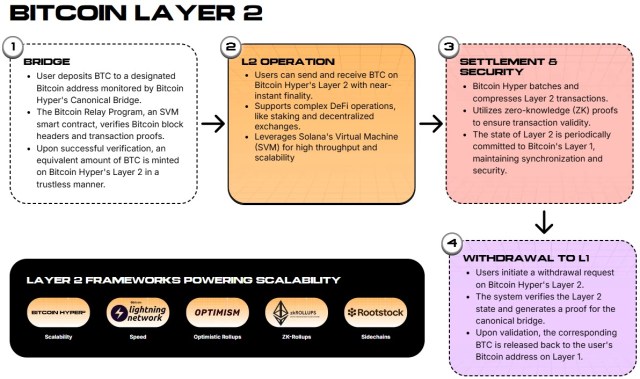
It’s a modular approach that finally allows for DeFi swaps, lending protocols, and Rust-based gaming dApps that were previously impossible on the Bitcoin network.

The result is obvious: faster and cheaper on-chain transactions, turning Bitcoin into an investor magnet if everything goes to plan.

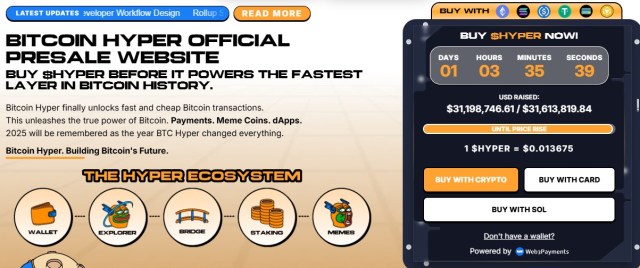
The market’s appetite for this ‘best of both worlds’ setup, Bitcoin’s security plus Solana’s speed, is obvious. According to the official presale page, Bitcoin Hyper has already raised $31.2M.

That figure suggests serious conviction from early backers, even while the broader market looks choppy. Based on these numbers, $HYPER looks hot for 2026, once the token hits DEXs.

Check the official $HYPER presale.

Smart Money Targets $HYPER As Presale Crosses $31.2M

Retail investors often wait for green candles. On-chain analysis suggests the big players aren’t waiting. Etherscan records show that three whale wallets have already accumulated $1M in the Bitcoin Hyper ecosystem.
That accumulation tracks with the project’s tokenomics (specifically the staking incentives). Bitcoin Hyper offers high APY for immediate staking after the Token Generation Event (TGE), plus a short 7-day vesting period. It’s designed to incentivize holding rather than immediate dumping, a potential supply shock scenario that sophisticated investors love to hunt for.

At $0.0136751, the entry point is still accessible relative to the massive capital already committed. The combination of that $31.2M+ raise and verifiable whale activity signals a market betting on Layer 2s as the dominant narrative for the next cycle, regardless of Bitcoin’s short-term price action.

Explore the $HYPER presale today.

Disclaimer: This article is for informational purposes only and does not constitute financial advice. Cryptocurrency investments, including presales and Layer 2 tokens, carry significant risk. Always perform your own due diligence before investing.

Related Questions

QWhat is Galaxy Digital preparing according to the article and why?

AGalaxy Digital is preparing a new $100M hedge fund designed to handle market volatility, signaling that institutional 'smart money' is preparing for a prolonged period of market uncertainty and a potential rotation of capital rather than a straightforward Bitcoin bull run.

QHow does Bitcoin Hyper ($HYPER) aim to solve Bitcoin's scalability problem?

ABitcoin Hyper introduces the first Bitcoin Layer 2 integrated with the Solana Virtual Machine (SVM). This architecture decouples settlement from execution, using the SVM for fast execution (achieving sub-second finality) while anchoring final settlement on Bitcoin's secure base layer, thus enabling complex dApps and solving the network's low transaction throughput.

QWhat evidence does the article provide to show strong investor interest in the $HYPER presale?

AThe article states that the $HYPER presale has already raised $31.2 million. Furthermore, on-chain analysis from Etherscan shows that three 'whale' wallets have each accumulated over $1 million worth in the Bitcoin Hyper ecosystem, indicating serious conviction from large, sophisticated investors.

QWhat is the current price and key incentive for staking $HYPER tokens mentioned in the article?

AThe current presale price for a $HYPER token is $0.0136751. A key staking incentive is a high Annual Percentage Yield (APY) offered immediately after the Token Generation Event (TGE), coupled with a short 7-day vesting period. This is intended to incentivize holding and prevent immediate selling, creating a potential supply shock.

QAccording to the article, where is capital rotating to as Bitcoin's price weakens?

AAs Bitcoin's price weakens and struggles for momentum, capital is rotating into infrastructure protocols and Layer 2 solutions built on top of the Bitcoin network. These projects, which offer actual utility and high-beta plays, are soaking up the liquidity that is moving away from spot Bitcoin.

Related Reads

Why Hasn't the U.S. Seen the Rise of 'Huabei' or 'Jiebei'?

The article explores why the U.S. lacks large-scale consumer credit products like China's "Huabei" and "Jiebei," despite having a developed financial sector. Key reasons include: 1. **Structural Barriers**: A fragmented federal and state regulatory system, reinforced by post-2008 reforms like the Dodd-Frank Act, raises compliance costs and protects traditional banks, stifling fintech innovation. 2. **Credit Card Dominance**: Credit cards, used by 70-80% of adults, form a $1.28 trillion debt market with high APRs (avg. 22.3%). This system cross-subsidizes users who pay in full with those carrying balances, creating a predatory yet entrenched ecosystem. 3. **Data Privacy Laws**: Strict regulations (e.g., FCRA, CCPA) prevent tech giants from leveraging behavioral data for credit scoring, unlike in China where such data fuels fintech models. 4. **Capital Market Disincentives**: Wall Street penalizes tech firms entering finance due to lower valuations associated with heavy regulation and risk, as seen in Apple’s failure with Apple Card. 5. **Banking Oligopoly**: Major banks control consumer lending, leveraging lobbying power and consumer habits to maintain high-cost credit, while alternatives like payday loans (400% APR) or "unbanked" services remain niche or exploitative. Ultimately, regulatory, structural, and corporate interests collectively block the emergence of accessible, low-cost digital lending in the U.S.

Odaily星球日报44m ago

Why Hasn't the U.S. Seen the Rise of 'Huabei' or 'Jiebei'?

Odaily星球日报44m ago

More and More 'Model Supermarkets' Are Opening: ByteDance, Alibaba, and Tencent Compete to Integrate

Chinese tech giants like ByteDance, Alibaba, and Tencent are accelerating the rollout of integrated AI model subscription services—dubbed “model supermarkets”—to provide developers with bundled access to multiple leading domestic large language models (LLMs). ByteDance’s Volcengine recently upgraded its "Coding Plan" by adding newer models like GLM-5.1, Minimax M2.7, and Kimi k2.6, allowing subscribers to use various top models under a single monthly fee starting at ¥40. However, user feedback reveals significant issues, including rapid consumption of usage limits (e.g., hitting caps within hours), frequent server errors (like HTTP 429), and slow response times during peak hours. Complaints about misleading deduction rates—where calls to advanced models consume more quota—are also common. The trend is industry-wide: Alibaba, Tencent, and Baidu have all launched similar multi-model coding plans. While these platforms reduce trial costs for developers, they also expose challenges in balancing affordability with service quality and computational stability. Amid this shift, independent AI companies like Zhipu, MiniMax, and Moonlight Face (Kimi) are developing strategies to avoid becoming mere “pipes” in this ecosystem—focusing on vertical applications, autonomous agents, and long-context models to retain competitiveness. Analysts suggest that, while platform aggregation may pressure model firms in the short term, specialized and vertical AI capabilities will remain differentiated in the long run.

marsbit48m ago

More and More 'Model Supermarkets' Are Opening: ByteDance, Alibaba, and Tencent Compete to Integrate

marsbit48m ago

Trading

Spot
Futures

Hot Articles

What is $BITCOIN

DIGITAL GOLD ($BITCOIN): A Comprehensive Analysis Introduction to DIGITAL GOLD ($BITCOIN) DIGITAL GOLD ($BITCOIN) is a blockchain-based project operating on the Solana network, which aims to combine the characteristics of traditional precious metals with the innovation of decentralized technologies. While it shares a name with Bitcoin, often referred to as “digital gold” due to its perception as a store of value, DIGITAL GOLD is a separate token designed to create a unique ecosystem within the Web3 landscape. Its goal is to position itself as a viable alternative digital asset, although specifics regarding its applications and functionalities are still developing. What is DIGITAL GOLD ($BITCOIN)? DIGITAL GOLD ($BITCOIN) is a cryptocurrency token explicitly designed for use on the Solana blockchain. In contrast to Bitcoin, which provides a widely recognized value storage role, this token appears to focus on broader applications and characteristics. Notable aspects include: Blockchain Infrastructure: The token is built on the Solana blockchain, known for its capacity to handle high-speed and low-cost transactions. Supply Dynamics: DIGITAL GOLD has a maximum supply capped at 100 quadrillion tokens (100P $BITCOIN), although details regarding its circulating supply are currently undisclosed. Utility: While precise functionalities are not explicitly outlined, there are indications that the token could be utilized for various applications, potentially involving decentralized applications (dApps) or asset tokenization strategies. Who is the Creator of DIGITAL GOLD ($BITCOIN)? At present, the identity of the creators and development team behind DIGITAL GOLD ($BITCOIN) remains unknown. This situation is typical among many innovative projects within the blockchain space, particularly those aligning with decentralized finance and meme coin phenomena. While such anonymity may foster a community-driven culture, it intensifies concerns about governance and accountability. Who are the Investors of DIGITAL GOLD ($BITCOIN)? The available information indicates that DIGITAL GOLD ($BITCOIN) does not have any known institutional backers or prominent venture capital investments. The project seems to operate on a peer-to-peer model focused on community support and adoption rather than traditional funding routes. Its activity and liquidity are primarily situated on decentralized exchanges (DEXs), such as PumpSwap, rather than established centralized trading platforms, further highlighting its grassroots approach. How DIGITAL GOLD ($BITCOIN) Works The operational mechanics of DIGITAL GOLD ($BITCOIN) can be elaborated on based on its blockchain design and network attributes: Consensus Mechanism: By leveraging Solana’s unique proof-of-history (PoH) combined with a proof-of-stake (PoS) model, the project ensures efficient transaction validation contributing to the network's high performance. Tokenomics: While specific deflationary mechanisms have not been extensively detailed, the vast maximum token supply implies that it may cater to microtransactions or niche use cases that are still to be defined. Interoperability: There exists the potential for integration with Solana’s broader ecosystem, including various decentralized finance (DeFi) platforms. However, the details regarding specific integrations remain unspecified. Timeline of Key Events Here is a timeline that highlights significant milestones concerning DIGITAL GOLD ($BITCOIN): 2023: The initial deployment of the token occurs on the Solana blockchain, marked by its contract address. 2024: DIGITAL GOLD gains visibility as it becomes available for trading on decentralized exchanges like PumpSwap, allowing users to trade it against SOL. 2025: The project witnesses sporadic trading activity and potential interest in community-led engagements, although no noteworthy partnerships or technical advancements have been documented as of yet. Critical Analysis Strengths Scalability: The underlying Solana infrastructure supports high transaction volumes, which could enhance the utility of $BITCOIN in various transaction scenarios. Accessibility: The potential low trading price per token could attract retail investors, facilitating wider participation due to fractional ownership opportunities. Risks Lack of Transparency: The absence of publicly known backers, developers, or an audit process may yield skepticism regarding the project's sustainability and trustworthiness. Market Volatility: The trading activity is heavily reliant on speculative behavior, which can result in significant price volatility and uncertainty for investors. Conclusion DIGITAL GOLD ($BITCOIN) emerges as an intriguing yet ambiguous project within the rapidly evolving Solana ecosystem. While it attempts to leverage the “digital gold” narrative, its departure from Bitcoin's established role as a store of value underscores the need for a clearer differentiation of its intended utility and governance structure. Future acceptance and adoption will likely depend on addressing the current opacity and defining its operational and economic strategies more explicitly. Note: This report encompasses synthesised information available as of October 2023, and developments may have transpired beyond the research period.

363 Total ViewsPublished 2025.05.13Updated 2025.05.13

What is $BITCOIN

Discussions

Welcome to the HTX Community. Here, you can stay informed about the latest platform developments and gain access to professional market insights. Users' opinions on the price of BTC (BTC) are presented below.

活动图片