From PolyMarket to Hyperliquid: App Chain Is Becoming the New Alpha

marsbitPublished on 2026-01-24Last updated on 2026-01-24

Abstract

The article discusses the trend of successful applications, such as PolyMarket and Hyperliquid, building their own dedicated App Chains. Initially, deploying on established public blockchains is efficient for product validation. However, as applications scale, they face challenges like network congestion, unpredictable fees, and a lack of control over their user experience and economic model. An App Chain allows them to own their infrastructure, optimizing for performance, cost, and value capture. Yet, the real challenge shifts from the technical ability to launch a chain to overcoming its cold start: attracting users, facilitating seamless asset transfers, and preventing liquidity fragmentation. The piece highlights Caldera as a solution that simplifies chain deployment and, crucially, integrates new chains into an interconnected network from day one through its Metalayer technology. This system reduces onboarding friction and uses its token, $ERA, to align incentives and create a flywheel effect where each new chain strengthens the entire ecosystem. The key takeaway is that the new competitive advantage (Alpha) is not merely launching an App Chain, but successfully integrating it into a broader network to ensure immediate usability and growth.

Over the past period, the popularity of the prediction market project PolyMarket has taught the industry a lesson: when a truly in-demand, well-designed application takes off, it not only brings users and buzz but can even push a long-dormant network back into the spotlight—Polygon once topping Chain Revenue, surpassing Base, is a highly representative signal. But more notably, it's the "top priority" that PolyMarket repeatedly emphasized amid the hype: building its own chain.
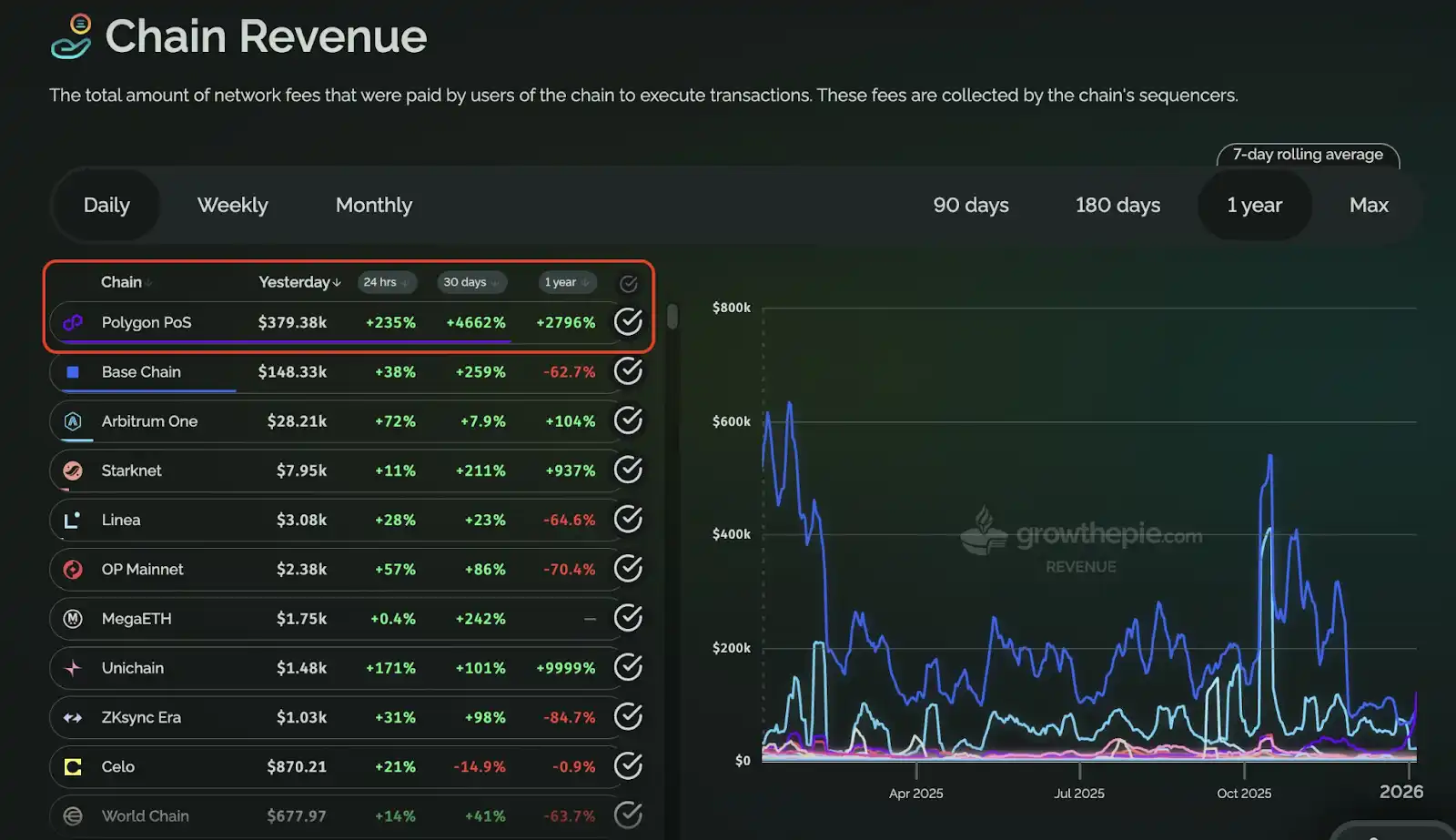
This sounds like a further technical upgrade, but in essence, it's an inevitable choice as applications enter the deep end of growth. Once product validation is complete, transaction behaviors stabilize, and user scale expands, applications begin to feel dissatisfied with "renting someone else's underlying infrastructure" and instead want to control key experiences and revenue streams. The same path has appeared in another more typical case: the leading Perp DEX, Hyperliquid. It didn't settle for being just an "application" on mainstream public chains but directly built its own App Chain to unify the trading system, execution environment, and user experience, ultimately achieving near "centralized exchange-level" smoothness and throughput, thereby establishing a moat.

Looking at these two cases together, they point to the same trend: App Chain is becoming the new Alpha.

Why "The More Successful the Application, the More It Wants to Build Its Own Chain"?

The more successful an application is, the more likely it is to reach the point of "building its own chain," for practical reasons: when you move from "validating whether the product can run" to the "scaled operation" stage, public chains no longer bring just traffic and tool dividends but a bunch of external variables you can't control. Choosing a public chain early on is, of course, the most cost-effective—quick deployment, mature ecosystem, users and assets are already there; the most important thing is to get the product running and ensure users are willing to keep using it. But once the business explodes, your key paths will be increasingly affected by congestion, fee fluctuations, confirmation times, and other public network conditions. The uncertainty of experience begins to directly erode conversion and retention. At the same time, costs shift from "user complaints" to "financial structure": in high-frequency, high-volume scenarios, gas and infrastructure expenses become a curve that must be meticulously calculated, managed, and that can fluctuate wildly with external conditions.

Furthermore, successful applications care more about "value closure" and "iteration speed." The transactions and growth you generate often have a significant portion captured by the underlying and middle layers, yet you struggle to accurately redirect incentives back to the core users who contribute liquidity and trading. You want to customize rules for key processes and optimize the execution environment but can only make patchwork fixes within the public framework. Thus, projects like PolyMarket, which have already gained momentum, treat "building their own chain" as the main task for the next phase; strong trading products like Hyperliquid directly use App Chain to bind the execution environment, experience, and economic system together, turning controllability into a moat. At this stage, the chain is no longer just a deployment location but part of the product.

The Chain Can Be Launched, but Network Effects May Not Follow

App Chain is indeed becoming a trend, but that doesn't mean the barriers have lowered—more accurately, "launching a chain" is getting easier, while "making the chain actually work" is getting harder. Many teams think that after building their own chain, they can reclaim control over experience, costs, and rules, only to find after launch that the hardest part has shifted from engineering implementation to network management: users won't migrate just because you have an extra chain, and funds won't automatically flow in just because you changed the execution environment. Once the chain becomes independent, it immediately faces the reality of "starting from scratch": how to onboard the first batch of users, how to ensure assets flow smoothly, how to stabilize transaction and usage frequency—none of these are solved simply by launching a chain.

More specifically, App Chains often hit three walls:

  • Cold Start: New chains lack default entry points and positioning; users need extra learning, extra switching, and extra trust.
  • Liquidity Fragmentation: Once assets are cross-chain, versions and paths proliferate; pools get split, depth becomes insufficient, and the user experience becomes more expensive, slower, and more complex, even leading to confusion like "the same token has different prices in different places."
  • Weak Ecological Synergy: You can make your product more specialized and extreme, but if it can't be seen by larger networks and can't form smooth asset and user flows with other chains and applications, it easily becomes a "functionally strong but isolated" new island.

Therefore, the truly scarce capability in the App Chain era is shifting from "can you launch a chain" to "can you make the chain part of the network from day one," ensuring that user and fund flows feel as natural as if they were on the same chain.

Getting App Chain into the Flywheel Faster—From "Launching" to "Using"

The difficulty of App Chain is no longer just "can you launch a chain" but whether it can be used immediately after launch: how users come in, how assets get there, how liquidity is承接, and whether the cross-chain experience will be dragged down by fragmentation. Many ambitious teams consider appchain essentially to "own their own infrastructure" (sequencing, block rhythm, execution model, RPC, transaction revenue, etc.), using more controllable block space to create better products and business; but in reality, poor interoperability and chain-to-chain fragmentation often turn onboarding into a cost black hole, making new chain launches feel like "new islands" rather than "network nodes."

Caldera's entry point is to turn this path into a reusable product组合: using the Rollup Engine to lower the deployment and operational barriers, making chain launches a more controllable routine action rather than heavy engineering; then using Metalayer to make "connection" a default configuration, equipping each chain from day one with a full set of capabilities like cross-chain message passing, fast bridging, bridge aggregation, and development tools, reducing the friction of user and fund cross-chain flows, making "launching" closer to "joining a ready-made interconnected ecosystem." On this basis, Caldera's growth logic isn't single-point SaaS but a network flywheel: each new chain brings new users and liquidity sources, and Metalayer makes these increments更容易 flow within the ecosystem and feed back into existing chains, thereby enhancing the entire network's appeal to the next batch of teams.

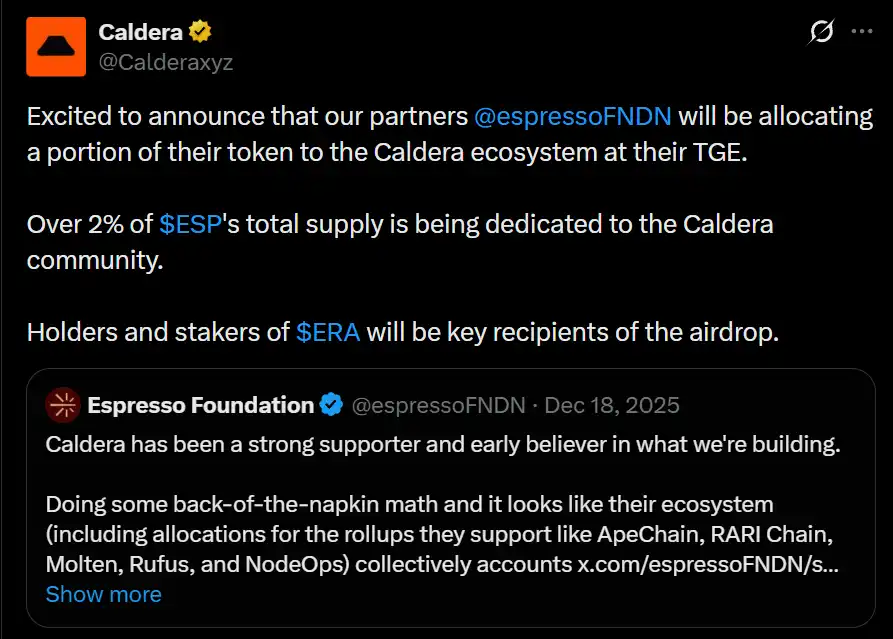
The design around $ERA further "accelerates and compounds" the flywheel: it is both the universal participation and economic coordination carrier for Metalayer (the basis for fee pricing of cross-chain interactions, etc.) and, through staking/node participation and governance, binds the incentives of chains, applications, users, and infrastructure participants within the same network, turning collaboration and growth from "possible" to "easier to sustain and roll." A more直观 example is that ecological联动 incentives themselves reinforce network effects in return. For instance, Espresso allocated over 2% of the total $ESP supply to the Caldera community during its TGE and made $ERA holders and stakers key airdrop targets: the value回流 from external high-quality partners enhances the appeal of participating in the $ERA ecosystem; and more holding and staking further strengthen network cohesion and collaboration expectations, in turn促成 more partnerships and more chains choosing to "join the network." Ultimately, Caldera aims to solve this: making App Chain not only launchable but also usable smoothly from day one, entering the growth flywheel faster.
The Alpha of App Chain Isn't in "Launching the Chain" but in "Networking"

From PolyMarket to Hyperliquid, the industry is seeing one thing越来越 clearly: as applications enter the scaled operation stage, the "chain" upgrades from a deployment location to part of the product, with experience, cost structure, iteration speed, and value回流 all being rewritten around it. But the real barrier for App Chain也随之 changes: launching a chain is getting easier; the hard part is ensuring the chain has entry points, asset paths, liquidity, and collaboration from the moment it goes live. Therefore, the next phase's Alpha isn't "who launched more chains" but who can turn "new chain cold start" into an action of "joining the network," reducing fragmentation friction enough that users can naturally complete funding, trading, and cross-chain use as if on the same chain. When this connectivity and incentive mechanism (e.g., participation around $ERA and external partnership回流) can continuously self-reinforce, App Chain will move from single-point success to replicable systemic victory and become a truly sustainable new Alpha.


Related Questions

QWhat is the main trend discussed in the article regarding successful applications?

AThe main trend is that App Chains are becoming the new Alpha, where successful applications are increasingly building their own dedicated blockchains to gain control over user experience, cost structure, and value capture.

QWhy do successful applications like PolyMarket and Hyperliquid consider building their own chains?

ASuccessful applications build their own chains to overcome limitations of public blockchains, such as congestion, fee volatility, and lack of control over key experiences. It allows them to optimize performance, manage costs, and create a closed-loop value system for users and incentives.

QWhat are the common challenges faced by App Chains after launch?

ACommon challenges include cold start (lack of initial users and trust), liquidity fragmentation (broken pools and asset depth), and weak ecological synergy (isolation from broader networks, making asset and user flow difficult).

QHow does Caldera aim to address the challenges of App Chains?

ACaldera provides a product suite including a Rollup Engine to simplify chain deployment and Metalayer for seamless cross-chain messaging, bridging, and tooling. It focuses on integrating new chains into an existing network from day one, reducing friction and enabling faster growth flywheels through incentives like $ERA.

QWhat is the key to sustainable success for App Chains according to the article?

AThe key is not just launching a chain, but effectively integrating it into a network from the start, minimizing fragmentation, and ensuring smooth user onboarding, asset flow, and cross-chain interactions. Sustainable success relies on connection capabilities and incentive mechanisms that reinforce network effects.

Related Reads

When Doing Cryptocurrency Payment, the First Thing is Licenses, What is the Second?

When launching a crypto payment business, obtaining the necessary licenses is the crucial first step. However, the second, and arguably more critical, step is designing a comprehensive operational framework that forms a coherent business loop. This loop must be clearly understood and executable by all stakeholders: banks, payment partners, exchanges, on-chain analytics providers, regulators, and your internal team. Many projects mistakenly believe a single license permits all operations. Licenses merely grant entry; they don't define how the specific business functions. The real challenge lies in detailing every aspect of the workflow. This involves clarifying the customer base, the flow of fiat and crypto assets, the settlement process, and establishing clear lines of responsibility for risks like AML compliance, sanctions screening, chargebacks, and regulatory inquiries. A robust framework must answer seven core questions: Who are the clients and merchants? Who collects fiat and crypto? Who handles conversion and custody? And who is ultimately accountable for compliance and risk management? Projects often fail not from a lack of licensing, but during due diligence when they cannot convincingly explain these operational details. Therefore, beyond securing licenses, the priority must be constructing a closed-loop system. This system ensures the business model is transparent, risks are managed, responsibilities are delineated, contracts are aligned, and the entire process is comprehensible to partners and regulators. The true competitive edge in crypto payments lies not in acquiring a license quickly, but in integrating licensing, banking, compliance, and operations into a sustainable and executable whole.

marsbit34m ago

When Doing Cryptocurrency Payment, the First Thing is Licenses, What is the Second?

marsbit34m ago

Arthur Hayes Analysis: AI Bubble Nears Burst, Crypto Market Faces Short-Term Pressure

Arthur Hayes argues that the current AI market is a bubble poised to burst, which will exert downward pressure on the crypto market in the near term. The core trigger is rising oil prices due to the US-Iran conflict and a blockade of the Strait of Hormuz. Higher energy costs directly increase the operational expenses of AI data centers, squeezing profit margins for companies like Google, Anthropic, and OpenAI. Hayes predicts that persistent inflation from high oil prices will force Trump, in a bid to win the November election, to turn public sentiment against the AI industry. He may propose regulations and taxes on data centers and AI companies to appeal to voters concerned about costs and job displacement. Such political rhetoric could shatter market confidence. Furthermore, the market is unlikely to healthily absorb the massive concurrent IPOs of SpaceX, Anthropic, and OpenAI, which together seek valuations in the trillions. The combination of soaring energy costs, overwhelming equity supply, and negative political pressure will puncture the AI bubble. Hayes notes that nearly all new USD liquidity since 2022 has flowed into AI, leaving crypto like Bitcoin behind. When the AI bubble bursts, liquidity will contract sharply, pulling down all risk assets, including cryptocurrencies. In response, Hayes's fund, Maelstrom, has sold all AI-related stocks and non-core cryptocurrencies. It maintains core positions in Bitcoin and Ethereum while increasing exposure to energy sector equities, betting on rising oil and gas prices. He expects Bitcoin to bottom after the AI-led market decline, before rallying again with future monetary easing.

Foresight News48m ago

Arthur Hayes Analysis: AI Bubble Nears Burst, Crypto Market Faces Short-Term Pressure

Foresight News48m ago

To C, To B, and the Next Big Thing Called To A

After To C and To B, the Next Wave is To A: Serving AI Agents In a recent quarterly earnings call, Meituan's Wang Xing introduced a new concept: To A (To Agent), signifying that future business services will increasingly target AI Agents as primary clients, not just consumers or merchants. This shift implies that internet giants must now consider how to make their services more appealing for AI Agents to recommend, fundamentally altering traditional distribution logic. This "To A era" is prompting an unusual trend of alliances among major tech companies. Unlike previous competitive battles, firms like Meituan, Tencent, JD.com, Huawei, OPPO, and OpenAI are rapidly forming partnerships. The reason is strategic: as AI Agents become the primary user interface, handling tasks from a single command (e.g., "Book a Japanese restaurant for tomorrow"), the risk for platforms is being bypassed entirely. Companies are positioning themselves within this new value chain. Three primary strategies are emerging: 1. **Super-Entry Points + Service Providers:** Platforms like Tencent's Yuanbao, WeChat, and ChatGPT aim to be the first-stop Agent, integrating various services (food delivery, shopping, travel) from partners like Meituan and JD.com. 2. **Apps as Callable Services:** Companies like Meituan, JD.com, and Uber are ensuring their core services remain accessible and callable by external Agents, shifting from front-end apps to back-end capabilities. 3. **System-Level Agent Entry Points:** Smartphone makers (Huawei, Honor, OPPO) are leveraging their OS-level AI assistants to control the initial user command, redistributing it to relevant service apps. While alliances offer mutual benefit—entry points gain service capabilities, and service providers gain traffic—inherent conflicts of interest exist. A dominant Agent platform could eventually attempt to connect directly with suppliers (restaurants, hotels), bypassing current aggregators like Meituan or Ctrip. Other unresolved challenges include the potential for Agent recommendations to become a new form of paid ranking and unclear accountability for faulty recommendations. The current rush to form alliances is a defensive move by service providers to secure their position before the landscape solidifies. In this To A-driven restructuring, the greatest risk is not losing the race but failing to hear the starting gun.

marsbit57m ago

To C, To B, and the Next Big Thing Called To A

marsbit57m ago

The More Lifelike the Robot, the More Terrifying? Unveiling the 'Uncanny Valley Effect' in the Era of Humanoid Robots

As humanoid robots become increasingly lifelike, they confront a significant psychological barrier known as the "Uncanny Valley Effect," a concept proposed by Japanese roboticist Masahiro Mori in 1970. This phenomenon describes a dip in human comfort and acceptance when robots appear almost, but not perfectly, human. Minor imperfections in facial expressions, eye movements, or skin texture trigger a subconscious sense of unease, as the brain detects something trying, yet failing, to mimic a person. Examples range from the controversial human-like robot Sophia to animated characters in films like *The Polar Express*. The effect poses a key design challenge for robotics companies. Some, like Boston Dynamics, avoid it entirely by creating highly capable but visibly mechanical robots. Others, like Hanson Robotics, push for greater human likeness despite the risk. For consumer robots, especially in homes, most manufacturers opt for stylized or clearly mechanical designs to ensure broader acceptance. While the Uncanny Valley remains a powerful force, its impact may diminish over time through technological advancements that achieve near-perfect realism or through generational familiarity as people grow accustomed to interacting with humanoid machines. Ultimately, navigating this psychological frontier requires as much understanding of human perception as of robotics technology itself.

marsbit58m ago

The More Lifelike the Robot, the More Terrifying? Unveiling the 'Uncanny Valley Effect' in the Era of Humanoid Robots

marsbit58m ago

Trading

Spot
Futures
活动图片




