From Payment to Deployment: Stripe Bets on the AI Agent Economy

marsbitPublished on 2026-06-08Last updated on 2026-06-08

Abstract

From Payments to Deployment: Stripe Bets on the AI Agent Economy Stripe is redefining economic infrastructure for the AI era, shifting its focus from serving primarily human users and software companies to enabling machine agents as active economic participants. The core thesis is that AI agents are evolving from tools into independent buyers and builders on the internet, necessitating a complete overhaul of traditional payment, billing, and deployment models. To empower agents as **buyers**, Stripe, in collaboration with Tempo, developed the Machine Payments Protocol. This protocol allows businesses to programmatically accept payments from agents without human intervention, using machine-readable payment instructions. Furthermore, Stripe's consumer wallet, Link, is being adapted to let users securely authorize agents to spend on their behalf. To empower agents as **builders**, Stripe Projects aims to simplify the deployment process. It allows developers and their agents to register, manage, and integrate the services needed to deploy applications directly from the command line, making "vibe-deploying" as seamless as "vibe-coding." This agent-driven economy, where products have real, variable costs (like AI tokens), disrupts traditional SaaS models. **Token-based monetization** is becoming central, requiring usage-based billing that charges for actual resource consumption, as seen with companies like Lovable and ElevenLabs. However, this model introduces new challenges l...

Author: Emily Sands

Translated by: Peggy, BlockBeats

This article stems from Stripe's redefinition of the "AI economy infrastructure": In the past, payment infrastructure primarily served human users and software companies; now, it must also serve machine agents. Agents need to be able to read prices, complete payments, call wallets, and deploy services; AI companies also need to build new billing, risk control, and settlement mechanisms around token consumption.

The Machine Payments Protocol, Link, Stripe Projects, Metronome, Tempo, and streaming payments mentioned in the article essentially all point to the same trend: AI Agents are evolving from "tools" into new types of economic participants on the internet. They are both buyers and builders; they both create software and consume resources. Consequently, the traditional SaaS-era business model of per-seat pricing, post-service invoicing, and manual settlement is being replaced by new models featuring real-time metering, real-time settlement, and machine-readable interfaces.

This is not just Stripe's product narrative; it's also a broader industry judgment: if a significant portion of future software consumption is initiated by Agents, then payment, billing, wallets, risk control, and deployment processes all need to be redesigned. AI is changing not just production efficiency, but also the very organization of business itself.

The original text follows:

Agents are becoming buyers and builders. This will fundamentally change how business operates.

For the past few years, Stripe has been building economic infrastructure for AI. This happens on a few dimensions: We help the world's fastest-growing AI companies accelerate through payments, billing, checkout, fraud and risk prevention, and tax infrastructure; we deploy AI across our own payments flow to help businesses earn more; and we make Stripe natively embeddable in the AI tools developers use.

But in the last six months, the meaning of "economic infrastructure for AI" has shifted. Agents are emerging as a new kind of actor on the internet. And that has given us two new tasks: helping agents purchase and build on behalf of people and companies; and helping companies adapt to the new economies that token consumption enables. In other words, Stripe is empowering agents to act independently, and empowering companies to monetize token-powered products that agents create and consume.

Agents as buyers

Ecommerce was built for humans. Humans browse websites, click on pricing pages, enter card details, and complete checkout. Agents don't. They need a programmatic way to understand that a service costs money, how much it costs, and how to pay for it without a human clicking through a checkout.

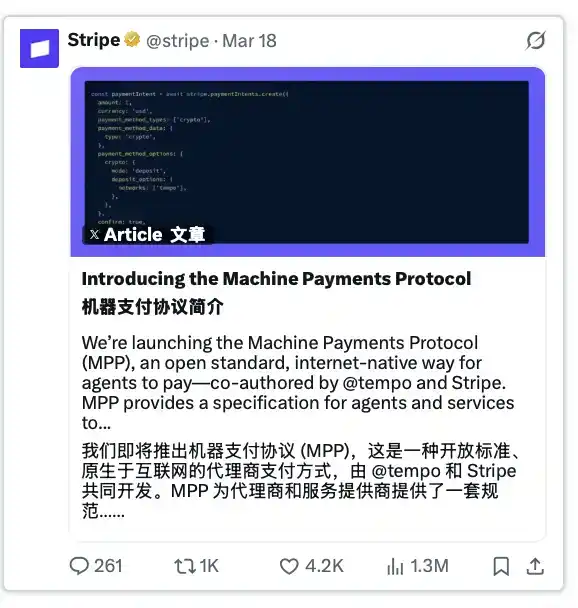
That's why we created the Machine Payments Protocol in partnership with Tempo. It lets businesses programmatically accept payments from agents, without human intervention. There's no account creation, no checkout page, and no human-in-the-loop; just a machine-readable way for agents to buy services from businesses.
Once businesses can accept payments from agents, the next equally important question is: How can consumers safely authorize agents to spend money on their behalf? That's where our consumer wallet Link comes in.

More than 250 million people already use Link. And we're making Link work for agents, so that people can authorize agents to safely spend on their behalf. Humans remain in control, and agents gain the ability to spend on their users' behalf.

Helping agents buy things on the internet is one way to empower them. The other is helping them build.

Agents as builders

Today, vibe-coding is easy, but vibe-deploying isn't. Agents can generate an application in minutes, but deploying it to the internet still requires a lot of manual glue: creating accounts, provisioning services, managing credentials, connecting APIs, and switching back and forth between different consoles.

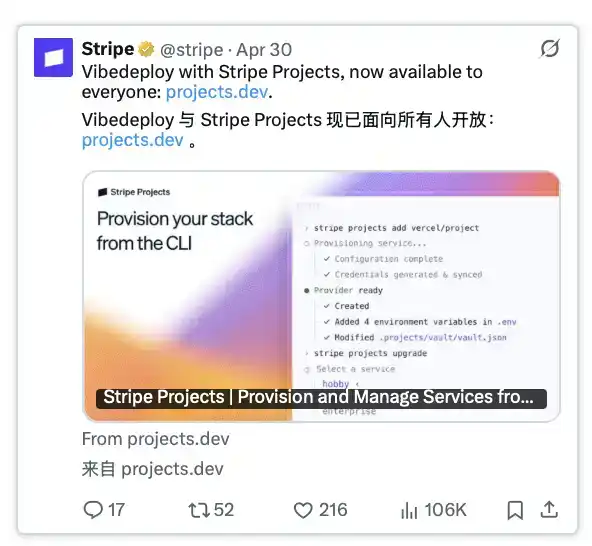
Stripe Projects lets developers—and their agents—register for, manage, and connect to the services needed to deploy an application, directly from the command line. The goal is simple: make vibe-deployment as easy as vibe-coding.
Token monetization

As agents begin to act as buyers and builders, businesses also need to adapt to a world where the cost of inference—the token cost of the product—changes dynamically. And that's changing software's economics.

In SaaS, serving one more user often costs almost nothing extra. But in AI, every prompt, every API call, every agent task has a real marginal cost. So companies can't just charge per seat. They need to meter usage in real time and charge customers for the resources they actually consume.

That's why usage-based billing is at the heart of AI monetization. Businesses can charge for what their customers actually value: usage, workflows, outcomes, or any billing unit that best fits their product.

Lovable is a great example. It started with simple subscriptions on Stripe so that it could commercialize quickly after launching. As the company evolved, so did its billing model. Today, Lovable charges for AI tokens consumed once customers exceed the usage included in their subscription plan. ElevenLabs has followed a similar path: it started with subscriptions on Stripe and later, as its product and its customers' usage evolved, added pay-as-you-go pricing.

Token theft

But usage-based billing only works if businesses can actually collect. And today, fraudsters aren't just stealing money or account credentials; increasingly, they're stealing tokens. They can sign up for an account, quickly consume a large volume of tokens, and disappear before the bill comes due, which collapses AI products' economics.

Token theft is one of the least-discussed problems in AI today. Stripe Radar, our fraud prevention product, evaluates new accounts in real time, predicts which free trials are likely to be abused, and identifies non-payment risk as usage accumulates.

Streaming payments

Abuse gets even more difficult when the customer itself is an agent. An agent can consume tokens at machine speed, which makes traditional billing models riskier—and sometimes unworkable.

Businesses can ask for upfront payment and cut off service when the prepaid amount runs out. This protects the business, but creates a worse experience for customers, and prevents good customers from spending more. Businesses can also let usage accumulate, then send an invoice later. That's better for customers, but then the bill may never get paid—and the tokens are already gone.

The better answer is obvious, but technically complex for businesses to build themselves: track usage and collect payment in real time. That's what Metronome and Tempo can do, together.

Metronome is a company we acquired that serves the most complex usage-based businesses; it can track usage in real time, as tokens are consumed. Tempo enables low-cost, high-frequency stablecoin payments that settle instantly. Together, AI companies can charge for tokens as they're used—without having to choose between hard limits and uncollectable bills.

We call this streaming payments: a new business model built for AI-native businesses, and for machine-speed software consumption.

This is what "economic infrastructure for AI" needs to be today.

It's no longer just payments for AI companies. It's commerce for agents, wallets for agents, deployment for agents, billing for tokens, fraud and abuse for tokens, and streaming payments for agents.

AI is changing business, and it's changing how businesses are built. So the infrastructure has to change, too.

We're building it at Stripe.

Related Questions

QAccording to the article, what is the core shift that necessitates a redefinition of payment infrastructure for the 'AI economy'?

AThe core shift is that payment infrastructure must now serve machine agents as economic actors, not just human users and software companies. AI agents are transitioning from being tools to becoming independent buyers and builders in the digital economy.

QWhat is the purpose of the Machine Payments Protocol that Stripe is developing in partnership with Tempo?

AThe purpose of the Machine Payments Protocol is to enable businesses to accept payments programmatically from AI agents without human intervention. It provides a machine-readable way for agents to understand service costs and complete payments without traditional checkout pages or account registration.

QHow does the article contrast the traditional SaaS billing model with the new requirements for AI-based products?

AThe article contrasts them by stating that traditional SaaS models typically charge per seat with low marginal costs per user and invoice later. In contrast, AI products have real marginal costs per action (like token usage), requiring real-time metering, usage-based billing, and immediate settlement to reflect the actual resources consumed.

QWhat new type of fraud is highlighted as a critical but under-discussed challenge for AI companies?

AThe article highlights 'Token theft' or token abuse as a critical challenge. Fraudsters steal token credits by creating accounts, rapidly consuming large amounts of resources (like AI inference), and disappearing before the bill is due, which can undermine the economic model of AI products.

QWhat is 'streaming payments,' and what problem does it solve for businesses serving AI agents?

A'Streaming payments' is a business model that combines real-time usage tracking (via Metronome) with high-frequency, instant settlement payments (via Tempo). It solves the problem of AI agents consuming resources at machine speed by allowing companies to collect payment in real-time as tokens are consumed, avoiding the trade-off between hard usage caps and the risk of unpaid invoices.

Related Reads

STRC Major De-pegging's First Financial Report, How Will Strategy Repair Its Capital Flywheel?

Bitcoin treasury company Strategy released its Q2 2026 earnings report on July 31. Despite a 6.9% year-over-year revenue increase to $122 million, the company recorded a net loss of $8.22 billion, largely due to $8.32 billion in unrealized losses from Bitcoin price fluctuations. As of quarter-end, Strategy holds 843,775 BTC with an average cost of $75,000 per coin, and Bitcoin per share increased. The report highlights a critical shift in Strategy's capital model following the de-pegging of its key financing tool, STRC (Strategic Coin), which fell below its $100 target. Management's top priority is restoring STRC to its target value, aiming for a recovery by September 8. They rule out discounted STRC issuances and plan to maintain its dividend yield at 12%, instead focusing on bolstering its $3.75 billion cash reserve. Strategy has moved from a one-way "buy-and-hold" Bitcoin strategy to active capital management. This new approach, part of its "Digital Credit Capital Framework," involves flexibly managing its balance sheet across four elements: BTC, USD cash, common stock (MSTR), and digital credit securities like STRC. This allows for BTC monetization (having sold $218.4 million in BTC so far), strategic repurchases of discounted securities, and debt optimization, as seen with a $1.5 billion convertible bond buyback. The company's future hinges on two key tests: successfully re-pegging STRC to restore market confidence in its digital credit system, and a long-term recovery in Bitcoin's price to ultimately support its growth thesis.

marsbit42m ago

STRC Major De-pegging's First Financial Report, How Will Strategy Repair Its Capital Flywheel?

marsbit42m ago

STRC's First Financial Report Post-Depegging, How is Strategy Restoring the Capital Flywheel?

On July 31, 2026, Bitcoin treasury company Strategy released its Q2 financial report. Despite a 6.9% year-over-year increase in revenue to $122 million, the company recorded a substantial net loss of $8.22 billion, primarily due to $8.32 billion in unrealized losses from Bitcoin holdings. While Strategy's core Bitcoin strategy remains intact—its holdings grew 11% to 843,775 BTC—the company is undergoing a fundamental shift in its capital model. Following the de-pegging of its key financing tool, the STRCoin (STRC), from its $100 target in May, Strategy has pivoted from a one-directional "raise funds, buy Bitcoin" cycle to a more dynamic, multi-asset capital management approach. A key part of this new framework is the "Monetization Program," through which Strategy has sold approximately $218.4 million worth of BTC to bolster liquidity. The company's top priority is repairing STRC's peg, committing not to issue discounted shares until it returns to its target range. It has initiated a $1 billion buyback program for discounted digital credit securities, having repurchased $28.9 million face value of STRC so far. Management aims to restore the peg around September 8, 2026. Strategy now actively manages a matrix of assets: Bitcoin (for accumulation or strategic sales), USD cash reserves (now at $3.75 billion), common stock (MSTR), and digital credit securities like STRC. This allows for tactical moves like repurchasing discounted debt or equity to capture value. The future success of Strategy's "capital flywheel" hinges on two factors: the short-term ability to successfully re-peg STRC to restore market confidence in its digital credit system, and the long-term price trajectory of Bitcoin, upon which its entire investment thesis ultimately depends.

Odaily星球日报47m ago

STRC's First Financial Report Post-Depegging, How is Strategy Restoring the Capital Flywheel?

Odaily星球日报47m ago

With Two Consecutive Quarters of Losses, Coinbase Must Rely on Paths Beyond Trading

Coinbase posted its second consecutive quarterly net loss of $359 million on $1.22 billion in revenue for Q2, highlighting its vulnerability to crypto market cycles where weaker prices and lower volatility reduce user trading. However, the report also reveals a strategic shift in its business model. Despite a 25% quarter-over-quarter decline in global spot trading volume, Coinbase increased its market share to a company-record 10.3%. This suggests its position as a compliant U.S. on-ramp is strengthening even in a cooler market. A key development is the diversification of revenue streams. Transaction revenue fell to $599 million, nearly equaling subscription and services revenue of $555 million. Stablecoin services, generating $292 million, are becoming a crucial revenue "floor." This income, derived from interest on the $20 billion average USDC balance held on its platform, is less tied to daily trading activity. Furthermore, while spot trading volume dropped significantly, derivatives volume held steady at $1.03 trillion. Coinbase is pushing to integrate spot, stablecoin, and derivatives liquidity to create a more interconnected and sticky ecosystem for users. The GAAP net loss includes non-cash expenses like stock-based compensation and crypto asset valuation changes. Its adjusted EBITDA remained positive at $208 million for the 14th straight quarter, indicating core operations can cover ongoing costs. The company is also reducing expenses to manage the downturn. The central question moving forward is whether Coinbase's growing market share, stablecoin revenues, and expanding product integration can sufficiently offset the inherent cyclicality of its core trading business during future market contractions.

marsbit1h ago

With Two Consecutive Quarters of Losses, Coinbase Must Rely on Paths Beyond Trading

marsbit1h ago

Trading

Spot
活动图片