From Outcast to Priceless Target: Mastercard Acquires BVNK for $1.8 Billion

marsbitPublished on 2026-03-18Last updated on 2026-03-18

Abstract

Mastercard has announced its acquisition of stablecoin infrastructure provider BVNK for up to $1.8 billion, including $300 million in contingent payments. The deal, expected to close by year-end, aims to strengthen Mastercard’s capabilities in digital assets and cross-border value transfers. Founded in 2021, BVNK has built a significant crypto settlement network, processing $25–30 billion in annual stablecoin transactions across 130+ countries. Despite earlier advanced acquisition talks with Coinbase—which ultimately fell through—Mastercard moved decisively to secure the startup. The acquisition is widely seen as a defensive strategy against the growing disruption stablecoins pose to traditional payment networks. With advantages like low cost, speed, and 24/7 operation, stablecoins are increasingly used in B2B and cross-border payments. By integrating BVNK, Mastercard aims to co-opt this technology rather than compete with it. The move is part of a broader trend: traditional financial giants like Visa, Citi, and Stripe are also aggressively investing in or acquiring crypto infrastructure firms. These established players are consolidating fragmented stablecoin liquidity under regulated, centralized frameworks, reinforcing their dominance in the evolving payments landscape.

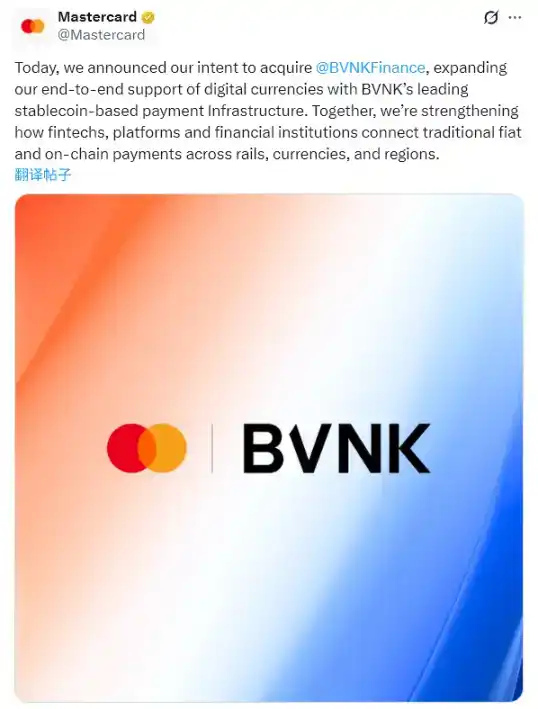
On March 17, global payment giant Mastercard announced the acquisition of stablecoin infrastructure provider BVNK. The deal is valued at up to $1.8 billion, including a $300 million contingent payment clause. Mastercard expects to complete the transaction by the end of this year, thereby expanding its end-to-end support capabilities in the digital assets and cross-currency value transfer fields.
The Value of the Outcast: Coinbase's Hesitation and Mastercard's Decisiveness

BVNK was founded in 2021 and is headquartered in London. In May 2022, BVNK completed a $40 million Series A funding round, reaching a post-money valuation of $340 million. Two years later, in December 2024, it completed a $50 million Series B funding round, raising its valuation to approximately $750 million.

BVNK is led by three South African founders, including CEO Jesse Hemson-Struthers (a serial entrepreneur who previously founded e-commerce and gaming companies acquired by Naspers and Sportradar, respectively), CTO Donald Jackson (a blockchain and enterprise systems expert), and CBO Chris Harmse (a CFA charterholder and former macro/crypto fund partner focused on foreign exchange and cross-border payments).

This startup has quietly built a vast settlement network for crypto assets.

Currently, the platform processes an annual stablecoin payment volume of about $25–30 billion. It provides businesses with a seamless channel connecting fiat currency and stablecoins, supporting payment activities across major blockchain networks in over 130 countries and regions.

But before Mastercard made its move, the real potential buyer for BVNK was actually crypto giant Coinbase.

In November 2025, acquisition talks between Coinbase and BVNK, valued at up to $2 billion, entered the deep due diligence phase, and the two parties even signed an exclusivity agreement at one point.

Coinbase was an investor in its Series B round. Had the deal gone through, it would have been a landmark event for a crypto-native company expanding into the core of global payment infrastructure. However, the two parties ultimately called off the deal that same month without disclosing any substantive reasons for the breakdown.

As Coinbase stepped back, Mastercard swiftly moved in to fill the gap precisely.

For a startup with annual revenue of only about $40 million, the $1.8 billion price tag appears extremely expensive from a financial model perspective. But this sky-high price was never about current profitability; it was about buying a monopoly-level ticket to the next-generation settlement network.

Defensive Counterattack: Buying Out the Possibility of 'Bypassing Card Networks'

Mastercard's move is actually a strategic counterattack with strong defensive overtones.

Stablecoins are visibly eroding the market share of traditional cross-border settlements. With their 24/7 operation, low friction costs, and extremely fast settlement speeds, blockchain-based digital dollars are beginning to show their edge in B2B payments and cross-border remittance scenarios.

In the global financial network, traditional credit card organizations are the payment channels most threatened by the disruption of stablecoins. If multinational corporations and business institutions become accustomed to peer-to-peer on-chain settlements, the centralized fiat routing network that Mastercard relies on for survival faces the risk of being completely marginalized.

If you can't beat them, decisively buy them.

Mastercard's Chief Product Officer, Jorn Lambert, was unequivocal about this. In the acquisition announcement, he stated that he expects most financial institutions and fintech companies to offer digital currency services in the future.

Mastercard's calculation is very clear: it is determined to directly integrate BVNK's ready-made stablecoin rails and compliance engine into its vast global fiat network. Stablecoins are no longer competitors to card networks; instead, they have been forcibly incorporated as a highly complementary business subset of its underlying network.

Traditional giants are building high walls with capital barriers that are difficult to surmount.

Land Grab: Wall Street's Payment Table Has No New Players

This is by no means an isolated action by Mastercard alone; the entire traditional finance sector is frantically scrambling for access to on-chain infrastructure.

Even before this acquisition was finalized, BVNK's backers already included a豪华 (luxury) lineup of Wall Street capital. In May 2025, Mastercard's arch-rival Visa made a strategic investment in BVNK through its venture arm, Visa Ventures.

Then, in October, Citi Ventures, the venture capital department of Citigroup, also invested real money to join the game. Although Citi declined to disclose the specific investment amount and BVNK's valuation, the company stated in an interview that its valuation was higher than the $750 million from the Series B round.

Even just two months before Mastercard announced the acquisition, Visa高调 (high-profile) announced it would integrate BVNK's stablecoin settlement capabilities into its core Visa Direct platform to support cross-border fund disbursement to global digital wallets.

This is both a hard technological integration and a默契 (tacit) capital collusion.

Looking across the entire payments industry, Silicon Valley's current darling, Stripe, had previously acquired stablecoin startup Bridge for $1.1 billion. And before finalizing the BVNK deal, Mastercard was also reported by the market to be in acquisition talks with another crypto infrastructure startup, Zerohash (founded in 2017, headquartered in Chicago), for as much as $1.5 to $2 billion.

Traditional payment giants are using疯狂且密集 (frenzied and密集 intensive) mergers and acquisitions to重新聚拢 (re-aggregate) the originally decentralized, fragmented stablecoin liquidity within the highly familiar business frameworks and regulatory channels they control.

At this highly lucrative table, the ones who ultimately sit down are still the old rulers holding heavy capital.


Related Questions

QWhat is the significance of Mastercard's acquisition of BVNK for the digital asset and cross-border payment industry?

AMastercard's acquisition of BVNK, valued at up to $1.8 billion, is significant as it aims to expand the company's end-to-end support capabilities in digital assets and cross-currency value transfer. It represents a strategic move by a traditional payment giant to integrate stablecoin infrastructure, counter the threat of blockchain-based settlements, and secure a dominant position in the next-generation payment network.

QWhy did Coinbase's potential acquisition of BVNK fall through, and how did Mastercard capitalize on this?

ACoinbase's acquisition talks with BVNK, which reached an advanced stage including due diligence and an exclusivity agreement, were called off in November 2025 without public disclosure of the specific reasons. Mastercard swiftly moved in to acquire BVNK after Coinbase's withdrawal, seizing the opportunity to secure a key player in the stablecoin infrastructure space.

QHow does BVNK's business model and network pose a threat to traditional card networks like Mastercard?

ABVNK's platform, which processes $25-30 billion in annual stablecoin payment volume, provides a seamless channel for businesses to convert between fiat and stablecoins, supporting payments across 130+ countries. Its blockchain-based, peer-to-peer settlement offers 24/7 operation, low friction costs, and fast clearing, threatening to marginalize the centralized fiat routing networks that traditional card organizations like Mastercard rely on.

QWhat defensive strategic motive does Mastercard have for acquiring BVNK?

AMastercard's acquisition is a defensive strategic move to counter the disruptive threat of stablecoins to traditional cross-border settlement. By acquiring BVNK, Mastercard aims to co-opt the technology, integrating its stablecoin轨道 and compliance engine into its global fiat network, thereby turning a potential competitor into a complementary subset of its business and building high capital barriers to maintain its dominance.

QHow are other major traditional financial institutions involved in the stablecoin infrastructure space, as indicated in the article?

AOther major traditional financial institutions are heavily investing in stablecoin infrastructure. Visa's venture arm, Visa Ventures, made a strategic investment in BVNK in May 2025, and Citi Ventures also invested later that year. Furthermore, Visa integrated BVNK's stablecoin settlement capabilities into its Visa Direct platform. Stripe also acquired stablecoin startup Bridge for $1.1 billion, indicating a trend of traditional payment giants consolidating the fragmented stablecoin liquidity within their familiar commercial and regulatory frameworks.

Related Reads

The Value Distribution of Stablecoins

**Summary: The Value Distribution of Stablecoins** The article argues that stablecoins are evolving from mere trading tools into broader channels for dollar access. It divides the stablecoin ecosystem into four layers to analyze how value is distributed: 1. **Issuance Layer:** Mints stablecoins, holds reserve assets, and captures the spread between reserve yield and user costs (e.g., Tether, Circle). This layer currently earns the largest profit margin. 2. **Infrastructure Layer:** Connects stablecoins to the traditional financial system, handling fiat on/off-ramps, banking integration, compliance (KYC/AML), and asset management (e.g., Bridge, BVNK). This is the "unglamorous" but critical work, building the essential bridges between crypto and real-world finance. 3. **Acquiring/Distribution Layer:** Integrates stablecoins into merchant systems, manages payment flows, and provides enterprise financial software (e.g., Stripe, Coinbase). They act as the access point for businesses. 4. **Application Layer:** The end-users and businesses that ultimately use stablecoins for payments, settlements, or as a store of value. They benefit from convenience but have little pricing power. The core thesis is that while the issuance layer currently dominates profits, the often-overlooked **infrastructure layer holds significant long-term potential**. The real challenge and barrier to mass adoption is not the on-chain transfer of stablecoins (which is simple), but the complex "last mile" integration into existing business workflows, banking systems, and regulatory frameworks across different countries. Companies in this layer are currently in a "land grab" phase, investing heavily to build networks, secure bank partnerships, and establish compliance pathways. While their position is currently pressured by the profitable issuers above and distribution platforms below, the article suggests that if stablecoins become a default financial rail for businesses, the infrastructure providers who have done the hard work of integration will ultimately gain strong pricing power and become entrenched, essential players.

marsbit6h ago

The Value Distribution of Stablecoins

marsbit6h ago

The Value Distribution of Stablecoins

The Value Distribution of Stablecoins The article argues that stablecoins are evolving from a mere trading tool into a broad "dollar channel." It analyzes the industry's value chain through four layers: 1. **Issuance Layer (e.g., Tether, Circle):** The top layer that mints stablecoins, holds reserve assets, and captures the thickest interest rate spread. 2. **Infrastructure Layer (e.g., Bridge, BVNK):** Connects stablecoins to the traditional financial system, handling critical but complex "dirty work" like fiat on/off-ramps, banking integration, compliance (KYC/AML), and cross-border settlement. 3. **Acquiring/Distribution Layer (e.g., Stripe, Coinbase):** Embeds stablecoins into merchant systems, manages payment flows, and integrates with enterprise software. 4. **Application Layer:** End-users and businesses that ultimately use stablecoins for payments, settlement, or storing value. The author posits that while the issuance layer currently captures the most profit, the most overlooked and potentially critical layer is infrastructure. The core challenge for stablecoin adoption isn't the on-chain transfer (which is simple), but bridging the gap between blockchain and the real-world financial system. This involves solving practical problems for businesses: fiat conversion, reconciliation, tax handling, and user onboarding. Infrastructure companies are currently in a difficult "land-grab" phase—building networks, securing banking relationships, and achieving compliance country-by-country. They face pressure from both the profitable issuance layer above and distribution platforms below. However, the author suggests this layer is building a crucial moat. Once stablecoins become a default business rail, the infrastructure players who have done the hard work of integration may gain significant, durable value and pricing power.

链捕手6h ago

The Value Distribution of Stablecoins

链捕手6h ago

Trading

Spot
Futures
活动图片