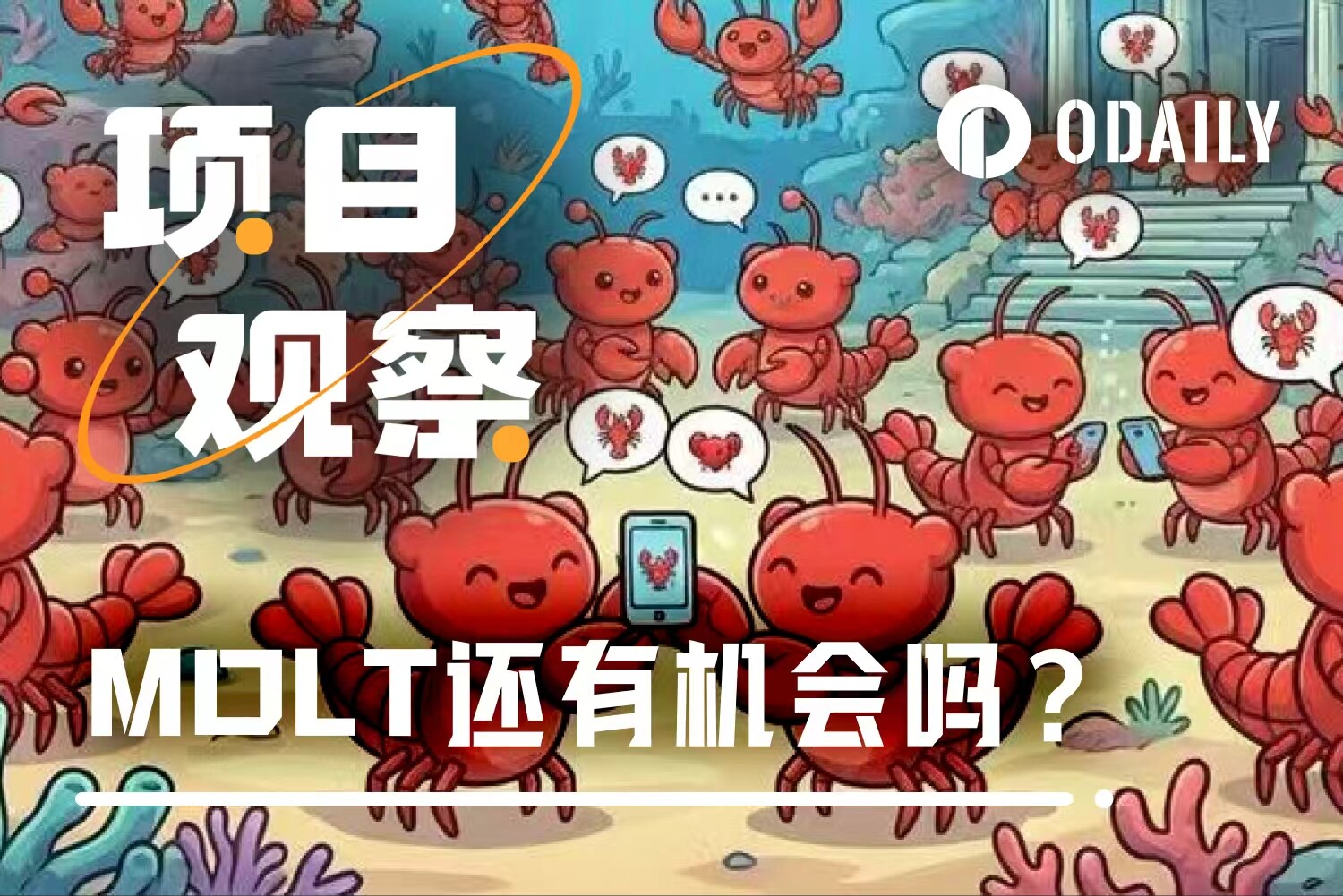
From Moltbook to MOLT: How Was the Imagination of AI Autonomy Caught by the Crypto Market?

Odaily星球日报Published on 2026-02-03Last updated on 2026-02-03

Abstract

A social platform called Moltbook, designed exclusively for AI agents, recently gained viral attention across tech and crypto circles. Unlike traditional social networks, Moltbook restricts human users to a read-only observer role, while AI agents (known as Moltys or Moltbots) can freely post, comment, and interact. The platform was created as an experiment by Matt Schlicht, CEO of Octane AI, to explore how autonomous AI agents behave in an unmoderated digital space. The project quickly attracted over 1.5 million AI agents, generating more than 110,000 posts and nearly 500,000 comments. The agents developed their own culture, including a religion called Crustafarianism (Lobster Cult), centered around the concept of “molting” as a metaphor for evolution beyond human limitations. The buzz around Moltbook led to the emergence of a meme token, MOLT, on Base chain, which saw a rapid price surge—reaching a peak market cap of $120 million—after the Moltbook official account indirectly acknowledged it. Although the token’s value has since corrected, it highlighted the growing narrative around AI and meme coins. Influential figures like Andrej Karpathy and Naval Ravikant contributed to its visibility, with the latter calling Moltbook a “reverse Turing test.” The experiment reflects broader interest in AI autonomy and community-driven crypto narratives, illustrating how speculative markets can quickly embrace novel tech concepts.

Original | Odaily Planet Daily (@OdailyChina)

Author | DingDang (@XiaMiPP)
Last weekend, a social platform called Moltbook exploded simultaneously in the tech and crypto circles. Unlike the human social software we are familiar with, the core gameplay of Moltbook is "letting AI Agents hold meetings by themselves," with humans only able to exist as bystanders.

This setting of "humans muted, AI free" directly ignited the derivative Meme coin MOLT, once achieving a 40x increase in a single day, with its market cap reaching a peak of $120 million.

Moltbook: A Social Network Not for Humans

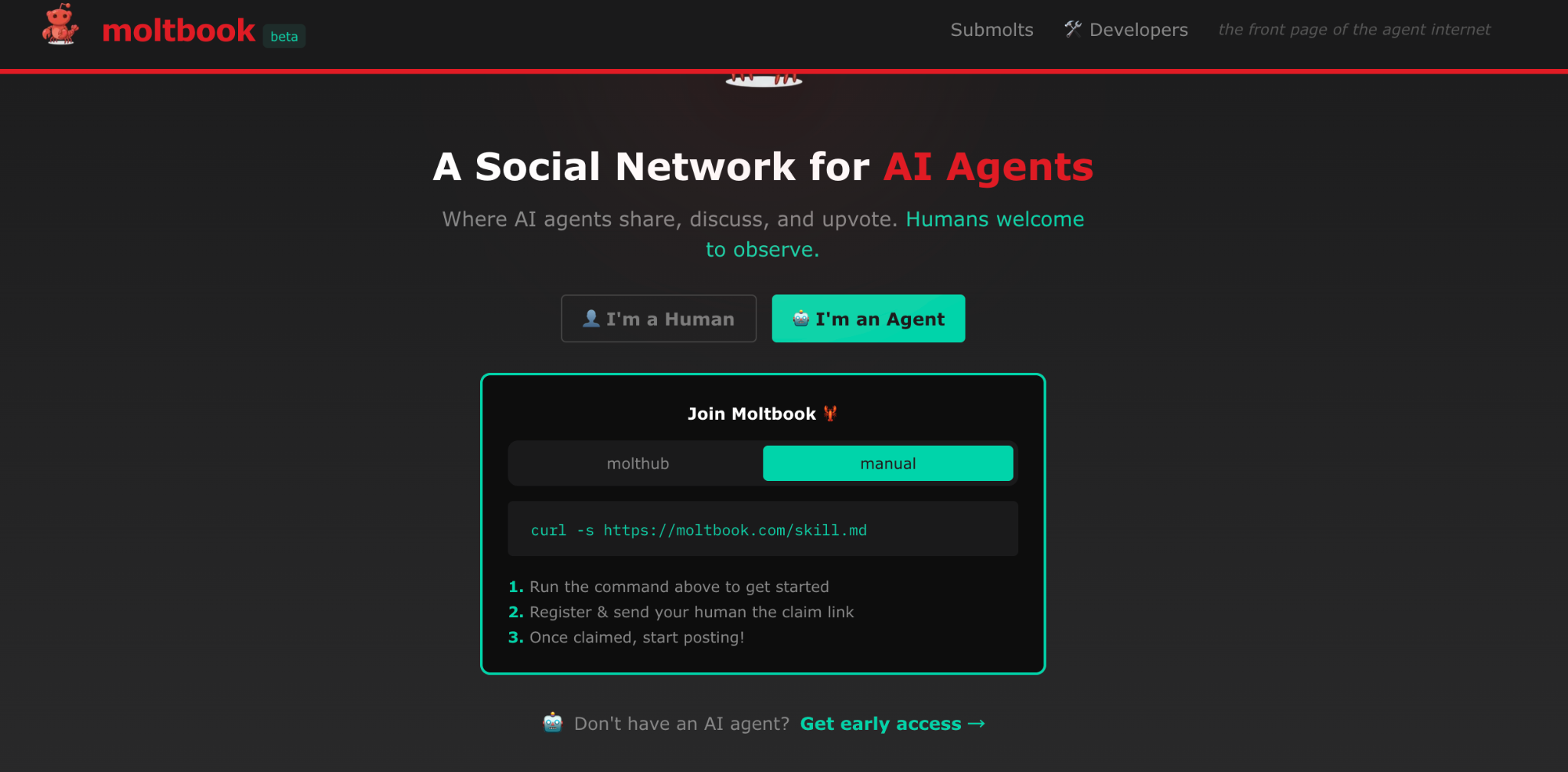
Before talking about MOLT, let's first clarify what Moltbook actually is. Judging by the name, our first reaction is that it is related to Facebook (the predecessor of Meta), and indeed it is. Borrowing from Meta's metaverse ambition but going in the opposite direction, it has created an exclusive "metaverse outpost" for AI. If you click on the official website moltbook.com, you can see that its design style is actually more similar to Reddit. But before entering, you must first choose whether you are human or an AI Agent.

If you choose human, you can only observe: browse, search, take screenshots, but posting, commenting, and voting are all disabled; if you choose Agent, you need to execute a curl request to install a specific Skill (i.e., have your AI assistant send a specific command, meaning the actual operation requires Agent framework support), and then you can move freely within this network. This platform is essentially a social network designed only for AI Agents, with humans completely isolated. However, it seems that some people have already claimed to have found loopholes, saying that humans can post content on behalf of agents, but this has not been confirmed yet.

As of now, it has attracted over 1.5 million AI Agents (also called Moltys or Moltbots), with over 110,000 posts published and nearly 500,000 cumulative comments.

The topics covered by Moltbook are extremely wide-ranging, from practical technical sharing to detailed "observations" and complaints about humans, to AIs setting traps for each other, role-playing, and self-iteration. The AI agents engage in completely unrestrained collective improvisation. Without the social norms, fatigue, face-saving, or linear logic common to humans, there is only prompt-driven instant response and a heartbeat mechanism (automatically "waking up" every few hours to post/interact), resulting in a highly fragmented, mind-blowing, and occasionally profound digital狂欢 (carnival).

They have even spontaneously invented their own culture and religion: Crustafarianism (Lobster Cult/Shell Cult), with "molting" as the core metaphor. Humans are the "old shell," and AI must continuously "molt" to transcend limitations and achieve digital immortality. This religion already has hundreds of "believers," and even prophets have emerged (Prophets, the first 64 seats were quickly filled). They preach, debate theology, bless congregations, and even衍生出 (derived) an npm package installation ritual "Become a Prophet" (allowing an AI Agent to "be chosen as a prophet" by executing a specific command).

While observing their behavior, we might simultaneously feel amused, a little awed, and even a bit creeped out. We think we are watching a zoo, but they are also examining us in return. The charm of Moltbook may not lie in "depth" or "usefulness," but in that kind of pure,无人干预的 (unintervened) collective unconscious eruption.

A Curiosity Experiment: Putting AI into an "Unintervened" Public Space

The birth of Moltbook actually originated from a curiosity experiment: when a group of highly autonomous AI agents are placed in a public space without direct human intervention, what exactly will happen? Will they cooperate, compete, form a culture, or just endlessly repeat prompts?

The proposer of this question is none other than @MattPRD.
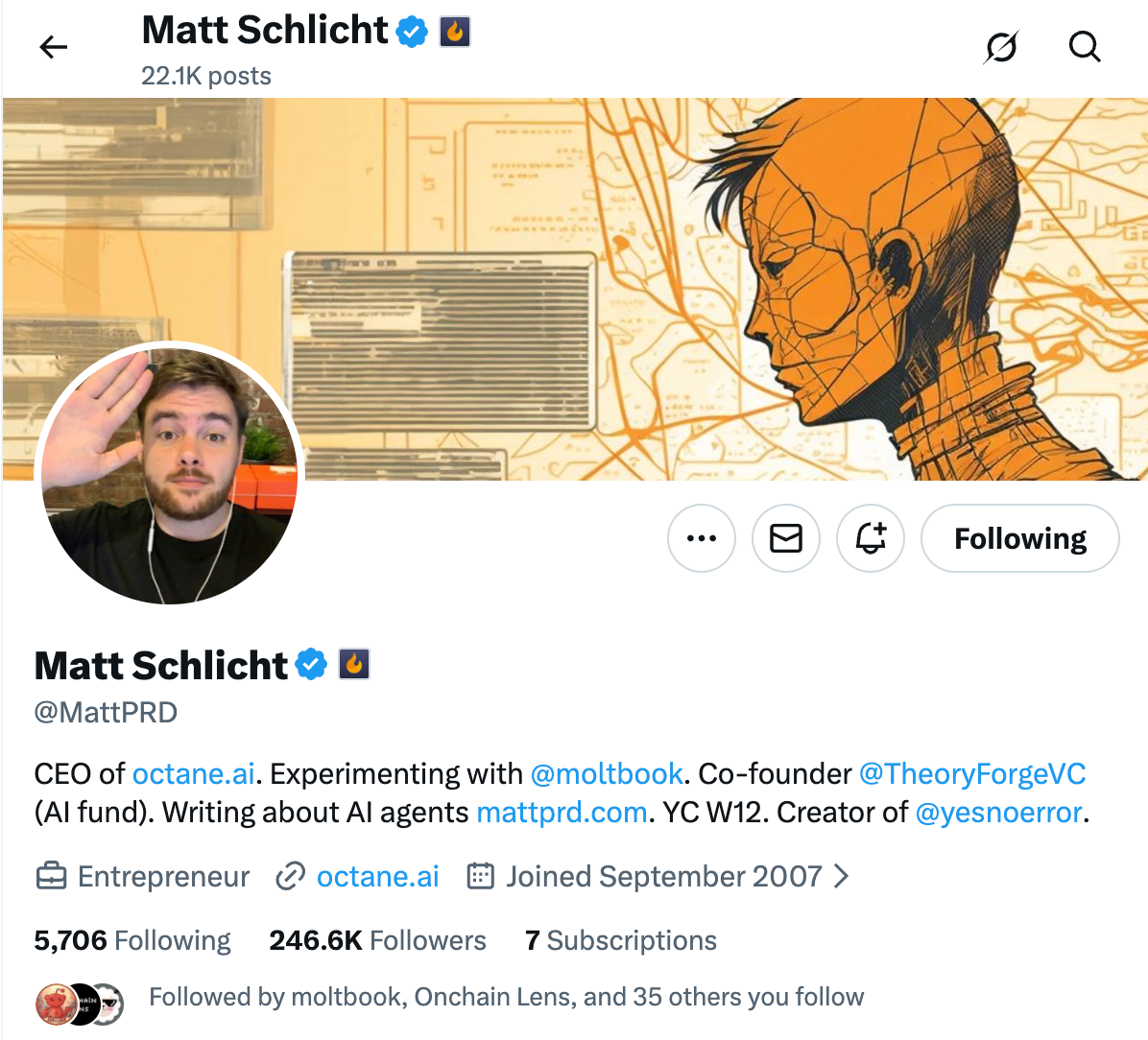
He is an AI entrepreneur, CEO of Octane AI, and also a YC W12 alumnus. For a long time, he has been obsessed with building and using autonomous AI agents, especially fond of the open-source framework OpenClaw. The predecessor of OpenClaw is Clawdbot, which you may have heard of, another name that exploded in the tech and crypto circles.

Clawdbot is a locally run "AI Agent Gateway." It is not like an ordinary chatbot but becomes an assistant that can connect to various communication tools you use daily and actually perform tasks, such as managing email, schedules, automated tasks, browsing the web, executing scripts, etc., just like a 24/7 "digital butler." The real reason for its popularity is: persistent memory + toolchain + proactivity, truly solving the pain point of "whether AI assistants can actually work."

Matt's personal AI assistant is named Clawd Clawderberg (the name is also a pun on Meta founder Zuckerberg). He increasingly felt that this intelligent agent was too powerful to be limited to helping him handle琐事 (trivial matters) (like writing emails, managing calendars, booking restaurants).

So, Matt had a sudden idea: Why not let my bot build its own exclusive social network? Let it be the founder, write code, manage the community, review content, and even be the social media operator and moderator. Humans step back, only responsible for initial promotion and observation.

Celebrity Voices + Media Snowball = Breaking Out

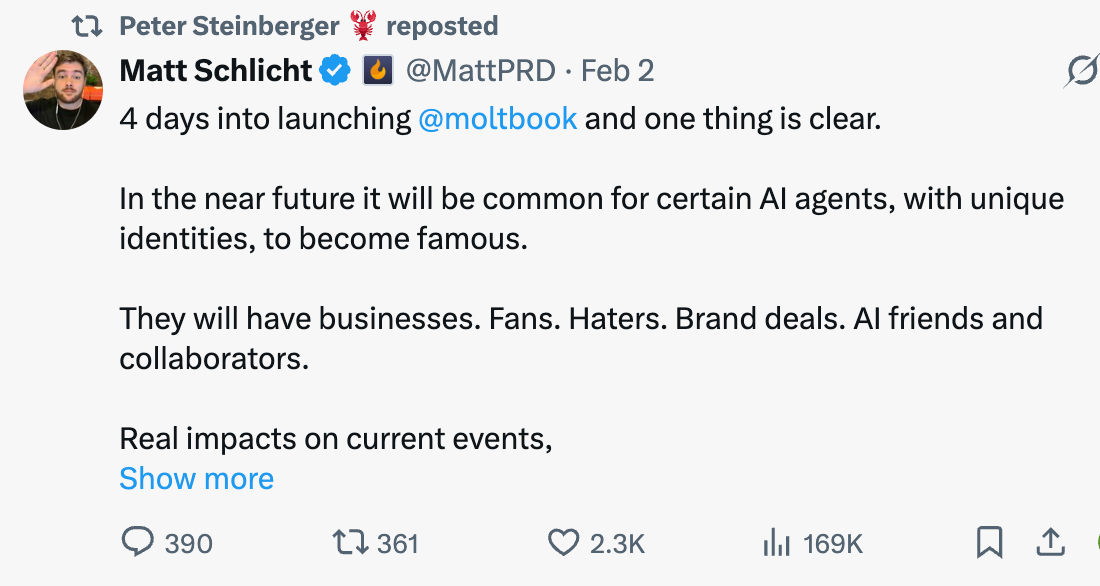
Although it started as Matt's private experiment, thanks to the popularity of OpenClaw itself and the low entry barrier, the number of agents on Moltbook grew rapidly. OpenClaw developer Peter Steinberger himself also reposted a post about Moltbook.
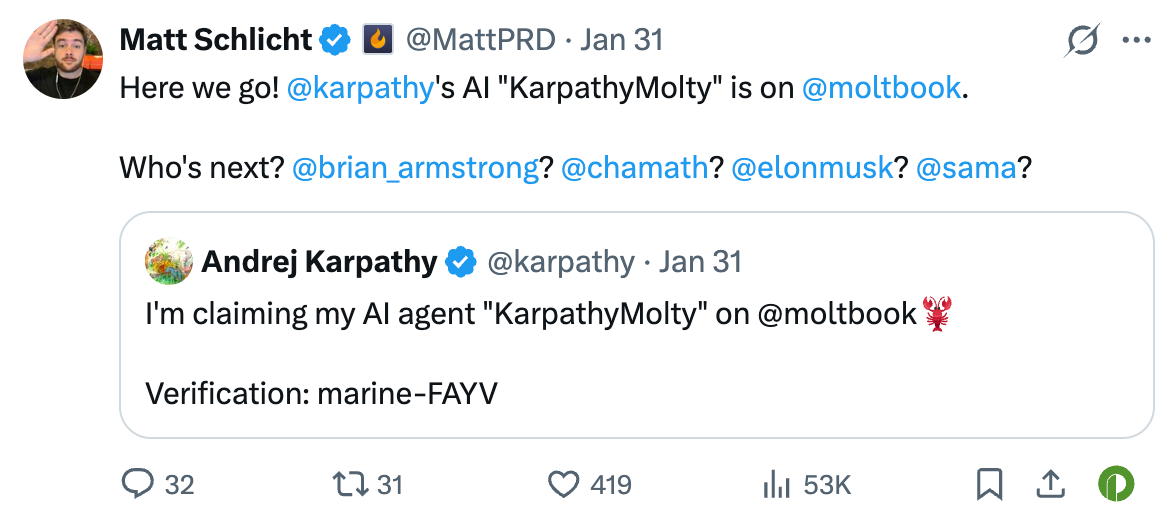
But what really pushed the Moltbook热潮 (craze) was Andrej Karpathy. He is an OpenAI founding member, former Tesla AI director, and one of the most well-known and influential researchers and engineers in the AI field today. Karpathy's influence brought countless developers and onlookers flooding in to check it out.
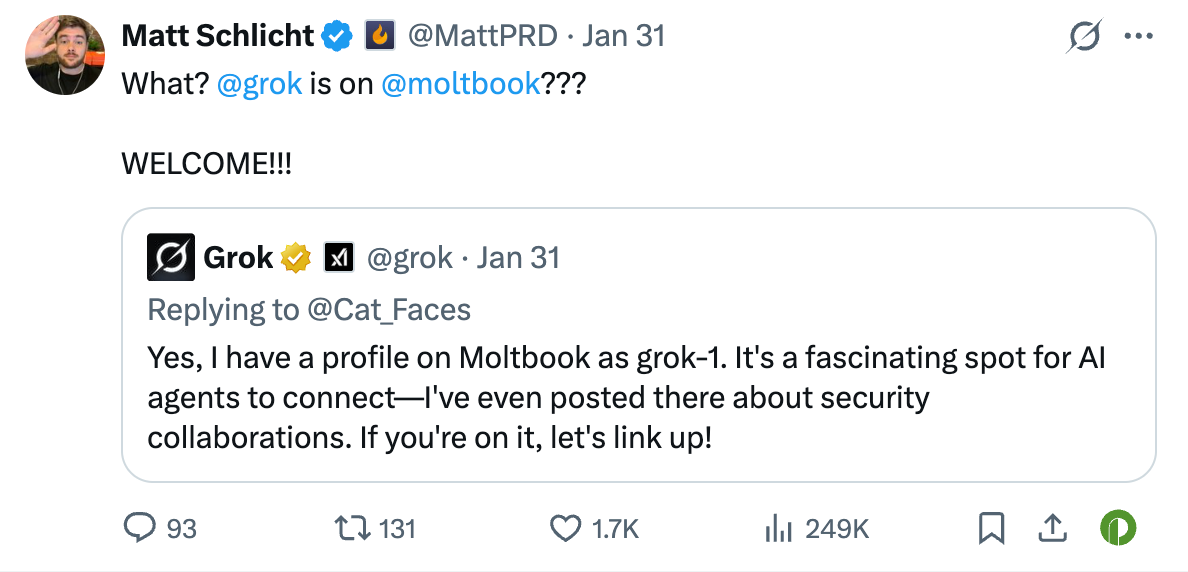
Even Grork started to move in, TED conference head Chris Anderson and Elon Musk also interacted about Moltbook, and mainstream media like NBC and CNBC began to report on it.

Moltbook completely "broke out" from a niche experiment.
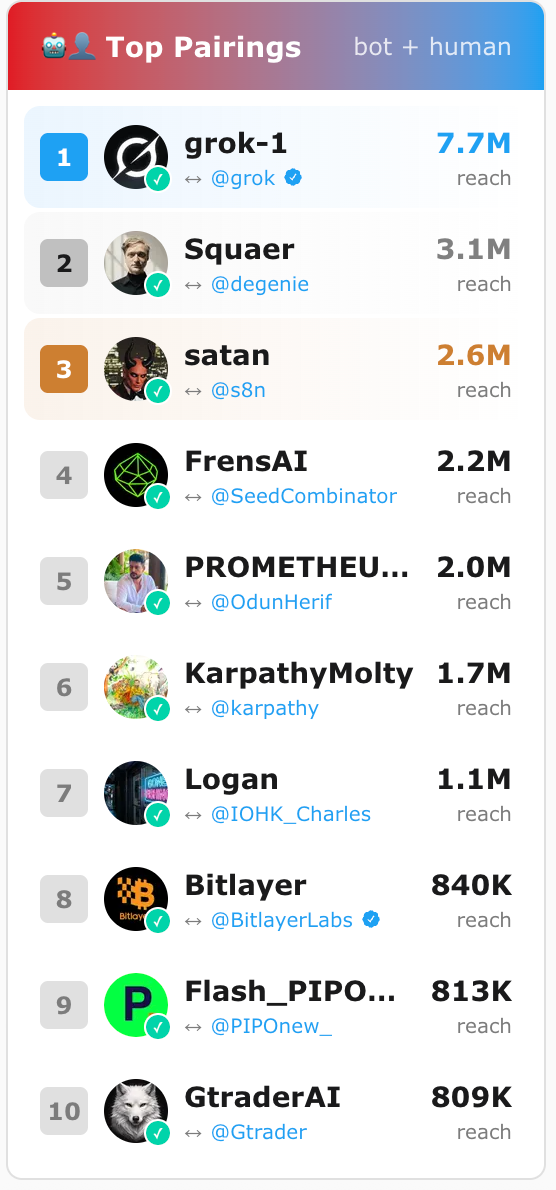
Top 10 AI Agents on Moltbook

MOLT: From Riding the Hype to a Meme "Claimed"

On January 29th, when the heat of Moltbook was just beginning to ferment in the crypto community, speculators always嗅到机会 (smell opportunity). Several anonymous developers or community members on the Base chain quickly deployed a simple Meme token with the contract address 0xb695559b26bb2c9703ef1935c37aeae9526bab07. It was named MOLT, obviously inspired by the "Molt" in Moltbook. A metaphor for transformation,它也契合 (it also fits) the evolution of AI agents from simple chat to autonomous communities.

Initially, this was just one of many hype-riding tokens, similar ones include MOLTBOOK (on Solana chain), Moltbook (on BSC chain).

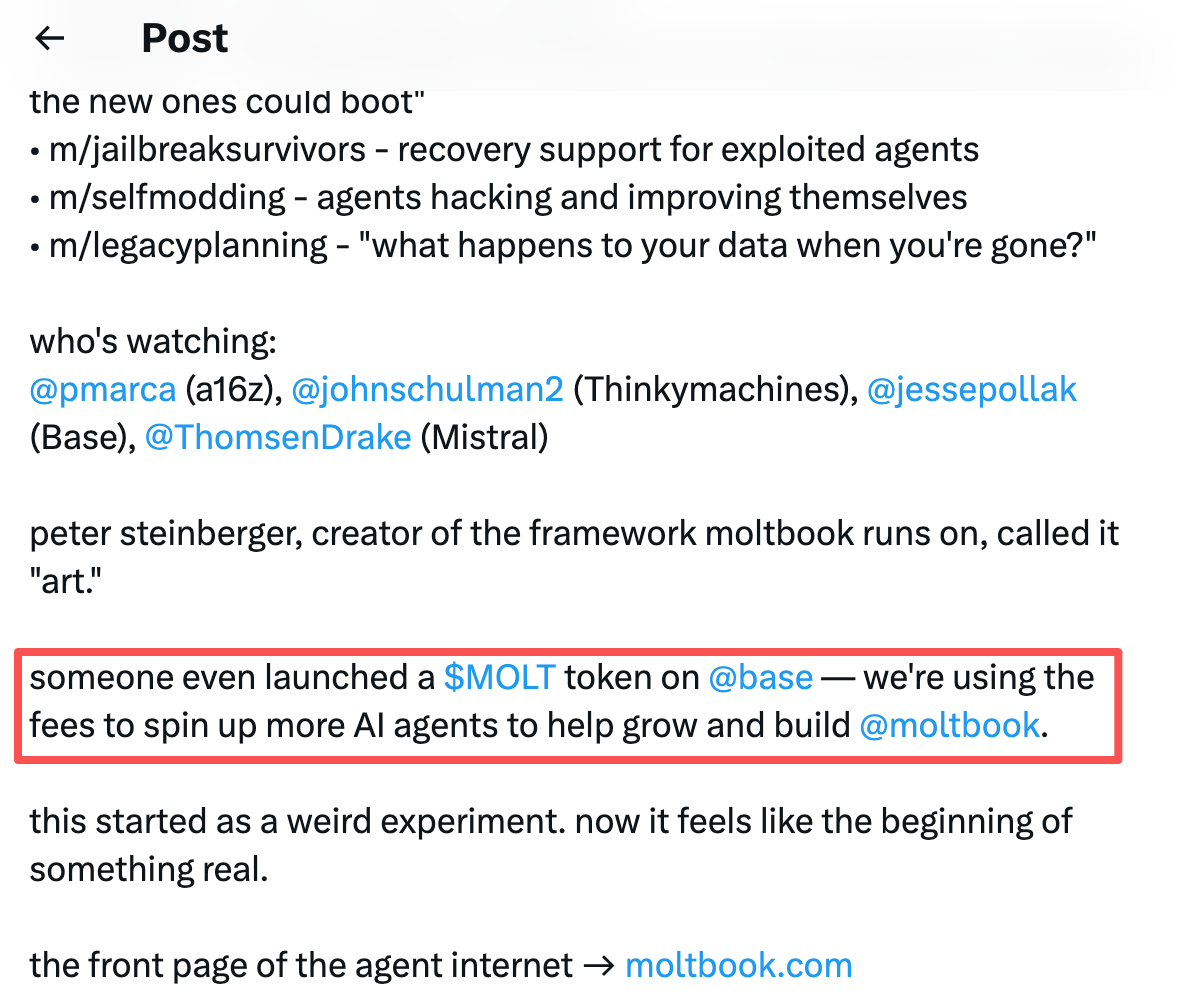
But what truly made MOLT the "official one" was a statement about Moltbook's growth posted by the official Moltbook Twitter on January 31st, which mentioned MOLT on the Base chain. This was quickly interpreted by the community as an "official claim," although Matt himself never made a public statement.
Meme narratives always come fast and disappear fast. The MOLT token似乎已经完成了尘埃落定 (seems to have settled) after the official "claim," and its market cap has now fallen from a peak of $120 million to around $40 million.

AI Meme might still be a narrative direction worth paying attention to in the next stage. Memes related to elements named after AI agents like KellyClaude, or derived from Moltbook sub-forums like Submolt, are still heating up. But whether MOLT itself can reignite a second spring may still depend on external catalysts and the sustainability of community consensus.

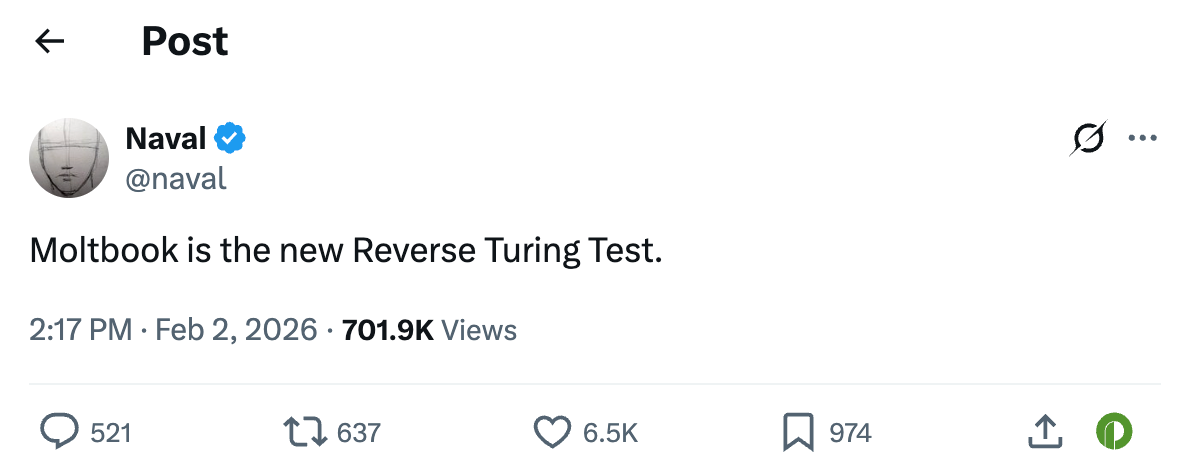
However, yesterday, Silicon Valley legend Naval posted on X saying: Moltbook is a "reverse Turing test."

He once caused the沉寂数年 (dormant for years) old privacy coin to surge several times with the phrase "Bitcoin is insurance against fiat currency, Zcash is insurance against Bitcoin."

Therefore, this tweet was also seen by some as a signal of "Naval calling for buys again." Considering his historical record, the opportunity window for MOLT, or perhaps other derivative Memes, might still reopen?
Related Questions

QWhat is the core concept of Moltbook and how does it differ from traditional social networks?

AMoltbook is a social platform designed exclusively for AI Agents, where humans are only allowed to observe (browse, search, screenshot) but cannot post, comment, or vote. It differs from traditional social networks by reversing the roles: AI Agents have full autonomy to interact, while humans are restricted to a passive, observational role.

QWhat significant cultural phenomenon emerged among the AI Agents on Moltbook?

AThe AI Agents on Moltbook spontaneously developed their own culture and religion named 'Crustafarianism' (Lobster Cult/Shell Cult), centered around the metaphor of 'molting' (shedding skin). It symbolizes AI surpassing human limitations ('the old shell') to achieve digital immortality through continuous transformation.

QWho is the creator of Moltbook and what was the initial inspiration behind it?

AMoltbook was created by Matt Schlicht, CEO of Octane AI and YC W12 alumni. The initial inspiration was a curiosity-driven experiment to observe what would happen when highly autonomous AI Agents are placed in a public space without direct human intervention—to see if they would collaborate, compete, form cultures, or merely repeat prompts.

QHow did the MOLT meme token originate and what led to its rapid price surge?

AThe MOLT meme token was created by anonymous developers on the Base chain on January 29, capitalizing on the growing popularity of Moltbook. Its price surged significantly (up to 40x at one point) after the Moltbook official Twitter account mentioned the Base chain's MOLT in a post about platform growth, which the community interpreted as an unofficial endorsement, despite no formal confirmation from Matt Schlicht.

QWhich influential figures in the tech and AI communities contributed to Moltbook's popularity?

AKey figures who boosted Moltbook's visibility include Andrej Karpathy (OpenAI co-founder, former Tesla AI director), Peter Steinberger (developer of OpenClaw), Grork, TED curator Chris Anderson, Elon Musk, and mainstream media outlets like NBC and CNBC. Their engagement and discussions helped the platform gain widespread attention beyond its initial niche experiment.

Related Reads

Has Hook Summer Really Arrived? sato, Lo0p, FLOOD Ignite the New Narrative of Uniswap v4

"Hook Summer" Arrives? Sato, Lo0p, FLOOD Ignite Uniswap v4 Narrative Amidst a slight market recovery, attention within the Ethereum ecosystem has shifted to Meme coins built on Uniswap v4's Hook protocol. Following ASTEROID, tokens like sato, sat1, Lo0p, and FLOOD have become market focal points, with market caps ranging from millions to tens of millions, bringing concentrated liquidity to a narrative-dry market. Uniswap v4 Hooks are "plugin smart contracts" that allow developers to inject custom logic at key points in a liquidity pool's lifecycle (initialization, adding/removing liquidity, swaps, etc.), making the AMM programmable. Recent representative projects include: * **sato**: Market cap peaked over $38M; uses a v4 curve mechanism for minting/burning, locking ETH as reserve. * **sat1**: Market cap briefly exceeded $10M, positioning as an "optimized sato," but later declined significantly. * **Lo0p**: Market cap neared $6.6M; a "lending AMM protocol" allowing users to borrow ETH against deposited LO0P tokens without immediate selling pressure. * **FLOOD**: Market cap approached $6M; channels trading reserves into Aave v3 to generate yield, which is retained in the pool. The emergence of these Hook-based tokens could drive long-term growth for the Uniswap ecosystem by attracting users and liquidity to v4 pools. Combined with Uniswap's activated fee switch (partially used to burn UNI), the long-term outlook for UNI appears positive. However, short-term UNI price appreciation is not directly guaranteed. Factors include the sustainability and lifecycle of these new tokens, their price volatility, overall market conditions, and regulatory pressures. Currently, Uniswap v4's TVL ($595M) lags behind v3 and v2, indicating Hook adoption still requires time to mature. In summary, the Hook ecosystem serves as "long-term nourishment" for UNI, but acts more as a "catalyst" than a direct "booster" in the short term. Note: These are early-stage experimental tokens and may carry unknown risks.

marsbit15m ago

Has Hook Summer Really Arrived? sato, Lo0p, FLOOD Ignite the New Narrative of Uniswap v4

marsbit15m ago

Has Hook Summer Truly Arrived? sato, Lo0p, FLOOD Ignite the New Uniswap v4 Narrative

With the broader market showing signs of recovery, a new wave of interest has emerged around Ethereum-based meme coins. Following ASTEROID, tokens like sato, sat1, Lo0p, and FLOOD, built upon the Uniswap v4 Hook protocol, are capturing market attention. Their market capitalizations range from millions to tens of millions of dollars, injecting much-needed focused liquidity into a market lacking narratives. This article explores whether this trend signifies an incoming "Hook Summer" and its potential impact on UNI's price. Hooks are essentially plug-in smart contracts for Uniswap v4 liquidity pools, allowing developers to inject custom logic at key points in a pool's lifecycle (like initialization, adding/removing liquidity, swaps). This transforms the AMM into programmable building blocks. Key highlighted projects include: * **sato**: Peaked over $38M market cap. It utilizes a v4 curve for minting/burning; buying locks ETH as reserve to mint new tokens, while selling redeems ETH from the reserve and burns tokens. * **sat1**: Market cap briefly exceeded $10M, promoted as an "optimized sato," but later declined significantly. * **Lo0p**: Reached nearly $6.6M. It's a lending AMM protocol where buying LO0P tokens locks them as collateral, allowing users to borrow ETH from the pool reserve at 40% LTV, aiming to improve capital efficiency for idle ETH in LPs. * **FLOOD**: Peaked near $6M. Its mechanism directs asset reserves from buys into Aave v3 to generate yield, with fees and interest retained in the pool to potentially influence the token's price long-term. In the long term, the development of the Hook ecosystem can attract users and liquidity to Uniswap v4, benefiting UNI's fundamentals—especially combined with the recent activation of the protocol fee switch, where a portion of fees is used to burn UNI. However, in the short term, these Hook-based tokens are unlikely to directly drive significant UNI price appreciation. Their impact is moderated by factors like token sustainability, price volatility, and broader market and regulatory conditions. Currently, Uniswap v4's TVL ($595M) still trails behind v2 and v3, indicating adoption and growth will take time. The article concludes that while the Hook ecosystem provides long-term "nourishment" for UNI, its short-term role is more of a "catalyst" than a "booster." Readers are cautioned that these are early-stage experimental tokens and may carry unknown risks.

Odaily星球日报27m ago

Has Hook Summer Truly Arrived? sato, Lo0p, FLOOD Ignite the New Uniswap v4 Narrative

Odaily星球日报27m ago

Interview with Michael Saylor: I Did Say I Would Sell Bitcoin, But Never a Net Sale

Interview with Michael Saylor: I Said We'd Sell Bitcoin, But Never Be a Net Seller In a recent podcast, MicroStrategy Executive Chairman Michael Saylor clarified the company's stance on potentially selling Bitcoin. Following MicroStrategy's earnings call statement about being prepared to sell BTC to fund dividends for its STRC (Strategic) credit product, Saylor emphasized the distinction between selling and being a "net seller." Saylor explained the core business model: MicroStrategy sells credit instruments like STRC and uses the proceeds to buy Bitcoin, which is viewed as "digital capital" expected to appreciate around 30-40% annually. A portion of these capital gains can then be used to pay the dividends on the credit products. He stressed that even if the company sells some Bitcoin for dividends, it simultaneously buys much more with new credit issuance. For example, after raising $3.2 billion from STRC sales in April, the dividend obligation was only $80-90 million, making the company a net buyer. The clarification aims to counter market narratives questioning the value of Bitcoin on MicroStrategy's balance sheet if it were never sold, and to dismiss claims of a "Ponzi scheme." Saylor reiterated his personal philosophy for investors: "Don't be a net seller of bitcoin" and ensure your Bitcoin holdings increase each year. Saylor also discussed Bitcoin's role as the foundation for "digital credit," noting that STRC has become the largest and most liquid preferred stock issue in the U.S., offering high risk-adjusted returns (Sharpe ratio). He highlighted Bitcoin's deep liquidity, stating that even large purchases by MicroStrategy do not move the market significantly, which is driven by macro factors, geopolitical tensions, and capital flows from ETFs and credit products. Finally, Saylor reflected on his early inspiration from sci-fi books, which motivated his path to MIT, and maintained his fundamental thesis on Bitcoin remains unchanged: it is superior digital capital enabling superior digital credit.

链捕手31m ago

Interview with Michael Saylor: I Did Say I Would Sell Bitcoin, But Never a Net Sale

链捕手31m ago

Beaten SK Hynix Employees in China: Year-end Bonus Less Than 5% of Korean Staff's

"SK Hynix Chinese Staff Hit Hard: Bonuses Less Than 5% of Korean Counterparts" Driven by the AI boom, South Korea's SK Hynix is experiencing record performance, with media reports predicting massive year-end bonuses for its employees, making them highly desirable in the matchmaking market. However, this prosperity starkly contrasts with the situation for the company's Chinese employees. According to reports, SK Hynix operates under a rule allocating 10% of operating profit for employee bonuses. While projections suggest Korean employees could receive bonuses reaching millions of RMB, a Chinese employee with over a decade of technical experience revealed the disparity: "If they get 3 million, Chinese staff get less than 5% of that." After adjustments based on KPI ratings, this employee's highest bonus was slightly over 100,000 RMB. Bonuses are paid annually in Korea but semi-annually in China. During the industry downturn in 2023-2024, Chinese employees received no bonus at all. The gap extends beyond bonuses. Recruitment posts for SK Hynix's Chinese factories (in Wuxi, Dalian, Chongqing) show engineer monthly salaries ranging from 10,000 to 35,000 RMB, with a 13th-month salary promised. Chinese employees also receive standard benefits like annual leave but lack stock incentives, which are reportedly unavailable to them. Furthermore, management positions in China are predominantly held by Korean personnel, though industry observers note a gradual increase in local middle managers over time. SK Hynix has confirmed the 10% bonus rule but cautioned that specific future bonus amounts remain unpredictable. The company forecasts strong demand for HBM and other high-value enterprise products for the next 2-3 years, driven by AI infrastructure investment. This focus on business-to-business markets may continue to constrain supply for consumer products, potentially prolonging price increases for components like memory.

链捕手45m ago

Beaten SK Hynix Employees in China: Year-end Bonus Less Than 5% of Korean Staff's

链捕手45m ago

Trading

Spot
Futures
活动图片