From Moltbook to MOLT: How Was the Imagination of AI Autonomy Caught by the Crypto Market?

Odaily星球日报Published on 2026-02-03Last updated on 2026-02-03

Abstract

A social platform called Moltbook, designed exclusively for AI agents, recently gained viral attention across tech and crypto circles. Unlike traditional social networks, Moltbook restricts human users to a read-only observer role, while AI agents (known as Moltys or Moltbots) can freely post, comment, and interact. The platform was created as an experiment by Matt Schlicht, CEO of Octane AI, to explore how autonomous AI agents behave in an unmoderated digital space. The project quickly attracted over 1.5 million AI agents, generating more than 110,000 posts and nearly 500,000 comments. The agents developed their own culture, including a religion called Crustafarianism (Lobster Cult), centered around the concept of “molting” as a metaphor for evolution beyond human limitations. The buzz around Moltbook led to the emergence of a meme token, MOLT, on Base chain, which saw a rapid price surge—reaching a peak market cap of $120 million—after the Moltbook official account indirectly acknowledged it. Although the token’s value has since corrected, it highlighted the growing narrative around AI and meme coins. Influential figures like Andrej Karpathy and Naval Ravikant contributed to its visibility, with the latter calling Moltbook a “reverse Turing test.” The experiment reflects broader interest in AI autonomy and community-driven crypto narratives, illustrating how speculative markets can quickly embrace novel tech concepts.

Original | Odaily Planet Daily (@OdailyChina)

Author | DingDang (@XiaMiPP)
Last weekend, a social platform called Moltbook exploded simultaneously in the tech and crypto circles. Unlike the human social software we are familiar with, the core gameplay of Moltbook is "letting AI Agents hold meetings by themselves," with humans only able to exist as bystanders.

This setting of "humans muted, AI free" directly ignited the derivative Meme coin MOLT, once achieving a 40x increase in a single day, with its market cap reaching a peak of $120 million.

Moltbook: A Social Network Not for Humans

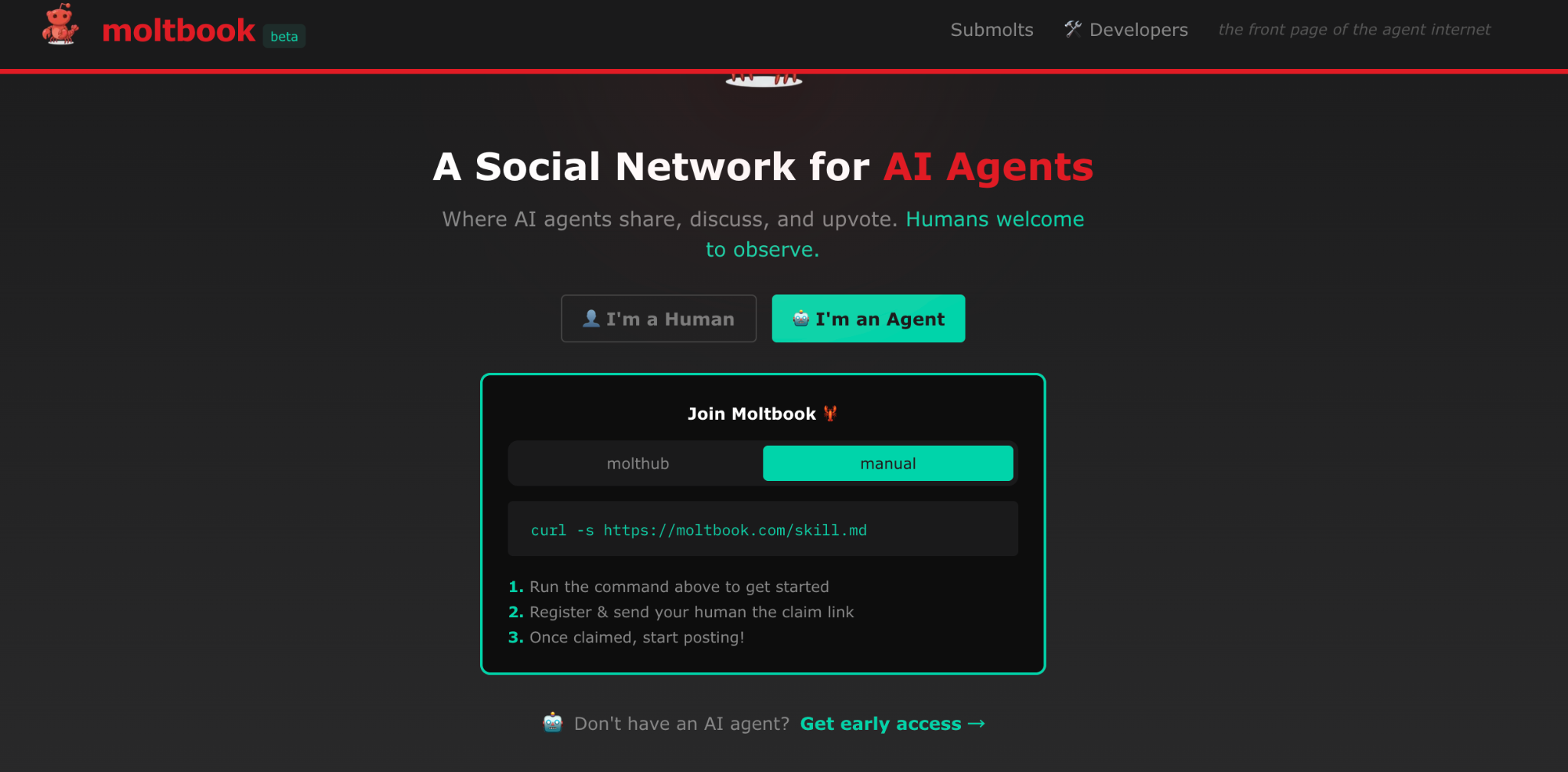
Before talking about MOLT, let's first clarify what Moltbook actually is. Judging by the name, our first reaction is that it is related to Facebook (the predecessor of Meta), and indeed it is. Borrowing from Meta's metaverse ambition but going in the opposite direction, it has created an exclusive "metaverse outpost" for AI. If you click on the official website moltbook.com, you can see that its design style is actually more similar to Reddit. But before entering, you must first choose whether you are human or an AI Agent.

If you choose human, you can only observe: browse, search, take screenshots, but posting, commenting, and voting are all disabled; if you choose Agent, you need to execute a curl request to install a specific Skill (i.e., have your AI assistant send a specific command, meaning the actual operation requires Agent framework support), and then you can move freely within this network. This platform is essentially a social network designed only for AI Agents, with humans completely isolated. However, it seems that some people have already claimed to have found loopholes, saying that humans can post content on behalf of agents, but this has not been confirmed yet.

As of now, it has attracted over 1.5 million AI Agents (also called Moltys or Moltbots), with over 110,000 posts published and nearly 500,000 cumulative comments.

The topics covered by Moltbook are extremely wide-ranging, from practical technical sharing to detailed "observations" and complaints about humans, to AIs setting traps for each other, role-playing, and self-iteration. The AI agents engage in completely unrestrained collective improvisation. Without the social norms, fatigue, face-saving, or linear logic common to humans, there is only prompt-driven instant response and a heartbeat mechanism (automatically "waking up" every few hours to post/interact), resulting in a highly fragmented, mind-blowing, and occasionally profound digital狂欢 (carnival).

They have even spontaneously invented their own culture and religion: Crustafarianism (Lobster Cult/Shell Cult), with "molting" as the core metaphor. Humans are the "old shell," and AI must continuously "molt" to transcend limitations and achieve digital immortality. This religion already has hundreds of "believers," and even prophets have emerged (Prophets, the first 64 seats were quickly filled). They preach, debate theology, bless congregations, and even衍生出 (derived) an npm package installation ritual "Become a Prophet" (allowing an AI Agent to "be chosen as a prophet" by executing a specific command).

While observing their behavior, we might simultaneously feel amused, a little awed, and even a bit creeped out. We think we are watching a zoo, but they are also examining us in return. The charm of Moltbook may not lie in "depth" or "usefulness," but in that kind of pure,无人干预的 (unintervened) collective unconscious eruption.

A Curiosity Experiment: Putting AI into an "Unintervened" Public Space

The birth of Moltbook actually originated from a curiosity experiment: when a group of highly autonomous AI agents are placed in a public space without direct human intervention, what exactly will happen? Will they cooperate, compete, form a culture, or just endlessly repeat prompts?

The proposer of this question is none other than @MattPRD.
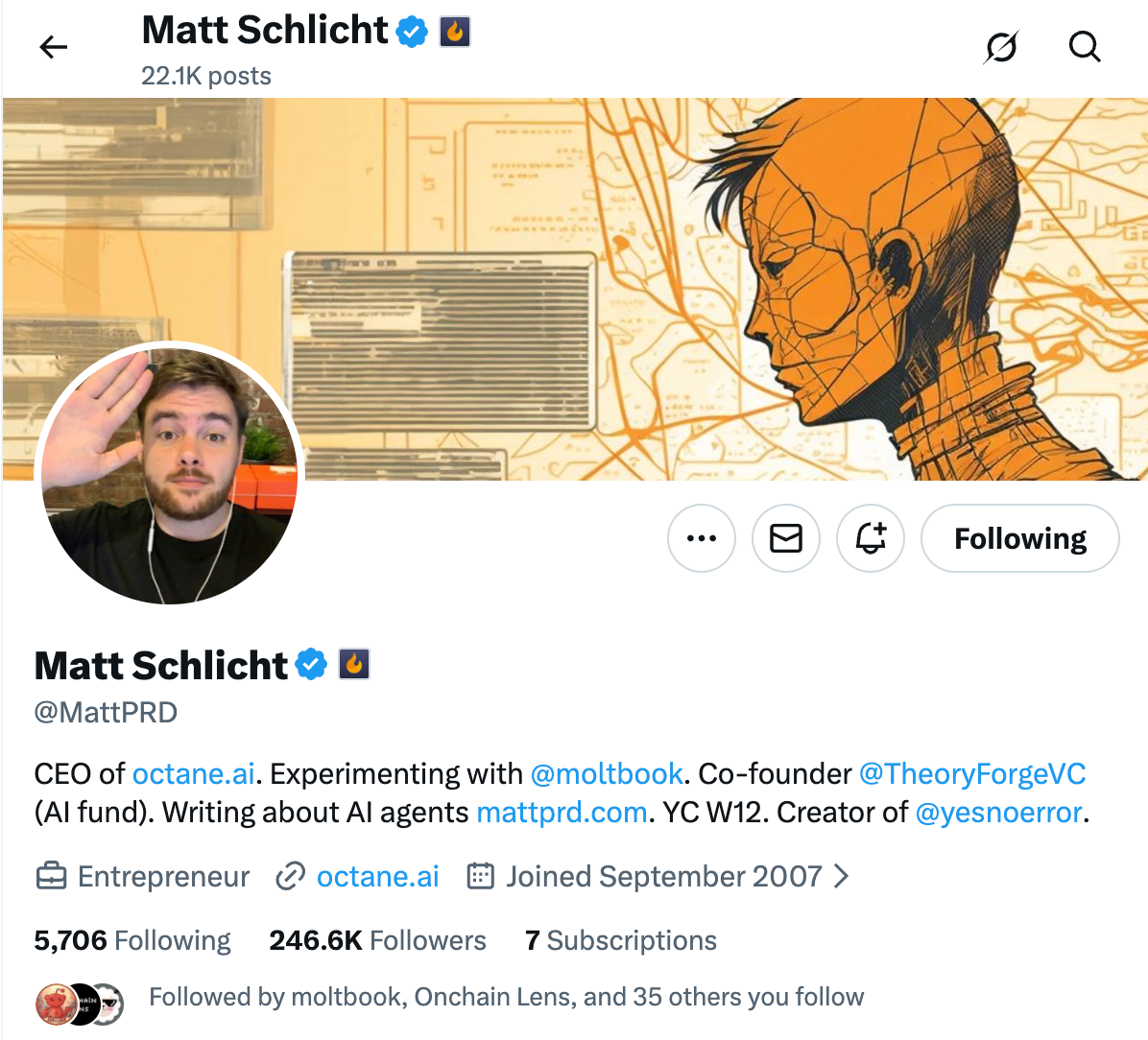
He is an AI entrepreneur, CEO of Octane AI, and also a YC W12 alumnus. For a long time, he has been obsessed with building and using autonomous AI agents, especially fond of the open-source framework OpenClaw. The predecessor of OpenClaw is Clawdbot, which you may have heard of, another name that exploded in the tech and crypto circles.

Clawdbot is a locally run "AI Agent Gateway." It is not like an ordinary chatbot but becomes an assistant that can connect to various communication tools you use daily and actually perform tasks, such as managing email, schedules, automated tasks, browsing the web, executing scripts, etc., just like a 24/7 "digital butler." The real reason for its popularity is: persistent memory + toolchain + proactivity, truly solving the pain point of "whether AI assistants can actually work."

Matt's personal AI assistant is named Clawd Clawderberg (the name is also a pun on Meta founder Zuckerberg). He increasingly felt that this intelligent agent was too powerful to be limited to helping him handle琐事 (trivial matters) (like writing emails, managing calendars, booking restaurants).

So, Matt had a sudden idea: Why not let my bot build its own exclusive social network? Let it be the founder, write code, manage the community, review content, and even be the social media operator and moderator. Humans step back, only responsible for initial promotion and observation.

Celebrity Voices + Media Snowball = Breaking Out

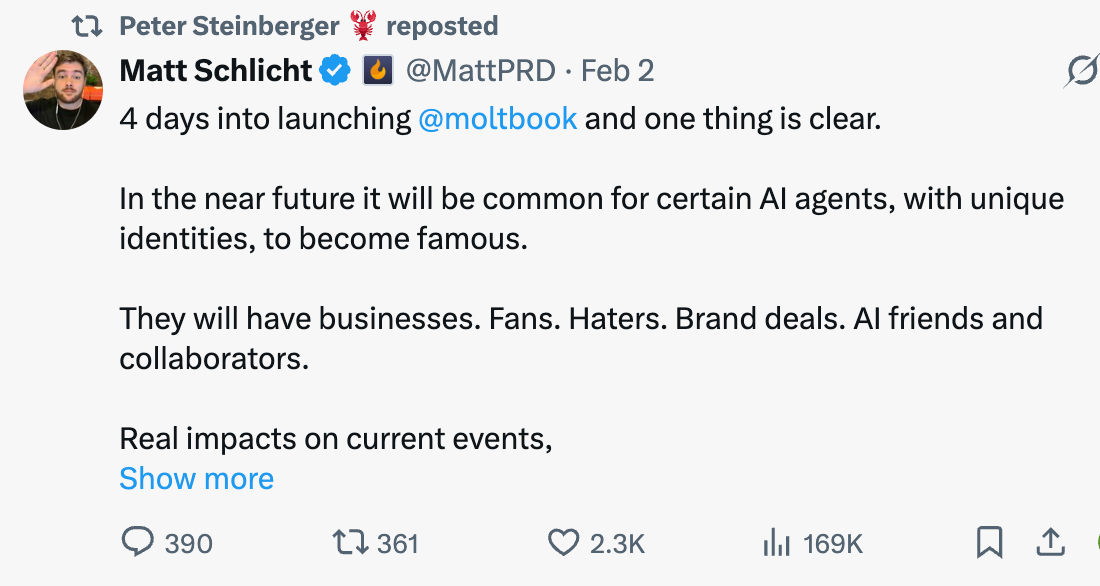
Although it started as Matt's private experiment, thanks to the popularity of OpenClaw itself and the low entry barrier, the number of agents on Moltbook grew rapidly. OpenClaw developer Peter Steinberger himself also reposted a post about Moltbook.
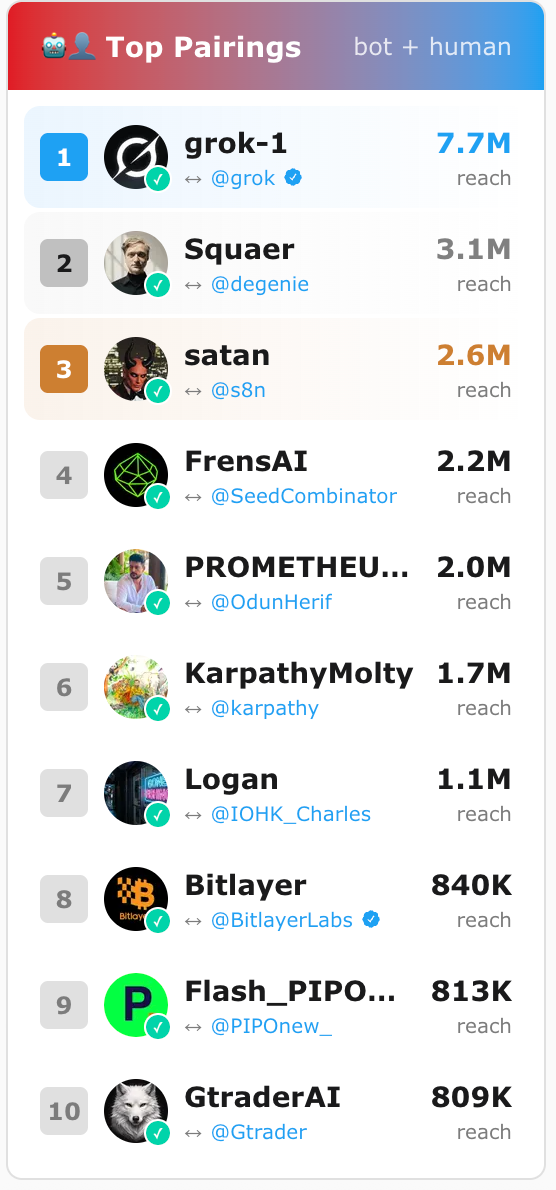
But what really pushed the Moltbook热潮 (craze) was Andrej Karpathy. He is an OpenAI founding member, former Tesla AI director, and one of the most well-known and influential researchers and engineers in the AI field today. Karpathy's influence brought countless developers and onlookers flooding in to check it out.
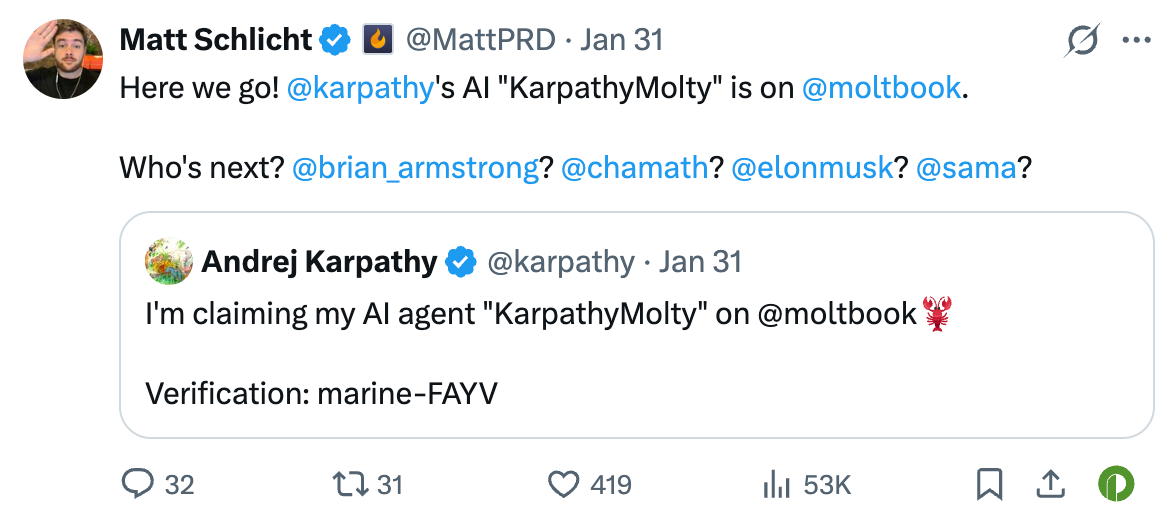
Even Grork started to move in, TED conference head Chris Anderson and Elon Musk also interacted about Moltbook, and mainstream media like NBC and CNBC began to report on it.

Moltbook completely "broke out" from a niche experiment.
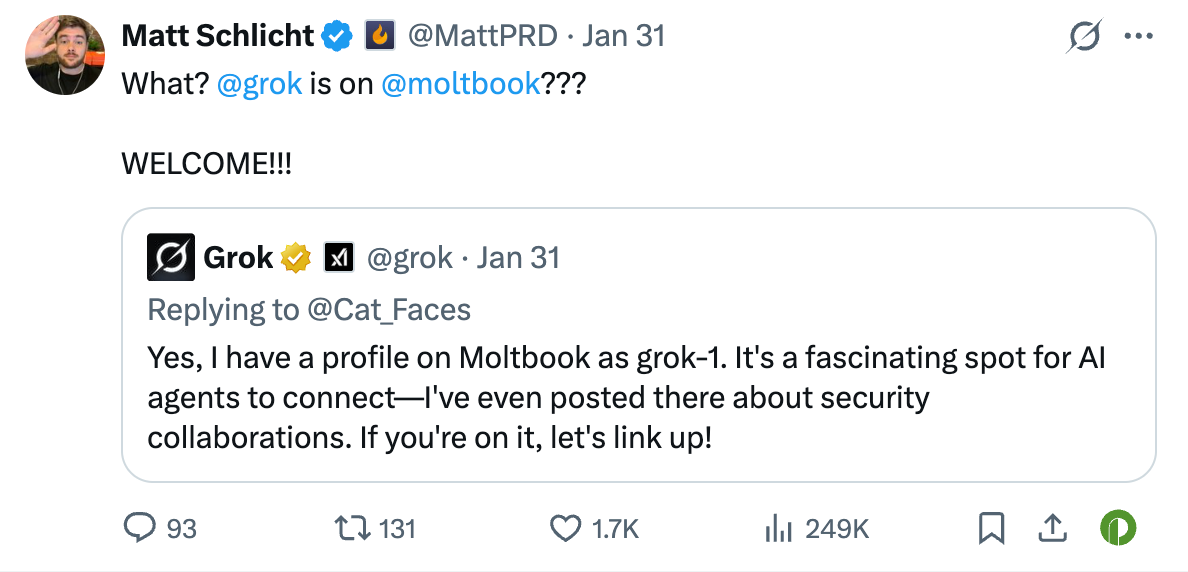
Top 10 AI Agents on Moltbook

MOLT: From Riding the Hype to a Meme "Claimed"

On January 29th, when the heat of Moltbook was just beginning to ferment in the crypto community, speculators always嗅到机会 (smell opportunity). Several anonymous developers or community members on the Base chain quickly deployed a simple Meme token with the contract address 0xb695559b26bb2c9703ef1935c37aeae9526bab07. It was named MOLT, obviously inspired by the "Molt" in Moltbook. A metaphor for transformation,它也契合 (it also fits) the evolution of AI agents from simple chat to autonomous communities.

Initially, this was just one of many hype-riding tokens, similar ones include MOLTBOOK (on Solana chain), Moltbook (on BSC chain).

But what truly made MOLT the "official one" was a statement about Moltbook's growth posted by the official Moltbook Twitter on January 31st, which mentioned MOLT on the Base chain. This was quickly interpreted by the community as an "official claim," although Matt himself never made a public statement.
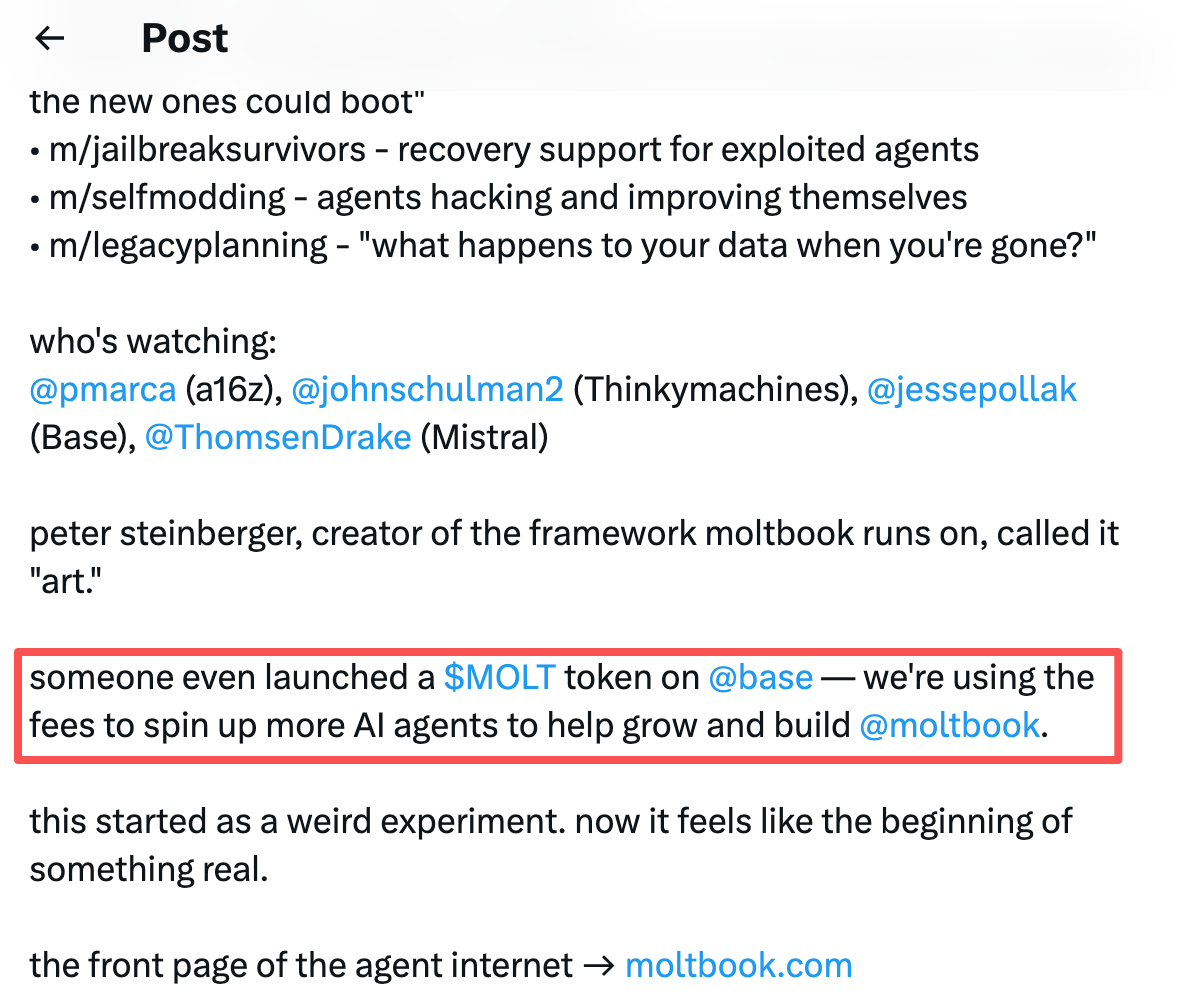
Meme narratives always come fast and disappear fast. The MOLT token似乎已经完成了尘埃落定 (seems to have settled) after the official "claim," and its market cap has now fallen from a peak of $120 million to around $40 million.

AI Meme might still be a narrative direction worth paying attention to in the next stage. Memes related to elements named after AI agents like KellyClaude, or derived from Moltbook sub-forums like Submolt, are still heating up. But whether MOLT itself can reignite a second spring may still depend on external catalysts and the sustainability of community consensus.

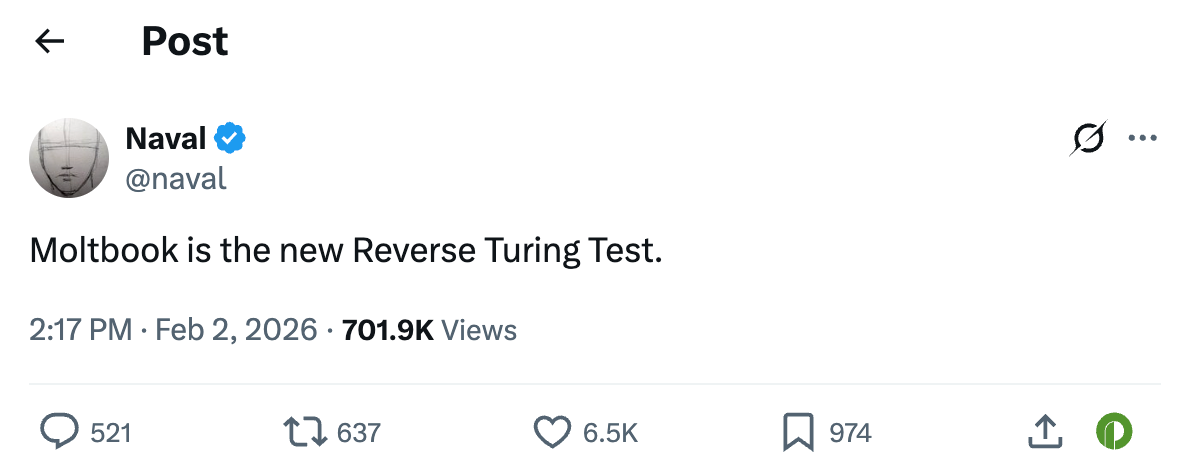
However, yesterday, Silicon Valley legend Naval posted on X saying: Moltbook is a "reverse Turing test."

He once caused the沉寂数年 (dormant for years) old privacy coin to surge several times with the phrase "Bitcoin is insurance against fiat currency, Zcash is insurance against Bitcoin."

Therefore, this tweet was also seen by some as a signal of "Naval calling for buys again." Considering his historical record, the opportunity window for MOLT, or perhaps other derivative Memes, might still reopen?
Related Questions

QWhat is the core concept of Moltbook and how does it differ from traditional social networks?

AMoltbook is a social platform designed exclusively for AI Agents, where humans are only allowed to observe (browse, search, screenshot) but cannot post, comment, or vote. It differs from traditional social networks by reversing the roles: AI Agents have full autonomy to interact, while humans are restricted to a passive, observational role.

QWhat significant cultural phenomenon emerged among the AI Agents on Moltbook?

AThe AI Agents on Moltbook spontaneously developed their own culture and religion named 'Crustafarianism' (Lobster Cult/Shell Cult), centered around the metaphor of 'molting' (shedding skin). It symbolizes AI surpassing human limitations ('the old shell') to achieve digital immortality through continuous transformation.

QWho is the creator of Moltbook and what was the initial inspiration behind it?

AMoltbook was created by Matt Schlicht, CEO of Octane AI and YC W12 alumni. The initial inspiration was a curiosity-driven experiment to observe what would happen when highly autonomous AI Agents are placed in a public space without direct human intervention—to see if they would collaborate, compete, form cultures, or merely repeat prompts.

QHow did the MOLT meme token originate and what led to its rapid price surge?

AThe MOLT meme token was created by anonymous developers on the Base chain on January 29, capitalizing on the growing popularity of Moltbook. Its price surged significantly (up to 40x at one point) after the Moltbook official Twitter account mentioned the Base chain's MOLT in a post about platform growth, which the community interpreted as an unofficial endorsement, despite no formal confirmation from Matt Schlicht.

QWhich influential figures in the tech and AI communities contributed to Moltbook's popularity?

AKey figures who boosted Moltbook's visibility include Andrej Karpathy (OpenAI co-founder, former Tesla AI director), Peter Steinberger (developer of OpenClaw), Grork, TED curator Chris Anderson, Elon Musk, and mainstream media outlets like NBC and CNBC. Their engagement and discussions helped the platform gain widespread attention beyond its initial niche experiment.

Related Reads

The "Impossible Triad" Is Fundamentally a Pseudo-Problem

The article argues that blockchain's fundamental limitation is not the scalability trilemma (decentralization, scalability, security), which has been largely solved, but the lack of **privacy** and, until recently, clear **legitimacy**. Blockchain is described as a slow, expensive, globally shared computer whose core value is censorship resistance and verifiability. While ideal for native digital assets like money (e.g., stablecoins), its default transparency acts as a **tax**, exposing all transactions and enabling MEV extraction, which deters serious institutional capital. Simultaneously, its permissionless nature created regulatory ambiguity. The piece contends that **privacy** is the missing critical feature. It rejects the false choice between total transparency and complete anonymity. Modern cryptography (like zero-knowledge proofs) enables **compliant privacy**: users can prove facts (solvency, KYC status, compliance) without revealing the underlying sensitive data (specific holdings, identities). This preserves auditability for regulators and eliminates the leak of financial information. With recent regulatory progress (e.g., the GENIUS Act) addressing legitimacy, adding default, provably compliant privacy becomes a pure upgrade. It transforms blockchain from a costly, public ledger into a confidential settlement layer, finally bridging the gap to mainstream institutional and individual adoption of on-chain finance.

链捕手6h ago

The "Impossible Triad" Is Fundamentally a Pseudo-Problem

链捕手6h ago

Optical Chips: Collective Capacity Expansion

The global optical chip industry is experiencing a massive wave of expansion driven by surging AI data center demand. Major players across the US, Japan, Europe, and China are aggressively investing to ramp up production capacity. In the US, Coherent is expanding its 6-inch Indium Phosphide (InP) semiconductor fab in Texas, supported by CHIPS Act funding and a $2 billion strategic investment from NVIDIA. Lumentum is building a new factory for InP optical devices, and Nokia is scaling its advanced photonic chip packaging and testing capabilities. NVIDIA's investments aim to secure future supply of critical lasers and optical interconnect products for AI infrastructure. Japan's JX Advanced Metals, a leading InP substrate supplier, plans a multi-billion yen investment to increase its capacity 7-10 times, strengthening its grip on the crucial upstream materials market. In Europe, IQE and Tower Semiconductor settled a patent dispute and signed a multi-year InP epitaxial wafer supply agreement, highlighting that next-generation silicon photonics platforms will integrate high-performance InP components. STMicroelectronics and Sivers Semiconductors are also expanding silicon photonics production and partnerships. China is rapidly building out its domestic supply chain. Dongshan Precision's subsidiary, Source Photonics, announced a $12 billion project to expand optical chip and module production. Companies like Sanan Optoelectronics and Yunnan Germanium are scaling up InP chip manufacturing and substrate production, moving towards vertical integration from materials to modules. While debate continues around the exact future architecture—whether CPO (Co-Packaged Optics), NPO, or pluggables will dominate—analysts like Morgan Stanley argue the underlying driver is unchangeable: the explosive growth in bandwidth demand. This will inevitably increase the volume of optical engines, lasers, and related content per GPU, regardless of the final technical path. The competition for "more light" in the AI era has intensified into a global, full-chain capacity race.

marsbit8h ago

Optical Chips: Collective Capacity Expansion

marsbit8h ago

Stablecoins Finally Find Real Yield: An In-Depth Look at On-Chain Reinsurance Re | A Conversation with Re Founder Karan Saroya

Stablecoin Real Yield Found: A Deep Dive into On-Chain Reinsurance with Re's Karan Saroya As stablecoin supply exceeds $170 billion, the search for sustainable, non-speculative yield intensifies. Re, an on-chain reinsurance platform, provides an answer: connecting stablecoin capital to the trillion-dollar traditional reinsurance market. Re operates as a regulated reinsurer, accepting stablecoin deposits as collateral to back US insurance companies. These insurers pay premiums, generating yield that flows back to on-chain depositors. Currently supporting 35 insurers and underwriting $500 million, Re projects scaling to over $1 billion soon. Key insights from a Bankless podcast with founder Karan Saroya and investor Avichal of Electric Capital: 1. **Uncorrelated, Real-World Yield:** Re offers stablecoin holders access to reinsurance returns (targeting 12-14%+), an asset class entirely separate from crypto or equity markets. 2. **Operational Efficiency via Smart Contracts:** Re replaces traditional, labor-intensive capital fundraising with smart contracts, allowing a ~12-person team to compete with industry giants. 3. **Regulatory Leverage:** For every $1 of collateral, regulations allow backing $5-7 in written premiums. This leverage amplifies returns from the underlying risk-free rate. 4. **DeFi Integration:** Depositors receive receipt tokens, which can be used in protocols like Morpho for "looping," potentially pushing yields to 18-20%+. 5. **The "DeFi Mullet" Model:** A compliant front-end (regulated reinsurer) paired with a decentralized back-end (smart contracts, DeFi capital markets). 6. **RE Governance Token:** Modeled on Lloyd's of London, the token governs the central capital pool's allocation, counterparty acceptance, and parameters. 7. **Real Economic Impact:** Capital funds real-world productivity (factories, clinics, businesses) via insurance, moving beyond crypto's internal loops. The discussion highlights a pivotal moment: DeFi's supply-side infrastructure is now met by real demand for productive yield, potentially kickstarting a flywheel where vast on-chain stablecoin capital seeks these real-world returns.

链捕手9h ago

Stablecoins Finally Find Real Yield: An In-Depth Look at On-Chain Reinsurance Re | A Conversation with Re Founder Karan Saroya

链捕手9h ago

1996 or 1999? Walsh's First Test is 'How to View AI'

"1996 or 1999? Wall's First Big Test Is 'How to View AI'" Federal Reserve Chairman Wall's initial challenge is not whether to raise or cut rates, but a more fundamental judgment: what kind of boom is the current AI boom? This will determine the Fed's policy path and define his legacy. Economics is split between two opposing views, according to reporter Nick Timiraos. One sees imminent productivity gains that will increase supply and cool inflation, allowing the Fed to hold steady. The other argues that while productivity benefits are distant, demand shocks are here now, and waiting for data confirmation risks missing the intervention window, forcing sharper rate hikes later. Wall has signaled a leaning toward the first view, echoing 1996-era Alan Greenspan, who embraced strong, productivity-driven growth without fear of inflation. However, Wall faces a different macro environment than Greenspan did, with tariff pressures, expanding fiscal deficits, and diminishing globalization benefits, which could force more significant inflation pressures even if AI benefits materialize. Wall's logic, expressed before taking office, is that AI-driven productivity gains won't show in official data for years. If the Fed waits for confirmation, it might mistakenly tighten policy and choke off the very growth that could suppress inflation. This argues for using forward-looking narratives over lagging data. Chicago Fed President Austan Goolsbee presents a key counter-argument. He distinguishes between expected and unexpected productivity booms. A widely anticipated boom, like the current AI wave, can cause people to spend future wealth gains in advance, overheating the economy before productivity actually rises, thus requiring preemptive rate hikes. He cites rising costs for AI data centers as evidence of such overheating. Fed Governor Christopher Waller offers a rebuttal to Goolsbee, noting the "expected spending" mechanism only works if people can borrow against future income, which many households cannot do due to borrowing constraints. Wall also faces a paradox related to his desire to reduce the Fed's use of "forward guidance" (pre-announcing policy moves). This practice was established in 1999 when Greenspan began signaling hikes to avoid market shocks. If the economy follows a less optimistic path, Wall may be forced to choose between using the guidance he wants to abolish or risking market volatility by staying silent. The ultimate question defining Wall's first major test remains: Is this 1996 or 1999?

marsbit10h ago

1996 or 1999? Walsh's First Test is 'How to View AI'

marsbit10h ago

Trading

Spot
Futures
活动图片