From Macro to Allocation: Key Variables for TradFi × Crypto in 2026

比推Published on 2026-01-22Last updated on 2026-01-22

Abstract

CoinFound's "TradFi x Crypto 2026 Outlook" report identifies key trends shaping the convergence of traditional finance and crypto. It highlights 2025 as an inflection point of integration, with 2026 accelerating into a phase of "programmable finance." The report outlines eight major macro forces, including a crisis of trust in fiat systems driving demand for hard assets like Bitcoin and gold, geopolitical shifts fostering parallel blockchain-based settlement systems, and AI automation creating demand for machine-to-machine payments using stablecoins. Additionally, energy scarcity is turning mining firms into critical infrastructure, while Real-World Assets (RWA) are evolving from issuance to utility, enhancing liquidity and serving as programmable collateral. Seven key investment trends for 2026 are projected: the RWA market will structurally expand, led by stablecoins and new growth in equities and commodities; stablecoins will compete as global payment infrastructure; tokenized stock liquidity will grow; and private credit RWA will become more transparent and asset-driven due to default risks. Furthermore, gold and commodity RWAs will enable new collateralized finance, RWA liquidity will centralize on major exchanges, and crypto equities (DATs) will see both differentiation and consolidation. The report concludes that 2026 will be defined by secondary market expansion and credit growth, with risks centered on the complexity of managing off-chain defaults triggering on-ch...

Author: CoinFound, TradFi × Crypto Data Technology Company

Original Title: 2026 TradFi x Crypto Outlook: 8 Macro Forces and 7 Investment Trends Driving 2026


On January 21, CoinFound officially released the "CoinFound Annual Report: TradFi x Crypto 2026 Outlook," which focuses on the deep integration trends between TradFi and Crypto. The following is a summary of the report:

2025 is the "tipping point for integration," and 2026 will enter an accelerated period of "programmable finance."

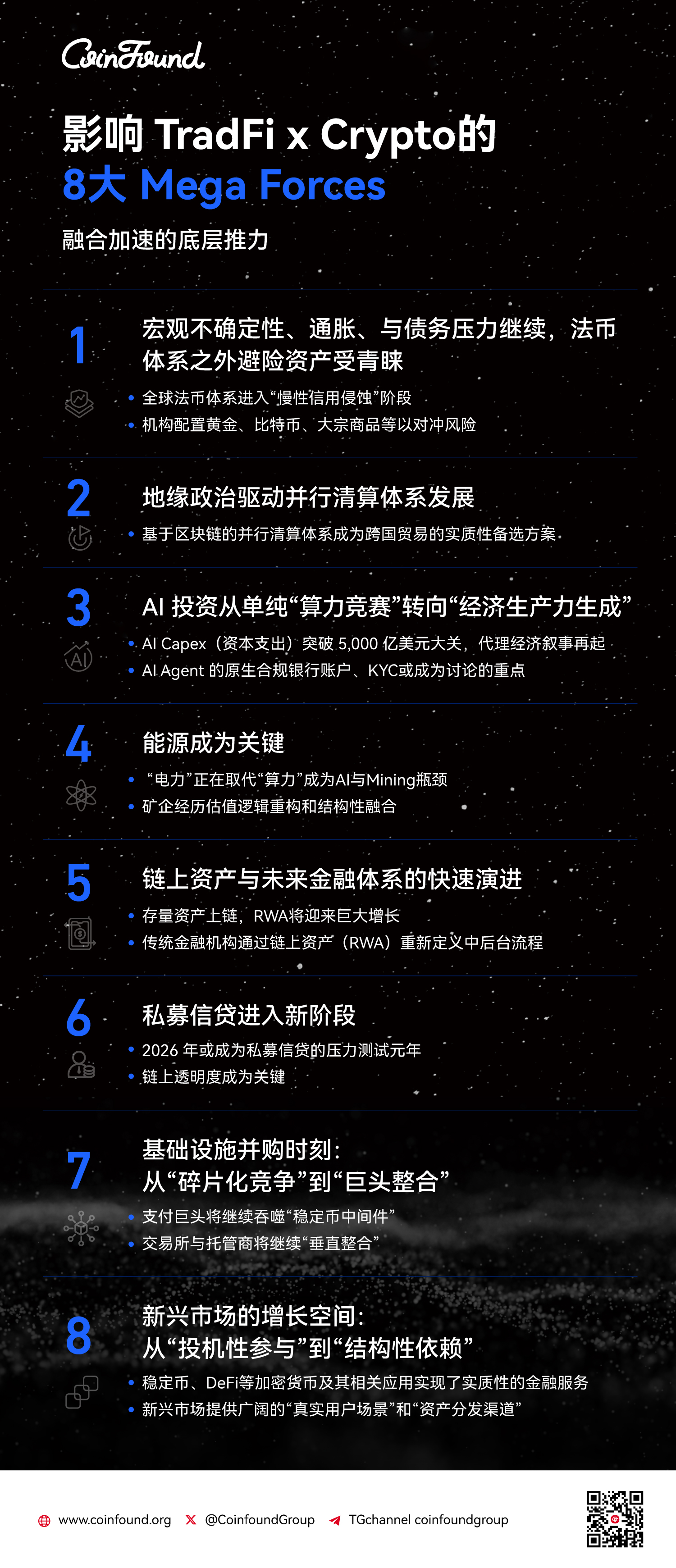
The report distills 8 Mega Forces and 7 trend outlooks: from Stablecoin 2.0 competing for global payment infrastructure, to RWA evolving from "issuance" to "utility," and key variables such as stock tokenization, DAT differentiation, and concentration.

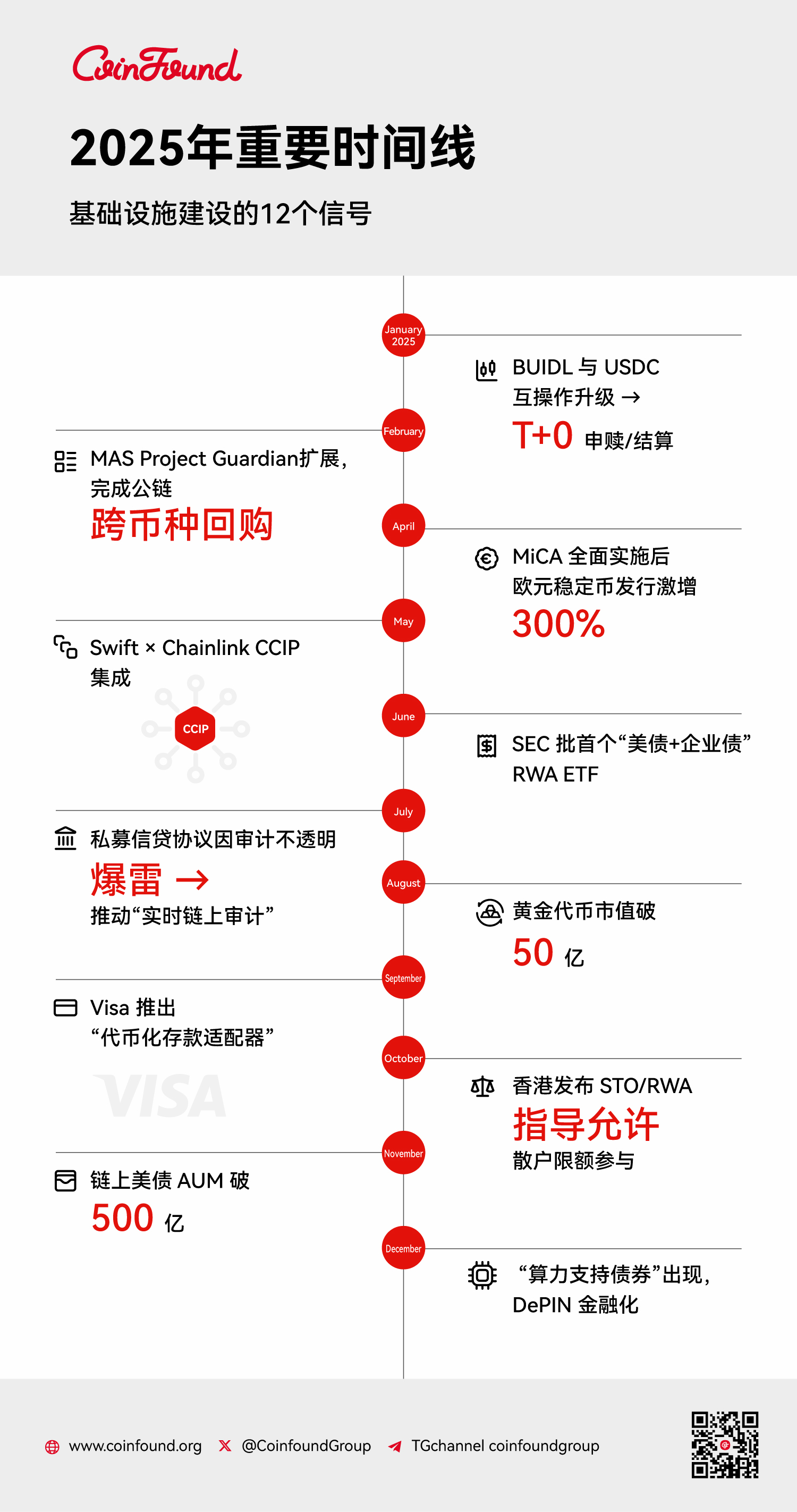
2025 Timeline of Key Events in Traditional Finance x Crypto
In 2026, the following macro trends will impact the TradeFi x Crypto field:

  • Fiat System Trust Crisis and Hard Asset Resurgence: Facing the global debt spiral and "fiscal dominance" risks, institutions are accelerating allocations to "hard assets" such as gold, Bitcoin, and commodities to hedge against fiat currency credit erosion.

  • Geopolitics Driving Parallel Settlement Systems: The need for "de-weaponization" of financial infrastructure is pushing blockchain as an alternative settlement solution independent of SWIFT, with atomic settlement mechanisms effectively reducing trust and counterparty risks in cross-border transactions.

  • AI Productivity Monetization and Machine Payment Emergence: The focus of AI investment is shifting from computing hardware to economic productivity generation, creating a rigid demand for compliant stablecoins and on-chain automated settlements by AI Agents to achieve value attribution between machines.

  • Energy as a Core Asset and Miner Infrastructure Transformation: Power shortages are driving mining companies to transform into "hybrid computing centers," with their scarce power access rights (Time-to-Power) triggering acquisitions by tech giants and driving a revaluation of mining companies towards data center infrastructure.

  • On-Chain Assets (RWA) Moving from Issuance to Utility: Asset tokenization is entering the "programmable finance" stage, where RWA is no longer just a digital certificate but serves as 24/7 core collateral, significantly enhancing the capital efficiency of repo markets and overall liquidity.

  • Private Credit Stress Testing and Transparency Transformation: The 2026 debt maturity wave may trigger default risks, forcing the industry to shift from "black boxes" to real-time on-chain transparent audits based on zero-knowledge proofs (ZK) to avoid DeFi chain liquidation crises.

  • Infrastructure Moving from Fragmented Competition to Giant Integration: The market is entering a consolidation phase similar to the telecommunications industry, with payment and financial giants acquiring stablecoin middleware and custodians to secure their positions, eliminate redundancy, and build compliance moats. Emerging markets are shifting from speculation to structural dependence: Crypto assets have deepened into underlying tools for payments and remittances in emerging markets, with vast real user scenarios making them a core hub connecting traditional financial assets with global retail liquidity.

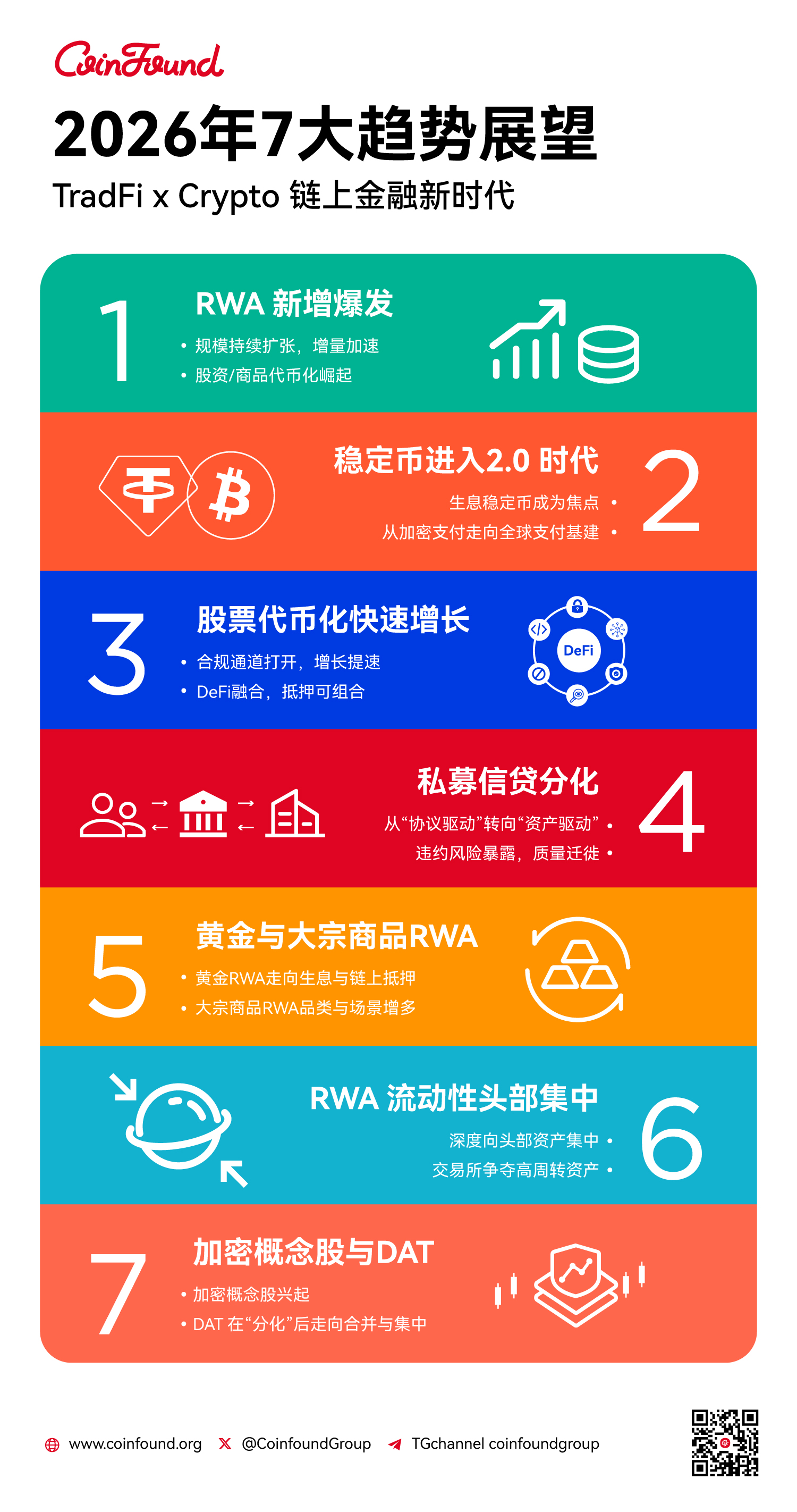
The trend outlook for 2026 is as follows:

1. Structural explosion in the RWA market, stablecoins laying the foundation for a $320 billion market, with equities and commodities becoming new growth points

2. Stablecoins enter the 2.0 era, moving from crypto payments to competing for global payment infrastructure

3. Stock tokenization liquidity may grow rapidly, with DeFi integration becoming key

4. Private credit RWA shifts to "asset-driven," potentially accelerating differentiation under "default" risk pressure

5. Gold and commodity RWA usher in a new era of "full-asset collateral"

6. RWA liquidity will further concentrate, with three types of RWA assets gaining favor among exchanges

7. The "rise" of crypto concept stocks, and the "differentiation" and "concentration" of DAT
Summary

2025 Summary: 2025 was a year of "demystification and integration" for TradeFi and Crypto. Blockchain technology is being reduced from its "revolutionary"光环 to an efficient bookkeeping and settlement technology. The success of Treasury RWA has demonstrated the feasibility of traditional assets on-chain, while the full entry of giants like BlackRock has provided irreversible credit endorsement for the industry.

2026 Prediction: 2026 will be a year of "secondary market explosion and credit expansion." We judge:

  • Liquidity Explosion: With the improvement of infrastructure, RWA will shift from "holding for yield" to "high-frequency trading."

  • Credit Downward Drift: Asset classes will drift downward from high-credit government bonds to corporate bonds, stocks, and emerging market credit, with risk premium becoming a new source of return.

  • Risk Warning: As the scale of RWA expands, the complexity of off-chain default transmission to on-chain liquidation will be the biggest systemic risk.

In 2026, both TradeFi and Crypto will be unified under the banner of "On-chain Finance."


Twitter:https://twitter.com/BitpushNewsCN

Bitpush TG Discussion Group:https://t.me/BitPushCommunity

Bitpush TG Subscription: https://t.me/bitpush

Original link:https://www.bitpush.news/articles/7605062

Related Questions

QWhat are the 8 Mega Forces that will influence the TradFi x Crypto landscape in 2026 according to the CoinFound report?

AThe 8 Mega Forces are: 1. Fiat system trust crisis and the return to hard assets, 2. Geopolitically driven parallel clearing systems, 3. AI productivity monetization and the rise of machine payments, 4. Energy as a core asset and the infrastructuralization of mining companies, 5. On-chain assets (RWA) moving from issuance to utility, 6. Stress testing and transparency transformation in private credit, 7. Infrastructure consolidation from fragmented competition to giant integration, and 8. Emerging markets shifting from speculation to structural dependence.

QWhat is the projected market size for stablecoins in 2026, and what is driving this growth?

AThe stablecoin market is projected to have a base of 3200 billion USD. This growth is driven by stablecoins evolving from crypto payments to competing for global payment infrastructure, entering what the report calls the 'Stablecoin 2.0' phase.

QHow does the report characterize the year 2025 versus the year 2026 for TradFi and Crypto?

AThe report characterizes 2025 as the 'inflection point for integration,' where blockchain technology was demystified and seen as efficient settlement tech. In contrast, 2026 is predicted to be a year of 'secondary market explosion and credit expansion,' marking an acceleration period for 'programmable finance'.

QWhat major shift is expected in the RWA (Real World Assets) market in 2026?

AThe major shift is that RWA will move from 'issuance' to 'utility.' It will no longer be just digital certificates but will function as 24/7 core collateral, significantly enhancing the capital efficiency of repo markets and overall liquidity. The asset class will also expand from high-credit government bonds to include corporate bonds, stocks, and emerging market credit.

QWhat does the report identify as the biggest systemic risk for the expanding RWA market?

AThe biggest systemic risk identified is the complexity of off-chain asset defaults being transmitted to on-chain liquidations as the scale of RWA expands.

Related Reads

Senior Trader's Confession: How to Trade Market's False Expectations?

Veteran trader's case study: trading the market's "wrong expectations". This trade centered on a textbook "expectation error" after a weak CPI report. While the market initially priced in broad monetary easing (sending Nasdaq to 30,060), the crucial 30-year real yield hit a 20-year high. This signaled a fractured transmission mechanism: short-term rates eased, but long-term funding costs (vital for tech valuations) refused to fall. The trader executed five short positions on the Nasdaq (NQ) as it fell from 30,060 to 28,768. The core methodology: don't just trade the data, but analyze the market's implied causal chain and identify where it breaks. In this case, the chain was: Weak CPI → Policy Easing → Lower Long-Term Funding Costs → NQ Valuation Expansion. The break occurred between policy easing and long-term rates. The "veto variable" – long-term real yields – refused to confirm the bullish narrative. Trades were structured around "fast variables" (price) temporarily repairing while "slow variables" (funding conditions) remained broken. The article outlines a repeatable framework: 1) Map the market's implied causal chain. 2) Identify the veto variable. 3) Observe if it rejects the narrative. 4) Enter when price still follows the old script. 5) Choose the cleanest asset expression (e.g., short NQ, not broad S&P). 6) Define both invalidation and fulfillment exit conditions. The key insight: Alpha often comes not from an information edge, but from a "reaction function edge" – recognizing when the market is applying an outdated causal logic to new data. The critical question: What causal chain is the market's first reaction relying on, and is that chain still valid today?

marsbit21m ago

Senior Trader's Confession: How to Trade Market's False Expectations?

marsbit21m ago

Opinion: The Hedging Relationship Between U.S. Treasuries and Stocks Has Broken Down, and BTC, as a Risk Asset, Is Under Dual Pressure

For the past 20 years, U.S. investors relied on a free insurance policy: when stocks fell, bonds rose, cushioning portfolio losses. This reliable inverse correlation underpinned entire financial strategies. However, this mechanism broke down around 2020 and has not recovered. Currently, the two-month rolling correlation between the S&P 500 and 10-year Treasury yields is at -0.69, its lowest level since 1996, indicating stocks and bonds are moving in sync to an unprecedented degree, eliminating the traditional portfolio shock absorber. The失效 of this hedge is not simply due to lost confidence in U.S. debt. The key driver is the shift from growth-dominated to inflation-dominated market narratives. When growth fears prevail, stocks and bonds move inversely. Since 2022, persistent inflation volatility has been the dominant factor, causing both asset classes to suffer simultaneously from higher inflation expectations. Investors now seek safety without duration risk, favoring cash, dollars, and short-term Treasuries while selling long-duration bonds. Record U.S. deficits, rising net interest payments, and waning foreign demand (e.g., from Japan) are pressuring long-term yields, with the 30-year yield surpassing 5%. This environment places Bitcoin, as a risk asset on the far end of the risk curve, under dual pressure. Higher risk-free rates increase the opportunity cost of holding non-yielding assets like Bitcoin, while falling equities reduce overall risk appetite. Bitcoin's performance has become highly sensitive to macro conditions such as real yields, dollar strength, and financial conditions. While its long-term thesis as a fixed-supply asset outside the sovereign credit system is strengthened by these fiscal trends, the same conditions hurt it in the short term. The return of bonds as a effective hedge requires inflation volatility to subside, growth risks to retake dominance, and the Fed to have room to ease policy. Until then, Bitcoin trades in a market where the deepest asset class no longer absorbs shocks, removing the safety floor for all risk assets, especially those that pay nothing to wait.

marsbit22m ago

Opinion: The Hedging Relationship Between U.S. Treasuries and Stocks Has Broken Down, and BTC, as a Risk Asset, Is Under Dual Pressure

marsbit22m ago

Funding Weekly | Crypto.com Secures $400M Investment, CeFi and Stablecoin Sectors Continue to Attract Capital

Crypto Weekly Investment Recap: Funds Converge on CeFi, Stablecoins, and AI Last week's crypto and AI investment landscape saw significant capital concentration, with a few large deals dominating. **Crypto/Web3 Highlights (July 13-19):** Total investment exceeded **$812 million** across 17 deals. Key trends: * **Centralized Finance (CeFi) & Stablecoins** remained a major magnet, led by **Crypto.com**'s massive **$400 million** raise from Citadel Securities, valuing the exchange at $20B. * **Infrastructure & Tools** saw 7 deals, including **Cyclops** ($20M for stablecoin payments) and **ADI Chain** ($50M for stablecoin settlement infrastructure). * **DeFi** had 2 deals, such as AI-native DEX **Quote Trade** ($4M). * Other notable raises: API broker **Alpaca** ($135M), cross-border platform **Flex** ($70M), treasury firm **ORANGE JUICE** ($40M), and prediction market **Pascal** ($9M). * **Acquisitions:** Keyrock bought BlockFills' trading unit, SBI Holdings acquired Singapore exchange Coinhako, and MoonPay bought startup Glide. **AI & Robotics Highlights:** Investment momentum in AI remained very strong. * Nvidia-backed AI cloud service **Fireworks** raised a massive **$1.5 billion** at a $17.5B valuation. * In robotics, **Walden Robotics** (spun out from Toyota) secured **$300 million**, and Chinese humanoid firm ****逐际动力** **(Climax Dynamics) raised nearly **$200 million** in a Pre-IPO round. * Other significant AI raises included Indian programming platform **Emergent** ($130M) and drone company **Brinc** ($125M), backed by Sam Altman. Overall, the trend shows capital flowing heavily into established crypto financial services, stablecoin infrastructure, and large-scale AI/robotics commercialization.

marsbit1h ago

Funding Weekly | Crypto.com Secures $400M Investment, CeFi and Stablecoin Sectors Continue to Attract Capital

marsbit1h ago

The Gentlest Bear Market? BTC Bears Exit, ARK and Bitwise Collectively Bullish

**Title: The Mildest Bear Market? BTC Shorts Exit, ARK and Bitwise Collectively Bullish** Bitcoin continues to consolidate around $75,000 while Ethereum struggles near $1,900. Market data shows $116 million in liquidations over 24 hours, with $62.7 million from short positions, and the Fear & Greed Index remains at 35 (Fear). According to Polymarket, there's a 33% probability BTC falls below $50,000 this year. ARK Invest's Q2 2026 Bitcoin report notes technical weakness but identifies potential bottoming signals, including a record high in long-term holder supply, suggesting selling exhaustion. Bitwise's Juan Leon calls this the "structurally mildest bear market" on record, with a ~50% drawdown from highs, less severe than past cycles. He highlights institutional accumulation and a shift in investor dialogue from survival to entry points. Technical analysis from Bit suggests a potential C-wave low may have formed, with an ideal bottoming range between $50,000-$55,000. However, glassnode's CryptoVizArt warns that failure to break $66,000 could signal a local top, as new buyer accumulation is concentrated there. Analyst Darkfost identifies a critical support band between $59,000-$70,000, where 50% of BTC's circulating supply has changed hands. Notably, trader Doctor Profit announced closing all crypto short positions—including BTC shorts from $115k-$125k and over 100 altcoin shorts—for significant profit. He has begun a phased accumulation of Bitcoin spot starting at $64,000, reversing his previous $40k-$50k target, citing structural positives like regulatory clarity and institutional adoption. He argues the anticipated September/October bottom may arrive earlier than the herd expects.

Foresight News2h ago

The Gentlest Bear Market? BTC Bears Exit, ARK and Bitwise Collectively Bullish

Foresight News2h ago

Trading

Spot
活动图片