This article is from:Arkham
Translator|Moni
Anatoly Yakovenko (@toly), the creator of the Solana blockchain, has become a leading figure in the blockchain industry and a well-known billionaire. This article will take a deep dive into his personal fortune.
As one of the most influential figures in the cryptocurrency space, Anatoly Yakovenko founded Solana, one of the most widely used blockchain platforms. Based on available information, the number of tokens he personally holds, and his equity stake in Solana Labs, his estimated net worth in 2026 could be between $500 million and $1.2 billion. The wide range is primarily due to significant recent volatility in the price of Solana's token.
Anatoly Yakovenko's Early Life
Anatoly Yakovenko was born in the Soviet Union and immigrated to the United States with his family in the early 1990s, settling in Illinois. He showed an early aptitude for computer science and engineering, eventually earning a degree in computer science from the University of Illinois at Urbana-Champaign, one of the top institutions in the field in the US.
Yakovenko's academic background focused on distributed systems and compression algorithms, technical areas that later proved crucial to his innovations in blockchain. According to his profile on LinkedIn (shown below), after graduation, he joined Qualcomm, where he worked on operating system-level software and distributed systems for over a decade—a period he might call his "grunt work" years. However, this experience at a leading communications technology company gave him deep expertise in building systems that handle massive scale and high throughput.
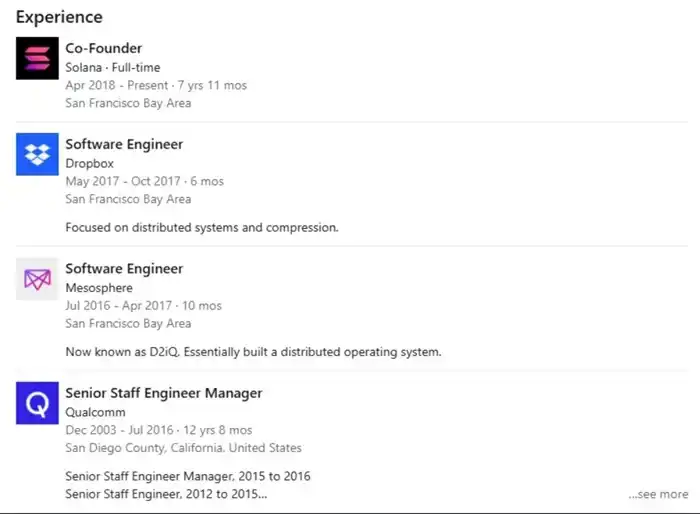
During his time at Qualcomm, Yakovenko also worked on technologies that required coordination across multiple devices and maintaining precise timing—a challenge conceptually similar to blockchain consensus mechanisms. He later had a brief stint at Dropbox, further deepening his understanding of distributed computing challenges in consumer-facing applications.
How Did Anatoly Yakovenko Get Involved in Cryptocurrency?
Like many others, Anatoly Yakovenko's initial foray into cryptocurrency began with Bitcoin mining. It's reported that he and a friend used the profits from mining to subsidize the cost of graphics processors for a side project they were developing together. This experience also gave him firsthand insight into the scalability limitations of Bitcoin and Ethereum, networks that could only process a small number of transactions per second, creating bottlenecks and high fees that seemed incompatible with mainstream adoption.
Rather than seeing these limitations as inherent flaws in blockchain technology, Yakovenko began exploring whether techniques from other fields could solve the throughput problem. He drew inspiration from his telecom background, specifically the concept of using time itself as a reliable reference point in distributed systems.
In November 2017, Anatoly Yakovenko published a white paper detailing a technology called "Proof of History" (PoH)—a cryptographic method for creating verifiable passage of time between events. This innovation allows network validators to process transactions in a predetermined order without requiring extensive communication between nodes, significantly increasing potential throughput. The Solana blockchain is fundamentally built upon this concept.

Yakovenko quickly recruited former Qualcomm colleagues Greg Fitzgerald and Stephen Akridge to help build a prototype. The team formally established Solana Labs in 2018 and secured initial funding to develop the protocol. Another co-founder, Raj Gokal, joined the project shortly after the Proof-of-History white paper was released, becoming the Chief Operating Officer of Solana Labs (the core founding team is shown in the image above). Solana Labs launched its first testnet in 2018, followed by the mainnet beta in March 2020, entering the market during the early stages of the COVID-19 pandemic.
Tracking Anatoly Yakovenko's On-Chain Holdings
At its launch, Solana minted 500 million SOL tokens, with 12.5% allocated to the founding team, including Anatoly Yakovenko. A Solana address starting with "9QgXq" is widely rumored to be associated with Anatoly Yakovenko (as shown below), though this has not been officially confirmed. This wallet holds over 136,725 SOL tokens, most of which are staked. Early transactions saw millions of dollars worth of SOL transferred to this address. This wallet address is over five years old. If it indeed belongs to Solana co-founder Anatoly Yakovenko, his held SOL would be worth over $11 million.

Furthermore, by tracking the history of transactions from staking accounts associated with Anatoly Yakovenko, it appears that large amounts of SOL were moved to various Solana addresses. For example, between August 2024 and November 2024, over 3 million SOL tokens were unstaked and transferred. Over 1.5 million SOL remain staked across multiple addresses, including 9E8zG, JQ5jC, A6mJn, and 7pgzZ. If these addresses also belong to Yakovenko, his SOL holdings would far exceed current estimates, nearing $122 million at current prices.
Another address potentially linked to Anatoly Yakovenko is the owner of the Solana domain name toly.sol, as his username on X is Toly. Tracing this domain reveals an owner address starting with "86xCn". This address currently holds various tokens worth over $1.3 million, but its value is primarily in illiquid tokens, so its actual spendable value is only about $16,500, equivalent to 203.8 SOL.
Tracking Anatoly Yakovenko's Off-Chain Holdings
In addition to holding tokens, Anatoly Yakovenko holds a significant equity stake in Solana Labs, the company primarily responsible for developing the Solana protocol and its related infrastructure. Although the exact percentage is not publicly disclosed, it is estimated that he holds approximately 5% to 10% of Solana Labs.
As a private company, Solana Labs' valuation has not been publicly disclosed. Solana Labs has conducted multiple funding rounds in the past, with investments from prominent venture capital firms like a16z (Andreessen Horowitz), Polychain Capital, and Multicoin Capital. These investments have valued the company in the billions of dollars, with many estimates placing its value between $5 billion and $8 billion. Based on these valuations, Yakovenko's equity could be worth between $250 million and $800 million, not including his personal token holdings.
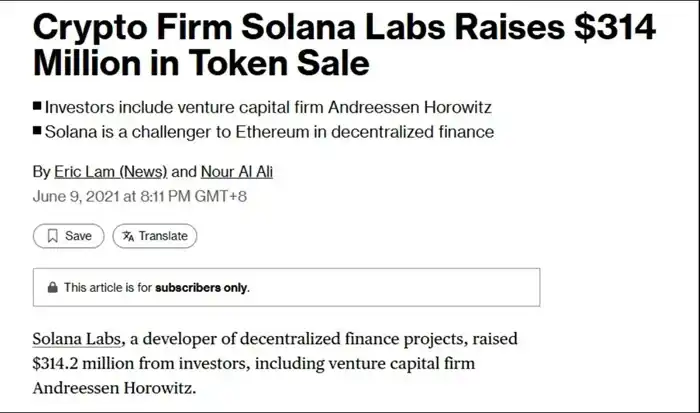
Although the company's valuation is still partially tied to the market performance of the SOL token, this dual ownership structure—personal tokens and company equity—provides some diversification for Yakovenko's wealth. SOL token prices can be highly volatile, but company equity represents a more stable asset, especially as Solana Labs' business expands beyond protocol development to other blockchain infrastructure projects.
Beyond his stake in Solana Labs, Anatoly Yakovenko is an active angel investor and has invested in over 40 companies to date. Some of these have grown into giants within the Solana ecosystem, including liquid staking service providers Jito Labs and Solayer, perpetual DEX Drift Protocol and Infinex, and staking infrastructure project Helius.
Who Owns the Most Solana?
As an emerging blockchain, Solana has come a long way since its inception. Today, SOL token distribution is diverse, including institutional investors, exchanges, founders, and retail participants. Major institutional holders include the Solana Foundation Treasury, cryptocurrency exchanges holding tokens on behalf of users, Solana ETFs, and staking service providers.
However, based on available data, the largest holder of SOL tokens is likely the winning bidders from the FTX bankruptcy auction. Following the collapse of the centralized exchange FTX, the SOL tokens held in its assets were auctioned off as part of the liquidation process. In this process, 41 million SOL tokens were sold, with Galaxy Digital and Pantera Capital acquiring the majority. Although these tokens were subject to lock-up and vesting schedules, about 60-70% of the sold SOL has likely been unlocked and may have been sold. Considering this, Galaxy Digital might still hold around 6-8 million SOL, while Pantera might hold around 3-5 million SOL.
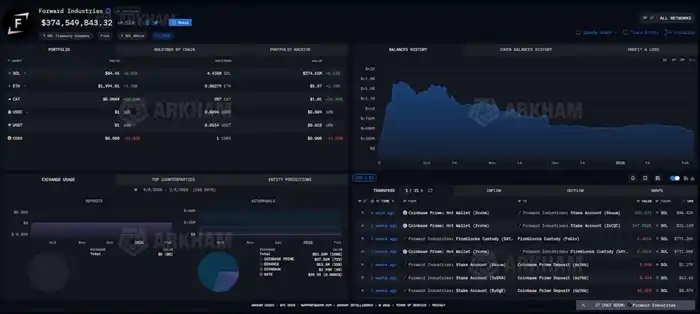
In 2025, the Solana Foundation Treasury companies came into focus. Due to highly publicized holdings, the largest SOL holder among these treasury companies is Forward Industries (shown below), which currently holds 6.9 million SOL tokens (worth $583 million), representing 1.115% of the total SOL supply. Other treasury companies lag far behind; the next nine companies combined hold only about 1.5% of the total SOL supply.
Regarding custodial service providers, some centralized exchanges also hold SOL on behalf of users. For instance, Binance's latest proof-of-reserves shows the exchange holds over 24.2 million SOL tokens. Similarly, ETF providers have become major SOL holders. The Bitwise Solana Staking ETF (BSOL) holds over 5.5 million SOL tokens and is currently the largest spot SOL ETF.
Among individual holders, while Anatoly Yakovenko likely ranks highly, he may not be the individual holding the most SOL tokens. Other Solana Labs co-founders and early team members also received significant allocations of SOL. Furthermore, some early private investors might hold larger positions in SOL than the Solana Labs co-founders themselves.
Anatoly Yakovenko's Net Worth Fluctuates Significantly with the Market
Over time, Anatoly Yakovenko's net worth has likely been closely tied to Solana's market performance, experiencing its dramatic volatility (the chart below shows Solana's token price movement in recent years). In November 2021, when SOL prices reached a cycle high of around $260, his combined token holdings and company equity could have pushed his net worth over $2 billion, potentially even approaching $3 billion, depending on the valuation of his Solana Labs equity.
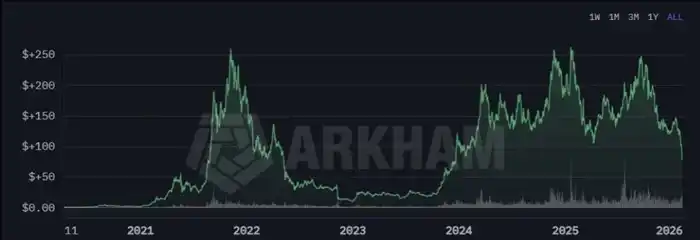
Conversely, the crypto bear market of 2022 severely compressed the value of Anatoly Yakovenko's assets. With SOL prices dropping below $10 at one point, the value of his token holdings fell more than 95% from their peak. Network outages during this period, coupled with Solana's close association with FTX and Alameda Research, added further negative pressure on the token's price and ecosystem sentiment. Assuming his net worth moved in line with market fluctuations, it might have dipped below $100 million during the bear market.
However, as markets rebounded into a bull run between 2023 and 2025, Yakovenko's net worth likely recovered significantly. Combined with the maturing equity value of Solana Labs (now estimated between $4 billion and $10 billion), it likely pushed his net worth back into the multi-billion dollar range.
At the beginning of 2026, the cryptocurrency market experienced a sharp crash, with Solana's price falling below $100. Estimates for Anatoly Yakovenko's net worth are largely in the range of $500 million to $1.2 billion, depending on the liquidity of the held tokens and the valuation of his Solana Labs equity.
Conclusion
As of early 2026, Anatoly Yakovenko remains one of the core architects of the digital economy, with a net worth that has fluctuated alongside the maturation of the Solana ecosystem. Although the crypto market crash in early 2026 reduced his fortune from its multi-billion dollar peak, his financial standing remains robust, underpinned by his equity in Solana Labs and a portfolio of early-stage investments.
From a grunt engineer working for a decade in networking companies to a crypto billionaire building a blockchain that rivals Bitcoin and Ethereum, Anatoly Yakovenko's influence on the crypto industry is evident. Solana has evolved from a high-speed blockchain into a hub for institutional finance, stablecoin payments, trading, and more. Yet, it seems like it's only just the beginning.






