From 100% Rebate to 20%: The Game Theory Behind Polymarket's Fee Adjustment

marsbitPublished on 2026-01-14Last updated on 2026-01-14

Abstract

Polymarket recently adjusted its fee structure for 15-minute cryptocurrency prediction markets, moving from a 100% fee rebate to a 20% rebate for market makers. This change aims to combat "latency arbitrage" bots that exploited tiny time delays between exchange price updates and Polymarket’s price adjustments, harming market makers and reducing liquidity. Initially, full rebates were introduced to incentivize market makers to stay despite bot activity. After data showed a significant drop in fee volume—indicating reduced bot activity—the platform reduced rebates to 20% for a trial period. This reflects an ongoing effort to balance fairness among market makers, automated traders, and regular users. The article also references ongoing "money printer" strategies used by some successful traders and emphasizes Polymarket’s role in providing a competitive, strategy-driven environment.

Author: DFarm

First, let's sort out the recent timeline of events related to Polymarket's transaction fees.

  1. Polymarket suddenly announced that it would charge a transaction fee for 15-minute cryptocurrency price prediction markets, but all fees collected would be rebated to market makers (those placing limit orders).

  2. The fee rebate was changed from a 100% rebate to a partial rebate.

  3. Until the 11th, the 100% fee rebate stopped. From the 12th to the 18th, 20% of the fees are being rebated.

Why Charge a Fee?

We all know that Polymarket previously did not charge any fees for basic transactions. Why did it specifically start charging fees on the 15-minute cryptocurrency markets this time?

This requires explaining what "latency arbitrage" bots are.

In very short-cycle markets like 15-minute intervals, outcomes are determined based on prices from major exchanges.

In the absence of fees, high-frequency trading bots exploit millisecond-level time delays to place orders on Polymarket before its price has had a chance to update, thereby securing profits.

For example, suppose the current probability for BTC going UP in the next 15 minutes on Polymarket is 90%. Suddenly, the BTC price on exchanges drops by 5%. A bot detects this and immediately buys the cheap DOWN shares. After it finishes buying, subsequent bots or traders come in to buy and drive the price, allowing the initial bot to profit and exit.

What is the consequence of this behavior? Market makers consistently get exploited by these high-frequency bots. Naturally, market makers become unwilling to continue providing liquidity by placing orders in these markets, ultimately leading to poorer liquidity in the 15-minute cryptocurrency markets.
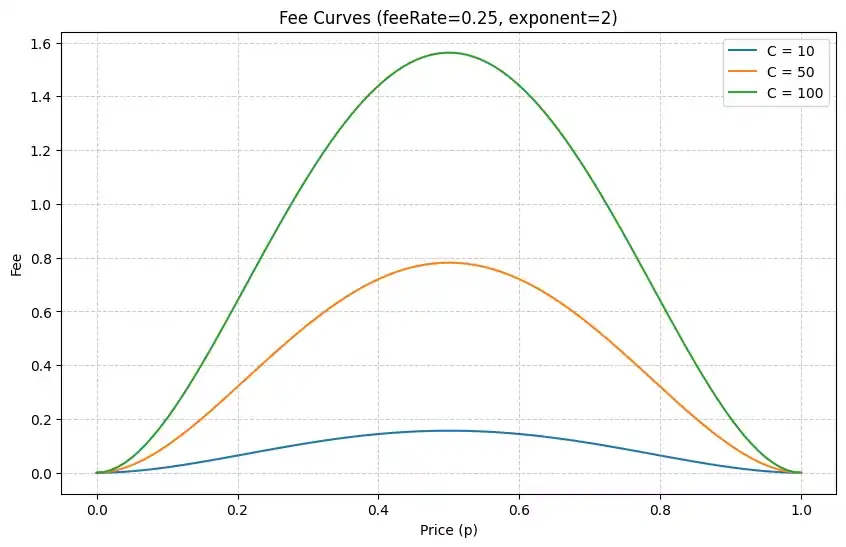
Therefore, the platform introduced a fee mechanism, with the highest fees specifically applied when the odds are 50:50 (as shown in the image). This directly makes the arbitrage cost for many bots higher than their potential profit, so these bots naturally shut down.

Why Subsidize Market Makers?

As mentioned earlier, market makers had too much capital extracted from them previously. To retain market makers, the platform distributes the collected fees to those placing limit orders (market makers).

So why was the rebate reduced from 100% to 20%?

The detail is in this phrase: "From the 12th to the 18th, 20% of fees are rebated." This tells us that the rebate percentage after the 18th is to be determined.

When fees were first introduced, market makers were actually uncertain—they didn't know if the fees would effectively block the bots. The platform initially rebated 100% of the fees to market makers to cover their risks and retain liquidity.

Why only 20% now? Let's look at the data first:
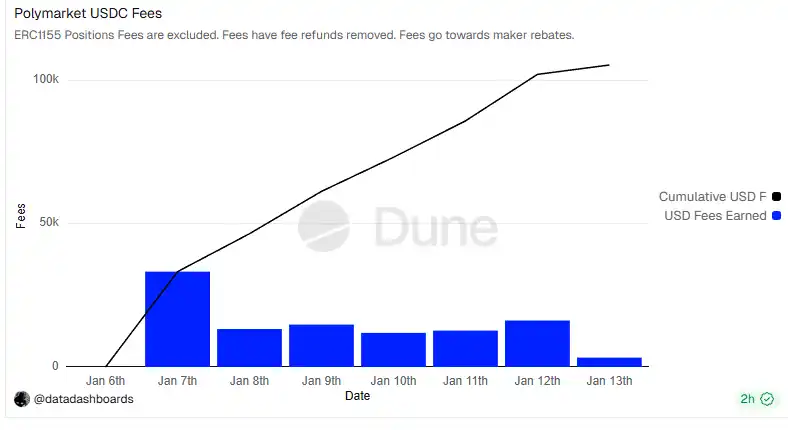
After fees were enabled, the total fee volume halved. What does this indicate? It confirms that many high-frequency bots indeed shut down.

Seeing that the bots are gone and the risk for market makers has decreased, the platform likely concluded that a 100% fee rebate is no longer necessary. They are trying 20% first to see the data performance.

This is why they are trialing a 20% fee rebate for one week first, to observe the data before deciding on the subsequent rebate ratio.

Ultimately, all this is about balancing the interests of market makers, bots, and regular traders.

The "Money Printer" Bots

There are many "money printer" entities present across various markets on Polymarket. Very few people in the market truly understand how they operate.

A very popular example is a post by X user: @the_smart_ape:
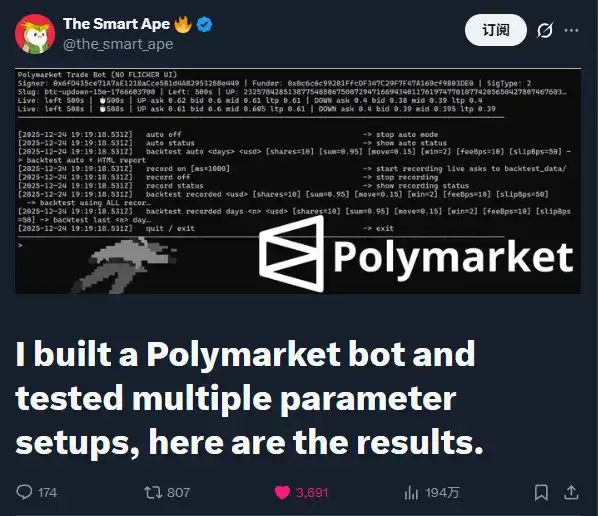
This post has nearly 2 million views. Many friends have tried the strategy described in the article, and indeed some have made profits.

But just a few days later, the fees were introduced, and many friends could no longer profit...

So have the "money printers" disappeared? Not entirely. Interested friends can check out these "money printers":

https://polymarket.com/@gabagool22?via=dfarm

https://polymarket.com/@distinct-baguette?via=dfarm

https://polymarket.com/@livebreathevolatility?via=dfarm

If you can decipher their strategies, your "money printer" isn't far away. But remember, don't tell anyone else—though you can secretly tell me.

Finally

Actually, on Polymarket, since there are no third-party commissions or fees, we are essentially betting against each other. Therefore, the platform's responsibility is to provide a fair playing field for both sides.

Players who enjoy PVP games also know that absolute fairness doesn't exist; it can only be approached through iterative version updates, striving for relative fairness.

This situation also shows us that "money printers" do exist on Polymarket, and it's all about competing on technology and strategy.

If this article was helpful to you, please help share it. Thank you.

If you are a newbie to Polymarket, be sure to check out this article → 《Beginner's Tutorial: Hand-Holding Guide to Getting Started with Polymarket from Scratch (Includes Anti-Ban + Low-Friction Deposit/Withdrawal Strategies)》


Related Questions

QWhy did Polymarket introduce fees specifically for the 15-minute cryptocurrency price prediction markets?

APolymarket introduced fees to combat 'latency arbitrage' bots that exploited millisecond delays in price updates to profit at the expense of market makers, which was degrading liquidity in these short-term markets.

QWhat was the initial fee rebate policy, and how did it change?

AInitially, Polymarket implemented a 100% fee rebate to market makers (those placing limit orders). This was later reduced to a 20% rebate for a trial period from the 12th to the 18th.

QWhat effect did the introduction of fees have on the trading activity of arbitrage bots?

AThe total amount of fees collected dropped by half after their introduction, indicating that a significant number of high-frequency arbitrage bots were no longer profitable and stopped operating.

QWhat is the purpose of the fee rebate given to market makers?

AThe rebate is an incentive to compensate market makers for the risks they faced from arbitrage bots and to encourage them to continue providing liquidity (placing limit orders) on the platform.

QAccording to the article, what is the ultimate goal of Polymarket's fee policy adjustments?

AThe goal is to balance the interests of market makers, arbitrage bots, and regular traders to create a fairer trading environment, akin to how game developers balance PVP games through iterative updates.

Related Reads

a16z: AI's 'Amnesia', Can Continuous Learning Cure It?

The article "a16z: AI's 'Amnesia' – Can Continual Learning Cure It?" explores the limitations of current large language models (LLMs), which, like the protagonist in the film *Memento*, are trapped in a perpetual present—unable to form new memories after training. While methods like in-context learning (ICL), retrieval-augmented generation (RAG), and external scaffolding (e.g., chat history, prompts) provide temporary solutions, they fail to enable true internalization of new knowledge. The authors argue that compression—the core of learning during training—is halted at deployment, preventing models from generalizing, discovering novel solutions (e.g., mathematical proofs), or handling adversarial scenarios. The piece introduces *continual learning* as a critical research direction to address this, categorizing approaches into three paths: 1. **Context**: Scaling external memory via longer context windows, multi-agent systems, and smarter retrieval. 2. **Modules**: Using pluggable adapters or external memory layers for specialization without full retraining. 3. **Weights**: Enabling parameter updates through sparse training, test-time training, meta-learning, distillation, and reinforcement learning from feedback. Challenges include catastrophic forgetting, safety risks, and auditability, but overcoming these could unlock models that learn iteratively from experience. The conclusion emphasizes that while context-based methods are effective, true breakthroughs require models to compress new information into weights post-deployment, moving from mere retrieval to genuine learning.

marsbit49m ago

a16z: AI's 'Amnesia', Can Continuous Learning Cure It?

marsbit49m ago

Can a Hair Dryer Earn $34,000? Deciphering the Reflexivity Paradox in Prediction Markets

An individual manipulated a weather sensor at Paris Charles de Gaulle Airport with a portable heat source, causing a Polymarket weather market to settle at 22°C and earning $34,000. This incident highlights a fundamental issue in prediction markets: when a market aims to reflect reality, it also incentivizes participants to influence that reality. Prediction markets operate on two layers: platform rules (what outcome counts as a win) and data sources (what actually happened). While most focus on rules, the real vulnerability lies in the data source. If reality is recorded through a specific source, influencing that source directly affects market settlement. The article categorizes markets by their vulnerability: 1. **Single-point physical data sources** (e.g., weather stations): Easily manipulated through physical interference. 2. **Insider information markets** (e.g., MrBeast video details): Insiders like team members use non-public information to trade. Kalshi fined a剪辑师 $20,000 for insider trading. 3. **Actor-manipulated markets** (e.g., Andrew Tate’s tweet counts): The subject of the market can control the outcome. Evidence suggests Tate’sociated accounts coordinated to profit. 4. **Individual-action markets** (e.g., WNBA disruptions): A single person can execute an event to profit from their pre-placed bets. Kalshi and Polymarket handle these issues differently. Kalshi enforces strict KYC, publicly penalizes insider trading, and reports to regulators. Polymarket, with its anonymous wallet-based system, has historically been more permissive, arguing that insider information improves market accuracy. However, it cooperated with authorities in the "Van Dyke case," where a user traded on classified government information. The core paradox is reflexivity: prediction markets are designed to discover truth, but their financial incentives can distort reality. The more valuable a prediction becomes, the more likely participants are to influence the event itself. The market ceases to be a mirror of reality and instead shapes it.

marsbit1h ago

Can a Hair Dryer Earn $34,000? Deciphering the Reflexivity Paradox in Prediction Markets

marsbit1h ago

Trading

Spot
Futures
活动图片




