Following the Clues: Guess What Projects a16z with $15 Billion Will Invest In?

Odaily星球日报Published on 2026-01-12Last updated on 2026-01-12

Abstract

Andreessen Horowitz (a16z) has raised $15 billion in new funding, its largest fundraising round to date, with a significant focus on cryptocurrency and AI. The funds are allocated across six major areas: American Dynamism ($11.76B), App ($17B), Bio + Health ($7B), Infrastructure ($17B), Growth ($67.5B), and Other Venture Strategies ($30B). While there is no dedicated crypto fund, the App, Infrastructure funds will be key channels for crypto investments—targeting application-layer products, Web3 apps, and blockchain infrastructure like L1/L2 protocols. The Growth fund will focus on later-stage investments in established players like Coinbase. In 2025, a16z made 31 investments in crypto-related areas, with major bets on prediction markets (Kalshi), wallets, privacy blockchains, stablecoins, and AI-crypto integrations. Looking ahead to 2026, a16z highlighted 17 areas of interest, including enhanced privacy, smarter prediction markets, improved stablecoin on/off ramps, AI-agent ecosystems, decentralized communication, and tokenization of real-world assets. The firm emphasizes that innovation in these areas will drive the next wave of crypto adoption.

Original | Odaily Planet Daily (@OdailyChina)

Author | Azuma (@azuma_eth)

On January 9, amidst a highly active cryptocurrency market, the venture capital giant Andreessen Horowitz (a16z) announced the completion of a new $15 billion fundraising round. This is the largest fundraising effort in the institution's history, accounting for over 18% of the total venture capital raised in the United States in 2025.

In the relatively short official announcement, a16z mentioned cryptocurrencies twice. The most critical statement, "Our mission is to ensure that the United States wins the technological competition of the next 100 years, which begins with winning the key architectures of the future—artificial intelligence and cryptocurrency technology," indicates that a16z, now well-supplied, will continue to actively invest in the cryptocurrency market.

Breakdown of Six Major Directions

According to a16z's plan, this batch of funds will be allocated to six major directions: the American Dynamism fund will receive $1.176 billion, the App fund $1.7 billion, the Bio + Health fund $700 million, the Infrastructure fund $1.7 billion, the Growth fund $6.75 billion, and the Other Venture Strategies fund $3 billion.

Although a16z did not explicitly designate a dedicated cryptocurrency fund in this fundraising, these six directions actually have significant overlap with the cryptocurrency space.

First is the American Dynamism fund. This is a direction with a clear "political" focus that a16z has been promoting in recent years. Its core goal is to use venture capital to rebuild America's "hard power" and national competitiveness. The fund will primarily invest in aerospace, defense, public safety, education, housing, supply chain, industry, and manufacturing—objectively speaking, this fund has little crossover with cryptocurrency.

Next is the App fund. This is one of a16z's most traditional and VC-centric funds. Its core goal is to focus on application-layer products that can be directly used by users. The fund will primarily invest in consumer internet products, AI applications, creator tools, social products, content services, games, fintech, and Web3 applications—this is also the direction where a16z's cryptocurrency narrative is most easily realized.

Then comes the Bio + Health fund. This is a long-term bet for a16z "beyond pure technology." Its core goal is to use software, data, and engineering thinking to transform the life sciences and healthcare systems. The fund's main investment areas include biotechnology, drug development platforms, gene editing, synthetic biology, medical data and AI diagnostics, and medical infrastructure software—this part has little direct overlap with cryptocurrency, but DeSci could be a potential intersection point.

The Infrastructure fund focuses on infrastructure. Its core goal is to provide an irreplaceable technical foundation for the next generation of applications and platforms. The fund's main investment areas are cloud computing and distributed systems, AI infrastructure, data platforms, developer tools, network protocols, and blockchain underlying protocols (L1, L2, other tools)—this is another core battlefield for a16z in the cryptocurrency space, besides the App fund.

The Growth fund primarily invests in Series C and later stages, as well as Pre-IPO stages. Its core goal is not to find new opportunities but to amplify returns by supporting proven winners. The fund mainly invests in mature tech companies, AI platforms, fintech unicorns, and mature Web3 infrastructure or applications—a16z's official website shows that Coinbase, Kalshi, etc., are explicitly categorized here.

The Other Venture Strategies fund is relatively special. It does not have a single theme but is more like a flexible "tactical capital pool," often used for special structured transactions, cross-fund collaborative investments, emerging field trials, secondary market opportunities, regional or thematic experimental funds, etc.—this fund has little direct crossover with cryptocurrency, but it cannot be ruled out that there may be temporary associations at special junctures, such as responsive moves during certain policy windows.

Looking at the six intended directions for this $15 billion, the App fund, Infrastructure fund, and Growth fund will be the main channels for a16z to inject capital into the primary cryptocurrency market. Among them, the App fund and Infrastructure fund will focus more on native application-layer and protocol-layer projects in the cryptocurrency market, respectively; while the Growth fund will tend to focus on platform services such as exchanges and prediction markets, and its investments will lean more towards leading players in the赛道 who have already shown an advantage.

2025: A Review of a16z's Investments

According to incomplete statistics from Odaily Planet Daily, a16z made a total of 31 investments in the broader cryptocurrency field over the past year, with two investments each in prediction market Kalshi, AI security company Doppel, privacy blockchain Seismic, etc.—especially Kalshi. a16z first co-led a $300 million Series D round for the company in October with Sequoia, at a valuation of $5 billion; then again in November, it participated in the company's $1 billion Series E round at a valuation of $11 billion—this was a16z's biggest bet in the cryptocurrency field last year.
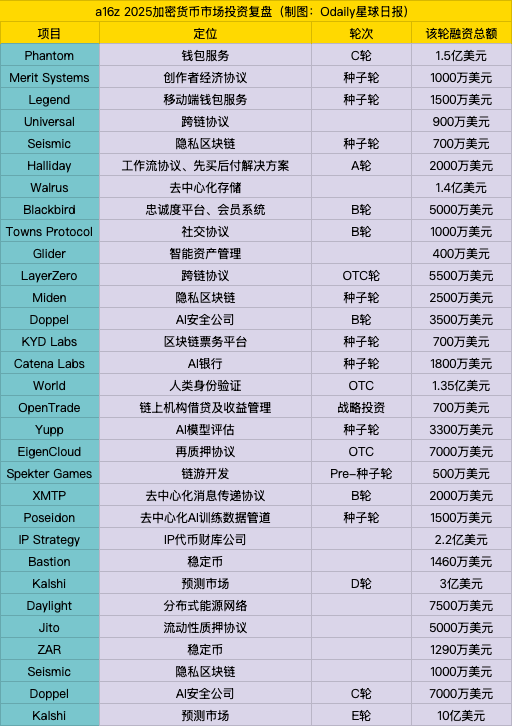
As can be seen from the statistics in the figure above, aside from the heavy bet on prediction markets, wallet services, privacy blockchains, stablecoins, and the intersection of AI and cryptocurrency were the focus of a16z's布局 in 2025. These sub-sectors can be classified into the blockchain underlying protocols and tools covered by the Infrastructure fund, and the fintech and AI applications covered by the App fund.

2026: a16z Made This Prediction

On New Year's Day 2026, a16z Crypto officially published a New Year's outlook article. In the article, a16z mentioned 17 potential developments they are excited about for 2026, which may contain clues to the institution's focus areas for future investments.
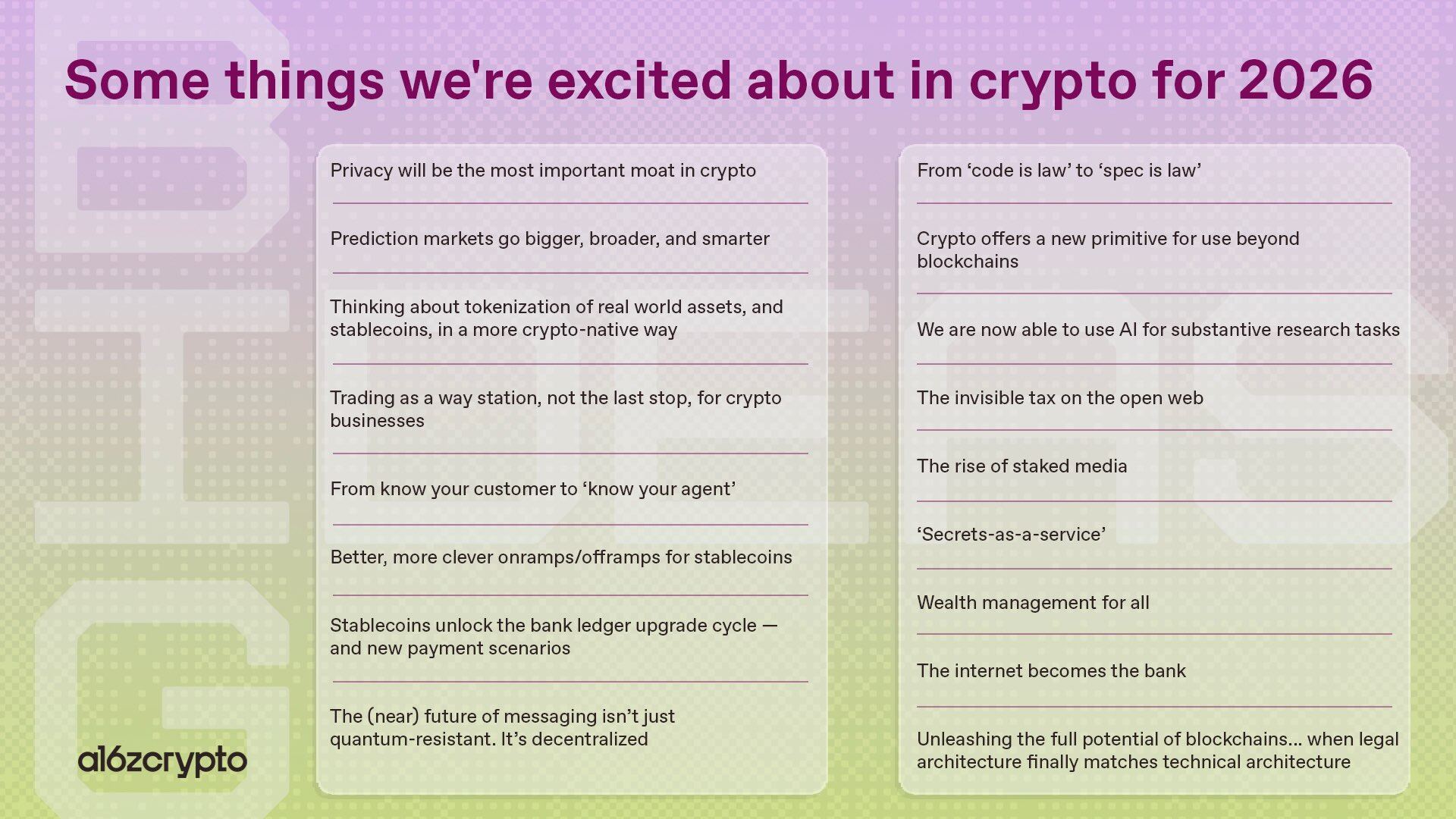
These 17 potential developments are:

  • Privacy will become the most important moat in crypto;
  • Prediction markets will become larger, broader, and smarter;
  • Thinking more "crypto-natively" about real-world asset tokenization and stablecoins;
  • Trading is just a waystation for crypto businesses, not the final destination;
  • From "Know Your Customer" (KYC) to "Know Your Agent";
  • Better, smarter on-ramps and off-ramps for stablecoins;
  • Stablecoins will kick off a bank ledger upgrade cycle and spawn new payment scenarios;
  • The future of instant messaging is not just quantum-resistant, but also decentralized;
  • From "code is law" to "norms are law";
  • Crypto is providing new kinds of foundational primitives usable beyond blockchains themselves;
  • We can now use AI to perform substantive research tasks;
  • The "invisible tax" of the open internet;
  • The rise of Staked Media;
  • "Secrets-as-a-Service";
  • Wealth management for everyone;
  • The internet is becoming the bank;
  • When the legal framework finally matches the technical framework, the full potential of blockchains will be unleashed.

Among these 17 potential developments, some explicitly mention specific business models, including the sectors a16z has already heavily invested in, such as privacy, prediction markets, stablecoins, and AI. a16z also directly suggests optimization paths for these models, such as the need for smarter on-ramp and off-ramp solutions for stablecoins.

At the same time, another part of the potential developments belongs to imaginings of future states, such as the internet eventually becoming the bank. But exactly how these imaginings will be realized, a16z does not give clear answers—this question needs to be left to entrepreneurs who can bring innovative solutions. And they are precisely the targets that a16z's $15 billion most wants to find.

Related Questions

QWhat are the six main directions that a16z plans to allocate its new $15 billion funding into?

AThe six main directions are: American Dynamism fund ($1.176 billion), App fund ($1.7 billion), Bio + Health fund ($700 million), Infrastructure fund ($1.7 billion), Growth fund ($6.75 billion), and Other Venture Strategies fund ($3 billion).

QWhich of a16z's funds are most likely to invest in the cryptocurrency market, and what are their focuses?

AThe App fund, Infrastructure fund, and Growth fund are the primary channels for cryptocurrency investments. The App fund focuses on application-layer products like Web3 apps; the Infrastructure fund targets protocol-layer projects like L1/L2 blockchains and tools; the Growth fund invests in mature companies such as exchanges and platform services.

QWhat were the key cryptocurrency sectors a16z invested in during 2025, according to the article?

AIn 2025, a16z focused on wallet services, privacy blockchains, stablecoins, and AI-crypto crossover opportunities. Notably, they made significant investments in the prediction market platform Kalshi.

QWhat does a16z's 2026 outlook suggest about their future investment interests in crypto?

Aa16z's 2026 outlook highlights 17 potential developments, with strong interest in privacy, prediction markets, stablecoins, AI integration, decentralized communication, and innovative financial models like 'internet as a bank'.

QHow did a16z describe its mission in the announcement, and what technologies did it emphasize?

Aa16z stated that its mission is to ensure the U.S. wins the next 100 years of technology competition, starting with key foundational architectures—artificial intelligence and cryptocurrency technologies.

Related Reads

Borrowing Money from a Hundred Years Later, Building Incomprehensible AI

Tech giants like Alphabet, Amazon, Meta, and Microsoft are undergoing a radical financial transformation due to AI. Their traditional "light-asset, high-free-cash-flow" model is being dismantled by staggering capital expenditures on AI infrastructure—data centers, GPUs, and power. Combined 2026 guidance exceeds $700 billion, a 4.5x increase from 2022, causing free cash flow to plummet (e.g., Amazon's fell 95%). To fund this, they are borrowing unprecedented sums through long-dated, multi-currency bonds (e.g., Alphabet's 100-year bond). The world's most conservative capital—pensions, insurers—is now funding Silicon Valley's most speculative bet. This shift makes these companies resemble heavy-asset industrials (railroads, utilities) rather than software firms, threatening their premium valuations. Historically, such infrastructure booms (railroads, fiber optics) followed a pattern: genuine technology, overbuilding fueled by competitive frenzy, aggressive debt financing, and a crash triggered by financial conditions—not technology failure. The infrastructure remained, but many original builders and financiers did not survive. The core gamble is a "time arbitrage": using cheap debt today to build scale and lock in customers before AI capabilities commoditize. They are betting that AI revenue will materialize before debt comes due. Their positions vary: Amazon is under immediate cash pressure; Meta's path to monetization is unclear; Alphabet has a robust core business buffer; Microsoft has the shortest path from infrastructure to revenue. The contract is set: the most risk-averse global capital has lent its time to Silicon Valley, awaiting a future that is promised but uncertain.

marsbit30m ago

Borrowing Money from a Hundred Years Later, Building Incomprehensible AI

marsbit30m ago

The 'VVV' Concept Soars 9x in Half a Year, The New AI Narrative on Base Chain

"The article explores the 'VVV' concept as the new AI-focused narrative within the Base ecosystem, centered around the token $VVV of the privacy-focused, uncensored generative AI platform Venice, led by crypto veteran Erik Voorhees. Venice has seen significant growth in 2026, with its API users surging, partly attributed to exposure from OpenClaw. The platform now boasts over 2 million total users and 55,000 paid subscribers. Correspondingly, the $VVV token price has risen over 9x this year. Key to its performance are tokenomics designed for value accrual: reduced annual emissions, subscription revenue used for buyback-and-burn, and a unique staking mechanism. Staking $VVV yields $sVVV, which can be used to mint $DIEM tokens. Each staked $DIEM provides a daily $1 credit for using Venice's API services, creating tangible utility. The article also highlights other tokens associated with the 'VVV' narrative. $POD, the token of distributed AI network Dolphin (which co-developed Venice's default AI model), saw a massive price surge. $cyb3rwr3n, a project for a Venice credit auction market, gained attention due to perceived connections to Venice's team despite official denials. Finally, $SR of robotics platform STRIKEROBOT.AI rose after announcing a partnership with Venice for robot vision-language model development. Overall, the 'VVV' ecosystem combines AI platform growth, deflationary tokenomics, and innovative utility mechanisms, driving significant investor interest and price action in related tokens."

marsbit39m ago

The 'VVV' Concept Soars 9x in Half a Year, The New AI Narrative on Base Chain

marsbit39m ago

Anthropic and OpenAI Have Single-Handedly Severed the Logic of Pre-IPO Stock Tokenization

The pre-IPO stock token market is experiencing significant turmoil following strong statements from AI giants Anthropic and OpenAI. Both companies have updated their official policies, declaring that any transfer of their company shares—including sales, transfers, or assignments of share interests—without prior board approval is "invalid" and will not be recognized in their corporate records. This means buyers in such unauthorized transactions would not be recognized as shareholders and would have no shareholder rights. A major point of contention is the use of Special Purpose Vehicles (SPVs), which are legal entities commonly used by pre-IPO token platforms to pool investor funds and indirectly acquire shares from employees or early investors. The companies explicitly state they do not permit SPVs to acquire their shares, and any such transfer violates their restrictions. They warn that third parties selling shares through SPVs, direct sales, forward contracts, or stock tokens are likely engaged in fraud or are offering worthless investments due to these transfer limits. This stance directly threatens the core model of many pre-IPO token platforms, which rely on SPV structures. The announcement revealed additional risks within this model, such as complex "SPV-within-SPV" layering that obscures legal transparency, increases management fees, and creates a chain reaction risk of invalidation. Following the news, tokens like ANTHROPIC and OPENAI on platforms like PreStocks fell sharply (over 20%). The market reaction highlights a divergence: while asset-backed pre-IPO tokens plummeted, purely speculative pre-IPO futures contracts, which are bilateral bets on future IPO prices with no claim to actual shares, remained relatively stable as they are unaffected by the transfer restrictions. The industry is split on the implications. Some believe the fundamental logic of pre-IPO token trading is broken if leading companies reject SPV-held shares, potentially causing a domino effect. Others, like Rivet founder Nick Abouzeid, argue that buyers of such unofficial tokens always knowingly accepted the risk of non-recognition by the company. The statements serve as a stark risk warning and a corrective measure for a market where valuations for some AI-related pre-IPO tokens had soared to irrational levels, far exceeding recent funding round valuations.

marsbit1h ago

Anthropic and OpenAI Have Single-Handedly Severed the Logic of Pre-IPO Stock Tokenization

marsbit1h ago

Anthropic and OpenAI Personally Sever the Logic of Pre-IPO Crypto-Stocks

The pre-IPO token market has been rocked by strong statements from Anthropic and OpenAI. Both AI giants have updated official warnings, declaring that any sale or transfer of their company shares without explicit board approval is "invalid" and will not be recognized on their corporate records. This directly targets Special Purpose Vehicles (SPVs), the common legal structure used by pre-IPO token platforms. These platforms typically use an SPV to acquire shares from employees or early investors, then issue blockchain-based tokens representing a claim on the SPV's economic benefits. Anthropic and OpenAI's position means that if an SPV's share purchase lacked authorization, the underlying asset could be deemed worthless, nullifying the token's value. Anthropic explicitly warned that any third party selling its shares—via direct sales, forwards, or tokens—is likely fraudulent or offering a valueless investment. The crackdown highlights risks in the popular SPV model, including complex multi-layered "Russian doll" SPV structures that obscure legal ownership, add fees, and concentrate risk. If one layer is invalidated, the entire chain could collapse. Following the announcements, tokens like ANTHROPIC and OPENAI on platforms like PreStocks fell sharply (over 20%). In contrast, purely speculative pre-IPO prediction contracts remained stable, as they involve no actual share ownership. The move is seen as a corrective measure amid a market frenzy where some pre-IPO token valuations (e.g., Anthropic's token hitting a $1.4 trillion implied valuation) far exceeded recent official funding rounds. Opinions are split: some believe this undermines the core logic of pre-IPO token trading if top companies reject SPVs, while others argue buyers always assumed this legal risk when accessing unofficial channels. The statements serve as a stark warning and a potential catalyst for market de-leveraging and clearer boundaries.

Odaily星球日报1h ago

Anthropic and OpenAI Personally Sever the Logic of Pre-IPO Crypto-Stocks

Odaily星球日报1h ago

Trading

Spot
Futures
活动图片