Financing Weekly Report | 10 Public Financing Events, Crypto Payment Network Mesh Completes $75 Million Series C Funding Led by Dragonfly Capital

marsbitPublished on 2026-02-02Last updated on 2026-02-02

Abstract

Last week (Jan 26-Feb.1) saw 10 blockchain funding rounds totaling over $197 million. Key deals include: - **DeFi**: 6 rounds, including Andre Cronje’s new project Flying Tulip raising $25.5M in Series A, bringing its total to $225.5M. - **Infrastructure**: Mesh, a crypto payment network, raised $75M in a Series C led by Dragonfly Capital, reaching a $1B valuation. - **CeFi**: Trading platform Talos raised $45M with participation from Robinhood and a16z. - **Web3 & AI**: AetheriumX secured $8M in strategic funding. Other notable deals include Doppler ($9M seed for token creation), Tenbin Labs ($7M for tokenized gold/forex), and Bleap ($6M seed for on-chain finance). Sony’s innovation fund invested $13M in Startale, co-developer of the Soneium blockchain. Venture firm Escape Velocity also closed a $62M fund focused on DePIN and crypto investments.

Highlights of This Issue

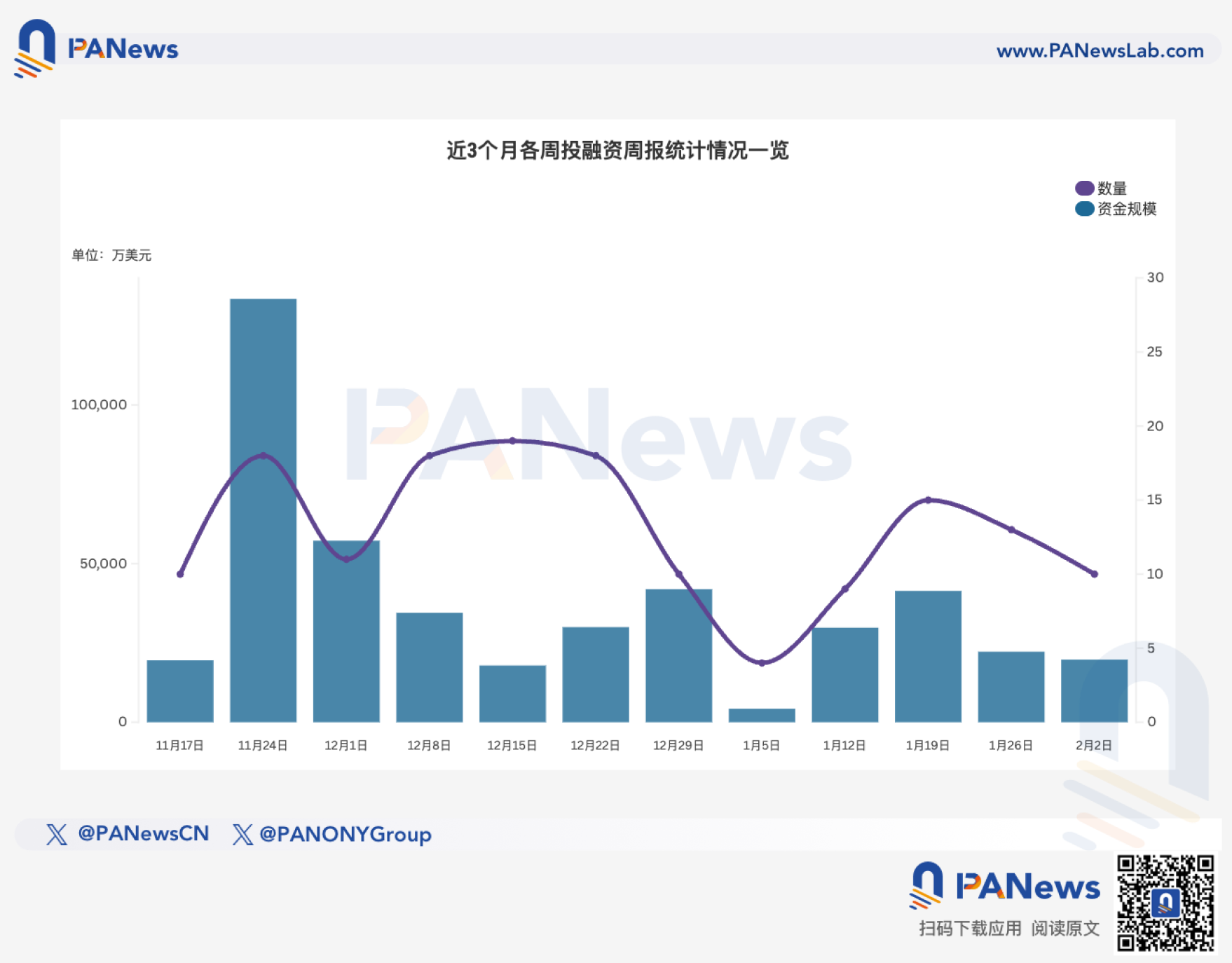
According to incomplete statistics from PANews, there were 10 investment and financing events in the global blockchain sector last week (1.26-2.1), with a total funding scale exceeding $197 million. The overview is as follows:

  • DeFi announced 6 investment and financing events. Among them, AC's new project Flying Tulip completed a $25.5 million Series A funding round, bringing its total funding to $225.5 million so far;
  • The Web3+AI track announced 1 investment and financing event. AetheriumX completed an $8 million strategic financing round, co-led by CGV, GAINS Associates, DuckDAO, and Genesis Capital;
  • The Infrastructure & Tools sector announced 2 investment and financing events. Among them, the crypto payment network Mesh completed a $75 million Series C funding round led by Dragonfly Capital;
  • The Centralized Finance sector announced 1 investment and financing event. The crypto trading platform Talos completed a $45 million funding round with participation from Robinhood, a16z, and others.
DeFi

AC's New Project Flying Tulip Completes $25.5 Million Series A Funding, Total Funding Reaches $225.5 Million So Far

Flying Tulip, a unified on-chain financial system founded by Sonic Labs creator Andre Cronje, announced it has completed a total of $225.5 million in institutional funding at the same fully diluted valuation of $10 billion as its seed round. This funding includes a $25.5 million Series A private token sale conducted through Amber Group, Fasanara Digital, and Paper Ventures, as well as a $200 million seed round completed last September.

In addition to institutional funding, Flying Tulip also raised $50 million through Impossible Finance's Curated platform and plans to launch another public sale on CoinList next week. The project stated that it has received approximately $1.36 billion in investment intentions so far. If the existing allocation quotas are fully filled, the remaining funding quota is about $400 million.

Token Creation Platform Doppler Completes $9 Million Seed Round Led by Pantera Capital

The token creation and issuance protocol platform Doppler has completed a $9 million seed funding round. This round was led by Pantera Capital, with participation from Variant, Figment Capital, and Coinbase Ventures. The team revealed that the financing was completed in Q2 2025 in the form of a Simple Agreement for Future Tokens (SAFT). Doppler is one of the two main products under Whetstone Research, the other being Pure Markets. Doppler compresses processes like token deployment, liquidity launch, and governance through an integrated interface and employs a price discovery auction mechanism designed to limit sniping and generate protocol-owned liquidity on the first day. The Doppler platform creates over 40,000 assets daily, with a cumulative value exceeding $1.5 billion and cumulative trading volume exceeding $1 billion.

Gold and Foreign Exchange Tokenization Market Tenbin Labs Completes $7 Million Funding Led by Galaxy Digital

Galaxy Digital led a $7 million funding round for Tenbin Labs, aimed at building a tokenized gold and foreign exchange market. The project focuses on bringing traditional financial assets on-chain, expanding the practical application of crypto assets in the global market.

Trading Platform Everything Completes $6.9 Million Seed Round Led by Humanity Protocol

Trading platform Everything announced the completion of a $6.9 million seed funding round led by Humanity Protocol, with participation from Animoca Brands, Hex Trust, and Three Point Capital. The platform aims to create an "Everything Exchange" integrating perpetual contracts, spot markets, prediction markets, and payment functions. The platform plans to launch an Everything Points system where users can earn points by holding assets, trading, and inviting friends. The total points will determine the allocation of the future platform token E airdrop and ecological rewards. The public sale of the E token is planned to be launched subsequently via Telegram and web mini-programs.

On-Chain Finance Application Bleap Completes $6 Million Seed Round Led by Blossom Capital

Bleap, a self-custody and stablecoin payment on-chain finance application backed by former Revolut executives Joao Alves and Guilherme Gomes, has completed a $6 million seed funding round. Joao Alves stated that this round, led by Blossom Capital, was completed last summer. The company did not disclose the post-money valuation. Bleap plans to use the new funds to develop yield vaults, expand on-chain trading functions, and drive business growth in Latin American and European markets. This funding round comes after Bleap completed a $2.3 million pre-seed round in late 2024, which was led by Ethereal Ventures, founded by Consensys creator Joe Lubin.

RWA Infrastructure Project Golden FI Completes $2 Million Seed Round Led by Gold Chain Capital

Golden FI, a Web3 physical asset (RWA) digitization infrastructure platform, announced the successful completion of a $2 million seed funding round. This round was led by strategic partner Gold Chain Capital, with participation from four other globally renowned investment institutions deeply involved in the Web3 and fintech sectors. According to the official statement, information about the other four participating institutions has not been disclosed due to strategic considerations.

Web3 Gaming

AetheriumX Completes $8 Million Strategic Financing

AetheriumX announced the completion of an $8 million strategic financing round, co-led by CGV, GAINS Associates, DuckDAO, and Genesis Capital. The funds from this round will be used to optimize its DCIP protocol, expand DeFi and GameFi modules, and focus on the Asia-Pacific market to build a sustainable and verifiable on-chain interactive economic ecosystem.

Infrastructure & Tools

Crypto Payment Network Mesh Completes $75 Million Series C Funding Led by Dragonfly Capital

The crypto payment network Mesh announced the completion of a $75 million Series C funding round, reaching a post-money valuation of $1 billion. The round was led by Dragonfly Capital, with participation from Paradigm, Moderne Ventures, Coinbase Ventures, SBI Investment, and Liberty City Ventures. The company's cumulative funding has now exceeded $200 million. The funds from this round will be used to accelerate expansion in Latin America, Asia, and Europe, and to drive product development. Positioned as an asset-agnostic unified payment network, Mesh already covers over 900 million users. It allows users to pay using any asset like Bitcoin or Solana, while merchants receive instant settlement in stablecoins like USDC or PYUSD, or local fiat currency. Part of this funding round was also settled in stablecoins.

Sony Innovation Fund Invests $13 Million in Soneium Co-Developer Startale, Initiating its Series A

Sony's innovation fund has invested an additional $13 million in Startale Group, the co-developer of the Soneium blockchain, as the first tranche of its Series A funding. Previously, Startale received a $3.5 million seed investment from Sony in 2023 and secured $3.5 million in a seed extension round from UOB Venture Management and Samsung Next in 2024, bringing its total public funding to $20 million.

Headquartered in Singapore, Startale co-developed the Ethereum Layer2 network Soneium and the ecosystem entry application Startale App with Sony's Blockchain Solutions Lab. Soneium, built on the OP Stack, focuses on applications for the entertainment industry and general scenarios. Since its mainnet launch in January 2025, it has processed over 500 million transactions, boasts 5.4 million active wallets, and supports over 250 active decentralized applications.

Centralized Finance

Crypto Trading Platform Talos Completes $45 Million Funding with Participation from Robinhood, a16z, etc.

Robinhood participated in an extension of the Series B funding round for crypto trading platform Talos, valuing the company at approximately $1.5 billion. Talos focuses on providing crypto trading infrastructure for global institutions, serving clients with assets under management totaling around $21 trillion. This $45 million extension also attracted new strategic investors including Sony Innovation Fund, IMC, QCP, and Karatage, while existing investors a16z crypto, BNY, and Fidelity Investments also participated. Robinhood stated that Talos's flexibility and rapid adaptability will further enhance the liquidity and functionality of its crypto business.

Venture Capital Firms

Venture Firm Escape Velocity Completes $62 Million Fundraise, Focusing on DePIN and Crypto Project Investments

Venture capital firm Escape Velocity has completed its second fundraise, totaling $62 million, primarily to support DePIN (Decentralized Physical Infrastructure) and broader crypto sector projects.

The fund attracted notable investors including Marc Andreessen and Micky Malka, founder of Ribbit Capital. The largest limited partner in the fund, Cendana, contributed $15 million. Mahesh Ramakrishnan, co-founder of Escape Velocity, expressed belief that decentralized physical infrastructure will see a breakthrough despite the current market downturn in the DePIN space. The firm has previously invested in DePIN projects like Daylight and Glow in the solar energy sector and plans to continue seeking high-quality projects that go beyond market hype.


Related Questions

QWhich company led the $75 million Series C funding round for the crypto payments network Mesh, and what was the post-money valuation?

ADragonfly Capital led the $75 million Series C funding round for Mesh, resulting in a post-money valuation of $1 billion.

QWhat is the total amount of institutional funding raised by Andre Cronje's new project, Flying Tulip, and what types of rounds does this include?

AFlying Tulip has raised a total of $225.5 million in institutional funding, which includes a $255 million Series A private token sale and a $200 million seed round completed last September.

QName the two main product categories that received the most funding events according to the PANews report.

ADeFi and Infrastructure & Tools were the two main categories with the most funding events, with 6 and 2 events, respectively.

QWhat is the primary focus of the risk investment company Escape Velocity's new $62 million fund?

AEscape Velocity's new $62 million fund is primarily focused on investing in DePIN (Decentralized Physical Infrastructure) and broader crypto projects.

QWhich major traditional financial company participated in the $45 million funding round for the crypto trading platform Talos?

AFidelity Investments, a major traditional financial company, participated in the $45 million funding round for Talos as an existing investor.

Related Reads

Understanding CPO (Co-Packaged Optics) in One Article: Why Nvidia Is Willing to Spend $3.2 Billion on a Fiber?

NVIDIA and Corning announced a multi-year strategic partnership on May 6, 2026, with NVIDIA committing up to $3.2 billion to support Corning's U.S. expansion. This investment will triple Corning's manufacturing plants and significantly boost its optical fiber and communications production capacity. The core driver behind this massive investment is the fundamental shift from copper to optical interconnect technology within AI data centers. As GPU clusters scale, copper wires face critical limitations: severe signal attenuation over distance, high energy consumption for signal integrity, and excessive heat generation. Optical fiber, transmitting light instead of electrical signals, solves these issues with minimal loss, near-light speed, and lower power needs. The article outlines a three-stage evolution of data center interconnect: 1. **Traditional Copper Interconnects:** The mainstream solution of the 2010s, now being phased out due to scaling bottlenecks. 2. **Pluggable Optical Modules:** The current mainstream, where modules convert electrical signals to light externally. This process still introduces energy loss and latency. 3. **CPO (Co-Packaged Optics):** The next-generation technology where the optical engine is integrated directly with the GPU chip package. This drastically reduces the electrical signal travel distance to mere millimeters, slashing power consumption and latency while boosting data density. NVIDIA CEO Jensen Huang has identified CPO as an essential core technology for AI infrastructure. NVIDIA's investment signifies a strategic shift from being a buyer to actively controlling its supply chain for critical components. With demand for specialized optical fiber far outstripping supply—evidenced by soaring prices—securing long-term manufacturing capacity has become a competitive necessity. While Corning's expansion may pressure some suppliers, a projected global fiber supply gap of 5-15% over the next few years creates a significant opportunity window, particularly for Chinese manufacturers competitive in optical preforms, chips, and modules. Ultimately, NVIDIA's move is not about chasing a trend but an engineering imperative. The transition to light-based interconnects like CPO is driven by the physical limits of copper, marking a definitive step in the ongoing AI computing revolution.

marsbit7m ago

Understanding CPO (Co-Packaged Optics) in One Article: Why Nvidia Is Willing to Spend $3.2 Billion on a Fiber?

marsbit7m ago

KOL's Perspective: Why Is SOL Set to Rise from This Point?

**Summary: Why SOL is Positioned for Growth at This Level** The article argues that SOL is poised for an upward move from its current price point, citing several key factors. Primarily, SOL has just broken out of a 4-month consolidation phase. This breakout signals a return of risk appetite to the broader crypto market, as SOL is seen as a key indicator of overall crypto health. The token's ownership has reportedly shifted from short-term traders and tourists to long-term accumulators, leading to low volume. Any meaningful increase in trading activity could thus trigger significant upward momentum. Fundamental strengths include strong institutional adoption, integration with DeFi and RWAs (Real-World Assets), and the potential benefits from the Clarity Act. Despite its high volatility—having dropped 70% from its all-time high but still up 12x from its bear market low—SOL is highlighted as one of the few tokens from the last cycle to reach new highs. It boasts a robust ecosystem of applications, users, and protocols. Future catalysts include the expected influx of AI developers following the Miami Accelerate conference, which focused on AI on Solana. Furthermore, Solana is positioned as the premier chain for memecoin activity, a trend expected to continue and drive network usage and fees. The article concludes that recent price action reflects a healthy transfer to long-term holders, setting the stage for growth.

marsbit57m ago

KOL's Perspective: Why Is SOL Set to Rise from This Point?

marsbit57m ago

Those Pre-Bitcoin PoW Protocols Have Recently Been Reimplemented

This article details a recent surge in replicating pre-Bitcoin Proof-of-Work (PoW) protocols, specifically focusing on Hal Finney's 2004 RPOW (Reusable Proofs of Work). Within five days in May 2026, multiple independent builders in the Bitcoin/cypherpunk community launched projects inspired by this early electronic cash proposal. The initiative began with Fred Krueger's `rpow2.com`, a centralized but auditable system that replaced RPOW's original IBM 4758 hardware with Ed25519 signatures. Initially a faithful replica, it later adopted Bitcoin-like features (21M supply cap, difficulty adjustment) and a controversial 5.24% founder allocation. This sparked rapid forks, including `rpow4.com` which incorporated full Bitcoin parameters, a prediction market (`rpowmarket.com`), and a DEX (`rpow2swap.com`). Concurrently, Mike In Space created a prototype of Wei Dai's 1998 b-money proposal (`b-money.replit.app`), pushing the historical exploration even further back. The article contrasts these centralized, server-dependent experiments with Bitcoin's core innovation of decentralized, trustless consensus. It also highlights a parallel development: the `HASH` project on Ethereum, which uses smart contract hooks to enable a purely fair-launch, browser-mineable PoW token with 0% allocations to team or VCs. The collective activity is framed as a meme-driven, educational exploration of cypherpunk history rather than a serious financial movement, with all projects heavily disclaiming any investment value.

marsbit1h ago

Those Pre-Bitcoin PoW Protocols Have Recently Been Reimplemented

marsbit1h ago

South Korean Exchanges 'Battle' Regulators, Challenging the Boundaries of Enforcement and Legislation

South Korea's cryptocurrency industry is engaged in a rare, direct confrontation with regulators. The Financial Intelligence Unit (FIU), the primary anti-money laundering (AML) watchdog, has recently imposed heavy penalties on major exchanges like Upbit and Bithumb for alleged violations involving unregistered overseas VASPs and AML procedures. However, exchanges are now actively challenging these actions in court and through industry associations. In a significant shift, the Seoul Administrative Court ruled in favor of Upbit's operator, Dunamu, overturning part of an FIU-ordered business suspension. The court found the FIU's penalty criteria and justification insufficiently clear. Similarly, the court suspended the enforcement of a six-month business suspension against Bithumb pending a final ruling, citing potential irreversible harm to the exchange. Beyond legal battles, the industry is contesting proposed legislative amendments. The Digital Asset eXchange Alliance (DAXA) strongly opposes a draft rule that would mandate Suspicious Transaction Reports (STRs) for all crypto transfers over 10 million KRW (~$6,800). DAXA argues this "poison pill" clause violates legal principles and would overwhelm the STR system, increasing reports from 63,000 to an estimated 5.45 million annually for major exchanges, thereby crippling effective AML monitoring. This conflict highlights a structural tension in South Korea's crypto governance: comprehensive digital asset laws are still developing, while regulators rely heavily on AML enforcement. The industry's move from passive compliance to active legal and legislative challenges signifies a new phase, pressing for clearer rules and more proportionate enforcement. While short-term disputes may intensify, this clash could ultimately lead to a more mature and sustainable regulatory framework for South Korea's vibrant crypto market.

marsbit1h ago

South Korean Exchanges 'Battle' Regulators, Challenging the Boundaries of Enforcement and Legislation

marsbit1h ago

Trading

Spot
Futures

Hot Articles

What is USDC(WORMHOLE)

USD Coin (Wormhole): A Comprehensive Overview Introduction In the rapidly evolving world of cryptocurrencies, USD Coin (Wormhole), referred to as $USDC(Wormhole), stands out as a pioneering solution within the DeFi (Decentralized Finance) landscape. Operating on several blockchain platforms, including Solana, USD Coin (Wormhole) is more than just a digital representation of the United States dollar. It embodies the innovative spirit of modern finance, enabling seamless cross-chain transactions and enhanced interoperability among diverse blockchain ecosystems through the advanced Wormhole protocol. What is USD Coin (Wormhole)? USD Coin (Wormhole) is a tokenized version of the US dollar designed to facilitate frictionless transactions across different blockchain networks. Its primary aim is to bolster liquidity and enhance the functionality of the DeFi ecosystem. By leveraging the Wormhole protocol, which establishes a robust cross-chain communication network, users can effortlessly transfer USDC tokens across various platforms. This cross-chain capability marks a significant advancement in cryptocurrency use, promoting a more interconnected and efficient ecosystem where assets can flow freely between different blockchains. The value proposition of USD Coin (Wormhole) lies not only in its stability, being pegged to the US dollar, but also in its ability to bridge gaps between disparate blockchain environments. This innovative approach fosters a greater level of participation among users and developers, paving the way for new and exciting applications within decentralized finance. Who is the creator of USD Coin (Wormhole)? The origins of USD Coin (Wormhole) are intricately tied to the Wormhole network, which was developed by Jump Crypto. While specific individual creators are not prominently documented, Jump Crypto is notable for its involvement in advancing blockchain technology and supporting its applications in finance. By creating the Wormhole network, Jump Crypto has played a vital role in promoting cross-chain asset transfers, enhancing the efficiency and diversity of cryptocurrency usage. Who are the investors of USD Coin (Wormhole)? The success of USD Coin (Wormhole) is supported by investments from several notable funds and organizations within the cryptocurrency realm. Key investors include: Coinbase Ventures: A prominent venture capital arm backed by one of the leading cryptocurrency exchanges in the industry, Coinbase Ventures provides essential capital and strategic support to promising blockchain projects. Arrington XRP Capital: Specializing in digital assets, Arrington XRP Capital recognizes the potential of innovative projects like USD Coin (Wormhole) and has invested accordingly to back its development. Jump Trading: As the parent organization of Jump Crypto, Jump Trading brings not only investment but a wealth of expertise in trading technology and market dynamics to bolster the Wormhole project. How Does USD Coin (Wormhole) Work? The operational framework of USD Coin (Wormhole) is intricately designed to facilitate effective cross-chain transactions, maximizing security and efficiency. Here’s a simplified overview of how it functions: Asset Locking: When a user wishes to transfer USDC from one blockchain to another, they first lock their tokens on the source blockchain. This process ensures that the assets are secure and are set to be either burned or moved later. Token Minting: After the tokens are locked, an equivalent amount of USDC is minted on the destination blockchain. This provides the user with access to their funds on a new platform, reflecting the flexibility that the Wormhole protocol enables. Cross-Chain Transfer: The Wormhole protocol efficiently facilitates the entire transfer process. It ensures that once the USDC is minted on the destination chain, the equivalent tokens are burned on the source chain. The result is a seamless transfer of value between two distinct blockchain environments. This cross-chain methodology ensures that transactions remain secure and transparent, significantly enhancing liquidity within the different DeFi ecosystems. Timeline of USD Coin (Wormhole) Understanding the evolution of USD Coin (Wormhole) provides vital context for its significance in the cryptocurrency arena. Here’s a timeline highlighting important milestones in the project’s history: 2021: The Wormhole project is launched, establishing a framework for cross-chain asset transfers and setting the stage for the development of USD Coin (Wormhole). 2022: The Wormhole network experiences a significant challenge with a security breach that results in a $325 million theft. However, the incident is later addressed and refunded by Jump Crypto, showcasing the project’s commitment to security and transparency. 2023: USD Coin (Wormhole) integrates with Circle’s Cross-Chain Transfer Protocol (CCTP), enhancing its capabilities for cross-chain transfers and further solidifying its place within the DeFi ecosystem. 2024: Ongoing development and expansion of the Wormhole network continue, aimed at increasing the utility and reach of USD Coin (Wormhole) as well as enhancing its operational framework. Key Features The success of USD Coin (Wormhole) can be attributed to several key features that differentiate it from other cryptocurrency offerings: Cross-Chain Interoperability At the core of USD Coin (Wormhole) is its ability to facilitate seamless transfers across multiple blockchain networks. This interoperability serves as a cornerstone for decentralized finance, allowing various platforms to interact with each other, thereby accelerating the evolution of financial services. Security Wormhole employs a well-designed Guardian Network comprised of node validators that ensure secure cross-chain transactions. This collective oversight minimizes the risk of fraud and provides users with confidence that their assets are protected during cross-chain transfers. Liquidity Enhancement By enabling USDC to circulate freely across different blockchains, USD Coin (Wormhole) enhances liquidity in the DeFi ecosystem. This increased liquidity can foster more efficient trading, contribute to better pricing strategies, and improve the overall market dynamics encompassing various digital assets. Conclusion USD Coin (Wormhole) is a pivotal innovation in the blockchain space, reinforcing the capabilities of decentralized finance (DeFi) and establishing a more connected financial ecosystem. With its robust framework for cross-chain transactions, security features, and strong backing from reputable investors, USD Coin (Wormhole) is positioned to play a key role in the future of cryptocurrency. As the digital finance landscape continues to evolve, USD Coin (Wormhole) not only embraces the future of interconnectivity among blockchain networks but also reaffirms the power of tokenization and blockchain technology in transforming how we perceive and utilize value in a digital world. By navigating the complexities of cross-chain functionality, it demonstrates a sophisticated approach to enabling financial inclusivity and innovation in the world of cryptocurrencies.

1.2k Total ViewsPublished 2024.04.01Updated 2024.12.03

What is USDC(WORMHOLE)

What is W$C

World$tateCoin ($W$C): A Comprehensive Exploration of the Emerging Cryptocurrency Project Introduction In the ever-evolving landscape of cryptocurrencies, World$tateCoin ($W$C) has emerged as a project that aims to harness the power of web3 technologies to create a distinctive digital ecosystem. As traditional models of online interaction undergo significant transformation, World$tateCoin seeks to establish itself in this budding third generation of the internet. This article will delve into the intricacies of World$tateCoin, providing an overview of the project, its objectives, and its potential impact on the web3 space. What is World$tateCoin ($W$C)? World$tateCoin ($W$C) is designed as a cryptocurrency that facilitates seamless transactions within a web3 environment. Aimed at creating a decentralized platform where users can interact with various web3 applications, $W$C intends to streamline user experience and enhance accessibility to digital services. While the project aspires to become an integral part of the web3 landscape, detailed insights into its specific objectives and use cases remain limited, raising questions regarding its potential role and utility in a rapidly advancing digital context. The essence of web3 revolves around decentralization and empowering users with greater control over their interactions online. World$tateCoin intends to align with these principles, although specific applications and functionalities of the currency are still under discussion within the community. Who is the Creator of World$tateCoin ($W$C)? In exploring the origins of World$tateCoin, information regarding its creator remains elusive. As of now, there is no publicly available data identifying the individuals or organizations behind the project. This obscurity may cast a shadow of uncertainty over the project’s credibility, but the commitment to innovation within the cryptocurrency framework could be a driving force for its adoption in the future. The lack of identifiable leadership may result in hurdles related to trust and transparency—elements that are crucial for establishing a strong community in the crypto space. Who are the Investors of World$tateCoin ($W$C)? Current research does not reveal any specific investors or backing organizations involved with World$tateCoin. It is not uncommon for emerging cryptocurrency projects to either attract discreet investments or operate in a minimalist financial structure during their initial phase. The ambiguity surrounding investment supports and funding methodologies could affect the project’s sustainability and growth prospects. When assessing new projects within the cryptocurrency domain, investors generally look for transparency regarding financial backing and support from established entities. The absence of this information might necessitate a cautious approach for potential users and stakeholders interested in the future of World$tateCoin. How Does World$tateCoin ($W$C) Work? The operational mechanics of World$tateCoin are grounded in the principles of decentralization, a hallmark of web3 technologies. By facilitating transactions directly between users without the intervention of intermediaries, $W$C is designed to enhance trust and efficiency. However, comprehensive documentation detailing the unique features and operational framework that distinguish World$tateCoin from other cryptocurrencies is markedly sparse. This lack of information complicates the understanding of how $W$C functions within the broader web3 ecosystem and what unique propositions it brings to users and developers alike. Nevertheless, the fundamental goal of allowing for decentralized transactions holds the promise of a more liberated financial landscape, should the project deliver on its aspirations of implementing robust mechanisms and user-friendly interfaces. Timeline of World$tateCoin ($W$C) Constructing a timeline that encapsulates the historical progression of World$tateCoin poses challenges due to an absence of significant documentation on key events and milestones. Nevertheless, an approximate sequence of hypothetical phases can be envisaged, constituting a path forward for the project: Initial Concept (Date Unknown): Conceptualization of the World$tateCoin framework in the broader context of web3 technologies. Development Phase (Date Unknown): Commencement of technical development and coding processes. Community Engagement (Date Unknown): Outreach to potential users and stakeholders to foster community interest in the project. Launch Target (Date Unknown): Announcing an expected launch date, contingent on the progress of development and testing phases. Due to the lack of substantiated dates and details surrounding these phases, stakeholders will need to remain vigilant and engaged with the project's communications for updates regarding its trajectory. Key Topics About World$tateCoin ($W$C) As the project unfolds, certain key subjects arise that embody the potential and aspirations of World$tateCoin: Decentralization: The core philosophy driving the project, aimed at fostering direct user interactions. Web3 Integration: The goal of mirroring web3 principles and enabling seamless user access to an array of digital services. Digital Currency: Positioned as a currency to facilitate internet-based transactions, World$tateCoin aims to inject additional liquidity into the web3 market. Challenge of Information Scarcity: The notable absence of detailed information regarding the project's foundations, creators, and operational methods, necessitating increased transparency from developers to build community trust. Conclusion World$tateCoin ($W$C) is positioned within an exciting yet uncertain terrain of cryptocurrency and web3 integration. While it aims to cultivate a decentralized environment, the limited availability of information regarding its creators, investors, and specific functionalities presents challenges for potential stakeholders and users. In the dynamic world of cryptocurrencies, transparency, engagement, and well-structured communication are vital for the success of projects such as World$tateCoin. As the landscape continues to evolve, stakeholders will be eager to see how the project can solidify its place within the web3 narrative and contribute to the ongoing transformation of the digital ecosystem.

1.0k Total ViewsPublished 2024.04.01Updated 2024.12.03

What is W$C

How to Buy W

Welcome to HTX.com! We've made purchasing Wormhole (W) simple and convenient. Follow our step-by-step guide to embark on your crypto journey.Step 1: Create Your HTX AccountUse your email or phone number to sign up for a free account on HTX. Experience a hassle-free registration journey and unlock all features.Get My AccountStep 2: Go to Buy Crypto and Choose Your Payment MethodCredit/Debit Card: Use your Visa or Mastercard to buy Wormhole (W) instantly.Balance: Use funds from your HTX account balance to trade seamlessly.Third Parties: We've added popular payment methods such as Google Pay and Apple Pay to enhance convenience.P2P: Trade directly with other users on HTX.Over-the-Counter (OTC): We offer tailor-made services and competitive exchange rates for traders.Step 3: Store Your Wormhole (W)After purchasing your Wormhole (W), store it in your HTX account. Alternatively, you can send it elsewhere via blockchain transfer or use it to trade other cryptocurrencies.Step 4: Trade Wormhole (W)Easily trade Wormhole (W) on HTX's spot market. Simply access your account, select your trading pair, execute your trades, and monitor in real-time. We offer a user-friendly experience for both beginners and seasoned traders.

5.6k Total ViewsPublished 2024.04.02Updated 2025.03.21

How to Buy W

Discussions

Welcome to the HTX Community. Here, you can stay informed about the latest platform developments and gain access to professional market insights. Users' opinions on the price of W (W) are presented below.

活动图片